
youtube.com
Machine Learning ka Chilla is a video resource with tutorials, demonstrations, reviews, or related media.
Directory
Published directory entries matching your search.
Machine Learning ka Chilla is a video resource with tutorials, demonstrations, reviews, or related media.

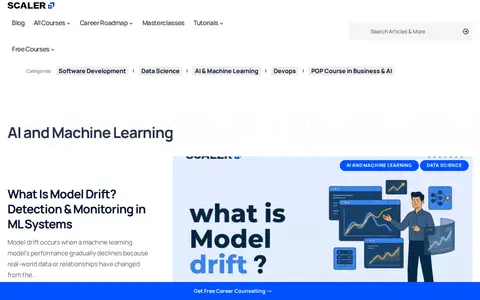
This is a Scaler blog category page collecting articles on artificial intelligence and machine learning. Posts listed include MLOps projects, becoming an AI research scientist, model drift detection and monitoring, and retrieval-augmented generation evaluation metrics. The page also links to categories such as software development and data science, and offers career counselling.

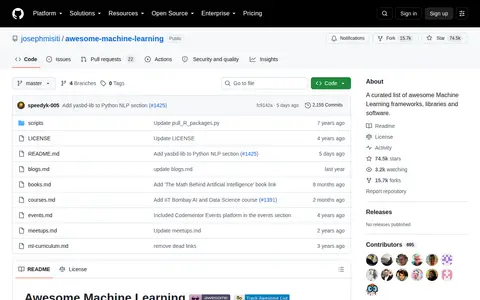
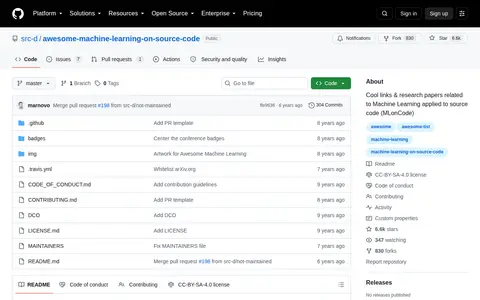
Open-source project that provides machine-learning models, research, training resources, or evaluation tools.

Open-source project that provides machine-learning models, research, training resources, or evaluation tools.
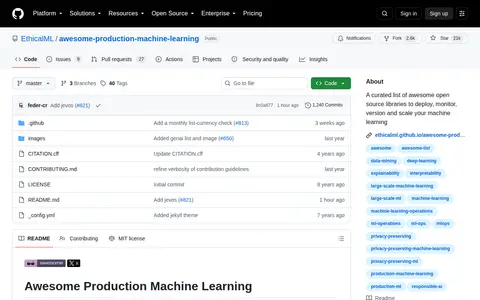
Curated list of awesome open source libraries to deploy, monitor, version and scale your machine learning.

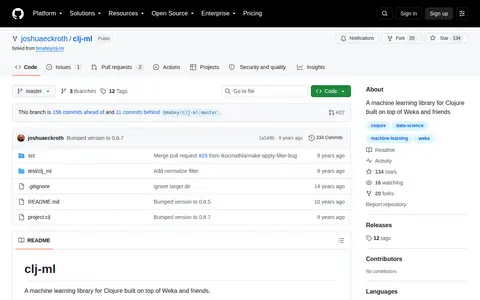
clj-ml is an open-source machine learning library for the Clojure programming language, built on top of the Weka framework and associated tools. It is hosted as a public repository on GitHub, with installation guides for Clojars and Maven, and supports a range of machine learning algorithms.
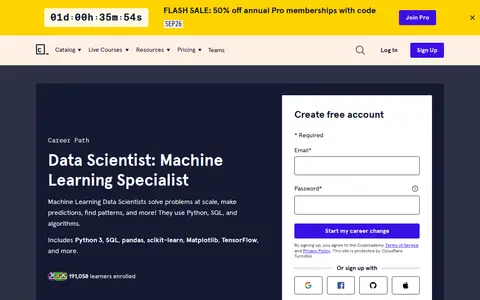
Codecademy's Data Scientist: Machine Learning Specialist Career Path is a beginner-level course covering Python 3, SQL, pandas, scikit-learn, Matplotlib, and TensorFlow. The path is listed as taking 95 hours on average and includes 59 projects with no prerequisites, and is described as teaching analysis of data, drawing predictions with machine learning, and building neural networks.

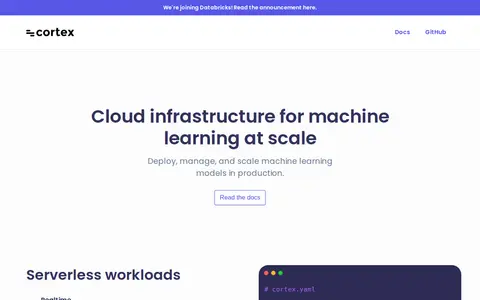
Cortex is cloud infrastructure for machine learning at scale, used to deploy, manage and scale machine learning models in production. It supports realtime, async and batch serverless workloads, along with automated cluster management including cluster autoscaling and spot instances with on-demand backups. Environments, provisioning and CI/CD and observability integrations are also listed. A notice states the project is joining Databricks.

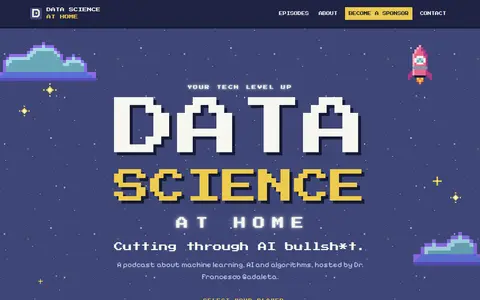
Data Science at Home is a podcast about machine learning, artificial intelligence, and algorithms. The site describes it as among the top AI and machine learning podcasts in the world and notes that industry leaders have sponsored its initiative.

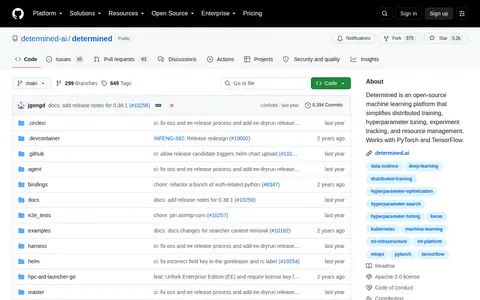
Determined is an open-source machine learning platform that simplifies distributed training, hyperparameter tuning, experiment tracking, and resource management. It works with PyTorch and TensorFlow, offering a Python library, command line interface, and web UI for managing machine learning workflows.
Helps find, analyze or synthesize information for research and knowledge discovery.

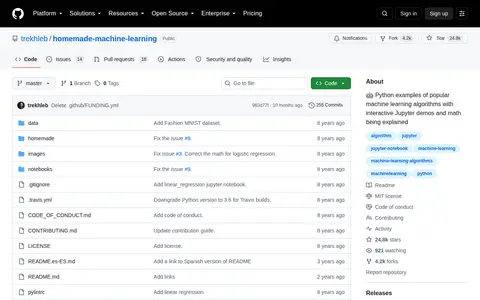
Python examples of popular machine learning algorithms with interactive Jupyter demos and math being explained.
Humanity's Last Machine is an educational resource for documentaries, courses, books, reference material, or self-learning.
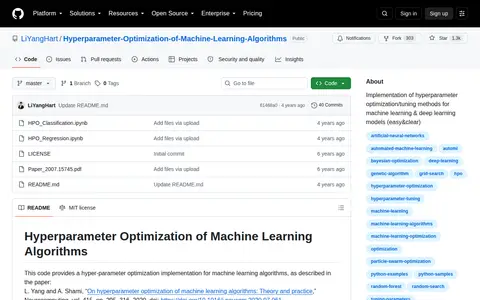
This repository provides a hyperparameter optimization implementation for machine learning algorithms, accompanying a paper on hyperparameter optimization theory and practice. It includes sample code for regression and classification problems using the Boston-Housing and MNIST datasets, covering algorithms such as random forest, SVM, KNN and artificial neural networks.

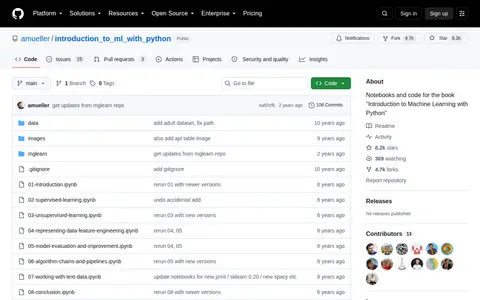
A GitHub repository holding the notebooks and code for the book "Introduction to Machine Learning with Python" by Andreas Mueller and Sarah Guido, together with the mglearn library of helper functions for figures and datasets. The book requires scikit-learn 0.20.0, and the code also needs numpy, scipy, matplotlib, pandas and pillow.

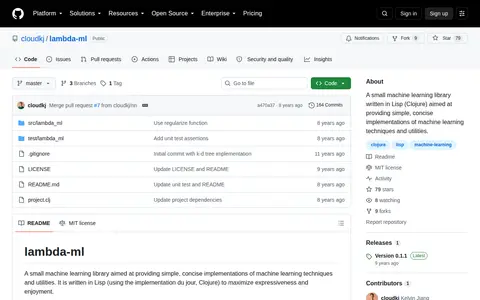
lambda-ml is a small machine learning library written in Lisp, specifically Clojure, aimed at simple, concise implementations of machine learning techniques and utilities. It covers supervised algorithms such as neural networks, decision trees, ensemble methods, k-nearest neighbors, linear and logistic regression, naive Bayes and random forest, plus unsupervised methods including DBSCAN, hierarchical clustering, k-means and non-negative matrix factorization.
A blog by Louis Dorard offering practical advice on applying machine learning. Posts cover the Machine Learning Canvas, the Prediction Task Canvas, an investor's approach to ML projects, choosing machine learning APIs, and trusting AI with important decisions.
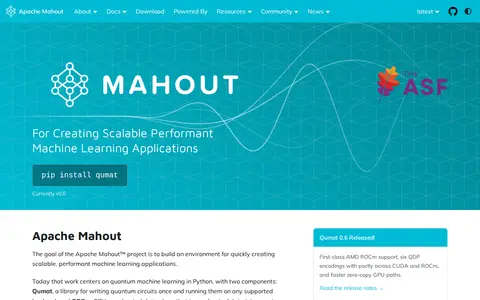
Apache Mahout builds an environment for quickly creating scalable, performant machine learning applications. Its current work centers on quantum machine learning in Python, with Qumat, a high-level library for writing quantum circuits once and running them on supported backends, and QDP, a GPU-accelerated engine that turns classical data into quantum states. The earlier Mahout Classic codebase is in maintenance mode.

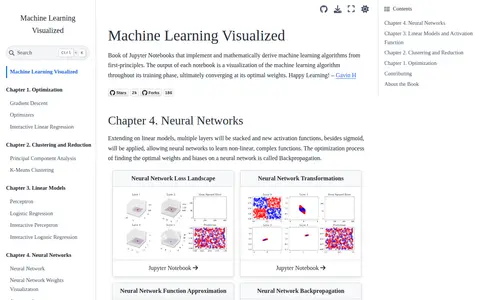
Machine Learning Visualized is a book of Jupyter Notebooks that implement and mathematically derive machine learning algorithms from first principles. Each notebook's output is a visualization of the algorithm during training, converging at its optimal weights. Chapters cover optimization, clustering and reduction, linear models and activation functions, and neural networks.

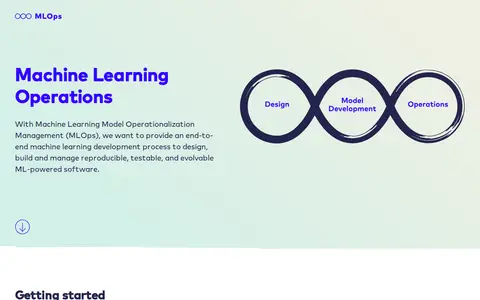
ML-Ops is a site about Machine Learning Operations. It covers motivation for MLOps, designing ML-powered software, the end-to-end ML workflow lifecycle, three levels of ML-based software, MLOps principles, CRISP-ML(Q), the MLOps Stack Canvas and ML model governance. It describes MLOps as aiming to unify the release cycle for machine learning and software.

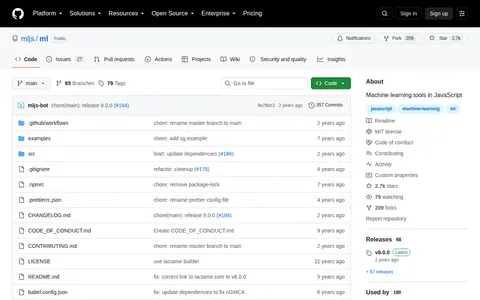
ml.js is an open-source machine learning toolset implemented in JavaScript, hosted in the mljs/ml GitHub repository. It provides libraries for both supervised and unsupervised machine learning tasks, alongside usage resources and standalone example code for users.

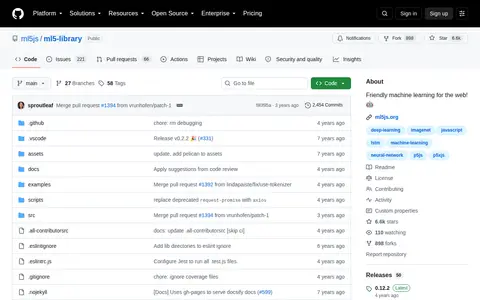
ml5.js is a JavaScript library providing access to machine learning algorithms and models in the browser, building on TensorFlow.js. It aims to make machine learning approachable for artists, creative coders and students, and is supported by code examples, tutorials and sample data sets. The project is described as currently in development.
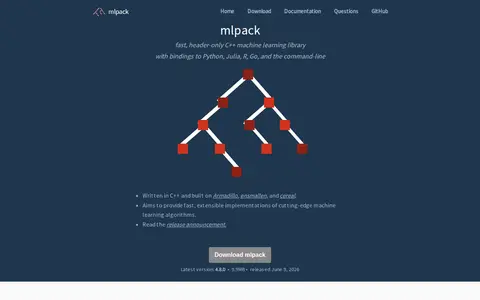
mlpack is a header-only C++ machine learning library with bindings to Python, Julia, R, Go, and the command line. It is built on Armadillo, ensmallen, and cereal and provides implementations of machine learning algorithms. The documentation lists classification, regression, clustering, and preprocessing facilities. It is open source under the 3-clause BSD license.

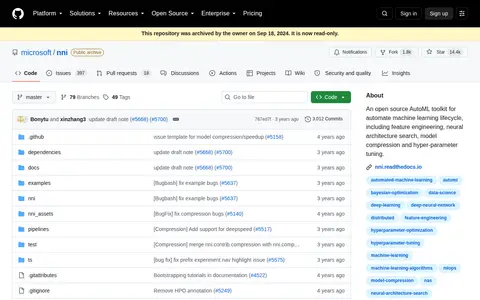
NNI is an open source AutoML toolkit developed by Microsoft. It automates tasks across the machine learning lifecycle, including feature engineering, neural architecture search, model compression and hyper-parameter tuning for machine learning workflows.