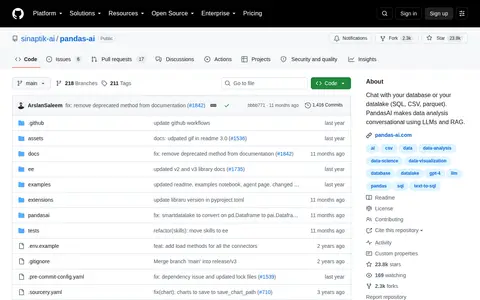

PandasAI is an open-source library that enables conversational data analysis using large language models and retrieval-augmented generation. It allows users to interact with databases or datalakes supporting SQL, CSV, and parquet file formats.
Directory
Search results
Published directory entries matching your search.
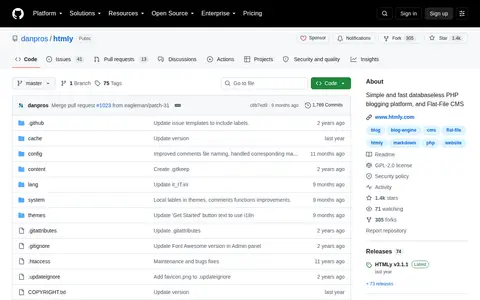
Simple and fast databaseless PHP blogging platform, and Flat-File CMS
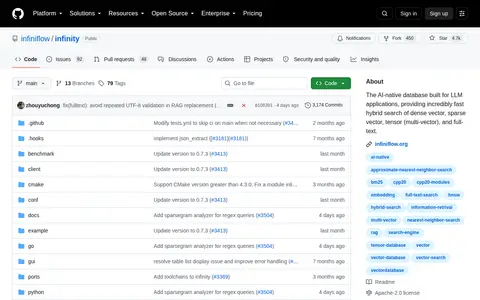
AI-native database built for LLM applications, providing incredibly fast vector and full-text search.
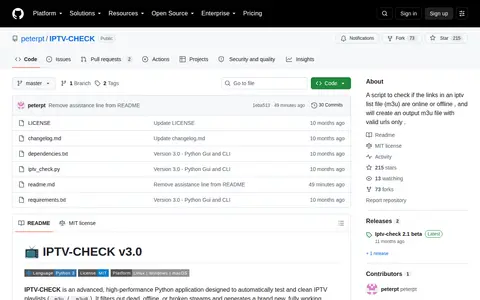
IPTV-CHECK is a script that verifies whether links in an IPTV m3u list file are online or offline. It creates an output m3u file containing only valid URLs. It operates in CLI mode and is at version 3.0. The script can check current IPTV lists in a URLs database.
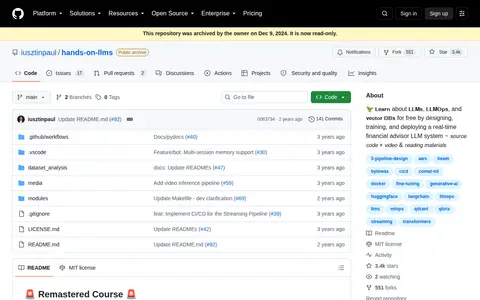
An archived educational course repository for learning about LLMs, LLMOps and vector databases by designing, training and deploying a real-time financial advisor LLM system. It includes source code, video and reading materials, and covers a training pipeline using QLoRA and a streaming pipeline ingesting financial news. The repository was archived by its owner and is read-only.
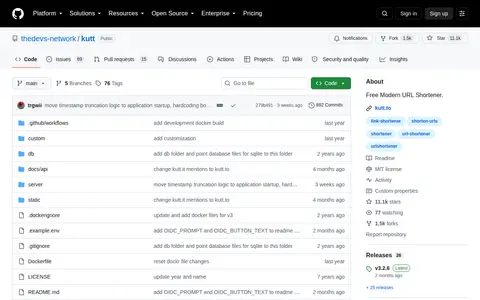
Kutt is a self-hosted URL shortener with custom domain support. It allows creating and editing links, setting custom URLs, passwords and expiration times, viewing statistics, and managing users. It supports SQLite, Postgres and MySQL databases, OpenID Connect login and a RESTful API.
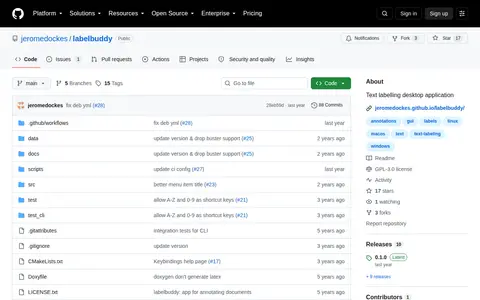
Labelbuddy is an open-source desktop GUI application for annotating documents, developed on GitHub. According to its documentation, it can be used for tasks such as Named Entity Recognition, sentiment analysis and document classification. The documentation states that it works completely offline and that its database is an ordinary file. Import and export use JSON, JSON Lines or plain text formats.
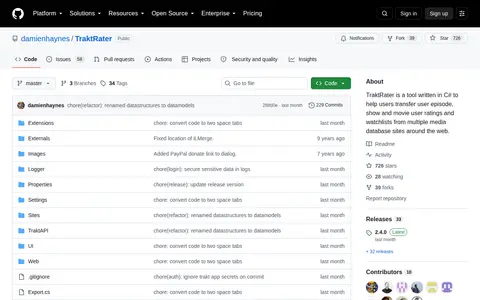
TraktRater is a C# tool designed to help users transfer their episode, show and movie ratings and watchlists between multiple media database websites. The project is hosted on GitHub for access.

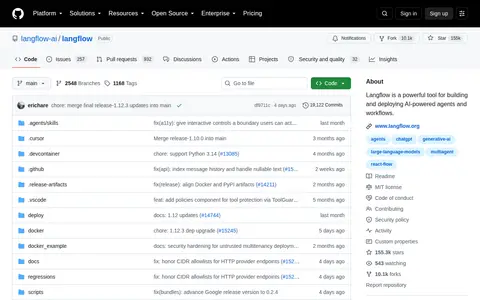
Langflow is a platform for building and deploying AI-powered agents and workflows, with a visual authoring interface and built-in API and MCP servers. It supports major LLMs, vector databases and AI tools, and allows deployment as an API, JSON export or MCP server.
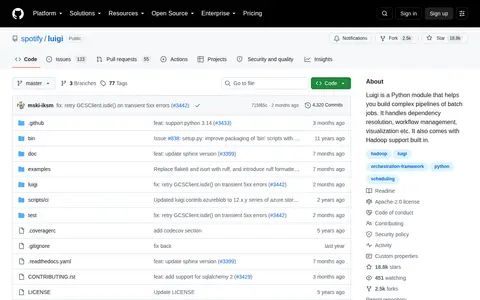
Luigi is a Python package for building complex pipelines of batch jobs. It handles dependency resolution, workflow management, visualization, handling failures and command line integration, and includes Hadoop support. It is intended to stitch together long-running tasks such as Hive, Pig, Hadoop, Spark or database jobs.
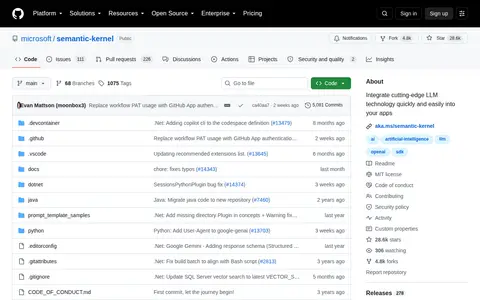
Model-agnostic SDK for building, orchestrating and deploying AI agents and multi-agent systems, with built-in support for OpenAI, Azure OpenAI, Hugging Face and Nvidia. It offers tools/plugins, memory, planning, vector database integrations and a process framework. Microsoft states that Semantic Kernel is now Microsoft Agent Framework.
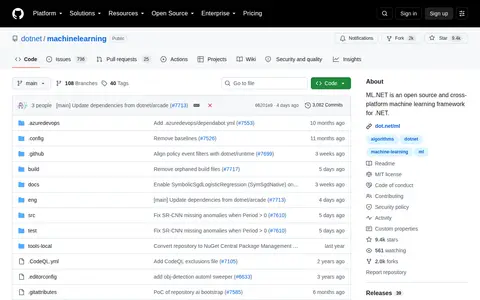
ML.NET is an open source, cross-platform machine learning framework for .NET. It lets developers build, train, deploy and consume custom models in .NET applications, with data loading from files and databases, data transformations and many ML algorithms. Models can be trained for scenarios such as classification, forecasting and anomaly detection, and TensorFlow and ONNX models can be consumed within the framework.
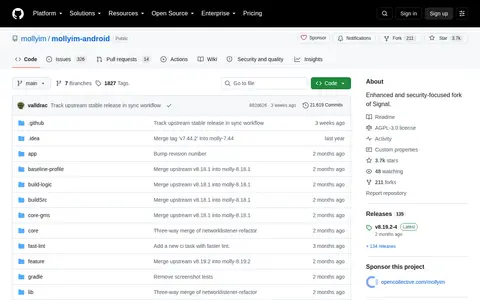
Molly is a hardened version of Signal for Android that connects to Signal's servers. It adds optional security features such as passphrase encryption of the app database, an automatic lock, a secure RAM wiper, blocking of unknown contacts, and Tor or SOCKS proxy support. It is released in Molly and Molly-FOSS versions.
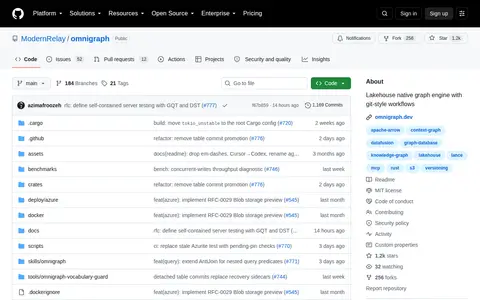
Typed graph database where agents branch and merge like Git. S3-native, Rust, traversal + vector + BM25 in one runtime.
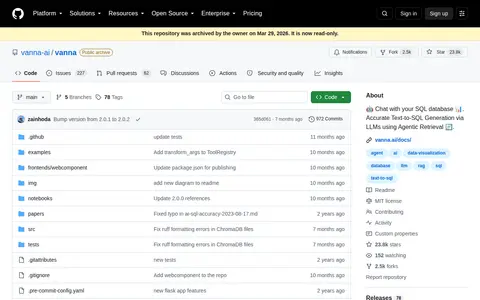
Vanna is an open source tool that enables users to interact with SQL databases via natural language. It uses large language models and agentic retrieval to generate accurate text-to-SQL queries.
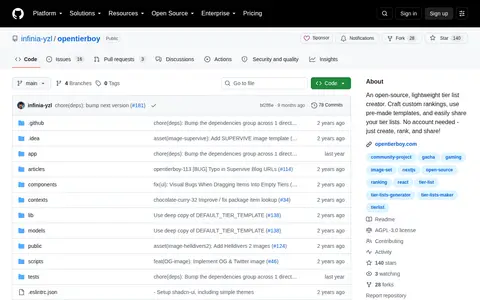
Opentierboy is an open-source, lightweight tier list creator. It enables users to craft custom rankings, use pre-made templates, share tier lists without requiring an account, upload personal images, share rankings via stateful URL or screenshot, and operates with no ads, tracking, or database, using only local storage for functionality.
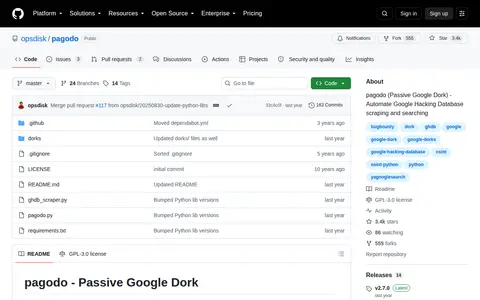
pagodo (Passive Google Dork) is a Python security tool that automates scraping of the Google Hacking Database and subsequent Google searches to identify potentially vulnerable web pages and applications. It replaces manual Google dork searches, consists of a dork retrieval component and a search execution component, uses the yagooglesearch library, and supports native HTTP(S) and SOCKS5 proxy support. Scraping Google Search results may violate Google's Terms of Service.
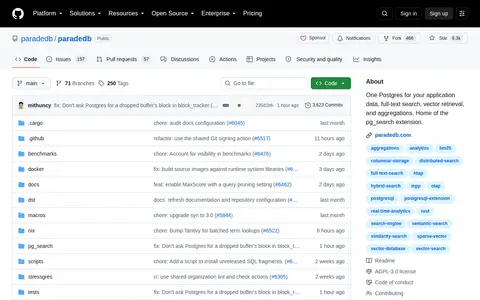
ParadeDB is an open-source PostgreSQL extension hosted on GitHub. It adds functionality for application data management, full-text search, vector retrieval and data aggregations to PostgreSQL databases, and is the home of the pg_search extension. The repository includes links to associated documentation, community resources, a blog and a changelog.
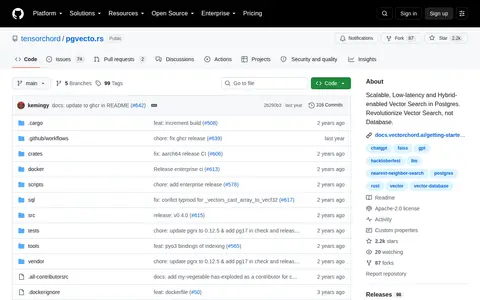
pgvecto.rs is an open-source tool that provides scalable, low-latency, hybrid-enabled vector search for PostgreSQL. It is designed to enhance vector search capabilities without modifying the core database system, per its official GitHub repository.
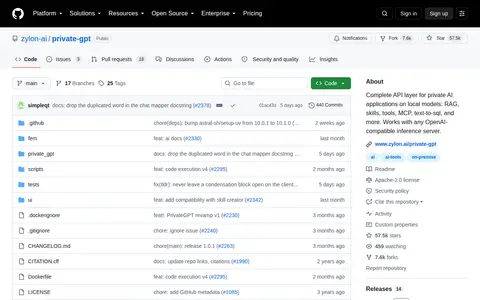
PrivateGPT is an open-source API layer for building private AI applications on local models, following the Claude API model. It provides a messages API, file and artifact ingestion, retrieval with citations and agentic RAG, built-in and custom tools, MCP connectors, structured database and CSV access, and embeddings. It connects to any OpenAI-compatible inference server and does not run models itself.
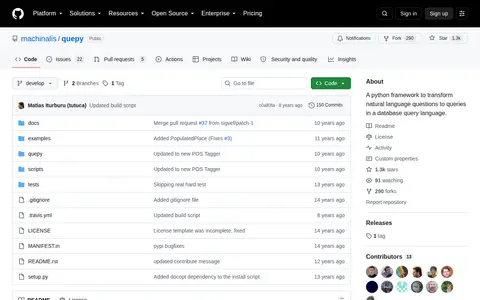
A python framework to transform natural language questions to queries in a database query language.
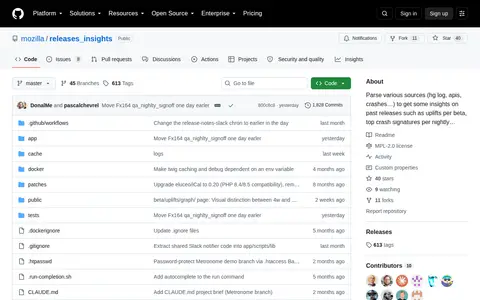
Release Insights is the code behind the whattrainisitnow.com dashboard, which shows the status of Firefox Desktop releases, including upcoming release timing, future milestones and main data points for past releases. It parses sources such as hg log, APIs and crashes to derive insights like uplifts per beta and top crash signatures per nightly. It requires PHP and Composer and needs no database or framework.
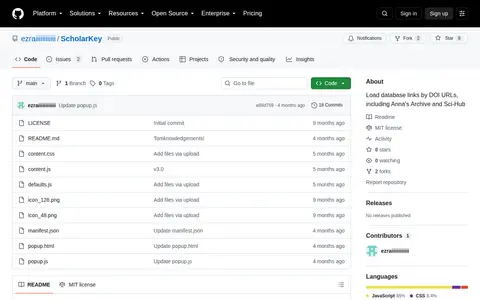
Scholar Key is a Firefox browser extension. It automatically adds shadow library and institutional access links next to DOI links on webpages, and displays Wikipedia citation counts for those DOIs. Users can configure enabled sources, reorder or edit source entries, and add their institution's library access via a maintained libproxy database. Default sources include Anna's Archive Search, Anna's Archive SciDB, and Sci-Hub.
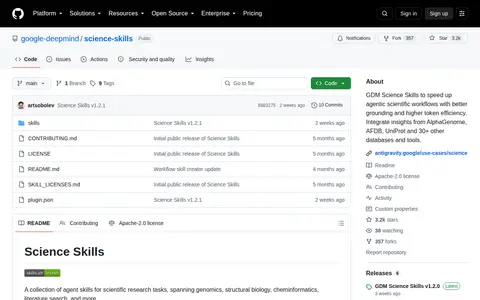
GDM Science Skills to speed up agentic scientific workflows with better grounding and higher token efficiency. Integrate insights from AlphaGenome, AFDB, UniProt and 30+ other databases and tools.