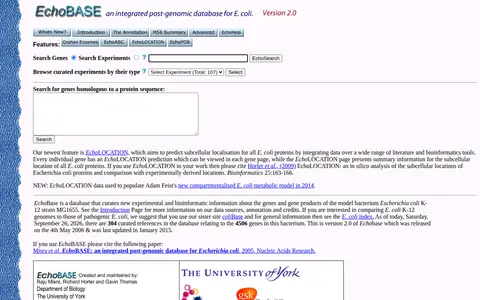
EchoBase is a database curating experimental and bioinformatic information on the genes and gene products of Escherichia coli K-12 strain MG1655. It allows searching for genes homologous to a protein sequence and includes EchoLOCATION, which predicts subcellular localisation for E. coli proteins. The database is version 2.0, released in 2006 and last updated in January 2015.
Directory
Search results
Published directory entries matching your search.
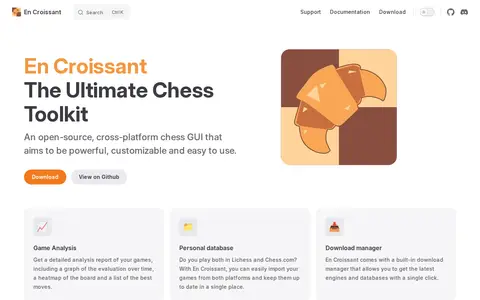
En Croissant is an open-source, cross-platform chess GUI. It serves as a chess database and analysis tool, and is designed to have a user experience closer to online chess websites while offering desktop application features. It provides game analysis reports, a database system for managing games, and an opening explorer for repertoire preparation.
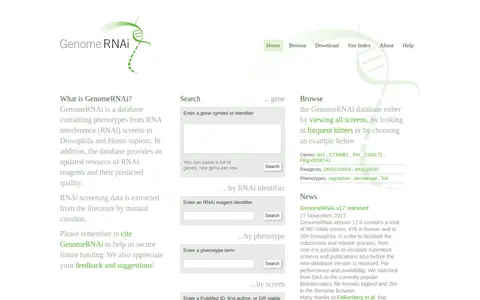
GenomeRNAi is a database of phenotypes from RNA interference screens in Drosophila and Homo sapiens. It also provides a resource of RNAi reagents and their predicted quality. Screening data is extracted from the literature through manual curation. The database supports searching by gene, RNAi identifier, phenotype or screen, and browsing by screens or frequent hitters.
GeoReM is a geochemical database previously managed by the Max Planck Institute for Chemistry in Mainz. The database has moved and is under reconstruction, now managed through a collaboration between the International Association of Geoanalysts (IAG) and the Digital Geochemical Infrastructure project (DIGIS) at the University of Göttingen.
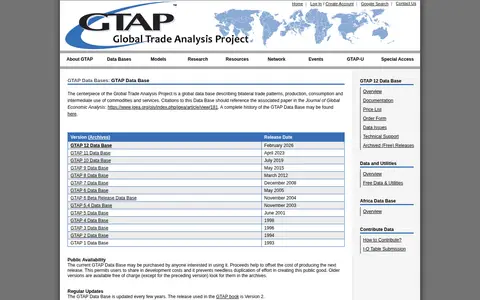
The Global Trade Analysis Project maintains a global database describing bilateral trade patterns, production, consumption and intermediate use of commodities and services. The current database may be purchased; older versions are available free of charge except for the preceding version. It is updated every few years.
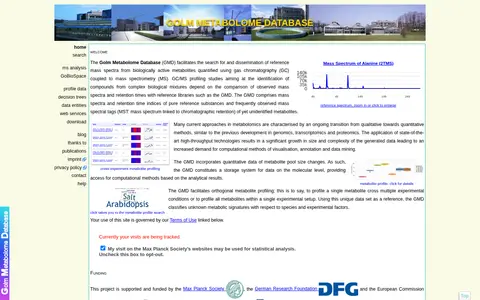
The Golm Metabolome Database (GMD) is a resource for searching and disseminating mass spectra from biologically active metabolites quantified using GC-MS. It offers search, MS analysis, library search, prediction and related data access.
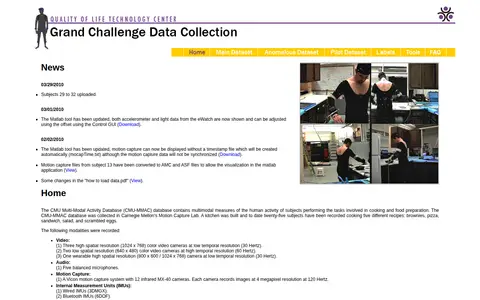
The CMU Multi-Modal Activity Database (CMU-MMAC) holds multimodal recordings of subjects cooking and preparing food, collected in Carnegie Mellon's Motion Capture Lab. The database includes video, audio, motion capture, IMU and wearable device data across three datasets. It lists a technical report, a Matlab tool and download and viewing options.
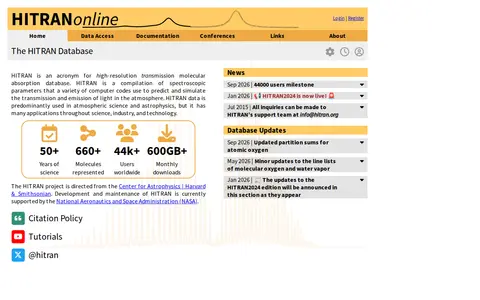
HITRANonline is a web interface to the HITRAN database, a compilation of high-resolution spectroscopic parameters used by computer codes to predict and simulate atmospheric transmission and emission of light. The database is chiefly applied in atmospheric science and astrophysics. The site provides data access, documentation, cross-section definitions, tutorials and citation policy.
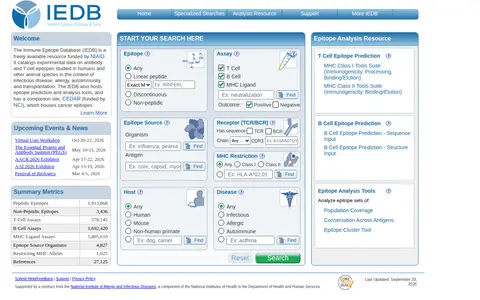
The Immune Epitope Database (IEDB) is a free public resource for searching and exporting immune epitope data. It hosts more than 95% of all published epitope data related to infectious diseases, allergies, autoimmune conditions, and transplant research, and also provides epitope prediction tools.
The Institutional Repository FHNW is the publication and research database of the FHNW University of Applied Sciences and Arts Northwestern Switzerland. It presents publications, projects and student theses, organized by university departments. Users can submit publications or projects through the My IRF section, with detailed instructions provided in the IRF manual.
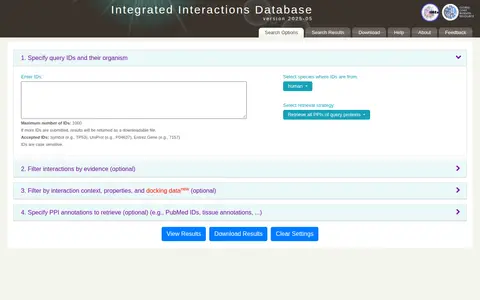
The Integrated Interactions Database (IID) is a resource for protein-protein interaction (PPI) data. It allows users to submit up to 1000 protein identifiers, including gene symbols, UniProt IDs, and Entrez Gene IDs, along with the source organism, to retrieve PPIs. Users can filter results by evidence source, including experimental and predicted data, and set minimum thresholds for experimental evidence. Retrieved results can be downloaded.
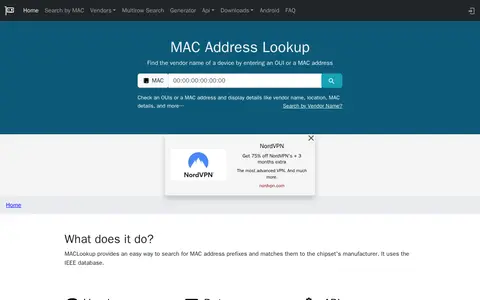
MAC Address Lookup is a tool that enables users to find the vendor, manufacturer or organization associated with a MAC or OUI address. It uses the IEEE directory and Wireshark manufacturer database for lookups, offers a free REST API for third-party integration, and provides access to its regularly updated MAC address prefix database.
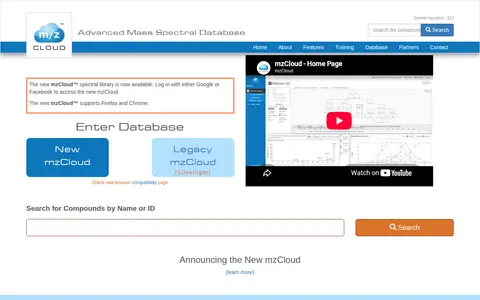
mzCloud is a curated mass spectral database of high-resolution tandem mass spectra arranged into spectral trees. It supports spectrum, tree, structure, substructure, m/z, and compound name searches, and is intended to help identify compounds, including those not present in the library. The database includes annotated fragments, molecular formulas, identifiers, and experimental metadata. It is an open consortium effort covering fields such as metabolomics and toxicology.
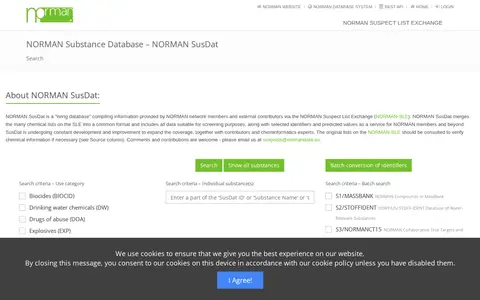
NORMAN SusDat is a living database that merges chemical lists from the NORMAN Suspect List Exchange into a common format for screening purposes. It includes selected identifiers and predicted values and is under constant development. Users should consult the original lists to verify chemical information.
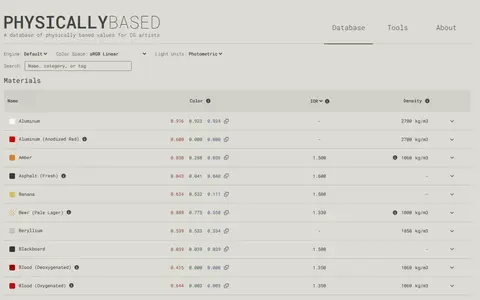
Physically Based is an open source database of physically based rendering values for CG artists, covering materials, light sources and cameras. It compiles values from publications, manufacturer documentation and user measurements, with each entry linked to at least one reference. The database is separate from the website and is built as an open API that can be integrated into applications as plug-ins, presets or web apps.
PlantTFDB is a plant transcription factor database, described as a portal for the functional and evolutionary study of plant transcription factors, at version PlantTFDB v5.0. The site offers browsing by species and by family, a BLAST search, a TF prediction server, downloads and help pages.
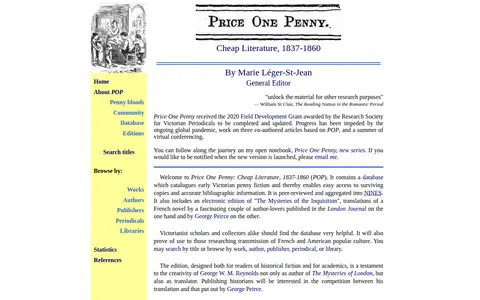
Price One Penny is a peer-reviewed database cataloguing early Victorian penny fiction from 1837 to 1860, providing bibliographic information and access to surviving copies. It includes an electronic edition of "The Mysteries of the Inquisition" with French and two English translations presented side-by-side. Users can search by title or browse by work, author, publisher, periodical or library.
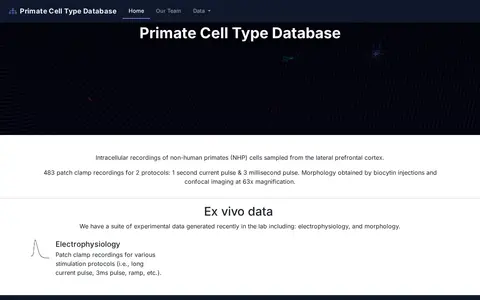
The Primate Cell Type Database provides ex vivo data from non-human primate cells sampled from the lateral prefrontal cortex. It includes intracellular patch clamp recordings for two protocols, a 1 second current pulse and a 3 millisecond pulse, and morphology obtained by biocytin injections and confocal imaging at 63x magnification.
RefractiveIndex.INFO is a refractive index database. It presents optical constants for materials such as silicon dioxide, including complex refractive index data and dispersion formulas over stated wavelength ranges. Records list conditions, comments and references, with data offered as CSV, TXT and full database records.
Multidisciplinary bibliographic database and online update of the science and practice of injury prevention.
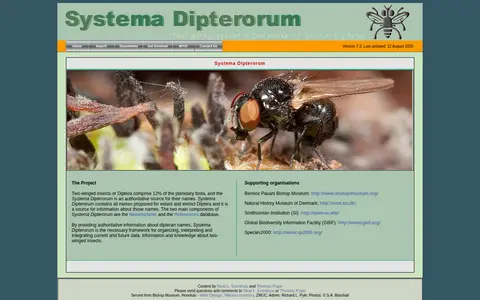
Systema Dipterorum is a database of names for two-winged insects, or Diptera, covering names proposed for extant and extinct species. Its two main components are the Nomenclator and the References database. It is presented as an authoritative source for dipteran names and a framework for organizing and integrating data about the insects.
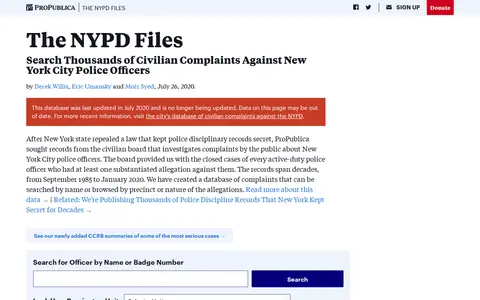
A searchable ProPublica database of civilian complaints against New York City police officers, drawn from closed cases provided by the civilian board that investigates such complaints. Records span September 1985 to January 2020 and can be searched by officer name or badge number, or browsed by precinct or nature of allegations. The database was last updated in July 2020 and is no longer being updated.
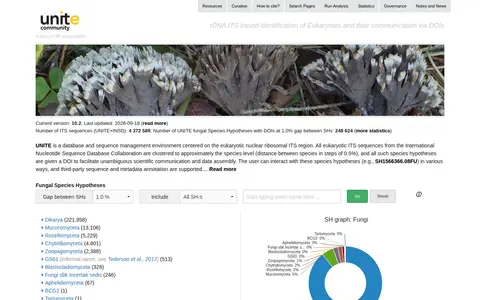
UNITE is a database and sequence management environment centered on the eukaryotic nuclear ribosomal ITS region. It clusters all eukaryotic ITS sequences from the International Nucleotide Sequence Database Collaboration to approximately the species level, and assigns a DOI to each species hypothesis. Precompiled reference datasets are available for download, and some features require registration.
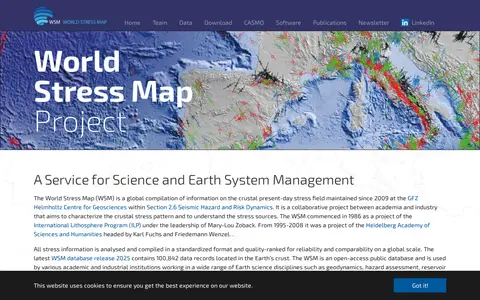
The World Stress Map is a global compilation of information on the crustal present-day stress field, maintained since 2009 at the GFZ Helmholtz Centre for Geosciences. It is an open-access database with stress information compiled in a standardized, quality-ranked format. The 2025 database release contains 100,842 data records in the Earth's crust.