Jupyter AI is an open source extension that connects AI agents to computational notebooks in JupyterLab. It provides a native chat UI and integrates agents through the Agent Client Protocol, with a permission system requiring approval before files are written or commands executed. It is under incubation in the JupyterLab organization.
Directory
Search results
Published directory entries matching your search.
Jupyter Notebooks as Markdown Documents, Julia, Python or R scripts.
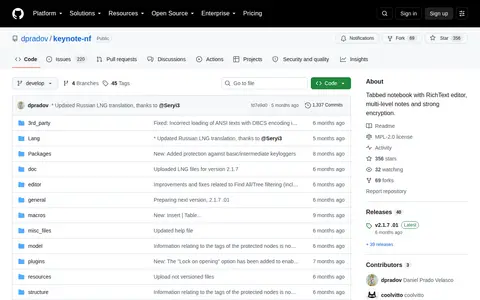
KeyNote NF is a tabbed notebook application that includes a RichText editor, support for multi-level note organization, and strong encryption features. The project is hosted on GitHub and provides reference documentation and contact information for users.
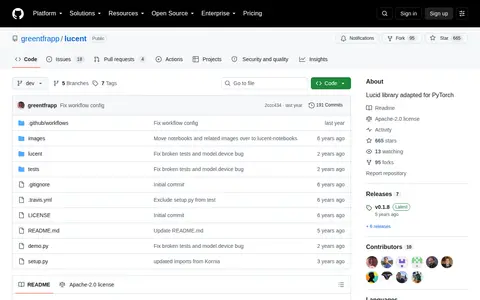
Lucent is an adaptation of the Lucid library for PyTorch. It is in a pre-alpha phase and can be installed locally with pip install torch-lucent. Its notebooks can be run via Google Colab or locally with Jupyter.
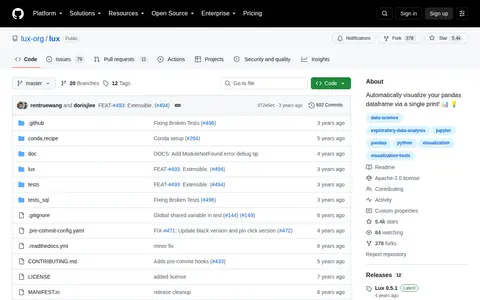
Lux is a Python library for automated data exploration. When a pandas dataframe is printed in a Jupyter notebook, Lux recommends a set of visualizations highlighting trends and patterns, shown in an interactive widget for browsing and exploring the dataset.

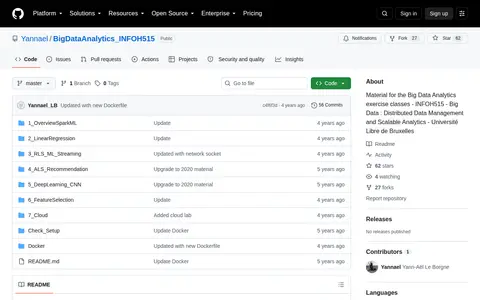
A repository of material for the exercise classes of a Big Data Analytics master course. Hands-on sessions cover Spark and its machine learning library, Map/Reduce implementations of linear regression and alternating least squares, streaming analytics with Recursive Least Squares, and image classification with convolutional neural networks. Material is provided as Jupyter notebooks.
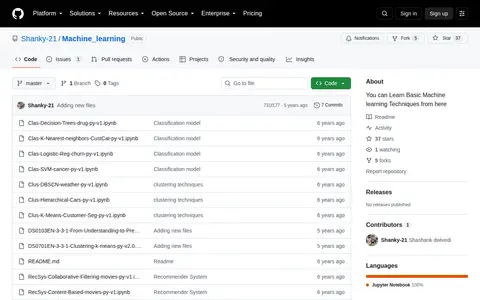
A Repository Containing Classification, Clustering, Regression, Recommender Notebooks with illustration to make them.
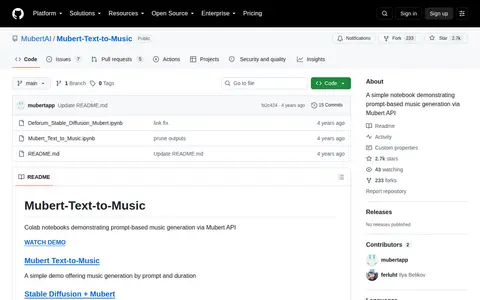
MubertAI/Mubert-Text-to-Music is a GitHub repository maintained by MubertAI. It hosts a simple notebook that demonstrates prompt-based music generation via the Mubert API, providing a reference implementation for users looking to generate music from text prompts using the service.
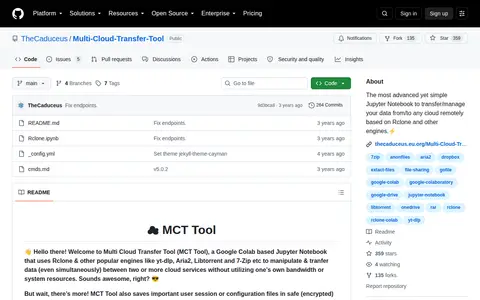
Multi-Cloud-Transfer-Tool is a GitHub-hosted Jupyter Notebook project created by TheCaduceus for transferring and managing data between local devices and any cloud service remotely. The tool is built on Rclone and other engines, and is described as advanced yet simple to use.
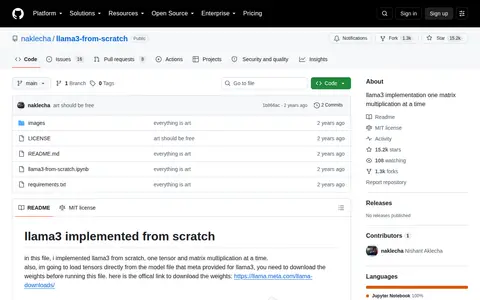
A notebook project that implements llama3 from scratch, one tensor and matrix multiplication at a time. It loads tensors directly from the model file Meta provided for llama3, and the weights must be downloaded before running the file. The author does not implement a BPE tokenizer and instead uses tiktoken.
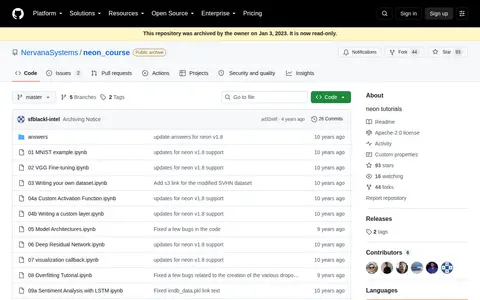
IPython notebooks for a complete course around understanding Nervana's Neon.
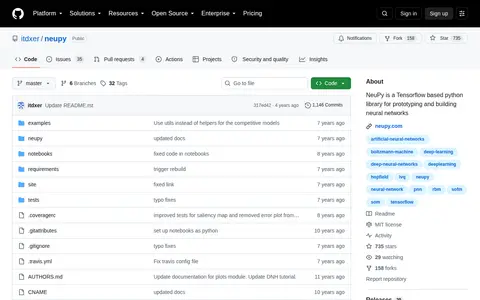
NeuPy is a Python library built on Tensorflow for prototyping and building neural networks. The repository notes that the library is no longer actively maintained. It includes examples and notebooks covering algorithms such as Boltzmann machines and self-organizing maps.
Open-source project that provides machine-learning models, research, training resources, or evaluation tools.
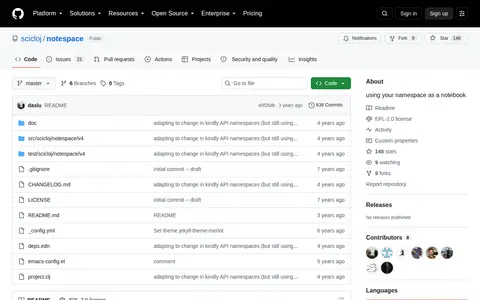
notespace is an open source project hosted as a public repository on GitHub under the scicloj/notespace project. It is designed to enable users to use their namespace as a notebook. The project invites contributions from developers.
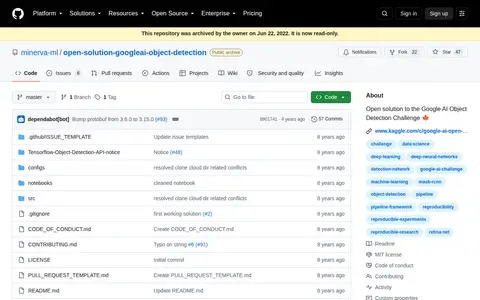
An archived, read-only GitHub repository holding an open solution to the Google AI Open Images Object Detection Track. It offers starter code, configs and notebooks, with RetinaNet training and references to the Neptune experiment platform; Neptune use is optional and the code can run as a plain Python script. The README notes the competition used Open Images Dataset V4.
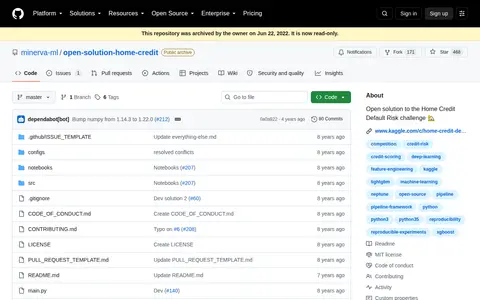
An archived, read-only GitHub repository holding an open solution to the Home Credit Default Risk challenge. It provides code, configs and notebooks plus documented solutions using LightGBM, sklearn and XGBoost with engineered features; the README lists cross-validation and leaderboard scores for each. References to Neptune are optional and the solution can run as a plain Python script.
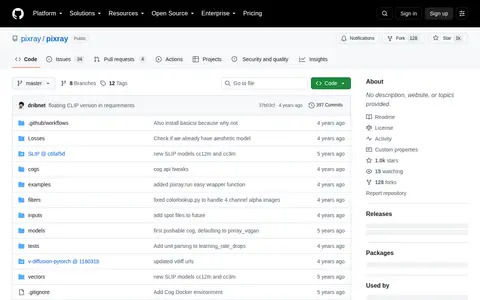
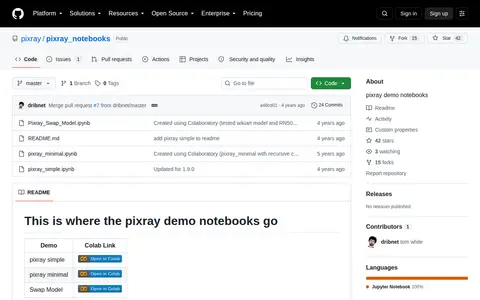
pixray is an image generation system combining perception engines, CLIP-guided GAN imagery and CLIPDraw. It is a Python library and command line utility that can also run in Google Colab notebooks or inside Docker using Cog. Installation requires a recursive git clone and a fresh Python 3.8 environment.
Creates or edits images with generative models and visual controls.
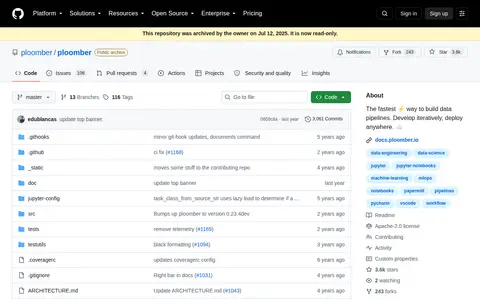
Ploomber is a tool for building data pipelines. It offers a YAML API and a Python API, and its features include caching previous pipeline results and running on Kubernetes, Airflow, AWS Batch or SLURM. It can convert monolithic notebooks into modular pipelines. The repository was archived on Jul 12, 2025 and is read-only.
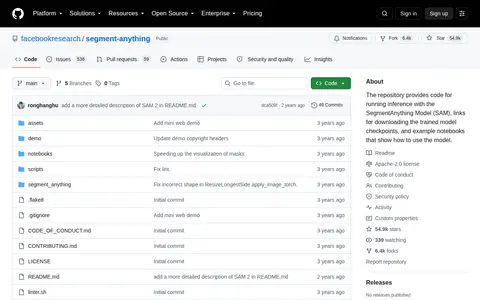
segment-anything (SAM) is an open-source GitHub repository from Meta's Facebook Research team for the Segment Anything Model. It provides code for running model inference, links to download trained model checkpoints, and example notebooks demonstrating model usage, with support for segmenting objects in images and videos via SAM 2.
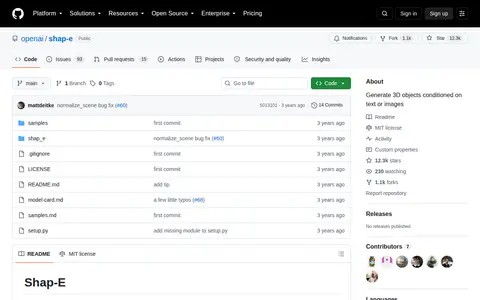
Shap-E is OpenAI's official code and model release for generating conditional 3D implicit functions. It generates 3D objects conditioned on text or images, with example notebooks for text-to-3D and image-to-3D sampling. It is released under the MIT license and installs with pip.
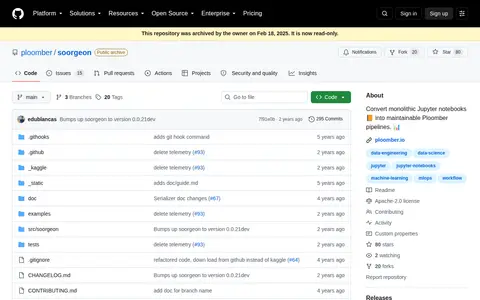
Soorgeon is a tool that converts monolithic Jupyter notebooks into Ploomber pipelines. It is compatible with Python 3.7 and higher and installs via pip. The repository was archived by its owner on Feb 18, 2025, and is now read-only. The project describes itself as being in alpha.
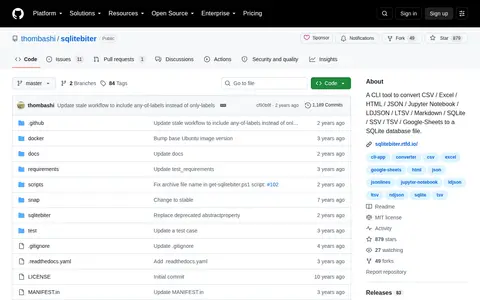
A CLI tool to convert CSV / Excel / HTML / JSON / Jupyter Notebook / LDJSON / LTSV / Markdown / SQLite / SSV / TSV / Google-Sheets to a SQLite database file.
Stable Dreamfusion is a software project that supports text-to-3D and image-to-3D generation, as well as mesh exportation, using NeRF and diffusion model technology. Its public repository includes update logs and links to Colab notebooks for user access.