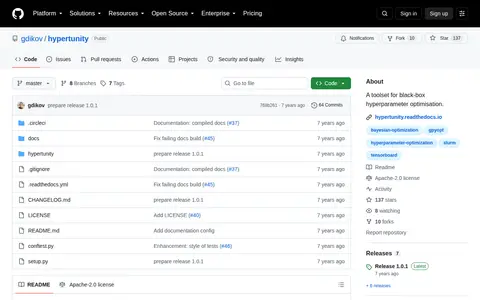

Hypertunity is a lightweight, high-level Python library for black-box hyperparameter optimisation. It supports Bayesian optimisation by wrapping GPyOpt, objective function evaluation through a scheduler that is also compatible with Slurm, and real-time visualisation of results in Tensorboard via the HParams plugin. A Trial wrapper class allows parallel optimisation without manual scheduling, optimiser updates and logging.
Directory
Search results
Published directory entries matching your search.
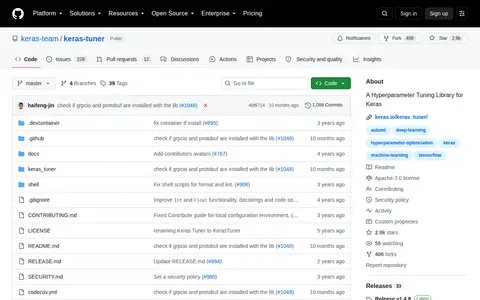
KerasTuner is a hyperparameter optimization framework for Keras. It provides a define-by-run syntax for configuring search spaces and includes Bayesian Optimization, Hyperband and Random Search algorithms. It requires Python 3.8+ and TensorFlow 2.0+.
Loic Tetrel is a blog about computer science and data science topics. Posts cover subjects such as enabling GPU acceleration in Windows 11 Hyper-V virtual machines, using Android TV without a Google account, and Windows/Linux dual-boot.
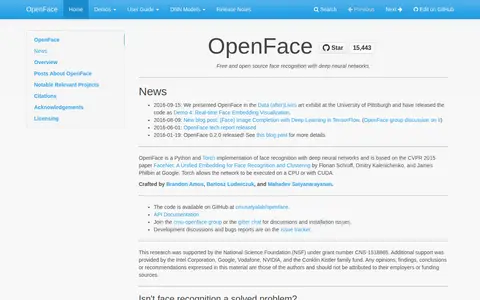
OpenFace is a free and open source face recognition implementation with deep neural networks, written in Python and Torch and based on the CVPR 2015 FaceNet paper. It detects faces, aligns them, and embeds faces on a 128-dimensional unit hypersphere.
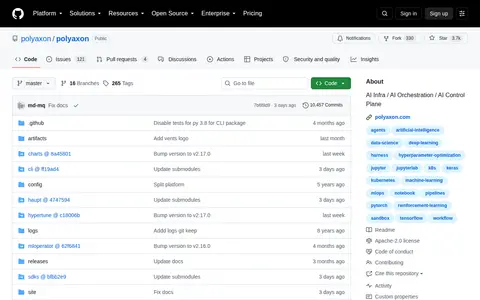
Polyaxon is a platform for building, training, and monitoring large-scale deep learning applications. It deploys into any data center or cloud provider and supports major deep learning frameworks such as Tensorflow, MXNet, Caffe, and Torch. It manages workloads with container and node management and offers hyperparameter tuning through experiment groups defining a search algorithm and search space.
A newsletter article by tech critic Paris Marx arguing that generative AI is a technology hype cycle. It cites SimilarWeb data showing ChatGPT worldwide traffic fell 9.7% in June and unique users dropped 5.7%, and reports that growth began stalling in March.
The Story of AI Winters and What it Teaches Us Today is a Turing Post article that outlines five AI winter periods between 1966 and 1988. It details the causes of each collapse in AI hype, lessons learned by researchers, and how these setbacks shaped the development of modern neural networks and current AI technology.
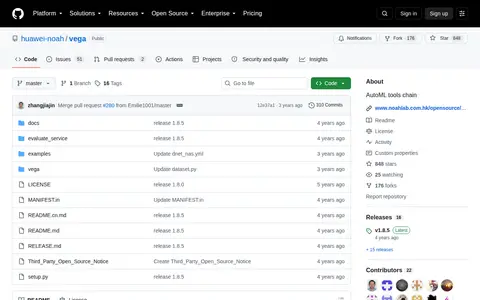
Vega is an AutoML algorithm tool chain developed by Noah's Ark Laboratory. It covers hyperparameter optimization, data augmentation, network architecture search, model compression and fully train functions, and supports PyTorch, TensorFlow and MindSpore backends.
A Gary Marcus article on his Marcus on AI Substack asking when the GenAI bubble might burst and how that could happen within 12 months. It cites survey findings on generative AI and security, notes $50B in and $3B out, and argues that hallucinations remain and that the industry is built on hype.
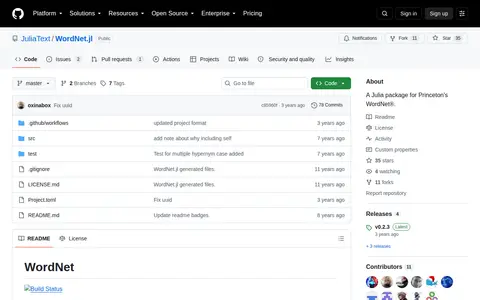
WordNet.jl is a Julia package for using Princeton's WordNet, described as heavily inspired by Doches' rwordnet. It provides functions for loading a database, retrieving synsets, antonyms, expanded hypernyms and sense keys, with example use shown for the words glad, dog and cat.
XPipe is a connection hub that accesses server infrastructure from a local machine. It works on top of installed command-line programs and requires no setup on remote systems. It manages remote connections, remote file management, terminal launching, SSH support, container runtime integrations, hypervisors, remote apps, and concurrency synchronization through a git repository. A Community plan is free; Homelab is $5/month or $40/year, and Professional is $10/month or $80/year.