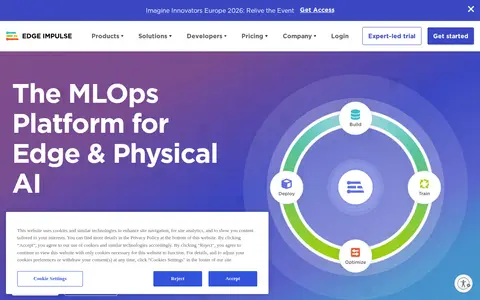

Edge Impulse is an MLOps platform for edge AI and physical AI. It provides native MLOps workflows covering end-to-end pipelines, security, versioning and model monitoring, and is used to develop, deploy and manage AI solutions at scale across the edge hardware ecosystem. A Developer plan is offered at $0 per month.
Directory
Search results
Published directory entries matching your search.
The UK Environmental Change Network is the UK's long-term ecosystem monitoring and research programme, making regular measurements of air, soil, water, animals and plants across a network of sites since 1993. It provides free access to over two decades of detailed environmental data and instrumented research sites supporting environmental research and education.
EverRise is a blockchain technology company offering bridging and security solutions across blockchains through an ecosystem of decentralized applications. Its listed products include EverRevoke, EverSwap, EverBridge, EverOwn, EverMigrate, NFT Staking Lab, EverLaunch and EverLock. In July 2023, the company announced CrossX, described as a tool for moving stablecoins cross-chain and earning yield by providing liquidity.
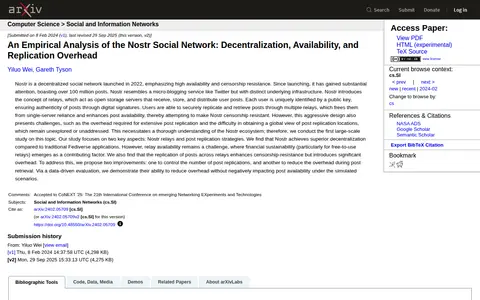
This arXiv paper presents the first large-scale study of the Nostr social network, focusing on relays and post replication strategies. The authors find Nostr achieves superior decentralization compared to traditional Fediverse applications, while relay availability remains a challenge and replication introduces overhead. They propose two improvements.
Feature Stores for ML is a global community of data science professionals, researchers, and engineers focused on feature stores for machine learning pipelines. It creates educational content about feature stores and the surrounding data and AI ecosystem, hosts monthly industry meetups, and provides resources including blog posts, videos, benchmarks, and an MLOps dictionary.
Flux is a machine learning library built as a pure-Julia stack, offering lightweight abstractions over Julia's native GPU and automatic differentiation support. It is compiled and eager, and existing Julia libraries can be incorporated into Flux models. Its ecosystem includes probabilistic programming, graph neural networks, computer vision and natural language processing packages, and it is maintained by a community team.
Forestry Images is a collection of photographs focused on forest health, natural resources, and silviculture. It features images of insects, diseases, trees, plants, weeds, ecosystems, fire, ecology, pests, and wildlife.
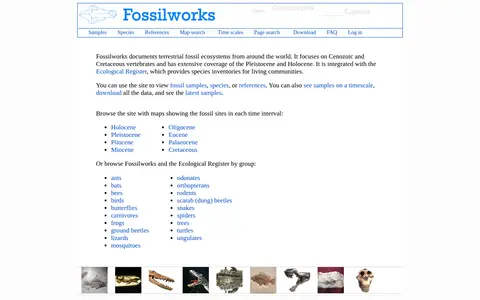
Fossilworks documents terrestrial fossil ecosystems worldwide, focusing on Cenozoic and Cretaceous vertebrates with extensive Pleistocene and Holocene coverage. It is integrated with the Ecological Register, which provides species inventories for living communities. Users can view fossil samples, species or references, see samples on a timescale, and download all data.
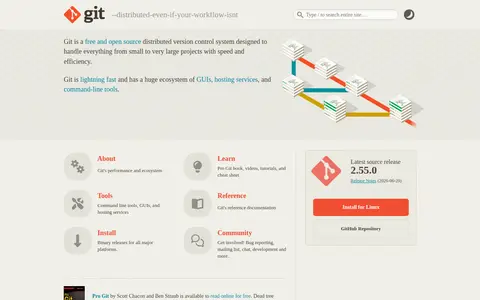
Git is a free and open source distributed version control system designed to handle projects of varying sizes with speed and efficiency. It has an ecosystem of GUIs, hosting services and command-line tools. The latest source release is 2.56.0.
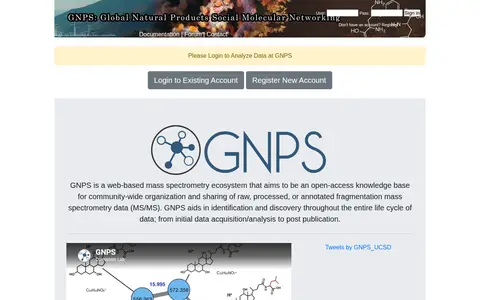
GNPS is a web-based mass spectrometry ecosystem serving as an open-access knowledge base for community-wide organization and sharing of raw, processed or annotated fragmentation mass spectrometry data. It provides tools for molecular networking, library search, MASST search and dataset browsing, supporting identification and discovery across the data life cycle.
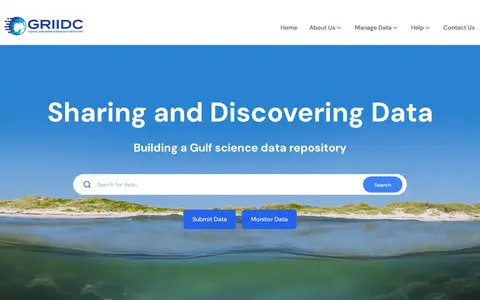
GRIIDC is a multidisciplinary data repository that stores and disseminates data. It lets users search and download data for free, while data can be stored for a fee. Its mission is to support a data and information legacy for coastal and marine ecosystems. It is based at the Harte Research Institute.
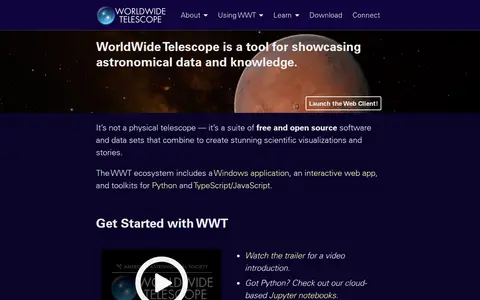
WorldWide Telescope is a suite of free and open source software and data sets that combine to create scientific visualizations and stories. Its ecosystem includes a Windows application, an interactive web app, and toolkits for Python and TypeScript/JavaScript.
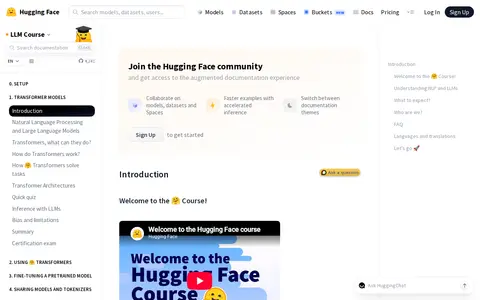
A free LLM course from Hugging Face that teaches large language models and natural language processing. It covers the Transformers, Datasets, Tokenizers, and Accelerate libraries and the Hugging Face Hub, along with some libraries outside the ecosystem. The course is without ads.
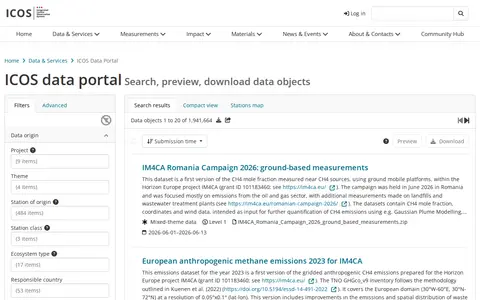
The ICOS Carbon Portal is the data access point for the Integrated Carbon Observation System (ICOS), a network measuring atmospheric, ecosystem, and ocean greenhouse gas data across European member countries. It provides access to raw and processed measurement datasets, along with tools including STILT atmospheric transport modeling, DOI minting, and SPARQL querying to support climate change and emissions research.
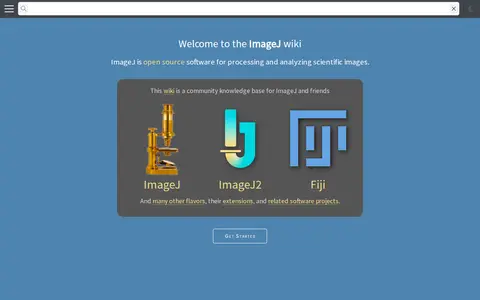
ImageJ is open source, public domain software for processing and analyzing scientific images. It is part of an ecosystem including ImageJ2, Fiji and other related variants, with support for hundreds of extensible plugins for scientific imaging tasks. The project maintains a community-edited wiki with documentation for users, developers and contributors across supported platforms.
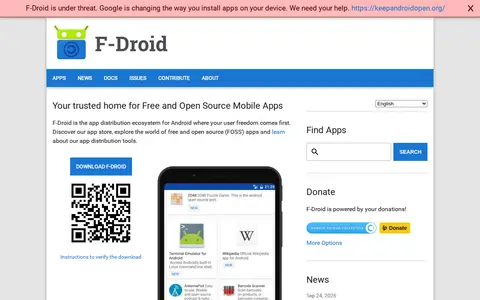
F-Droid is an app distribution ecosystem for Android focused on free and open source software. It operates a repository of verified free software Android apps and provides server tools, scripts and build and release tools for setting up and running an app store, including additional or alternative repositories.
JSON Schema is a declarative language for annotating and validating JSON documents' structure, constraints, and data types. It enables JSON data consistency, validity, and interoperability, and has a tooling ecosystem of validators, generators, and linters. Documentation covers schema design, guides, and keyword reference.
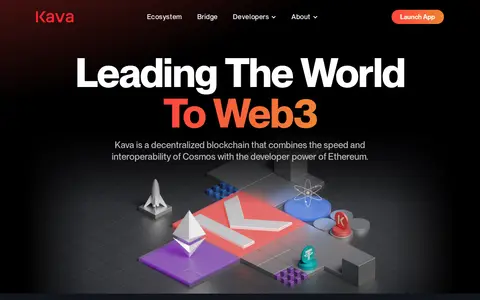
The source pages describe Kava as a decentralized blockchain combining Cosmos interoperability with Ethereum developer tooling. It is presented as EVM compatible, connected to the Cosmos ecosystem via the IBC protocol, and using Tendermint consensus. Developer resources include an EVM overview, JavaScript SDK and node guides, plus the Kava Rise incentive program.
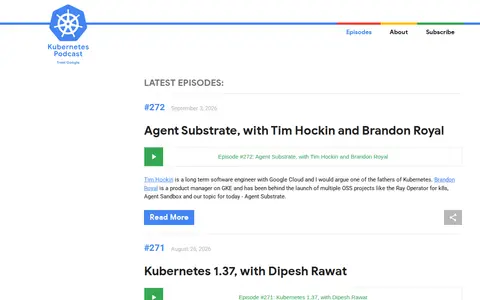
A weekly news and interview podcast covering the Kubernetes community, including release discussions, projects, and AI policy topics. Episodes feature guests from the Kubernetes ecosystem and are hosted as numbered installments with accompanying show notes.
Leaflet is a social publishing platform for creating blogs, newsletters, and other content. It offers collaborative editing, custom themes and domains, and tools to send updates to readers via email, Bluesky, and the Atmosphere social ecosystem.
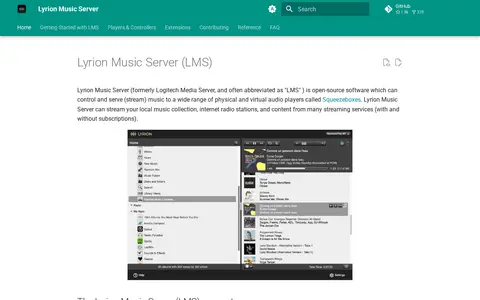
Lyrion Music Server (LMS) is open-source software that controls and streams music to Squeezebox audio players. It can stream local music, internet radio, and content from streaming services. The ecosystem includes server and player software for Windows, Mac, tablets, phones, and Raspberry Pi, and can support large libraries across multiple devices.
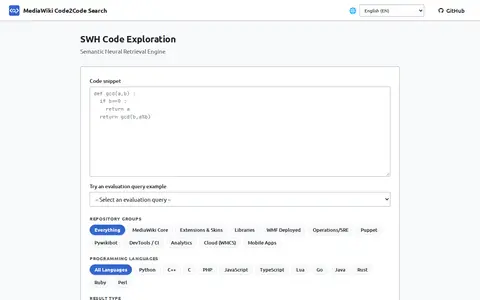
MediaWiki Code2Code Search is an AI-powered semantic neural retrieval tool for searching MediaWiki source code. It uses Sentence-Transformers to enable meaning-based search rather than keyword-only matching, allowing users to find functions, types, and templates across the entire MediaWiki ecosystem. It supports multiple programming languages including PHP, Python, JavaScript, Go, TypeScript and Lua, and provides sample evaluation queries for common code search tasks.
MegaETH describes itself as real-time Ethereum, streaming transactions with sub-millisecond latency and over 100,000 transactions per second, settled on Ethereum. A blog post highlights MNSTR, an onchain trading-card platform, as an ecosystem project.
Meld Gold is a platform for tokenising physical gold and silver as digital assets backed by real metals. It states that its tokens can be traded on the blockchain and that assets are accepted by wallets, exchanges and lending platforms across the Algorand and XRPL ecosystems.