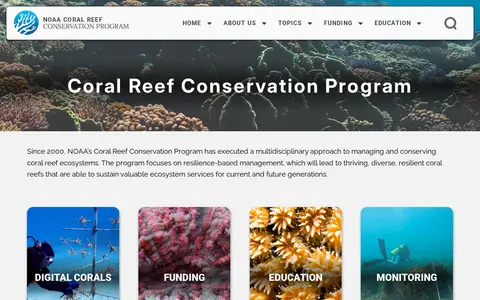
NOAA's Coral Reef Conservation Program takes a multidisciplinary approach to managing and conserving coral reef ecosystems. It focuses on resilience-based management and covers topics such as land-based sources of pollution, disease and disturbance response, changing ocean conditions, sustainable fisheries, coral restoration, monitoring and social science.
Directory
Search results
Published directory entries matching your search.
Dark-web intelligence company publishing monitoring, ransomware and underground-ecosystem analysis.
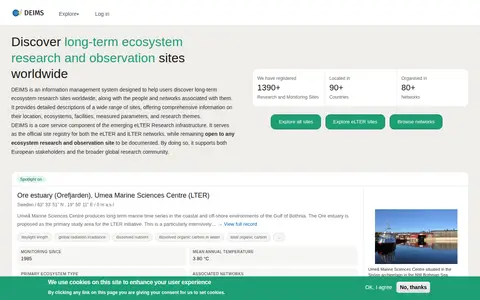
DEIMS is an information management system for discovering long-term ecosystem research and observation sites worldwide, along with associated people and networks. It gives detailed descriptions of sites including location, ecosystems, facilities, measured parameters and research themes, and serves as the official site registry for the eLTER and ILTER networks while remaining open to any site.
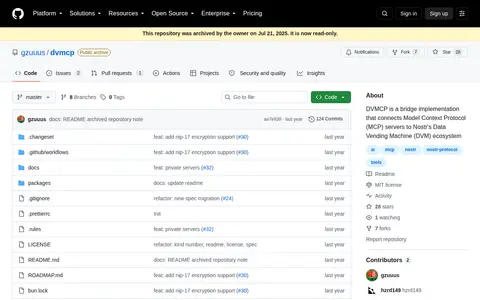
DVMCP is a bridge implementation that connects Model Context Protocol (MCP) servers to Nostr's Data Vending Machine ecosystem
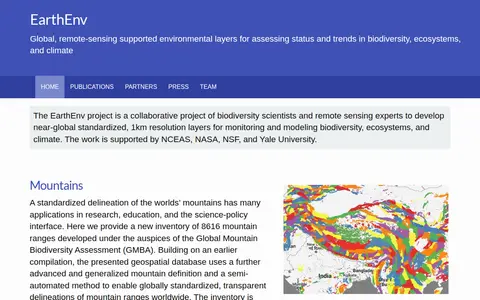
EarthEnv is a collaborative project of biodiversity scientists and remote sensing experts that develops near-global standardized 1km resolution layers for monitoring and modeling biodiversity, ecosystems, and climate. It presents datasets including mountain delineations, tropical cloud forests, precipitation, topography, habitat heterogeneity, land cover, cloud cover climatology, a digital elevation model and freshwater environmental variables.

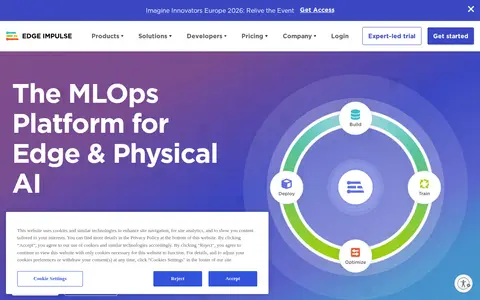
Edge Impulse is an MLOps platform for edge AI and physical AI. It provides native MLOps workflows covering end-to-end pipelines, security, versioning and model monitoring, and is used to develop, deploy and manage AI solutions at scale across the edge hardware ecosystem. A Developer plan is offered at $0 per month.
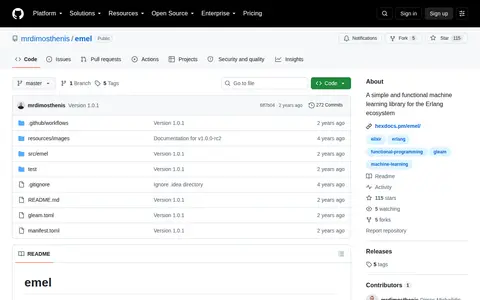
emel is a simple and functional machine learning library built for the Erlang ecosystem and implemented in Gleam. It turns data into functions and supports installing through rebar.config, mix.exs or gleam add. Implemented algorithms include linear regression, k nearest neighbors, decision tree, naive Bayes, k means, perceptron, logistic regression and neural network, along with mathematics, algebra, geometry and statistics.
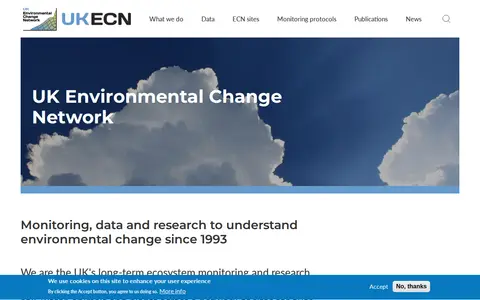
The UK Environmental Change Network is the UK's long-term ecosystem monitoring and research programme, making regular measurements of air, soil, water, animals and plants across a network of sites since 1993. It provides free access to over two decades of detailed environmental data and instrumented research sites supporting environmental research and education.
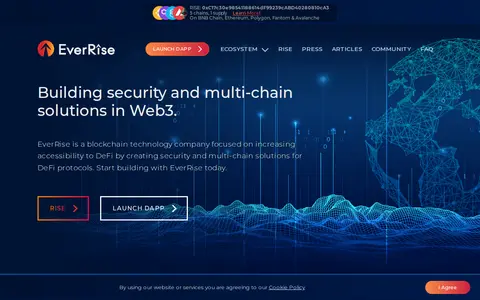
EverRise is a blockchain technology company offering bridging and security solutions across blockchains through an ecosystem of decentralized applications. Its listed products include EverRevoke, EverSwap, EverBridge, EverOwn, EverMigrate, NFT Staking Lab, EverLaunch and EverLock. In July 2023, the company announced CrossX, described as a tool for moving stablecoins cross-chain and earning yield by providing liquidity.
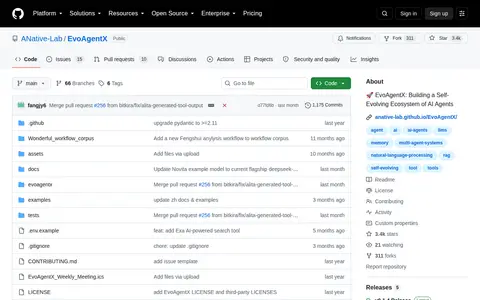
EvoAgentX is building a Self-Evolving Ecosystem of AI Agents, it will give you automated framework for evaluating and evolving agentic workflows.
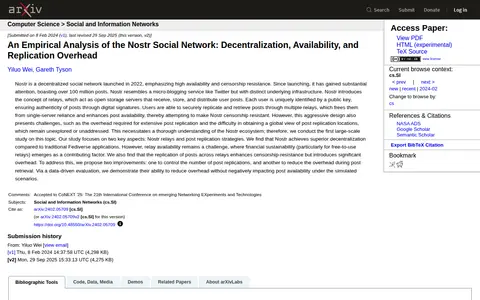
This arXiv paper presents the first large-scale study of the Nostr social network, focusing on relays and post replication strategies. The authors find Nostr achieves superior decentralization compared to traditional Fediverse applications, while relay availability remains a challenge and replication introduces overhead. They propose two improvements.
Feature Stores for ML is a global community of data science professionals, researchers, and engineers focused on feature stores for machine learning pipelines. It creates educational content about feature stores and the surrounding data and AI ecosystem, hosts monthly industry meetups, and provides resources including blog posts, videos, benchmarks, and an MLOps dictionary.
Flux is a machine learning library built as a pure-Julia stack, offering lightweight abstractions over Julia's native GPU and automatic differentiation support. It is compiled and eager, and existing Julia libraries can be incorporated into Flux models. Its ecosystem includes probabilistic programming, graph neural networks, computer vision and natural language processing packages, and it is maintained by a community team.
Forestry Images is a collection of photographs focused on forest health, natural resources, and silviculture. It features images of insects, diseases, trees, plants, weeds, ecosystems, fire, ecology, pests, and wildlife.
Fossilworks documents terrestrial fossil ecosystems worldwide, focusing on Cenozoic and Cretaceous vertebrates with extensive Pleistocene and Holocene coverage. It is integrated with the Ecological Register, which provides species inventories for living communities. Users can view fossil samples, species or references, see samples on a timescale, and download all data.
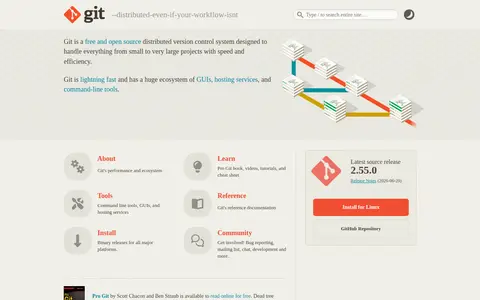
Git is a free and open source distributed version control system designed to handle projects of varying sizes with speed and efficiency. It has an ecosystem of GUIs, hosting services and command-line tools. The latest source release is 2.56.0.
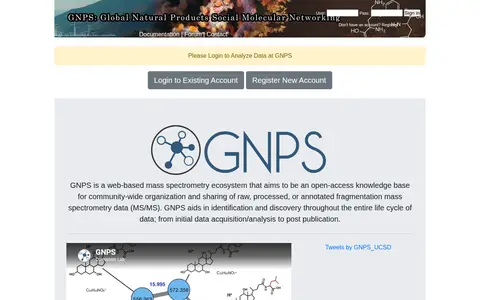
GNPS is a web-based mass spectrometry ecosystem serving as an open-access knowledge base for community-wide organization and sharing of raw, processed or annotated fragmentation mass spectrometry data. It provides tools for molecular networking, library search, MASST search and dataset browsing, supporting identification and discovery across the data life cycle.
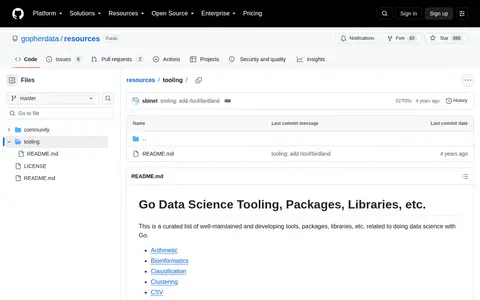
Gopherdata's tooling directory is a curated list of tools, packages, and libraries for doing data science with Go. It organizes resources across categories such as classification, clustering, CSV handling, distributed data analysis, geospatial work, machine learning, and plotting, and also lists proposed packages meant to fill gaps in the ecosystem.
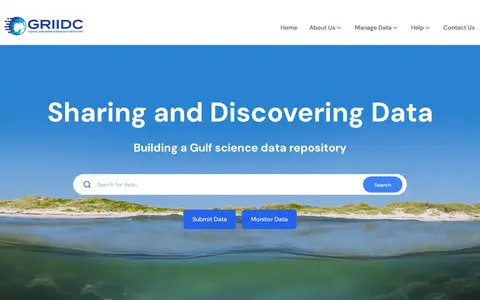
GRIIDC is a multidisciplinary data repository that stores and disseminates data. It lets users search and download data for free, while data can be stored for a fee. Its mission is to support a data and information legacy for coastal and marine ecosystems. It is based at the Harte Research Institute.
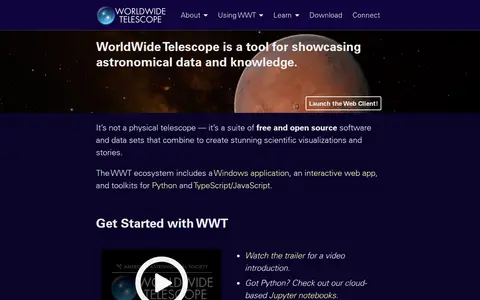
WorldWide Telescope is a suite of free and open source software and data sets that combine to create scientific visualizations and stories. Its ecosystem includes a Windows application, an interactive web app, and toolkits for Python and TypeScript/JavaScript.
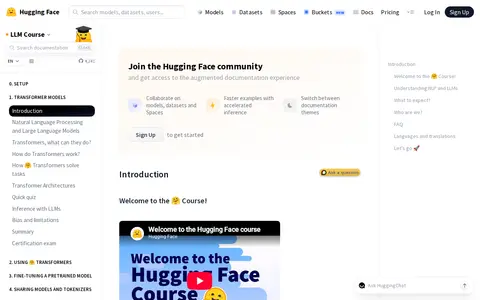
A free LLM course from Hugging Face that teaches large language models and natural language processing. It covers the Transformers, Datasets, Tokenizers, and Accelerate libraries and the Hugging Face Hub, along with some libraries outside the ecosystem. The course is without ads.
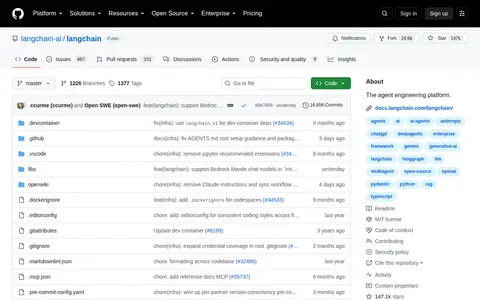
hwchase17/langchain is a GitHub repository for LangChain, an agent engineering platform. The repository hosts resources related to the LangChain ecosystem, including quickstart guides and documentation for users and developers working with the platform.
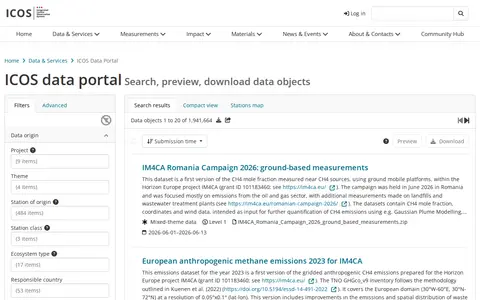
The ICOS Carbon Portal is the data access point for the Integrated Carbon Observation System (ICOS), a network measuring atmospheric, ecosystem, and ocean greenhouse gas data across European member countries. It provides access to raw and processed measurement datasets, along with tools including STILT atmospheric transport modeling, DOI minting, and SPARQL querying to support climate change and emissions research.
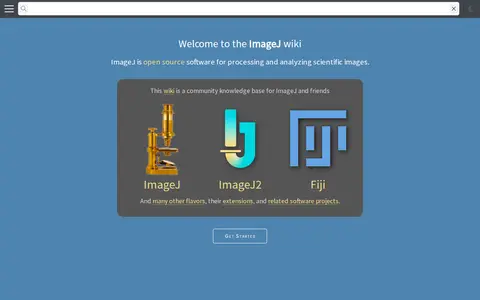
ImageJ is open source, public domain software for processing and analyzing scientific images. It is part of an ecosystem including ImageJ2, Fiji and other related variants, with support for hundreds of extensible plugins for scientific imaging tasks. The project maintains a community-edited wiki with documentation for users, developers and contributors across supported platforms.