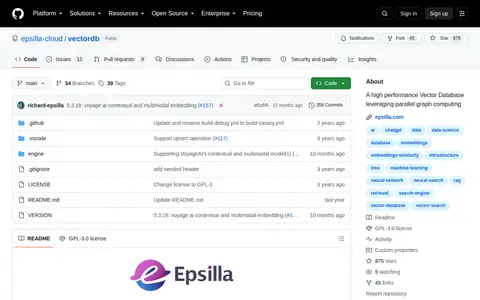

Epsilla is a high-performance vector database hosted on GitHub under the epsilla-cloud organization. It leverages parallel graph computing for its operations, and offers an experimental option to use it as a Python library without requiring a Docker image, alongside Epsilla Cloud as a deployment option.
Directory
Search results
Published directory entries matching your search.
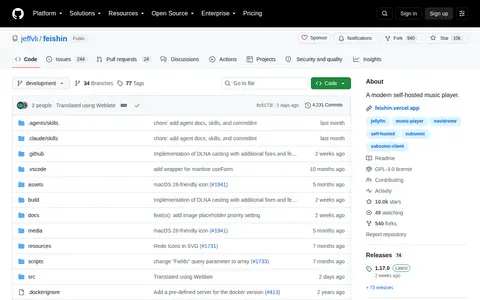
Feishin is a self-hosted music player with a desktop client and a web client. The desktop client supports MPV and web player backends and built-in lyric fetching. It is also distributed as a Docker image.
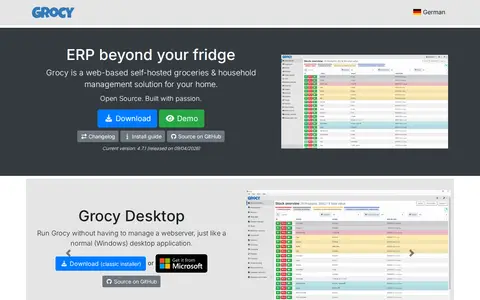
Grocy is a web-based, self-hosted groceries and household management solution for the home, released as open source. It supports barcode-assisted purchase tracking, shopping lists with minimum stock amounts, grouped products by assortments, recipe stock checks, and meal planning. Related tools include a desktop version, Docker image, Home Assistant add-on, and mobile and barcode helper apps.
Krita is a free and open source painting program made by artists, licensed as GNU GPL. It provides multiple brush types and brush engines, layers, drawing assistants, stabilizers, vector and text tools, and 2D animation features through a customizable interface with dockers and dark and light themes.
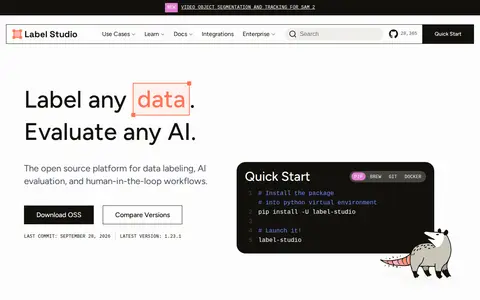
Label Studio is an open source data labeling and annotation platform for multi-modal data, including text, images, audio and time series. It lists uses such as LLM and agent evaluation, computer vision, NLP and document tasks, and audio transcription. It offers API, Python SDK and webhooks, and is available via pip, Homebrew, Git and Docker.

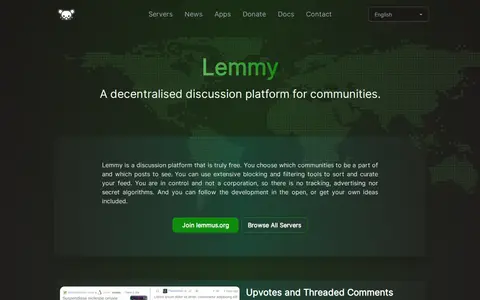
Lemmy is a decentralized discussion platform for communities. Posts can be upvoted or downvoted and support threaded comments. It consists of interconnected servers and can be self-hosted via Docker or Ansible. It offers apps for iOS, Android, desktop and web and is open source.
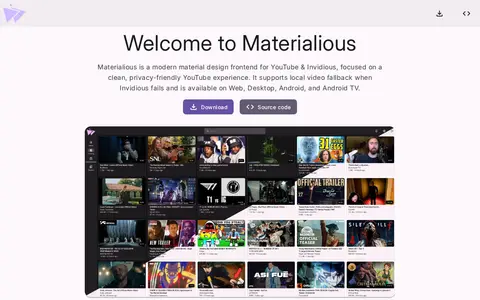
Materialious is a material design frontend for YouTube and Invidious aimed at a clean, privacy-friendly experience. It runs on Web, Windows, Android, Android TV, Docker, macOS and Linux, and supports local video fallback when Invidious fails.
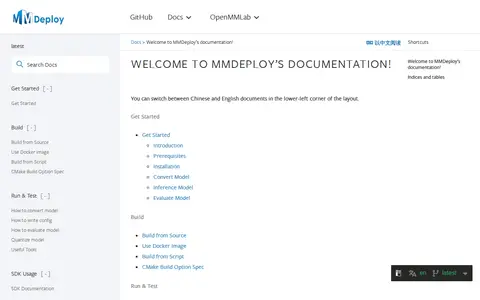
MMDeploy is documented at version 1.3.1 and covers getting started, converting, running, evaluating and quantizing models, building from source or Docker image, and SDK usage. Its backend support pages describe ncnn, ONNX Runtime, OpenVINO, PPLNN, SNPE, TensorRT, TorchScript, RKNN, TVM and Core ML, and its codebase support covers several OpenMMLab projects.
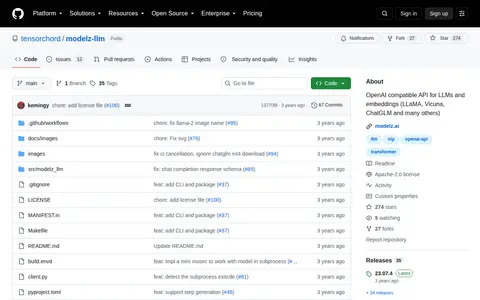
Modelz LLM is an inference server for running open source large language models such as FastChat, LLaMA and ChatGLM on local or cloud environments with an OpenAI compatible API. It supports interaction through the OpenAI python SDK or LangChain and provides docker images for deployment on Kubernetes or Modelz.
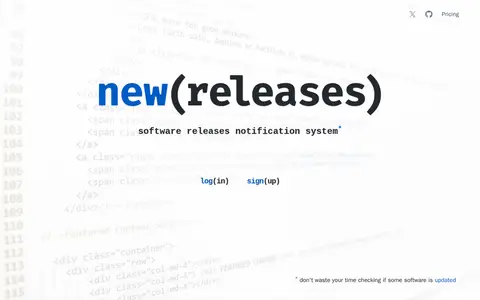
A release tracker for software developers and DevOps that sends notifications when software is updated. It supports many providers including GitHub, GitLab, Codeberg, Gitea, Bitbucket, package registries and Docker image tags, and delivers messages through email, webhooks and instant messengers. The service is free and accepts donations.
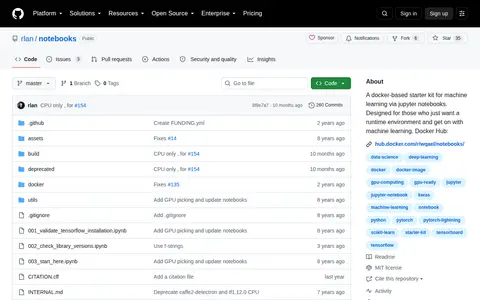
Notebooks is a Docker-based starter kit for machine learning through Jupyter notebooks, intended for users who want a ready runtime environment. Its images cover combinations of Keras, TensorFlow and PyTorch with CUDA v8 through v11, and include JupyterLab, scikit-learn, pandas and visualization, vision and NLP libraries. Python 3 only, as Python 2 is end-of-life.
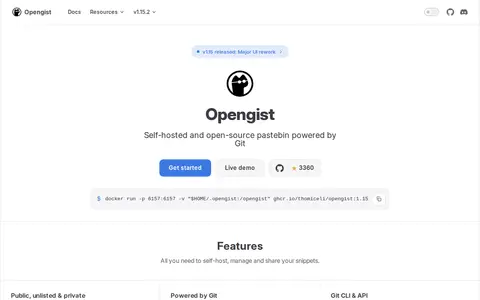
Opengist is an open-source, self-hosted pastebin powered by Git. Snippets are stored in Git repositories and can be managed with standard Git commands or a web interface. It supports public, unlisted, and private snippets, multiple files per snippet, revisions and diffs, syntax highlighting, and login through OAuth2 providers, LDAP, and passkeys. It is written in Go and can run as a single binary, Docker image, or Kubernetes deployment, backed by SQLite, PostgreSQL, or MySQL.
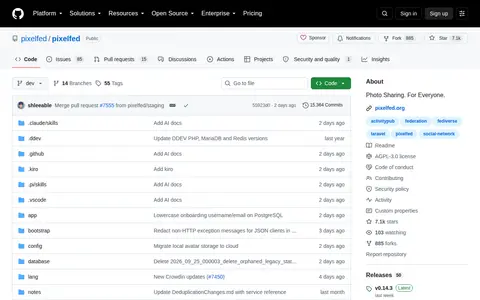
Pixelfed is open-source photo sharing software that lets casual shots and creative photography find an audience without algorithmic barriers. It is licensed under AGPL and built with Laravel, with ActivityPub federation and Docker-based deployment recommended for running instances.
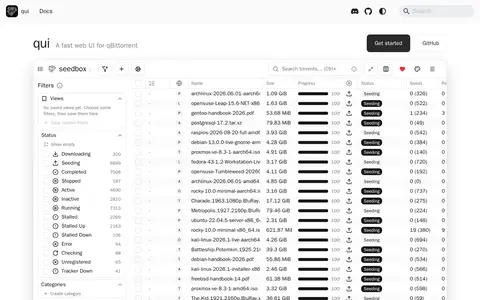
qui is a web UI for qBittorrent. It manages one or many qBittorrent instances from a single page, with cross-seed, rule-based automations, scheduled backups with restore, orphan scanning and a reverse proxy endpoint. It runs as a single binary or Docker image on Linux, macOS and Windows, using SQLite by default or Postgres. It is free and open source under GPL-2.0-or-later.
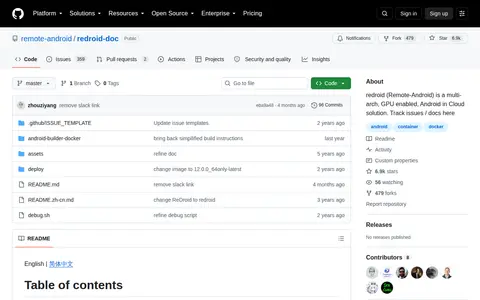
redroid is a multi-architecture GPU-accelerated Android in Cloud solution that boots Android instances on Linux hosts including Docker, podman and k8s. It supports arm64 and amd64 and is intended for cloud gaming, virtualized phones and automation testing. Android images from 8.1 through 16 are available.
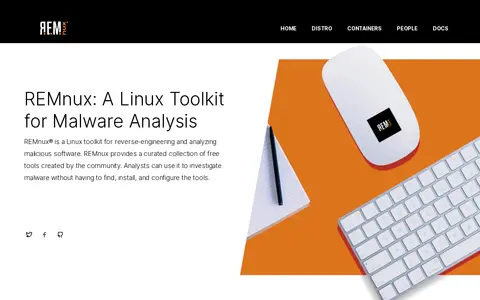
REMnux is a Linux toolkit for reverse-engineering and analyzing malicious software. It provides a curated collection of free community-created tools for hands-on malware investigation, distributed as a virtual machine, a from-scratch install on a dedicated host or compatible Ubuntu system, and Docker images of popular analysis tools.
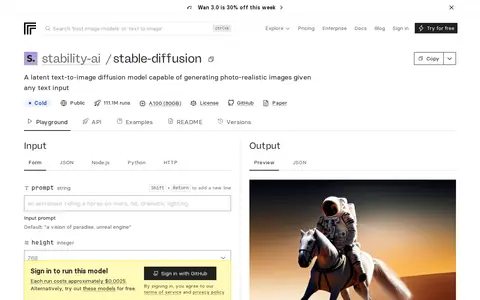
Stable Diffusion is a latent text-to-image diffusion model that generates photo-realistic images from text prompts, with support for versions 1.5 and 2.1. It is available to use via API on Replicate and can be run locally using Docker.
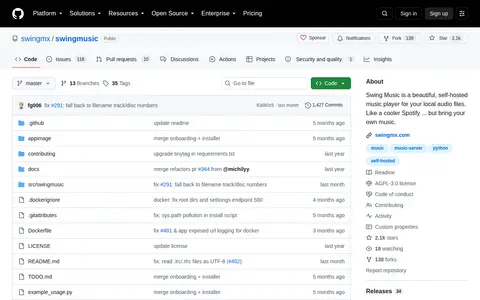
Swing Music is a self-hosted music streaming server for local audio files. It offers daily mixes, metadata normalization, album versioning, a folder view, collections, statistics, Last.fm scrobbling and multi-user support through a browser-based interface. A Docker image and an Android client are provided.
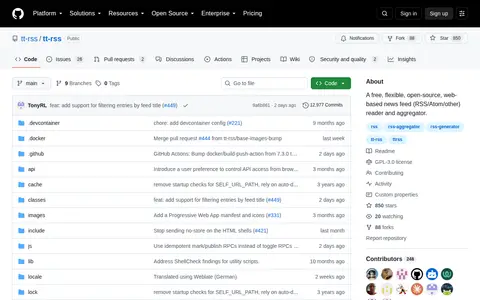
Tiny Tiny RSS is a free, open-source, web-based news feed reader and aggregator for RSS, Atom and other feeds. This repository is a fork of the original project, created in October 2025 after the original site was retired, and continues development with Docker images published for linux/amd64 and linux/arm64.
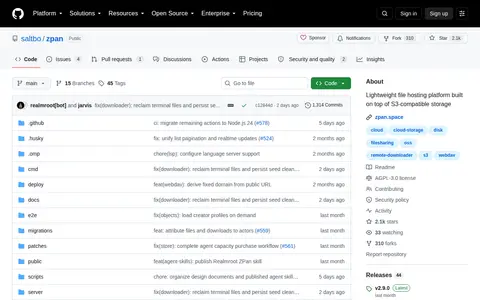
ZPan is a lightweight file hosting platform built on top of S3-compatible storage. Files upload directly from the client to S3 through presigned URLs, bypassing server bandwidth, while the server handles auth, metadata, shares, quotas, teams, WebDAV and admin operations. It can be deployed on Cloudflare Workers or Docker and provides a web UI, public sharing and image-hosting APIs.