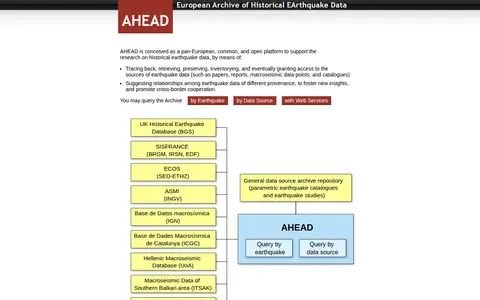
AHEAD is a pan-European, open platform for research on historical earthquake data. It traces, retrieves, preserves, inventories and grants access to earthquake data sources such as papers, reports, macroseismic data points and catalogues, and suggests relationships among data of different provenance. The archive can be queried by earthquake or by data source, and its services are integrated in the EPOS Data Portal.
Directory
Search results
Published directory entries matching your search.
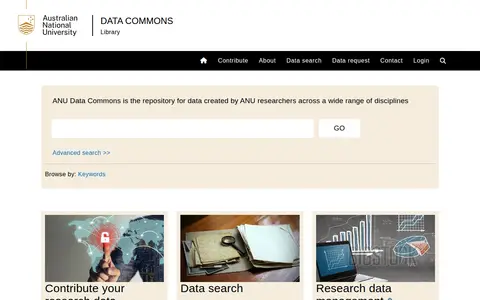
ANU Data Commons is a repository for data created by ANU researchers across a wide range of disciplines. It offers data search, research data management, recent submissions, and browsing by keywords, and invites researchers to contribute their research data.
The ARM Data Center obtains and archives data from the Atmospheric Radiation Measurement User Facility, collected through routine operations and scientific field experiments. Datastreams are generally available for download within 48 hours, and all data are monitored for quality and made available free of charge via Data Discovery. A free ARM user account profile is needed to access ARM data.
The Astromaterials Data System (Astromat) is a data infrastructure that curates, archives, and provides access to analytical data generated from astromaterials samples. It is NASA’s designated archive for laboratory analytical data acquired on samples from past, present, and future NASA missions curated by NASA’s Astromaterials Acquisition and Curation Office. The system supports end-to-end data curation and synthesis for advanced analysis and AI/ML use, and features machine- and human-actionable interfaces for the astromaterials research community.
The Canadian Astronomy Data Centre is a digital research facility for professional astronomers. It provides telescope data and advanced data products as an open data source for the international astronomy community, provided by the National Research Council of Canada. Documentation covers interactive archive access, web APIs, and data providers.
CCC Data Base is a database of convergent close-coupling cross-section data for atomic targets, created by Yuri Ralchenko and Igor Bray. It lists electron-impact data for several elements and ions, positron-impact data for several targets including H-like ions, and proton-impact data for helium. Molecular targets are directed to a separate site.
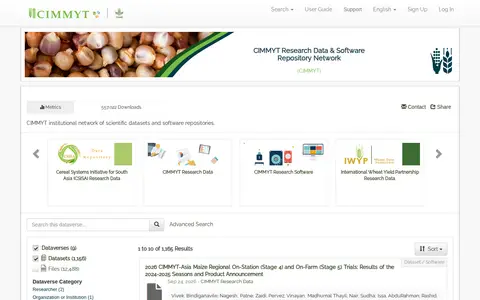
The CIMMYT Research Data & Software Repository Network is the institutional network of scientific datasets and software repositories operated by the International Maize and Wheat Improvement Center (CIMMYT). It hosts multiple data and software collections including research data from the Cereal Systems Initiative for South Asia, International Wheat Yield Partnership, Sustainable and Resilient Farming Systems Intensification in the Eastern Gangetic Plains, and Crops to End Hunger programs, as well as CIMMYT research data, research software, and Seeds of Discovery BNI-CropSustaiN research data and protocols. The network had recorded 557,560 downloads as of the snapshot.
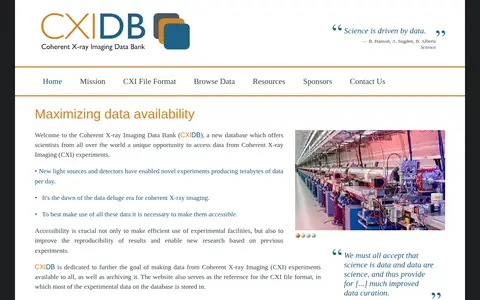
The Coherent X-ray Imaging Data Bank is a database offering access to data from Coherent X-ray Imaging experiments and archiving it. The site serves as the reference for the CXI file format, in which most experimental data on the database is stored. It also provides data deposit instructions and disk-based data downloads via Globus Online.
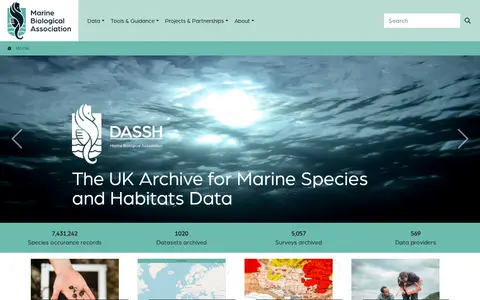
DASSH is a data archive that holds marine species occurrence records, archived datasets and archived surveys. It provides a data mapper for searching data, data access and tools, a citizen science hub, and a route for data providers to submit data.
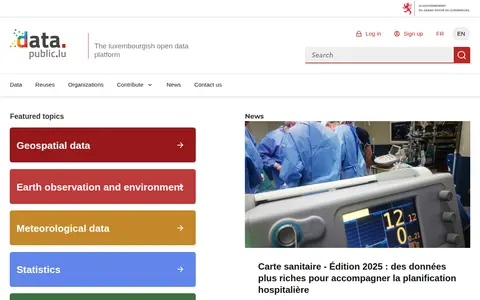
data.public.lu is the official open data portal of Luxembourg. It hosts public datasets, data reuses and related resources, with featured topic areas including geospatial data, earth observation and environment, meteorological data, statistics, mobility and companies.
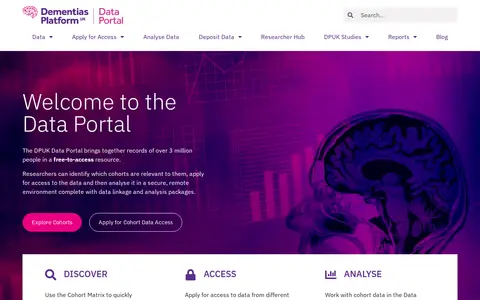
DPUK Data Portal provides secure, rapid access to a wide range of dementia-related datasets. It offers data discovery tools, imaging collections, genomics, stem cell, tissue data, and linkage resources. Users can apply for access, deposit data, and find information on data governance and policies.
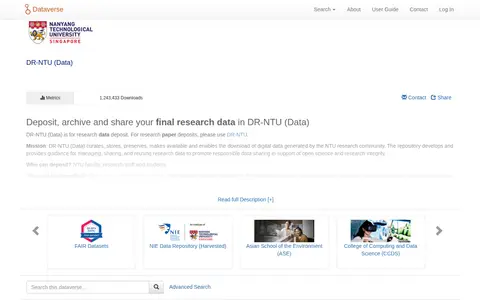
DR-NTU (Data) is an NTU repository for depositing, archiving and sharing final research data. It curates, stores and preserves digital data from the NTU research community and provides guidance on managing, sharing and reusing data. NTU faculty, research staff and students may deposit final, non-sensitive research data.
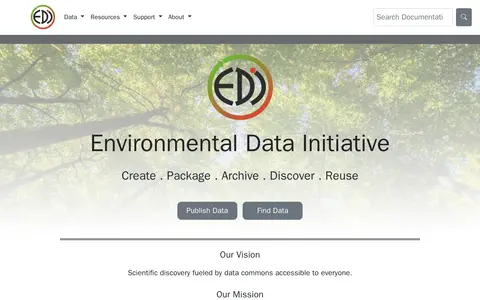
The Environmental Data Initiative preserves and provides open access to environmental and ecological data, with information-rich metadata and a secure, persistent archive. It supports publishing and reusing data through tools, a REST API for workflow automation, and personalized data catalogs. Authentication for API access becomes required on July 30, 2026.
The EDI Data Portal provides access to environmental and ecological data packages contributed by participating organizations. Each dataset includes metadata and a digital object identifier for citation. Users are asked to contact data providers before using data in published research and to cite data appropriately.
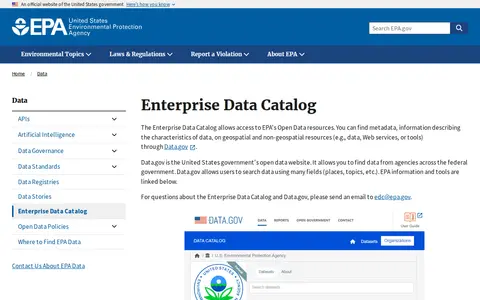
The Enterprise Data Catalog is the EPA's inventory of data assets and provides access to EPA Open Data resources. Users can find metadata on geospatial and non-geospatial resources through Data.gov, the US government's open data website, which allows searching data by fields such as places and topics.
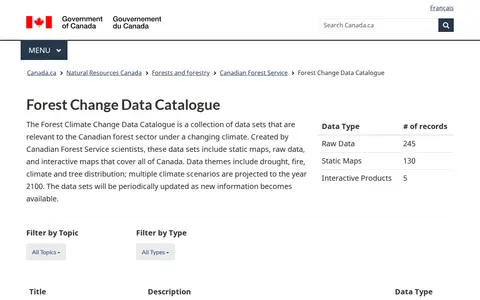
The Forest Climate Change Data Catalogue is a collection of data sets relevant to the Canadian forest sector under a changing climate. Created by Canadian Forest Service scientists, the data sets include static maps, raw data and interactive maps covering all of Canada. Themes include drought, fire, climate and tree distribution, with multiple climate scenarios projected to the year 2100. Data sets are periodically updated as new information becomes available.
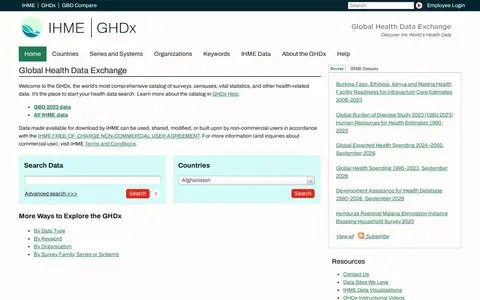
The Global Health Data Exchange (GHDx) is a catalog of global health and demographic data. It records information about data topics, links to data providers, and offers direct downloads where permission exists. The catalog covers surveys, censuses, vital statistics, registries, indicators, estimates, administrative health data, and health-related financial data. IHME-published data downloads may be used by non-commercial users under a free non-commercial user agreement.
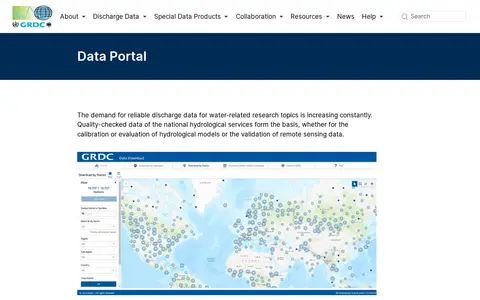
The GRDC Data Portal is a web-based tool for searching and visualising runoff stations and time series data in map and table view. Users select stations, regions, subregions or countries and download data in six formats, with optional subregion or watershed boundaries. Hydrological data are released only for research purposes; commercial use and redistribution are not allowed.
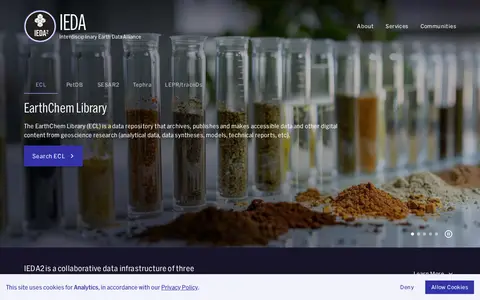
IEDA2 is a collaborative data infrastructure of three complementary data systems: EarthChem, LEPR/traceDs and SESAR. It supports geoscience researchers in sharing and accessing sample data following FAIR data principles, and its mission is open, reproducible and transparent science practices. Components include the EarthChem Library data repository and PetDB geochemical data access.
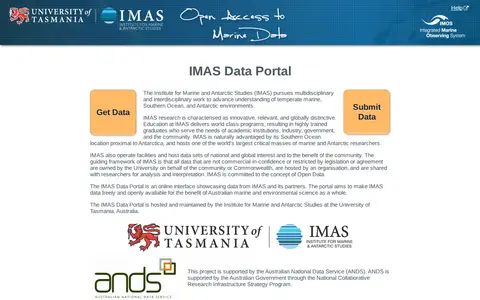
The IMAS Data Portal is an online interface showcasing data from the Institute for Marine and Antarctic Studies and its partners. It provides open access to marine data and lets users get data or submit data. The portal is hosted and maintained by IMAS at the University of Tasmania, Australia.
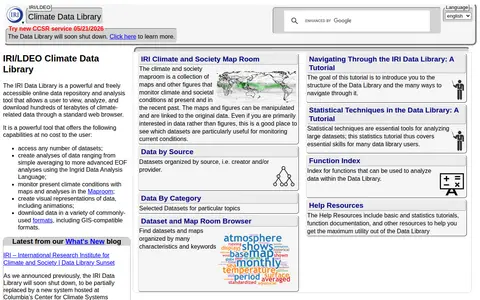
The IRI Data Library is a freely accessible online repository and analysis tool for climate-related data. It allows users to view, analyze and download hundreds of terabytes of data through a web browser, access datasets, create analyses with the Ingrid Data Analysis Language, monitor climate conditions in the Maproom, and download data in GIS-compatible formats.
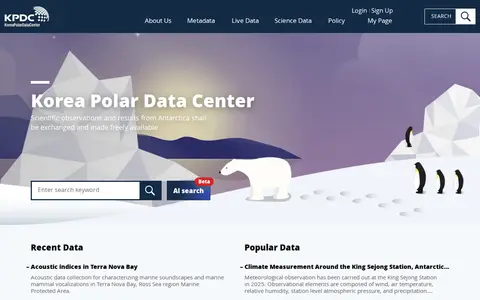
The Korea Polar Data Center (KPDC) manages diverse data obtained from Korean polar scientific research in the Arctic and Antarctic. Its site provides metadata keyword search, data collection browsing by type, and advanced search. It also lists science data resources and live data such as the IBRV ARAON route and weather.
MatDB is a database hosted within the European Commission Joint Research Centre's ODIN Portal, which operates as the EU's science and knowledge service to support European policies with independent evidence across the full policy cycle. The platform offers open access data catalogs, data summaries, citable datasets and catalogs, and DOI listings for frequently viewed, recently published, and recently uploaded data. The open access module only provides access to a limited subset of ODIN's hosted data, with full feature and data access requiring user registration and login. Downloading data from MatDB requires agreement to the licenses accompanying individual datasets and the ODIN terms and conditions.
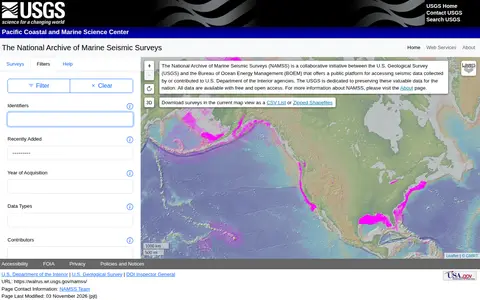
The National Archive of Marine Seismic Surveys is a USGS data website presenting marine seismic reflection data within the United States. Visitors can click the map to select nearby surveys, mouse over survey names to highlight surveys, filter surveys by keyword and open individual survey pages for data and information.