
The Rutgers/New Jersey Geological and Water Survey Core Repository is an official International Ocean Discovery Program repository, hosting Legs 150X and 174AX onshore cores from the NJ/Mid-Atlantic Transect as well as NJGWS materials. It also holds Newark Basin, Passaic Tunnel Project and Chesapeake Bay Impact Structure cores, and hosts educational tours. Samples are available to scientific investigators following IODP core policy.
Directory
Search results
Published directory entries matching your search.
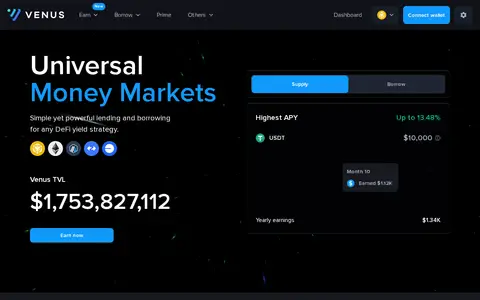
Venus Core Pool is a DeFi protocol for on-chain finance, liquidity, yield, trading, or asset management.
A curated list of pretrained CoreML models.
BOSCORF is described as the UK's largest deep-sea sediment repository and research facility, part of the National Oceanography Centre. It stores and curates sediment cores from UKRI-NERC research programmes, promotes secondary use of core samples and related data, and acquires physical and chemical data from geological cores via non-destructive analysis and imaging systems. It also offers training in core analysis and logging.
Cambridge Core is the books and journals platform from Cambridge University Press, replacing Cambridge Journals Online and Cambridge Books Online. It hosts the publisher's academic content. Its accessibility information states that users can change colours, contrast levels and fonts through browser settings, and can zoom in up to 400% without text spilling off the screen for most of the website. Cambridge University Press describes a transparent pricing policy for journals, under which subscription prices reflect the amount of subscription content, with subscription read costs reduced as open access content increases.
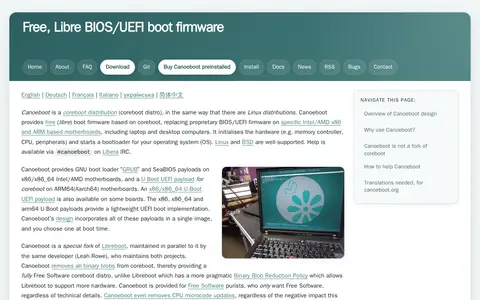
Canoeboot is a free/libre coreboot distribution providing BIOS/UEFI boot firmware for specific Intel/AMD x86 and ARM motherboards. It initialises hardware and starts a bootloader, offering GRUB, SeaBIOS and U-Boot payloads in a single image with a choice at boot time. Linux and BSD are supported. It removes binary blobs from coreboot, including CPU microcode updates.
Colibri Core is an NLP tool and a C++ and Python library for working with basic linguistic constructions such as n-grams and skipgrams, i.e. patterns with one or more gaps of fixed or dynamic size. It counts and extracts patterns from large corpus data. The central tool, colibri-patternmodeller, builds, views, manipulates and queries pattern models.
A Telegram group chat titled Core Patch Chat, described as a module for LSPosed. The listing links to a related channel and the project's GitHub repository. It shows member and online counts and offers joining via Telegram.

Official source repository for the Tor network daemon and core protocol implementation.
The Core torch7 demos repository is an open-source GitHub project that provides demos and tutorials for the Torch7 machine learning framework. It includes installation guides, Torch7 tutorials, and tutorials for third-party Torch7 packages.
Stanford CoreNLP is a set of natural language analysis tools that take raw text and produce base word forms, parts of speech, named entities, normalized dates and numeric quantities, sentence structure and sentiment. It is an integrated Java framework licensed under the GNU General Public License v3 or later, with a 260 MB download requiring Java 1.8+.
Core Patch N is presented as the successor to the original Core Patch module, an Xposed module that modifies Android's package manager service behavior. It can bypass app downgrade restrictions, APK signature checks and other installation restrictions. It requires Android 9 and above and an Xposed framework supporting libxposed API 101, and is licensed under GPL v2.0.
Core Temp is a program that monitors processor temperature and other vital information. It displays the temperature of each individual core of every processor in a system, showing fluctuations in real time with varying workloads. It is motherboard agnostic and works with Intel, AMD and VIA x86 processors, running on Microsoft Windows versions from XP through 11 and corresponding server editions.
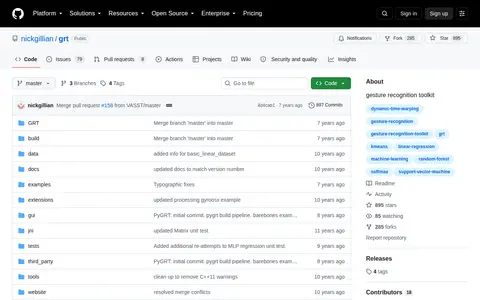
GRT (Gesture Recognition Toolkit) is an open-source project hosted on GitHub. It provides core algorithms, extensions, and related utilities for gesture recognition, with documented architecture and core resources available in the repository.
LearnOpenGL is an online book and tutorial resource for learning modern core-profile OpenGL. It covers basics through advanced topics with clear examples and aims to be understandable for people without graphics programming experience while remaining useful to experienced readers. Chapters discuss core graphics concepts, lighting, model loading and post-processing, and a walkthrough series builds a small game.
Quick CPU is a tool for performance tuning, system monitoring and stability testing on Intel and AMD processors. It monitors temperatures, voltages, frequencies, core usage and power settings, and runs CPU stress tests. Its features include CPU core parking, turbo boost and boost policies, performance hint and power modes, and advanced CPU settings for Intel.
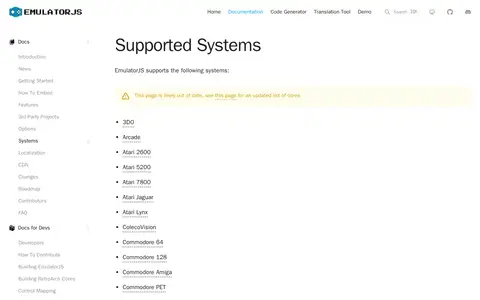
A documentation page for EmulatorJS, a tool to embed an emulator into a website. The page lists supported systems and shows code examples for cores including 3DO and Arcade. It notes that the list is likely out of date and points to an updated list of cores.
Stanford University is a leading global research and teaching institution. Its core mission centers on discovery and learning, fostering intellectual expansiveness, openness to new lines of thinking, and pursuit of excellence across disciplines. The university conducts cross-disciplinary research to address societal challenges, including work on human-centered artificial intelligence, and supports innovation pathways for new applications while shaping related public policies.
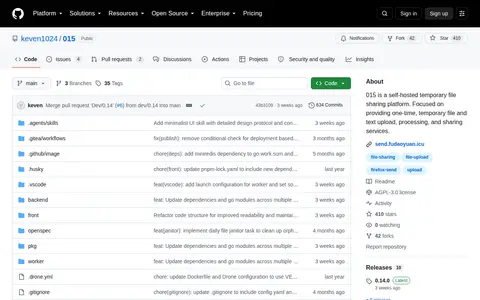
015 is a self-hosted temporary file sharing platform focused on providing one-time, temporary file and text upload, processing, and sharing services, maintained as an open source project on GitHub under the keven1024/015 repository. The project includes core functionality, file processing, and advanced features, with repository options for community contribution.
) - a telegram/wechat-like nostr client for iOS and Android
12-Factor Agents is a GitHub repository that outlines principles for building large language model (LLM) powered software that is reliable enough for production customer use. It documents a set of 12 core factors for developing such applications, and contributions to the project are accepted from the public.
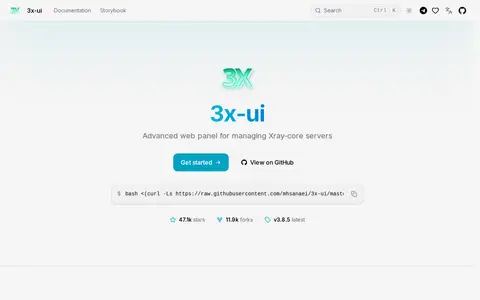
3x-ui is an open-source web panel for deploying and managing Xray-core servers, proxies, clients and subscriptions. It provides a dashboard for inbounds, protocols, clients, traffic accounting and subscriptions without hand-editing Xray JSON. It supports protocols including VLESS, VMess, Trojan, Shadowsocks, WireGuard and Hysteria2, and offers multi-node management and Telegram and Discord bots.
Agent2Agent (A2A) Protocol is an open standard that enables secure communication, collaboration, and joint problem-solving between different AI agents. The linked page hosts the official specification documentation for the protocol, covering core operations and enterprise features.
A newsletter post by Jon Stokes introducing the concepts behind AgentGPT, BabyAGI, LangChain and LLM-powered agents. It covers core agent concepts, how LLMs make plans, chain of thought reasoning, action planning, and example prompt-response pairs.