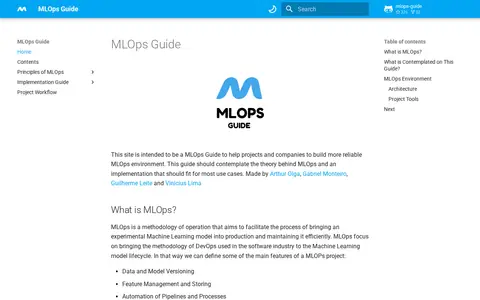

A guide explaining MLOps concepts and how to build an MLOps environment. It covers theory and a tutorial using tools such as DVC, CML, IBM Watson Machine Learning, IBM Watson OpenScale, Terraform and Cookiecutter. The guide is described as modular, allowing tools to be swapped according to project preferences and use cases.
Directory
Search results
Published directory entries matching your search.
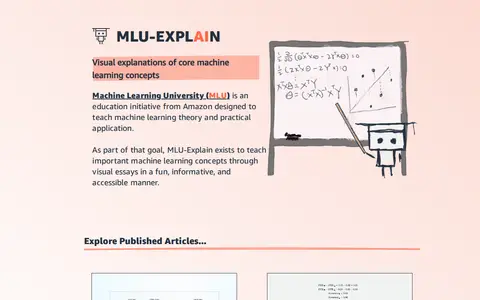
MLU-Explain is an education initiative from Amazon that teaches machine learning concepts through visual essays. It publishes interactive articles on topics such as neural networks, logistic regression, reinforcement learning, ROC and AUC, cross-validation, random forests, and decision trees.
Modern JS Cheatsheet is a document covering JavaScript concepts frequently encountered in modern projects and contemporary sample code. It is not intended to teach JavaScript from the ground up, but to help developers with basic knowledge get familiar with modern codebases.
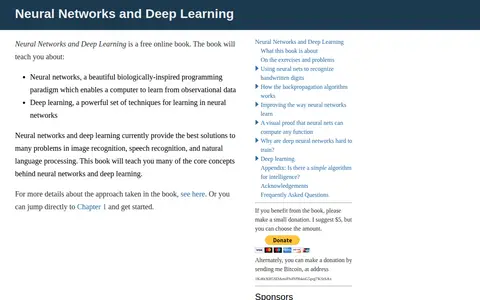
Neural Networks and Deep Learning is a free online book by Michael Nielsen. It teaches core concepts of neural networks and deep learning, covering handwriting recognition, backpropagation, and improving how neural networks learn. The work is licensed for copying and sharing but not for selling.
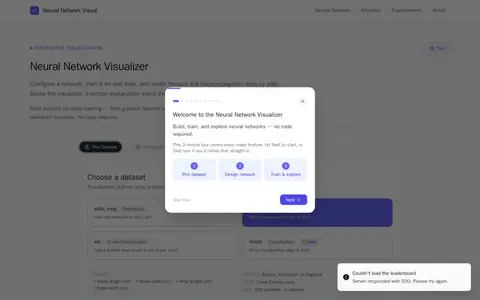
NN Visual is an interactive web-based neural network visualizer. It lets users configure hidden layers, select datasets such as auto_mpg, iris, xor, or mnist, and train a network while observing forward and backpropagation step by step. The tool displays training loss, mean absolute error, weight distributions, and node activation brightness. Written explanations accompany the visualizations to teach concepts like gradient descent, weights, biases, and activation functions without requiring code.
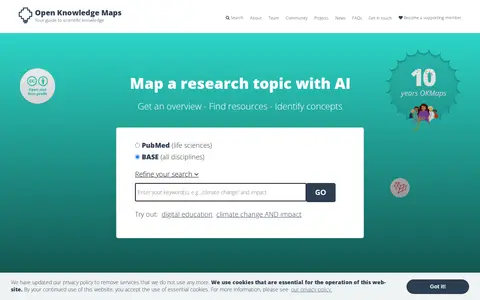
Open Knowledge Maps is a nonprofit, open science AI-based search engine for scientific knowledge. It provides visual overviews of research topics, helps users find relevant research outputs and identify key concepts. The platform searches over 400 million outputs from more than 11,000 sources, with results based solely on underlying metadata to avoid hallucinations.
Lithuanian OSINT article introducing open-source intelligence concepts, tools, and methods.
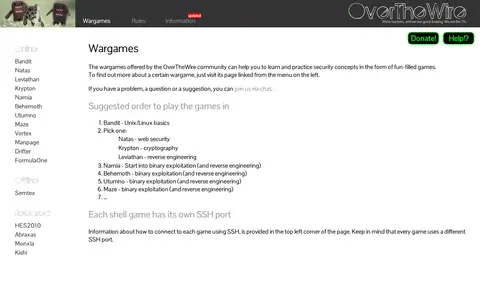
OverTheWire is a community offering wargames intended to help people learn and practice security concepts through games. Its suggested order begins with Bandit for Unix/Linux basics, followed by a choice among Natas for web security, Krypton for cryptography or Leviathan for reverse engineering, then binary exploitation games. Each shell game uses its own SSH port.
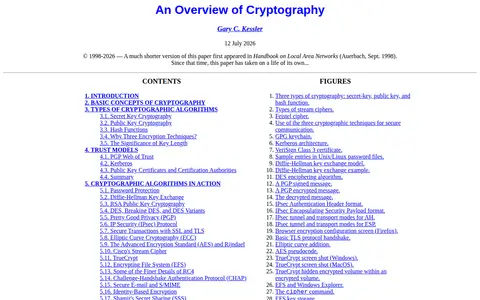
A free, evolving tutorial on cryptography maintained since 1999. It covers basic cryptographic concepts, types of algorithms including secret key, public key and hash functions, trust models, and applied algorithms in action.
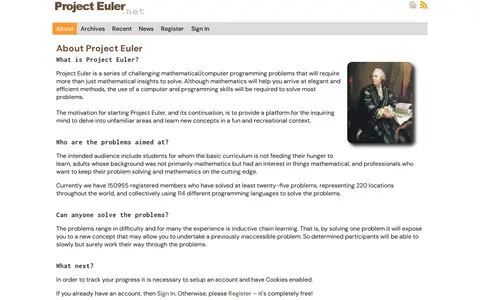
Project Euler is a series of challenging mathematical and computer programming problems. Most problems require computer and programming skills in addition to mathematical insight. The site aims to offer a platform for learning new concepts in a recreational context, and accounts can be used to track progress.
A hands-on, project-based introduction to programming with Python by Eric Matthes, published in its third edition in December 2022. The book covers basic concepts such as variables, lists, classes, and loops, and guides readers through projects including a Space Invaders-inspired arcade game, data visualizations, and a simple web application.
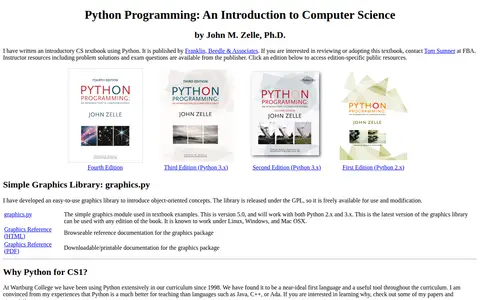
Teaching page by John M. Zelle, Ph.D., for an introductory computer science textbook written in Python and published by Franklin, Beedle & Associates. It links edition-specific public resources for four editions and offers graphics.py, a simple graphics library released under the GPL for introducing object-oriented concepts. Instructor resources including problem solutions and exam questions are available from the publisher.
RODBUK is the Cracow Open Research Data Repository for depositing and exploring open research data. Its site offers material on open research data concepts, data formats, FAIR principles, licenses, metadata, file naming and folder structure, version control and README files, and states data is accessible 24/7 from anywhere in the world.
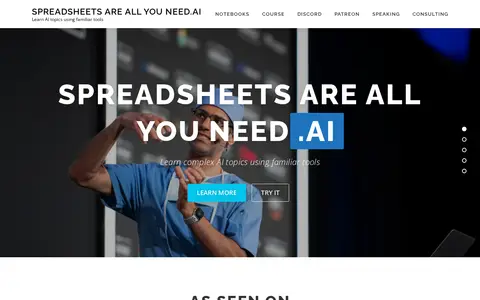
SAAYN (Spreadsheets are all you need.ai) is a platform that teaches artificial intelligence topics using familiar spreadsheet tools. It launched with a project implementing the GPT-2 model in Excel to demonstrate that AI concepts can be understood with accessible tools, and its core mission is to make complex AI topics easy to understand without oversimplifying them.
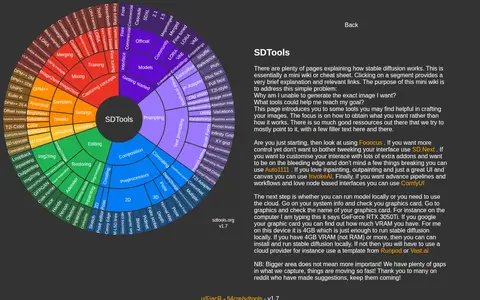
SDTools is a mini wiki and cheat sheet for Stable Diffusion users. It addresses common challenges in generating desired AI images, provides brief explanations of relevant concepts, and points to helpful tools and resources. It recommends Fooocus for users new to Stable Diffusion and SD.Next for those seeking more control without manual interface adjustments.
Semantic UI is a development framework for creating responsive layouts using human-friendly HTML. It treats words and classes as exchangeable concepts, using syntax from natural languages. It uses simple phrases called behaviors to trigger component functionality, and includes an intuitive inheritance system with high level theming variables. The project is described as free and open source.
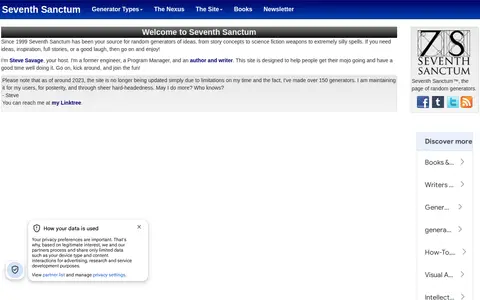
Seventh Sanctum is a site of random generators producing concepts, characters and descriptions for stories, role-playing games and art. The site states that since around 2023 it is no longer being updated, and its author maintains it for users and posterity.
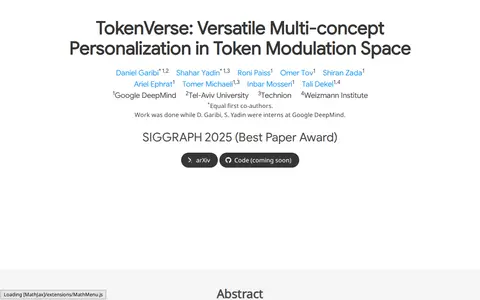
TokenVerse is a method for multi-concept personalization that uses a pre-trained text-to-image diffusion model. It can disentangle complex visual elements and attributes from a single image and combine concepts extracted from multiple images, supporting objects, accessories, materials, pose and lighting. It uses a DiT-based text-to-image model and learns modulation-space directions for each word.
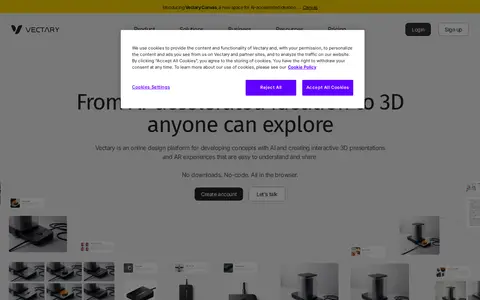
Vectary is an online, browser-based design platform for developing concepts with AI and creating interactive 3D presentations and AR experiences that can be shared through a single link. Vectary Studio offers modeling, import, real-time rendering, materials, animations, interactions and configurators, with embedding and app-free augmented reality. Vectary Canvas, in beta, is a collaborative AI-driven space for research, ideation and concept validation across 2D, 3D and AR.
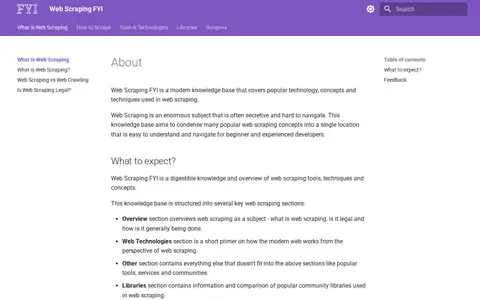
Web Scraping FYI is a knowledge base covering popular technology, concepts and techniques used in web scraping. Its sections address web scraping as a subject, a primer on how the modern web works, other tools and communities, and popular community libraries. Pages are designed to be self-sufficient and indexable.
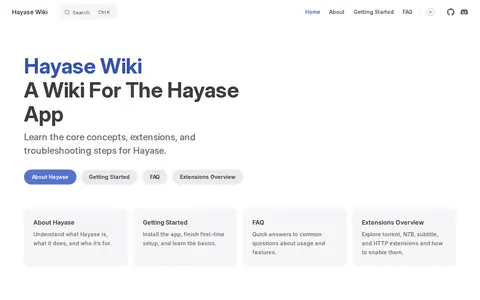
Hayase Wiki is a reference resource for the Hayase torrent streaming client. It covers core concepts, setup steps, frequently asked questions and extensions for torrent, NZB, subtitle and HTTP content.
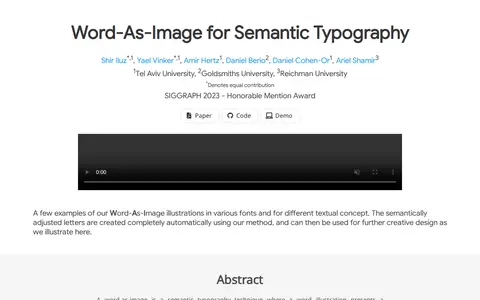
Word-As-Image for Semantic Typography is a research method that automatically creates word-as-image illustrations, visualizing a word's meaning while preserving readability. It optimizes letter outlines guided by a pretrained Stable Diffusion model and handles a large variety of semantic concepts and any font.
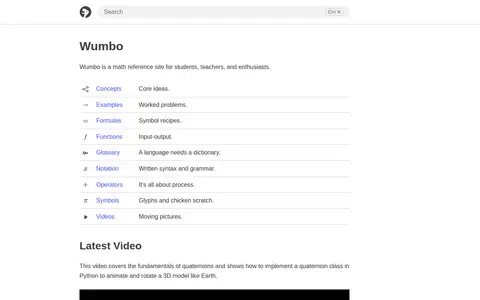
Wumbo is a math reference site for students, teachers, and enthusiasts. It organizes core concepts, worked examples, formulas, functions, a glossary, notation, operators, symbols, and videos, including a video on quaternions implemented in Python. It offers a contributing membership that funds future videos and resources.