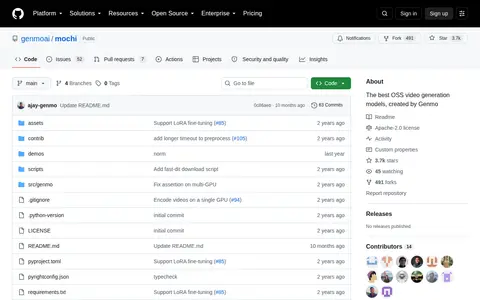

Mochi is an open-source video generation model by Genmo, released under an Apache 2.0 license. The repository provides installation, weight downloads, a Gradio UI, CLI, and API, plus LoRA fine-tuning support and an inference harness.
Directory
Search results
Published directory entries matching your search.
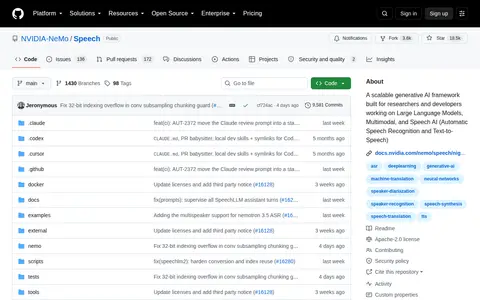
NVIDIA NeMo Speech is a framework built for researchers and developers working on speech AI, including automatic speech recognition and text-to-speech. The repository provides open weight checkpoints and demos through a Hugging Face collection. It is licensed under Apache-2.0 and has pivoted to focus on audio, speech, and multimodal LLMs.
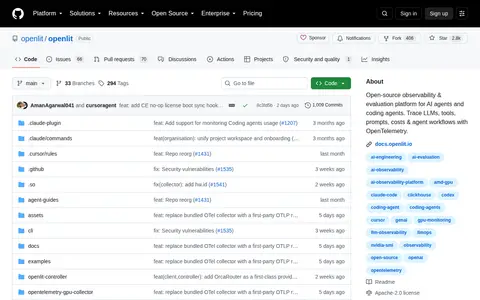
OpenLIT is an open-source agent harness engineering platform built on OpenTelemetry. It provides tracing, evaluations, guardrails, prompt and context management, and cost and GPU monitoring for the harness around AI agents and coding agents. It is free to self-host under Apache 2.0 and is described as working with many models, frameworks and harnesses.
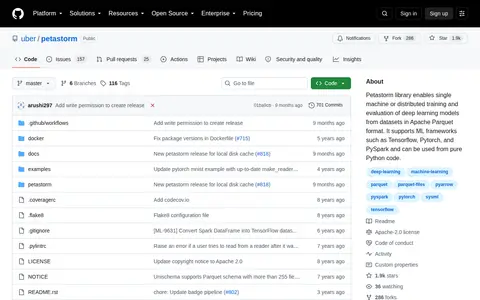
Petastorm is a library developed by Uber for deep learning model training and evaluation. It supports single-machine and distributed workflows with datasets in Apache Parquet format, is compatible with TensorFlow, PyTorch, and PySpark, and can be used via pure Python code.
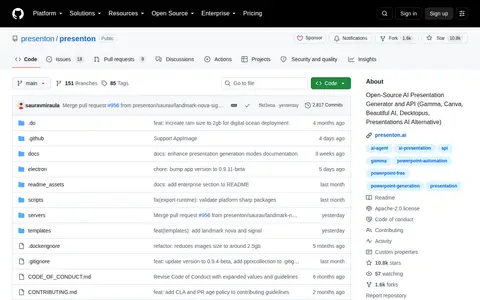
Presenton is an open-source AI presentation generator and API, licensed under Apache 2.0. It creates presentations from a prompt, an uploaded document, or a PowerPoint design, works with providers such as OpenAI, Gemini, and Ollama, and exports fully editable PPTX or PDF files. It runs fully self-hosted in web through Docker or as a desktop app for macOS, Windows, and Linux.
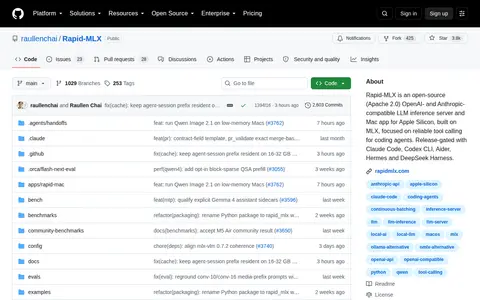
Rapid-MLX is an open-source, Apache 2.0 licensed large language model inference server and Mac application for Apple Silicon devices. It is compatible with OpenAI and Anthropic APIs, built on the MLX framework, and focused on reliable tool calling for coding agents.
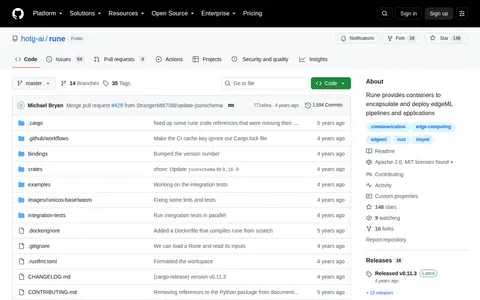
Rune is a project that provides containers to encapsulate and deploy EdgeML pipelines and applications. It is associated with the repository hotg-ai/rune and is licensed under Apache 2.0 or MIT at the user's option.
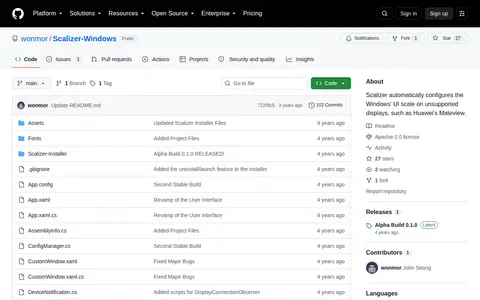
Scalizer is a Windows application that automatically configures the Windows UI scale on unsupported displays, such as Huawei's MateView, and replaces the default Windows DPI scaling software. It is written in C# and .NET with a WPF interface, distributed as open source under the Apache 2.0 License. The source notes that a custom scaling factor must be enabled in Windows Display settings before running the app.
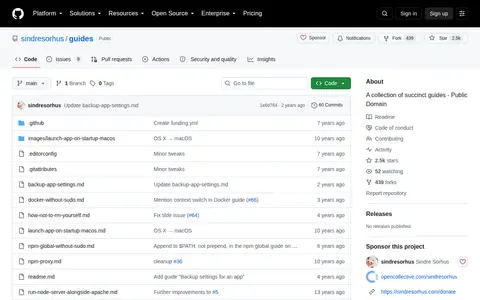
Guides is a GitHub repository holding a collection of succinct guides. Topics include setting environment variables, avoiding accidental file deletion, installing npm packages globally without sudo on macOS and Linux, running a Node.js server alongside Apache on Linux, launching an app at startup on macOS, using npm through a corporate proxy, running Docker commands without sudo on Linux, and backing up app settings on macOS. The work is published under a public domain dedication.
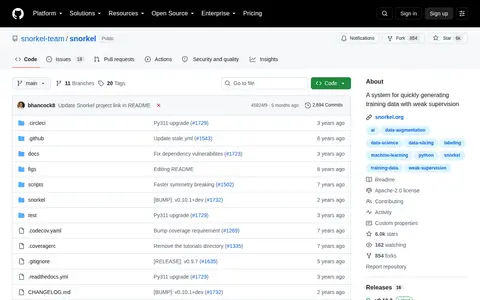
Snorkel is a system for quickly generating training data with weak supervision, released under an Apache-2.0 license and written in Python. The project started at Stanford in 2015 to programmatically label, build, and manage training data. The team now focuses on Snorkel Flow, an end-to-end AI application development platform based on the core ideas behind Snorkel.
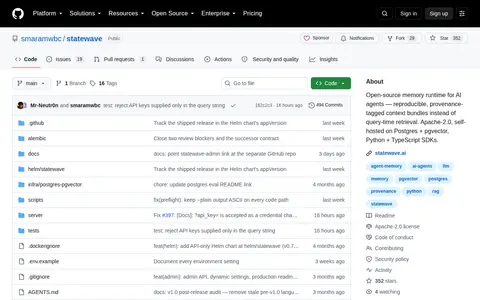
Statewave is an open-source memory runtime for AI agents. It uses reproducible, provenance-tagged context bundles in place of query-time retrieval, is licensed under Apache-2.0, self-hosted on Postgres with pgvector, and offers Python and TypeScript SDKs. The project is hosted on GitHub under the smaramwbc organization.
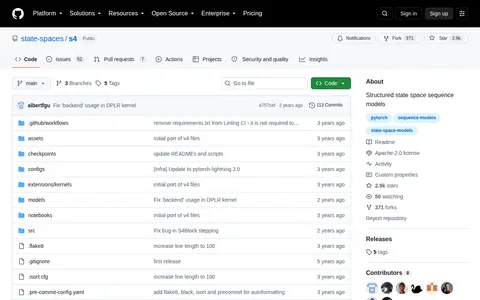
Structured State Spaces for Sequence Modeling is a GitHub repository providing official implementations and experiments for models related to S4, including HiPPO, LSSL, SaShiMi, DSS, S4D and S4ND. It states requirements of Python 3.9+ and Pytorch 1.10+, and is released under an Apache-2.0 license.
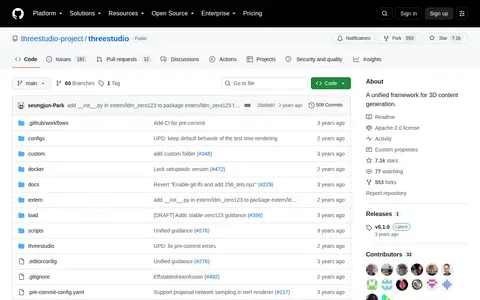
threestudio is a framework for 3D content generation, described by its repository as a unified framework. The project includes configuration files, documentation, scripts and a Gradio application. It is released under the Apache-2.0 license.
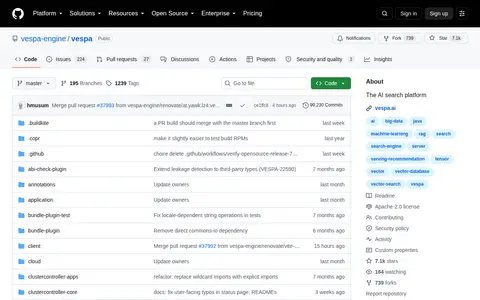
Vespa is an AI search platform. Its repository contains the code required to build and run Vespa. The project covers searching, making inferences in and organizing vectors, tensors, text and structured data at serving time and any scale. It is licensed under Apache 2.0.