
github.com
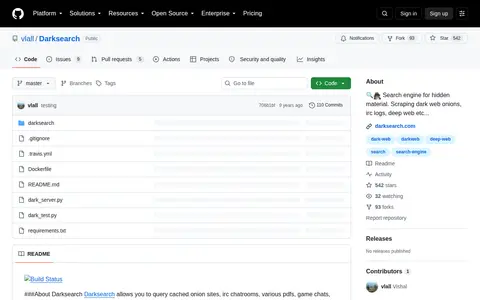
Open-source interface and API project for searching indexed onion content.
Directory
Published directory entries matching your search.
Open-source interface and API project for searching indexed onion content.

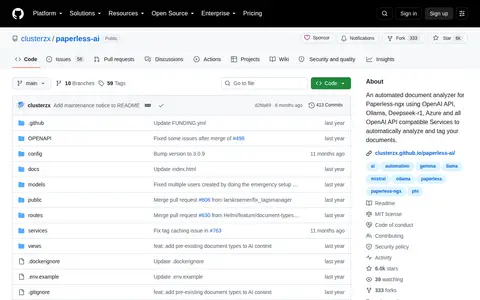
Paperless-AI is an automated document analyzer for Paperless-ngx that analyzes and tags documents using OpenAI API, Ollama, Deepseek-r1, Azure and other OpenAI API compatible services. The repository states it is currently not maintained, and notes uncertainty about continuing maintenance.

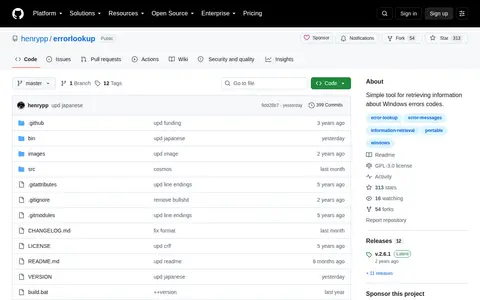
Error Lookup is a portable open source tool that translates Windows error codes into more meaningful text descriptions. Users type a code into a box and the details appear in another. It supports regular Windows API errors, Native API errors, DirectX, Windows Internet errors and STOP codes, and modules can be configured in settings. It is compatible with Windows 7 and higher.

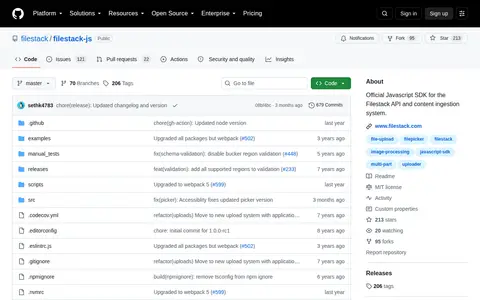
filestack-js is the official JavaScript SDK for the Filestack API and content ingestion system. It is hosted as an open-source repository on GitHub, with documentation covering installation, API reference, usage instructions, and supported browser compatibility.

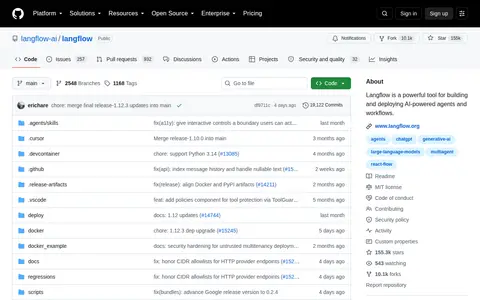
Langflow is a platform for building and deploying AI-powered agents and workflows, with a visual authoring interface and built-in API and MCP servers. It supports major LLMs, vector databases and AI tools, and allows deployment as an API, JSON export or MCP server.

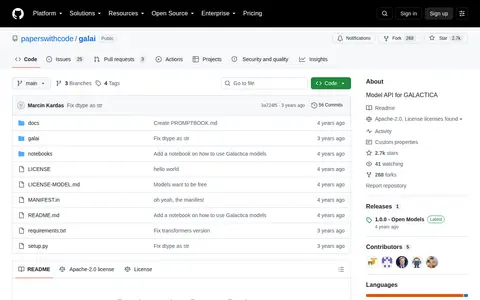
GALACTICA is a general-purpose scientific language model trained on scientific text and data. This repository provides a Model API for GALACTICA, installable from pip or the repository, with five model sizes. The models can be used with the transformers library. It is a stand-alone model that is not instruction tuned, so correct prompts are needed for good results.

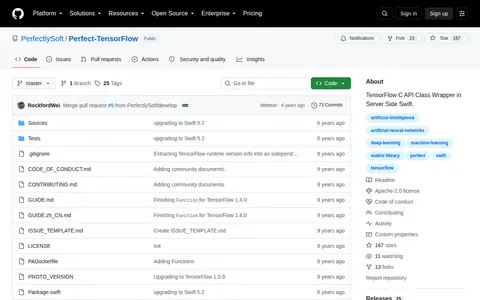
Perfect TensorFlow is an experimental wrapper of the TensorFlow C API that enables machine learning in server-side Swift. It builds with Swift Package Manager and can be used as part of the Perfect project or as an independent module. The framework conforms to TensorFlow v1.8.0 C API functionality.

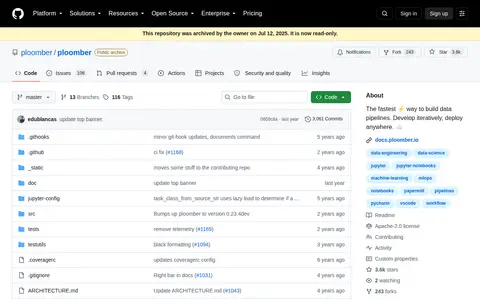
Ploomber is a tool for building data pipelines. It offers a YAML API and a Python API, and its features include caching previous pipeline results and running on Kubernetes, Airflow, AWS Batch or SLURM. It can convert monolithic notebooks into modular pipelines. The repository was archived on Jul 12, 2025 and is read-only.
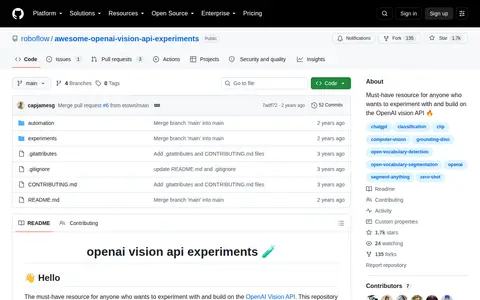
Examples showing how to use the OpenAI vision API to run inference on images, video files and webcam streams.

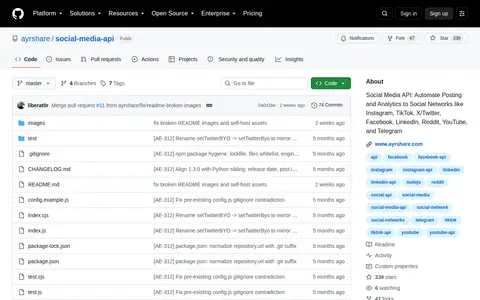
Social Media API: Automate Posting and Analytics to Social Networks like Instagram, TikTok, X/Twitter, Facebook, LinkedIn, Reddit, YouTube, and Telegram

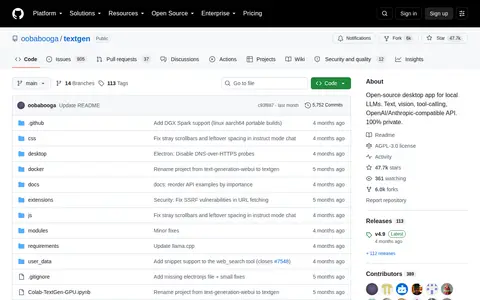
TextGen is an open-source desktop app for local LLMs, with text, vision, tool-calling and web search, plus a UI and API. It supports multiple backends including llama.cpp, Transformers, ExLlamaV3 and TensorRT-LLM, and an OpenAI/Anthropic-compatible API. It also offers LoRA training and image generation. Portable builds are provided for Linux, Windows and macOS.

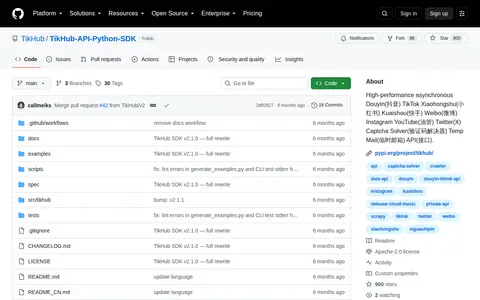
High-performance asynchronous Douyin(抖音) TikTok Xiaohongshu(小红书) Kuaishou(快手) Weibo(微博) Instagram YouTube(油管) Twitter(X) Captcha Solver(验证码解决器) Temp Mail(临时邮箱) API(接口).

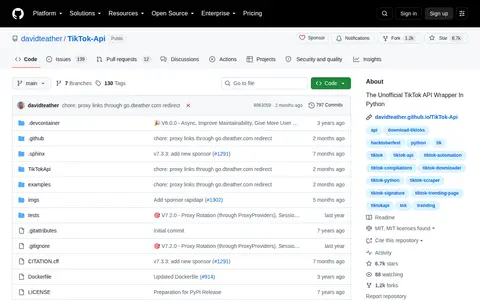
The Unofficial TikTok API Wrapper In Python

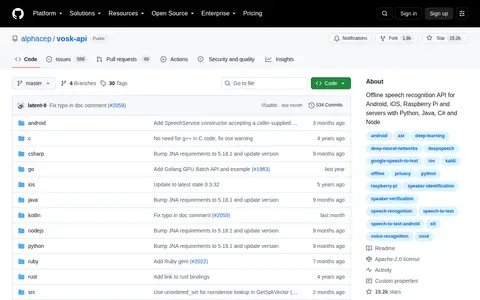
Vosk is an offline speech recognition API hosted in the alphacep/vosk-api GitHub repository. It is compatible with Android, iOS, Raspberry Pi, and server environments, and provides SDKs for Python, Java, C#, and Node.

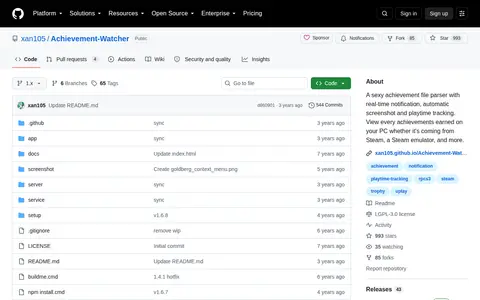
Achievement-Watcher tracks PC game achievements and playtime, with notifications and optional screenshots. The repository is archived; Steam data access requires a Steam Web API key.

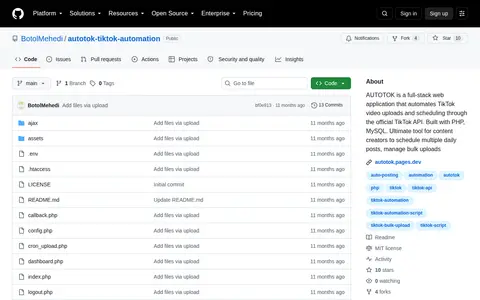
PHP and MySQL web application for scheduling TikTok video uploads through the TikTok API. The repository includes the source code and configuration notes.

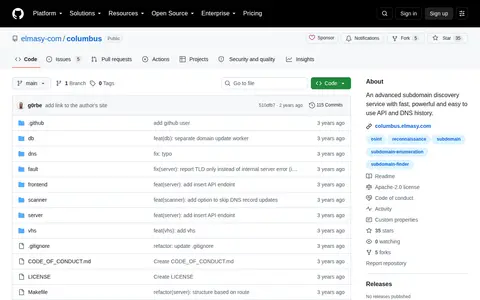
Columbus Project is an advanced subdomain discovery service with fast, powerful and easy to use API.

Reliable agent framework built on top of the latest OpenAI Assistants API.

Agent Reach is a command-line tool hosted in a GitHub repository that enables AI agents to read and search content from internet platforms including Twitter, Reddit, YouTube, GitHub, Bilibili and XiaoHongShu without requiring API fees.

AgentField is an open source tool designed to build, run, and scale AI agents structured similarly to APIs and microservices. It supports building production agents using prompts, and its code is hosted in a public GitHub repository.

AI Context Linter is a GitHub Action that checks AI coding context files such as CLAUDE.md, .cursorrules and AGENTS.md for security issues, structural problems and AI anti-patterns. It auto-detects context files and runs 12 rules, including detection of hardcoded API keys and leaked home directory paths. Rules cover structure, vague or conflicting instructions and file-type specifics, with configurable token limits and disabled rules.

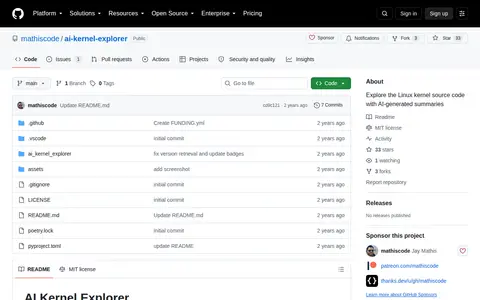
AI Kernel Explorer is a lightweight tool that uses GPT-4o to generate summaries of Linux kernel source code while the codebase is explored. It addresses the difficulty of understanding a codebase of over 30 million lines. It is installed via pip or pipx and requires an OpenAI API key; options include a cache path and a model selection.

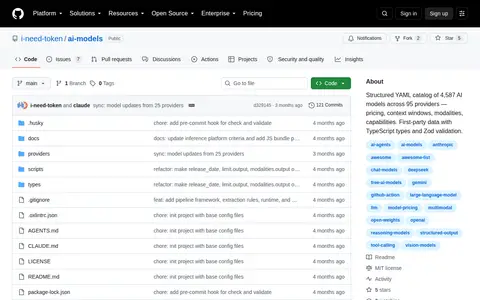
AI Models Catalog is a structured YAML catalog of AI model providers and their models, sourced from first-party APIs and official documentation. It includes TypeScript type definitions and Zod runtime validation schemas, plus scripts to sync data from providers and validate YAML files against schemas.

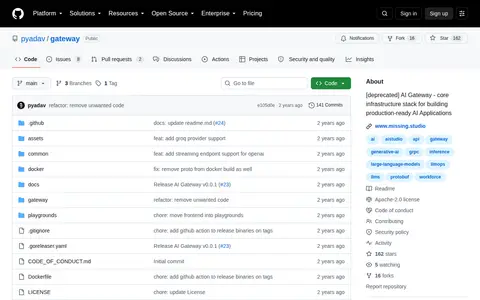
A deprecated GitHub repository described as an AI Gateway, a core infrastructure stack for building production-ready AI applications. It provides a universal API for inferencing over 100 LLMs and lists supported providers and endpoints such as OpenAI and Groq.