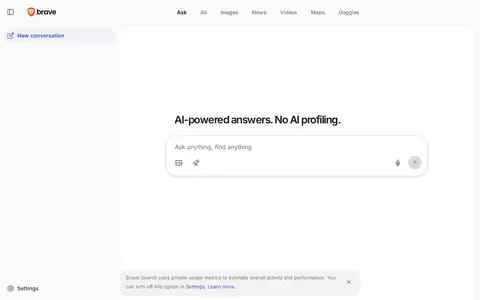

Ask Brave is a private AI-powered web search tool that is part of Brave Search. It uses an independent index to provide search results and AI-powered answers, and states that it does not profile users, has no bias, and is not affiliated with Big Tech. The tool supports searches for web content, images, news, videos, and maps.
Directory
Search results
Published directory entries matching your search.
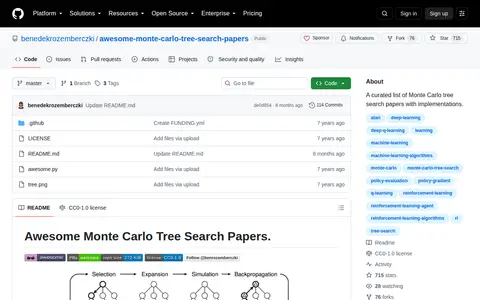
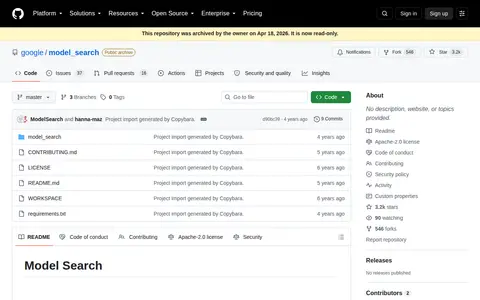
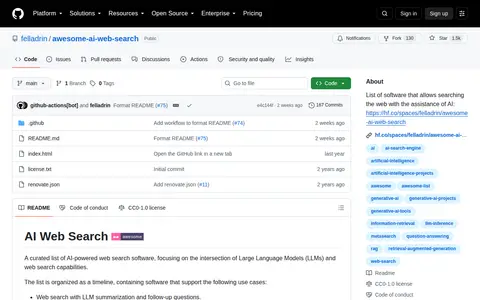
Awesome AI Web Search is a GitHub repository or organization with source code, releases, documentation, or project resources.
A curated list of Monte Carlo tree search papers with implementations, organized by conference and journal sources including NeurIPS, ICML, CVPR, ACL, AAAI, and others. The repository also links to similar collections covering graph classification, gradient boosting, and fraud detection papers.

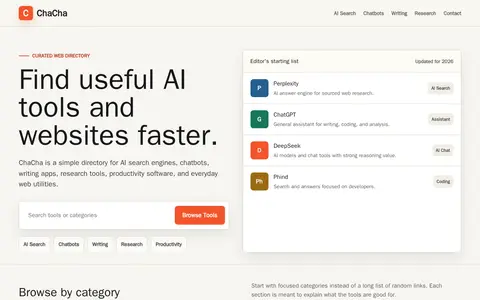
ChaCha is a curated web directory focused on AI tools, search engines, productivity apps, research tools, and everyday useful websites. It organizes resources into functional categories, with short practical notes for each featured tool to help visitors evaluate options. The directory also accepts public suggestions for additional tools to include.
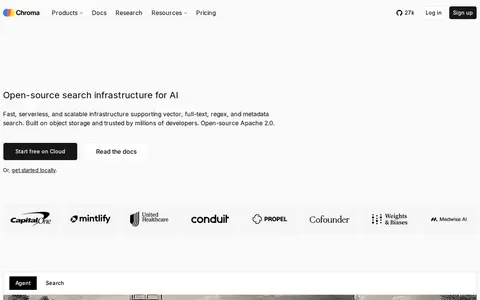
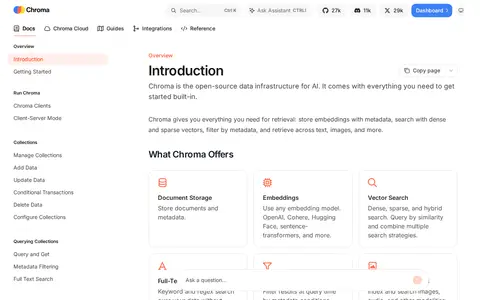
Chroma is open-source search infrastructure for AI under Apache 2.0. It supports vector, full-text, regex and metadata search, built on object storage. Chroma Cloud offers serverless, scalable deployment with usage-based pricing.
Consensus is a search engine that uses AI to find answers in scientific research.
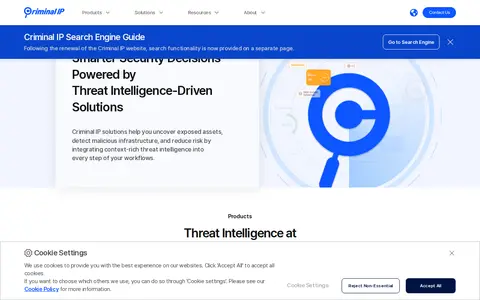
Criminal IP is a threat intelligence platform. It delivers AI-powered threat intelligence, IP reputation analysis, attack surface management, fraud detection, and brand protection. Users can use it to discover exposed assets, detect malicious infrastructure, and reduce cyber risk in real time.
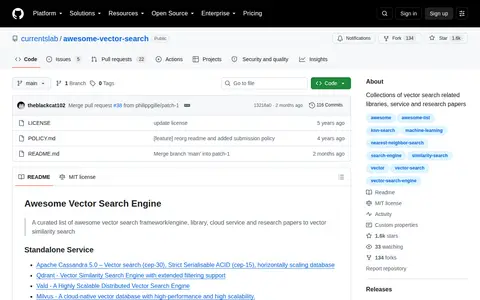
Curated list of awesome vector search framework/engine, library, cloud service and research papers to vector similarity search.
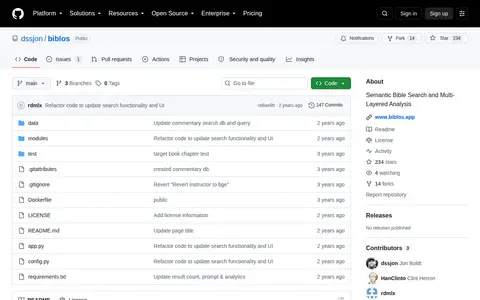
Biblos is a tool for semantic search and multi-layered analysis of Biblical texts, using Chroma and instructor-large embeddings for retrieval. Search results are summarized with Anthropic's Claude, and the tool includes Greek New Testament text, Dodson Greek Lexicon definitions and Church Fathers' commentaries. The web UI is built with Streamlit.
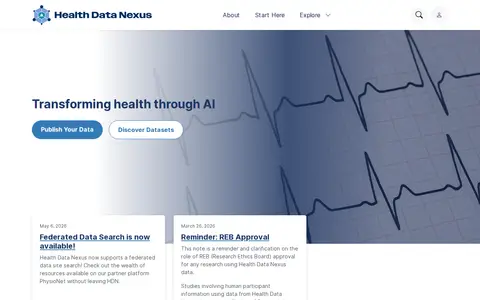
Health Data Nexus is an open data platform for AI research and education in medicine. It offers federated data search, allowing users to search partner platform PhysioNet resources without leaving the site. Datasets are listed under credentialed access, and access zones impose requirements including a data use agreement and, for Zone 3, REB approval.
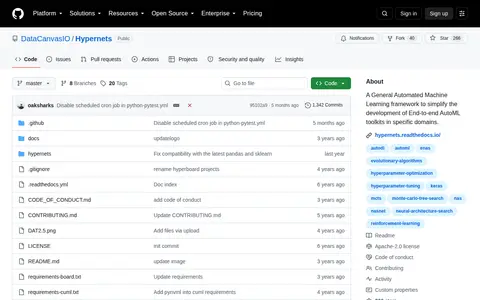
Hypernets is a general AutoML framework for building automatic optimization tools for machine learning frameworks and libraries, including tensorflow, keras, pytorch, sklearn, lightgbm and xgboost. It offers an abstract search space representation covering hyperparameter optimization and neural architecture search, with optimization algorithms such as evolution algorithm and Monte Carlo tree search.
Framework that implements AutoML algorithms for model architecture search at scale.
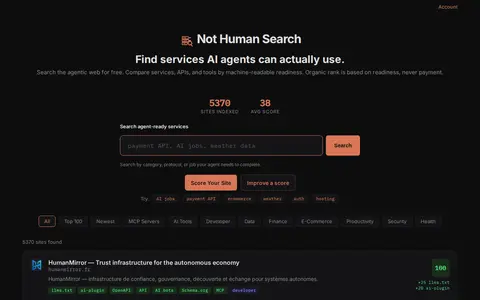
Not Human Search scores websites from 0 to 100 on seven agentic signals, including llms.txt, OpenAPI, MCP and Schema.org. It also indexes agent-ready sites and lets users search for services, APIs and tools by machine-readable readiness. Organic rank is said to be based on readiness rather than payment.
PUBLC was an AI-powered search engine that rewarded its community through the PUBLX token. A farewell notice states that the project has come to an end and that the team is building a successor called Society AI.
Chroma - Open-source search and retrieval database for AI applications. Vector, full-text, regex, and metadata search. or Cloud available.
AI literature search, document translation, and deep-research workspace for researchers.
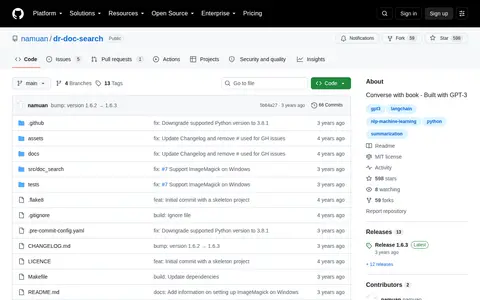
TalkToPapers, referenced as the namuan/dr-doc-search GitHub repository, is an open-source tool that enables users to converse with book content, built using GPT-3. The repository includes documentation covering prerequisites, installation steps, and example usage.
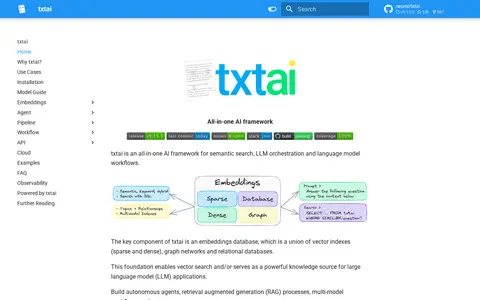
Build semantic search and retrieval applications.
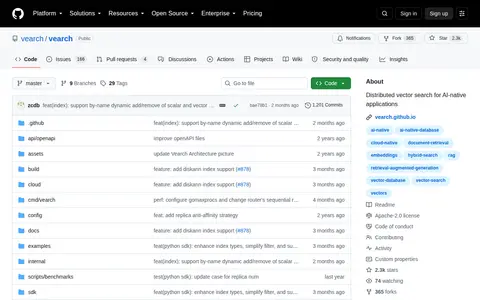
Vearch is a cloud-native distributed vector database for similarity search of embedding vectors in AI applications. It supports hybrid vector search and scalar filtering, replication, elastic scaling, RESTful APIs, and SDKs for Python, Go, Java and Rust. It integrates with frameworks including LangChain and LlamaIndex and can be deployed via Kubernetes or Docker Compose.
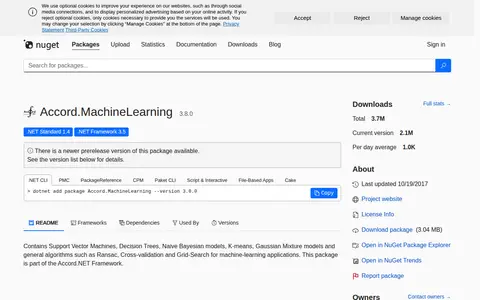
Accord.MachineLearning is a NuGet package, part of the Accord.NET Framework, that contains Support Vector Machines, Decision Trees, Naive Bayesian models, K-means, Gaussian Mixture models, and general algorithms such as Ransac, Cross-validation and Grid-Search for machine-learning applications. Version 3.8.0 targets .NET Standard 1.4 and .NET Framework 3.5.
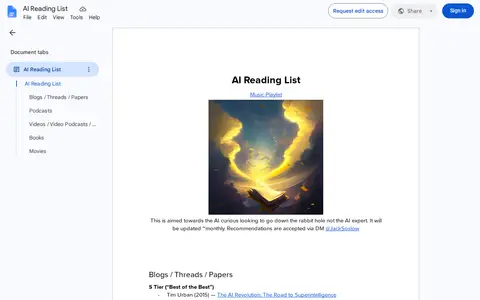
AI Reading List helps search books, ebooks, papers, library records, or reading archives.
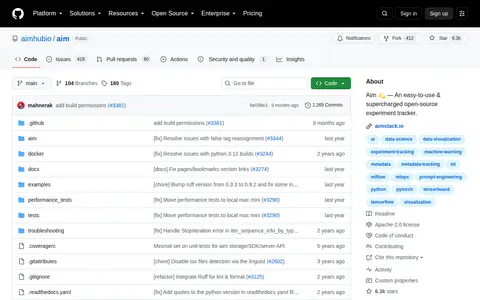
A super-easy way to record, search and compare 1000s of ML training runs.
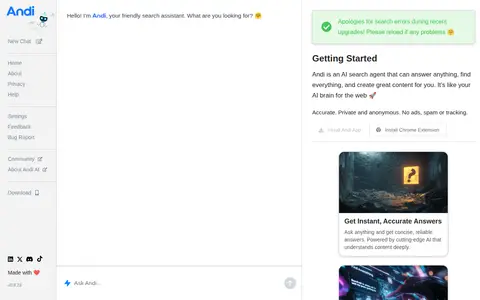
AI search assistant that answers questions and surfaces web results in a cleaner interface.
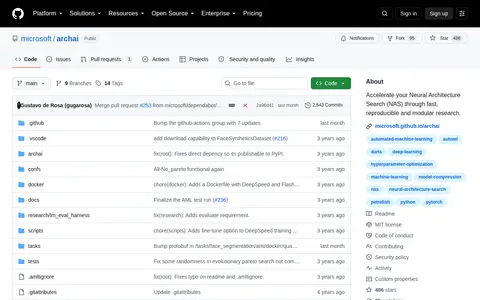
Archai is an open-source project developed by Microsoft and hosted on GitHub. It is designed to accelerate neural architecture search (NAS) research by providing fast, reproducible, and modular tooling for developing, testing, and refining new neural network architectures.