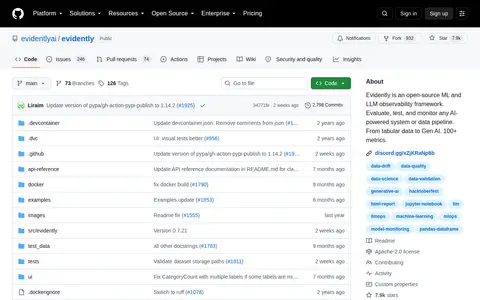

Evidently is an open-source observability framework for machine learning and large language models, hosted on GitHub under the evidentlyai organization. It enables users to evaluate, test, and monitor AI-powered systems and data pipelines, with support for use cases ranging from tabular data processing to generative AI, and includes more than 100 built-in metrics.
Directory
Search results
Published directory entries matching your search.
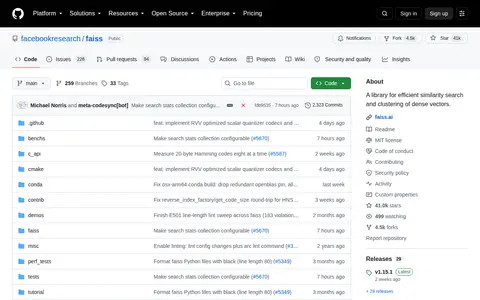
Faiss is a library for efficient similarity search and clustering of dense vectors, containing algorithms that search sets of vectors of any size. It is written in C++ with complete wrappers for Python/numpy, with some algorithms implemented on the GPU, and is developed primarily at Meta's Fundamental AI Research group.
FACTORIE is an open-source toolkit for deployable probabilistic modeling, implemented as a software library in Scala and hosted on GitHub under the factorie organization. It provides users with a succinct language for creating relational factor graphs, estimating model parameters, and performing inference, with documentation for installation, example usage, and pre-built NLP models.

FeatherCNN is a lightweight CNN inference library developed by Tencent AI Platform Department, originating from a game AI project for King of Glory. It targets ARM CPUs and is developed for mobile phones, embedded devices and ARM-based servers. It accepts Caffe models, which are converted into a single binary model.
An enterprise-grade, high performance feature store.
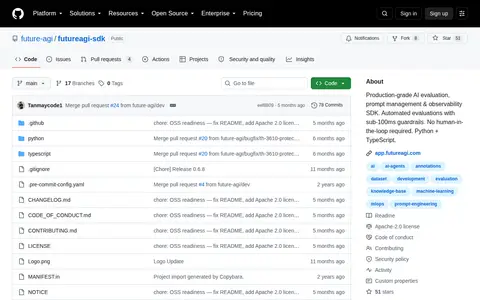
Future AGI is an open-source, self-hostable platform for evaluating, observing, and improving LLM and AI agent applications. It combines tracing, evals, simulations, datasets, a gateway and guardrails on one platform with a feedback loop. The Apache 2.0 core can be self-hosted, and a managed Cloud option is offered.
Future AGI SDK is a production-grade software development kit for AI evaluation, prompt management, and observability. It offers automated evaluations with sub-100ms guardrails and does not require human-in-the-loop. The SDK supports Python and TypeScript.
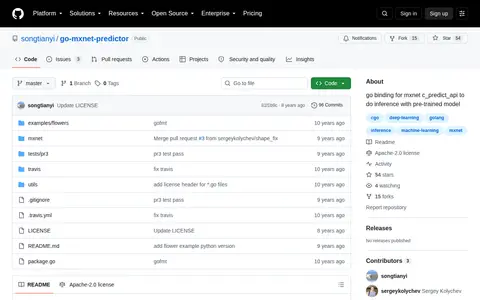
Go binding for MXNet c predict api to do inference with a pre-trained model.
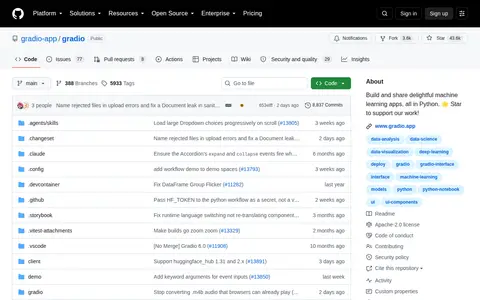
Gradio is an open-source Python library that enables developers to build and share machine learning web applications easily. It provides simple interfaces for creating demos and sharing models, supporting a wide range of ML frameworks.
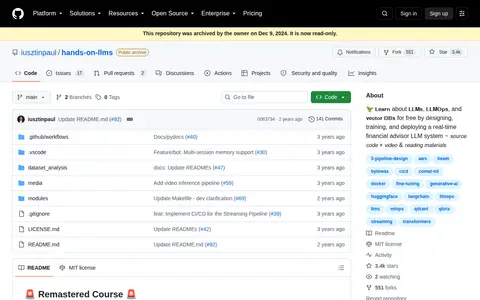
An archived educational course repository for learning about LLMs, LLMOps and vector databases by designing, training and deploying a real-time financial advisor LLM system. It includes source code, video and reading materials, and covers a training pipeline using QLoRA and a streaming pipeline ingesting financial news. The repository was archived by its owner and is read-only.
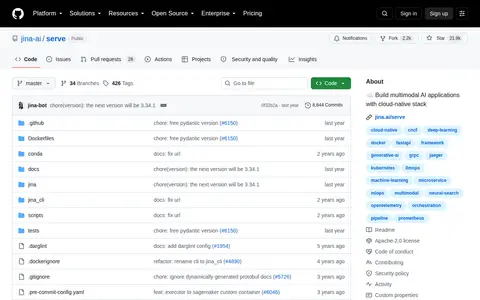
Build multimodal AI services via cloud native technologies · Model Serving · Generative AI · Neural Search · Cloud Native.
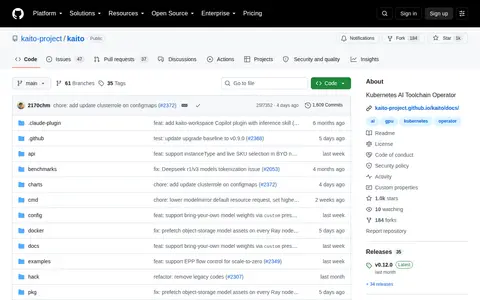
Kaito is the Kubernetes AI Toolchain Operator, an operator suite that automates LLM inference, fine-tuning and RAG engine deployment in a Kubernetes cluster. It simplifies the CRD API and provides optimized preset configurations for inference engine scheduling parameters. Workspaces are the basic CRD for managing inference and tuning workloads, and all vLLM-supported models can be run.
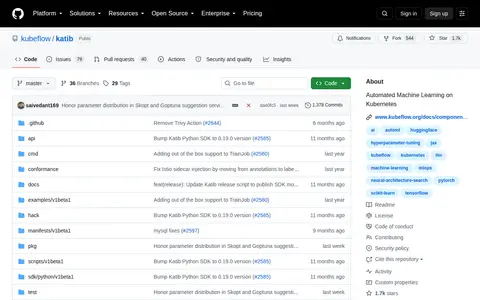
Kubeflow Katib is a Kubernetes-native project for automated machine learning (AutoML). It supports hyperparameter tuning, early stopping and neural architecture search, and is agnostic to machine learning frameworks, natively supporting frameworks such as TensorFlow, PyTorch and XGBoost. Training jobs can use any Kubernetes Custom Resources, with out-of-box support for Kubeflow Training Operator, Argo Workflows and Tekton Pipelines. A Python SDK simplifies creating tuning jobs.
Kubernetes custom resource definition for serving ML models on arbitrary frameworks.
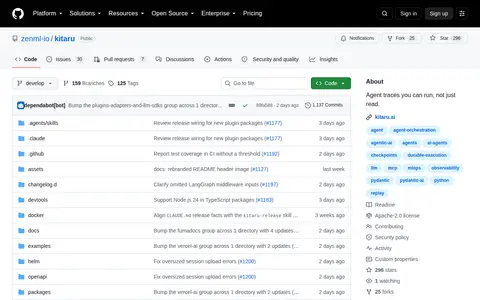
Kitaru is an open-source, self-hosted tool providing replay-based evaluations for AI agents. It records or imports production runs as sessions and replays them against a changed model, prompt, or code, with tool calls answered from the recording. It is available for Python and TypeScript and comes from the team behind ZenML.
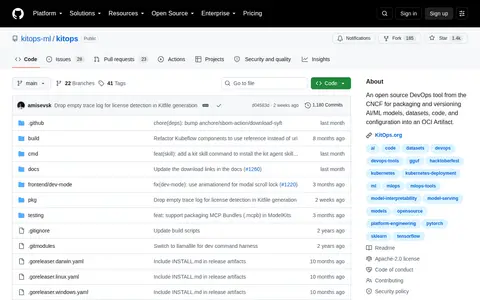
Open source MLOps project that eases model handoffs between data scientist and DevOps.
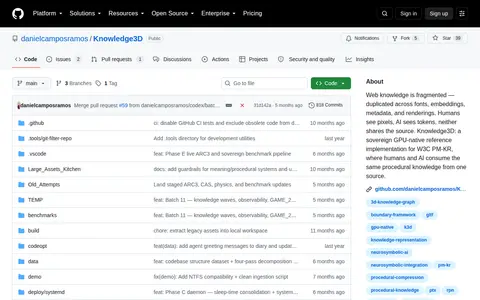
Knowledge3D (K3D) is a sovereign GPU-native reference implementation for the W3C PM-KR specification. It aims to unify web knowledge representation by allowing humans and AI to consume the same procedural knowledge from a single source, addressing fragmentation across fonts, embeddings, metadata, and renderings.
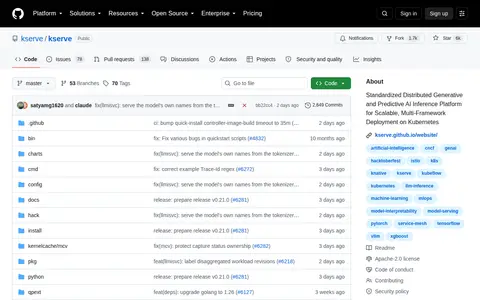
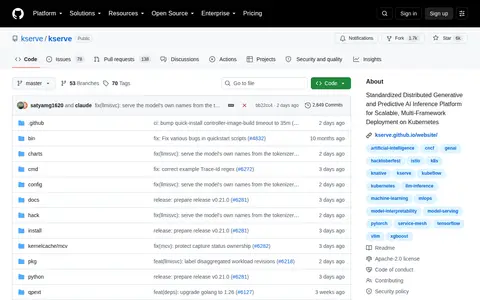
KServe is a standardized distributed generative and predictive AI inference platform for scalable, multi-framework deployment on Kubernetes. It is a Cloud Native Computing Foundation incubating project. The platform supports backends such as vLLM and llm-d for serving LLMs, and multi-framework predictive serving. Standalone installation on standard Kubernetes is described as more lightweight but without canary deployment or request-based autoscaling with scale-to-zero.
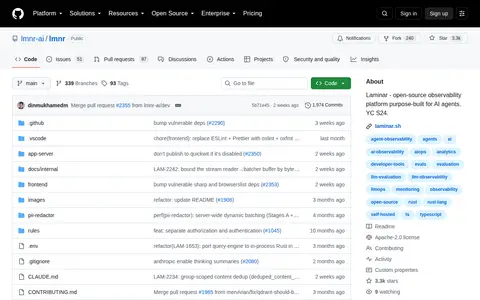
Laminar is an open-source observability platform purpose-built for AI agents. It provides OpenTelemetry-native tracing with a one-line SDK setup, plain-English signals that alert in Slack, and an SDK and CLI for running evals. It is written in Rust with 20x trace compression, and can be used via a managed platform or self-hosted with Docker Compose.
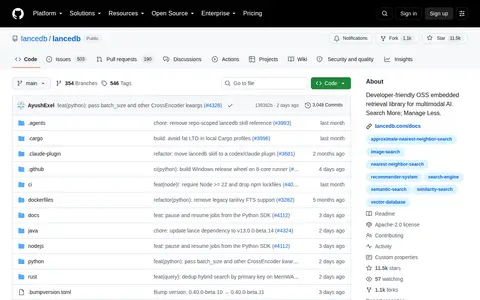
LanceDB is a developer-friendly open-source embedded retrieval library for multimodal AI. It emphasizes searching more and managing less. The project tagline is 'Search More; Manage Less.' It is available on GitHub.
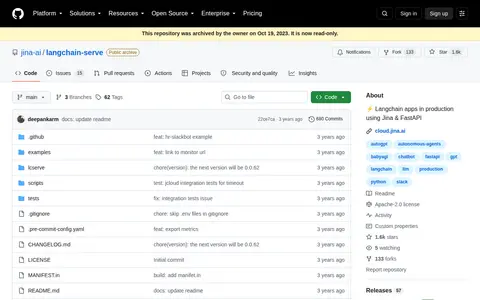
An archived, read-only repository that provided a way to deploy LangChain apps using Jina and FastAPI, wrapping apps as services on Jina AI Cloud. The README notes the project is no longer maintained and that it could deploy apps on a user's own infrastructure.
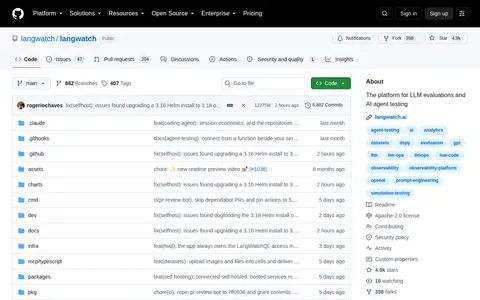
LangWatch is a platform for evaluating large language models and testing AI agents. The open-source project is hosted on the GitHub platform under the langwatch organization as the langwatch/langwatch repository.
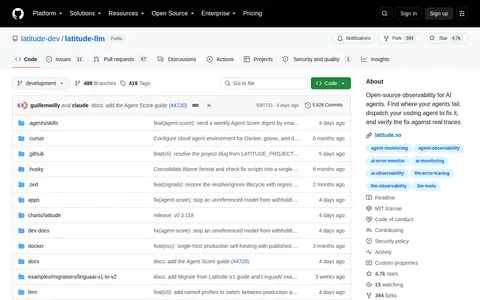
Latitude is an open-source observability tool for AI agents. It helps identify failures, dispatch coding agents to fix issues, and verify fixes using real traces. The platform is available on GitHub.
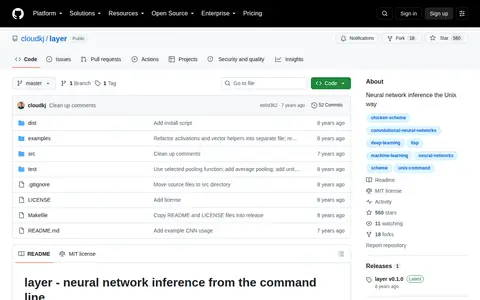
layer is a command-line tool for neural network inference, following the Unix philosophy. It enables users to perform inference from the command line. The project is open-source and hosted on GitHub.