Bulk URL Opener is a browser extension and cross-platform desktop app for opening lists of URLs in one click. It also allows users to create and store lists of links and load them from a drop-down menu. It is free and open-source.
Directory
Search results
Published directory entries matching your search.
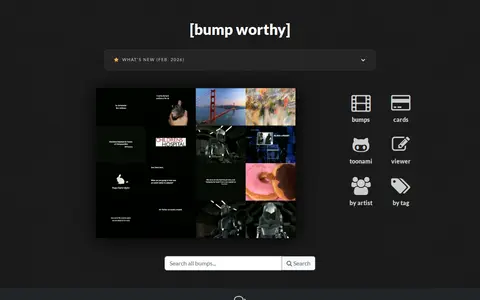
BumpWorthy is an encyclopedic archive of Adult Swim bumps and their music. After twenty years, the original site was frozen and archived by its operator, who notes that a community recorded, identified, tagged, and cataloged thousands of clips and their music. Downloads and the forum are no longer available, but every collected bump can still be browsed and watched in a browser. The community now operates on an existing subreddit.
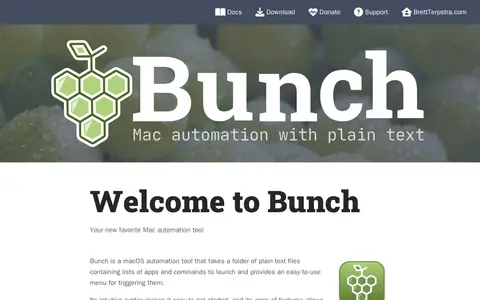
Bunch is a macOS automation utility that reads plain text files called Bunches to launch applications, run scripts, open files and websites, and change system settings. It sits in the menu bar and presents the Bunches as a menu for switching between work contexts with a click. The software is free.
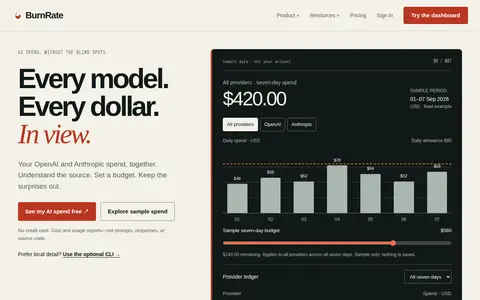
BurnRate is an AI usage analytics tool that tracks costs, tokens and usage patterns across AI coding providers. It connects OpenAI and Anthropic reporting accounts for provider-reported spend and offers a local CLI for session-level detail. Cloud workspaces come in Free, Pro at $12/month and Team at $29/seat/month plans.
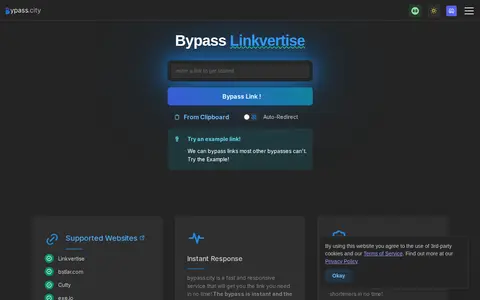
bypass.city is a web service that bypasses link shorteners and ad-link sites, including Linkvertise, lootlinks.com and work.ink, to reach the destination link. The site states the bypass is instant and lists many supported shorteners and paste sites. It also offers clipboard input and auto-redirect.
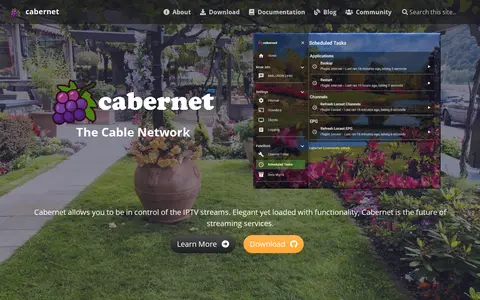
Cabernet is a modular appliance that cleans, organizes and repackages IPTV streams for media clients. It merges M3U and XMLTV data, manages channels, and supports M3U8 streaming through FFMPEG or internally. It offers M3U and HDHomeRun interfaces and was tested with TVheadend, Emby, Jellyfin, Plex and VLC. Deployment uses Python 3.7 or greater.
Caffeine is a browser extension that keeps the operating system from sleeping or hibernating when activated from the action button, shown by a color change from gray to brown. The user toggles the button to switch between an awake or released state at the system or desktop level, and changes state through the right-click context menu.
California Polytechnic State University, San Luis Obispo is a California public university that has operated since 1901, offering more than 150 undergraduate majors and minors and over 50 graduate programs across six academic colleges. It is united by a 'Learn by Doing' educational philosophy that combines rigorous academics with real-world applications, and its members work on challenges including climate change, wildfire prevention, space exploration and urban heat mitigation.
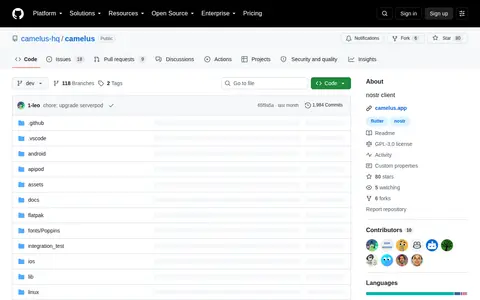
) - A Nostr client with a focus on simplicity and usability
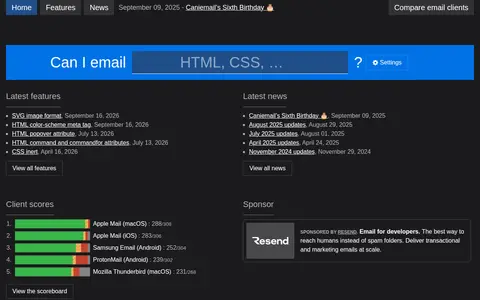
Can I Email? provides support tables for HTML and CSS features in email clients. The site lists features and tracks support across clients such as Apple Mail, Gmail, Outlook, Yahoo! Mail and others, and includes a client scoreboard.
Browse research datasets and geospatial data related to atmospheric, oceanography and climate.
The Canadian VirusSeq Data Portal is a data portal for clinical case data that has expanded into the iMicroSeq Data Portal, which supports integrative analyses of broader microbial data such as viruses and bacteria, including antimicrobial resistance data. Genome Canada partnered with DNAstack to share VirusSeq data on Viral AI, a federated network for genomic variant surveillance and infectious disease research.
Canary Mail is an email client with AI features and a built-in calendar for Mac, iPhone, iPad, Windows and Android. It offers a unified inbox for multiple accounts, AI Copilot drafting and summaries, and privacy-focused features such as on-device triage.
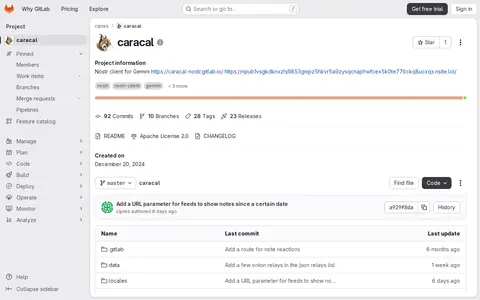
Nostr client for the [Gemini](https://geminiprotocol.net/) protocol. Use Nostr from your Gemini browser! [nsite](https://npub1vsgkdknxzhj9853gmpz5hkvr5a9zysqcnaphwfcex5k0te776ckq8ucxqx.nsite.lol/)
Animation software for creating and editing character motion, poses, and physics-assisted animation.
A free interactive map of 9,079 castles, fortresses, palaces and ruins across 155 countries, each with a photo and story. Points can be clicked for quick facts, and individual pages give full stories and locations. Data comes from Wikidata, Wikimedia Commons, Wikipedia and OpenFreeMap.
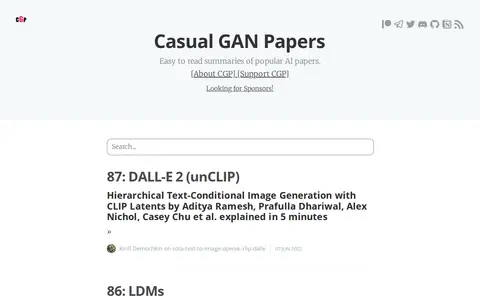
A site offering short, easy-to-read summaries of popular AI papers, with each explained in about five minutes. Covered papers include DALL-E 2, Latent Diffusion Models, GLIDE, Make-A-Scene, CLIP-GEN, and FILM.
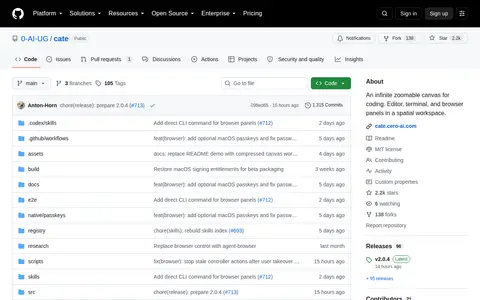
Cate is an infinite zoomable canvas for coding that places editor, terminal, and browser panels in a spatial workspace. It supports running agent CLIs in terminals, with panels shown on a canvas or dock and git worktrees for parallel branches.

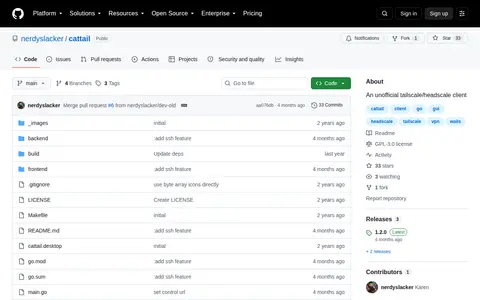
Cattail is an unofficial tailscale/headscale client for Linux and Windows, developed using the Wails project and the Naive UI library. Its features include account switching, detailed peer information and a tray menu for quick access. The application is an independent project not affiliated with the official Tailscale project.
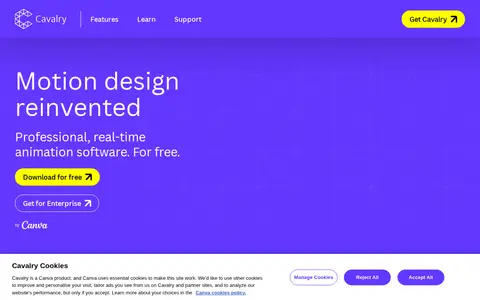
Cavalry is a video tool for editing, effects, stock footage, animation, 3D, or creator workflows.
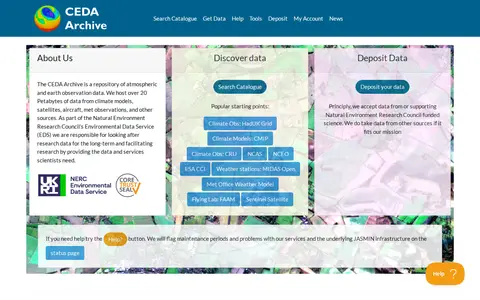
The CEDA Archive is a repository of atmospheric and earth observation data. It hosts over 20 petabytes of data from climate models, satellites, aircraft, meteorological observations and other sources as part of the Natural Environment Research Council's Environmental Data Service.
A PICO-8 platformer about climbing a mountain, made in four days, created by Maddy Thorson and Noel Berry. It is played with the arrow keys, X, and C, and is available on HTML5.

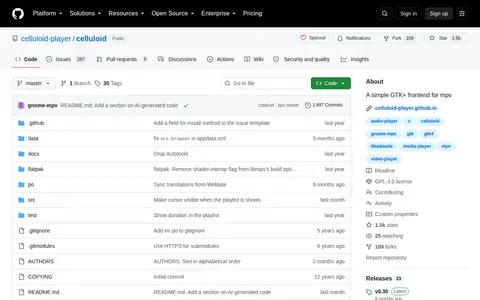
Celluloid, formerly GNOME MPV, is a GTK+ frontend for the mpv media player. It interacts with mpv through the client API exported by libmpv, giving access to mpv's playback capabilities. The project is distributed as a Flatpak and a Snap package.
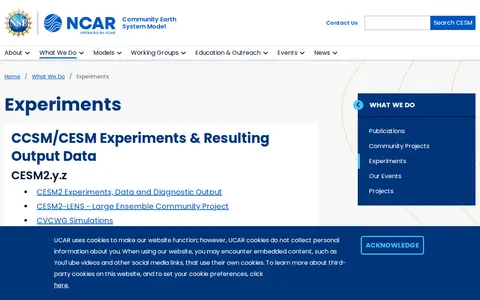
CESM Experiments is a page from the Community Earth System Model project that lists climate model experiments and their resulting output data across CCSM and CESM release versions. It organizes materials by model version, including CESM2, CESM1.3 HR, CESM1.2, CCSM4.0 and earlier CCSM runs; some data is noted as available on the Earth System Grid with registration required.