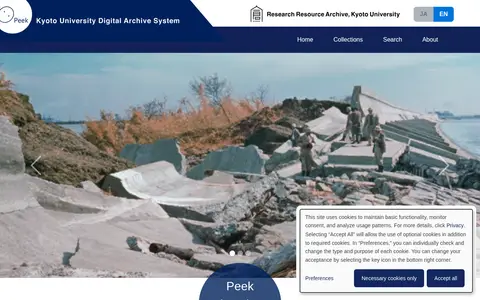
Peek is the Kyoto University Digital Archive System, providing digitized archival materials from the Research Resource Archive. It covers collections such as the Hotta (Mitsuru) Movie Collection, 1960-ca.1982, and the Tomoya Masuda papers and records, 1930–1984, bulk 1950–1981. KURRA finding aids can also be used to search for information about the materials.
Directory
Search results
Published directory entries matching your search.
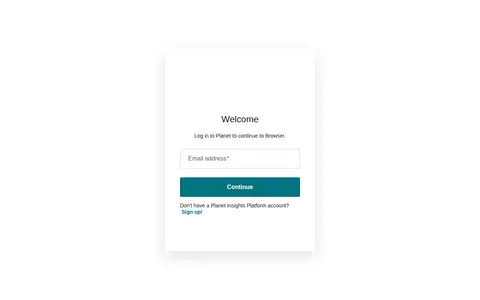
Planet Insights Browser is a component of the Planet Insights Platform that enables users to browse and compare full resolution satellite images from various data collections. Users can select an area of interest, define a time range and cloud coverage threshold, and inspect the results in the browser. The tool supports different visualizations, custom creation, high resolution image downloads, and timelapse generation. It provides visual, analytical, and download capabilities for satellite imagery.
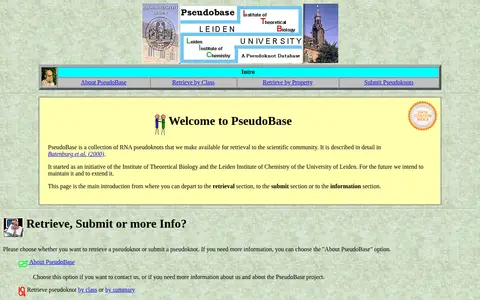
PseudoBase is a collection of RNA pseudoknots made available for retrieval to the scientific community. It offers retrieval by class or by summary, and a section for submitting new pseudoknots. The page serves as the main introduction to the retrieval, submit and information sections.
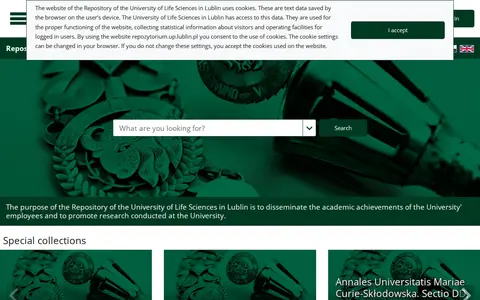
The Repository of the University of Life Sciences in Lublin disseminates the academic achievements of the University's employees and promotes research conducted at the University. It provides search, special collections, and a people and publication database. Depositors must determine the legal status of materials before making them available.
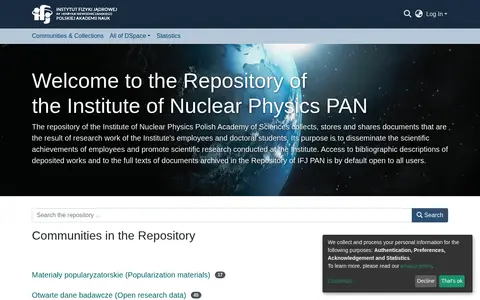
The Repository of the Institute of Nuclear Physics of the Polish Academy of Sciences (IFJ PAN) collects, stores, and shares research documents produced by the institute's staff and doctoral students. Its purpose is to disseminate scientific achievements and promote the institute's research. The repository provides open access to bibliographic descriptions and full texts. It organizes content into communities and collections.
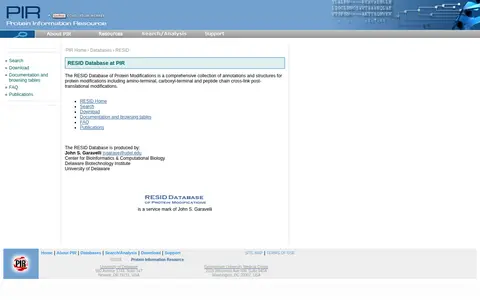
The RESID Database of Protein Modifications is a collection of annotations and structures for protein modifications, including amino-terminal, carboxyl-terminal and peptide chain cross-link post-translational modifications. It is produced by John S. Garavelli at the Center for Bioinformatics & Computational Biology, University of Delaware, and hosted by the Protein Information Resource.
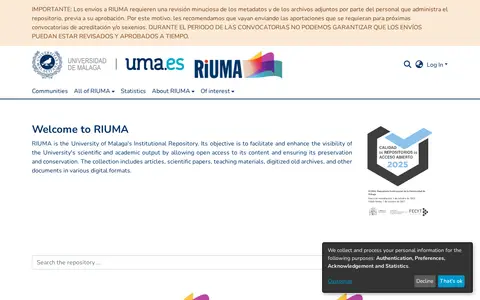
RIUMA is the University of Malaga's institutional repository. It aims to increase the visibility of the university's scientific and academic output by providing open access to its content and supporting its preservation. The collection includes articles, scientific papers, teaching materials, digitized old archives and other documents in various digital formats.
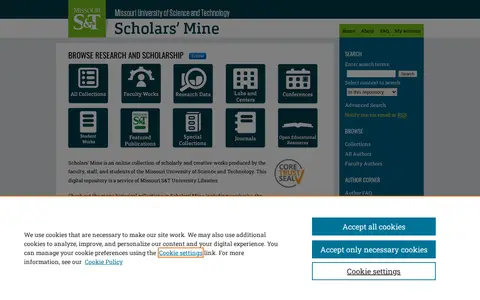
Scholars' Mine is the institutional repository for the Missouri University of Science and Technology, provided as a service of Missouri S&T University Libraries. It offers digital access to scholarly and creative works by the university's faculty, staff, and students, including faculty papers, departmental publications, conference proceedings, and graduate student works, plus campus cultural and historical collections such as yearbooks and the student newspaper.
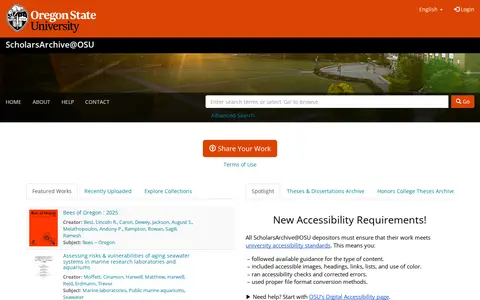
ScholarsArchive@OSU is Oregon State University's institutional repository. It hosts the university's scholarly research outputs, including featured works and recently uploaded materials across a range of academic subjects. Users can search, browse collections and access full content of hosted works.
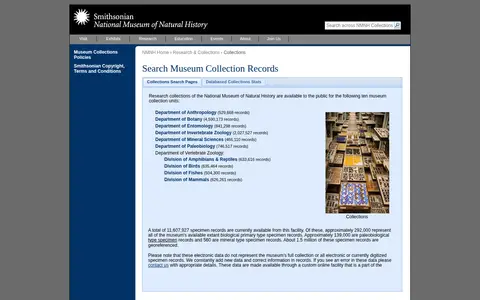
This Smithsonian National Museum of Natural History page provides search access to museum collection records. It also links to sections on exhibits, research, education, events, about, and joining the museum.
The Staatliche Naturwissenschaftliche Sammlungen Bayerns is a German natural history institution with about 31 million inventory units, described as Germany's second-largest natural history collection. Its collections span anthropology, paleoanatomy, botany, mineralogy, paleontology, geology and zoology, and are used in research, teaching, training and exhibitions in its museums.
SNAP is a general purpose network analysis and graph mining library written in C++ that scales to large graphs and supports node and edge attributes. Snap.py provides a Python interface with most of the SNAP C++ functionality. The project also offers the Stanford Large Network Dataset Collection, a set of network datasets.
The SWISS-MODEL Repository is a database of annotated 3D protein structure models generated by the SWISS-MODEL homology-modelling pipeline. It aims to provide an up-to-date collection of models for relevant model organisms and experimental structure information for sequences in UniProtKB. Users can search by UniProtKB accession or entry name, browse experimental structures, or search using free text.
The Netlib is a repository of mathematical software, papers, and databases hosted at UTK and ORNL. It offers browsing and searching of the collection and lists related services including the NA Digest archives, LAPACK working notes, the BibNet archive, and a Transactions on Mathematical Software mirror.
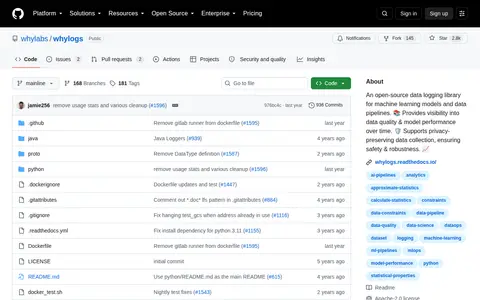
Whylogs is an open-source data logging library for machine learning models and data pipelines. It provides visibility into data quality and model performance over time, and supports privacy-preserving data collection to support system safety and robustness.
Dataset and resource search service for finding public data collections and research material.
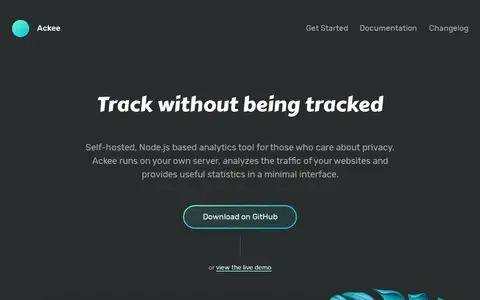
Ackee is a self-hosted, Node.js based analytics tool focused on privacy. It runs on the user's own server, analyzes website traffic, and provides statistics in a minimal interface. The tool is cookie-free, anonymizes data through a multi-step process, supports unlimited domains, and offers a central GraphQL API for data collection and integration.
Annotations Data Archive is an Internet Archive item or collection for preserved media, files, or records.
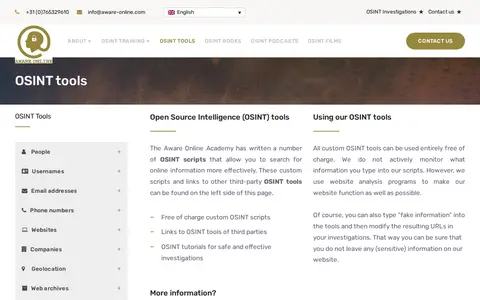
Aware-Online provides a free collection of custom Open Source Intelligence (OSINT) scripts and links to third-party OSINT tools, alongside tutorials, to support effective internet and social media investigations. The provider does not actively monitor information entered into its scripts.
cheminfo.org is a website offering a collection of utilities for chemistry and related fields. Tools include NMR spectrum analysis, mass spectrometry, JSON conversion, and image processing. The site also provides exercises and simulators for spectral interpretation.
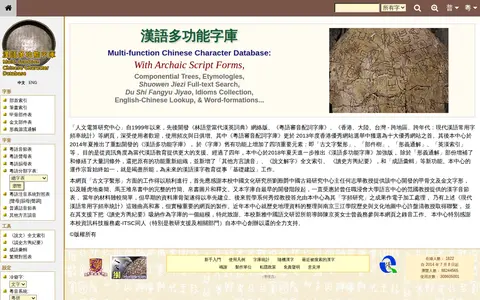
The Multi-function Chinese Character Database presents Chinese character information, including archaic script forms, componential trees, etymologies, a full-text search of Shuowen Jiezi, an idioms collection, English-Chinese lookup and word formations. Developed by the Research Centre for Humanities Computing, it received an enhanced version in summer 2018 adding other dialect readings and new modules.
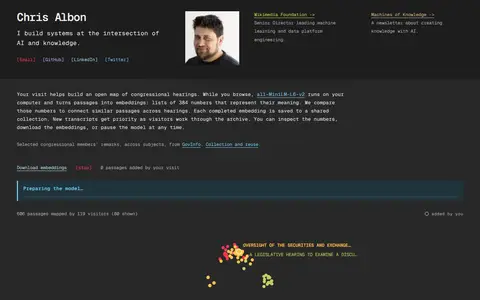
A personal website of Chris Albon. While browsing, the all-MiniLM-L6-v2 model runs on the visitor's computer and turns passages from congressional hearings into 384-number embeddings, which are compared to connect similar passages. Completed embeddings are saved to a shared collection, and visitors can inspect the numbers, download embeddings or pause the model.
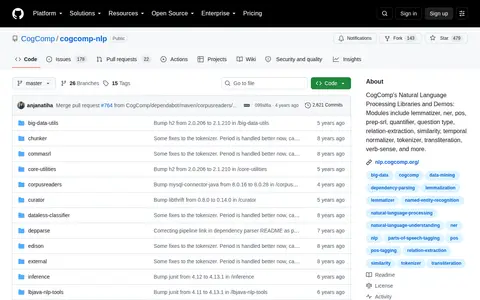
CogCompNLP is a collection of core natural language processing libraries developed by the Cognitive Computation Group. Its modules include a lemmatizer, part-of-speech tagger, named entity recognizer, tokenizer, transliterator, relation extraction, similarity, temporal normalizer and verb sense tools. The project includes a pipeline for annotating raw text and recommends JDK8.
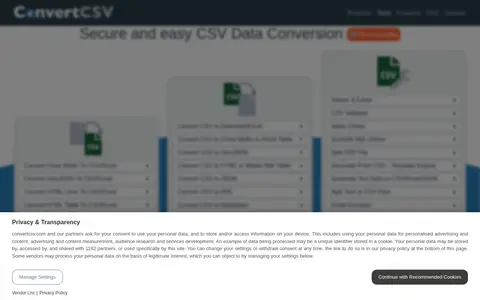
ConvertCSV.com is a collection of online tools for converting CSV and Excel data to and from formats such as JSON, XML, SQL, YAML, KML, GeoJSON, HTML, Markdown and PDF. It also provides a CSV viewer and editor, a CSV validator, SQL querying and data extraction tools. The tools run on the client side, so data never leaves the computer.