Leanpass is a NumPy-based autodiff library for small neural network experiments, designed to be readable and simple to inspect for learning how automatic differentiation works. It provides tensors with reverse-mode autodiff, activation functions, linear layers, multilayer perceptrons, loss utilities, and SGD and Adam optimizers. Its only dependency is NumPy.
Directory
Search results
Published directory entries matching your search.
A curated list of Claude Skills, resources, and tools for customizing Claude AI workflows. The repository describes Claude Skills as reusable instruction packages that teach an AI agent to handle a specific class of tasks, each a folder with a SKILL.md file.
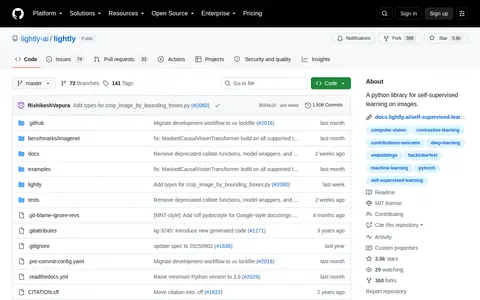
LightlySSL is a Python computer vision framework for self-supervised learning on images, written in a PyTorch-like style. It exposes low-level building blocks such as loss functions and model heads, supports custom backbone models for self-supervised pre-training, and supports distributed training using PyTorch Lightning. Sample code covers models including MoCo, SimCLR, BYOL and DINO.
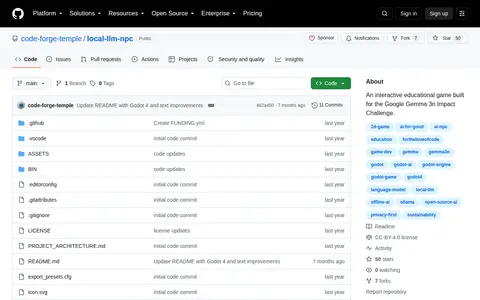
An interactive educational game built for the Google Gemma 3n Impact Challenge. It uses Gemma 3n via Ollama for on-device, structured educational conversations about sustainable farming and botany, and runs locally with no internet required for core features.
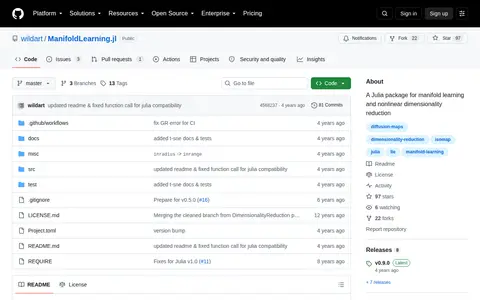
ManifoldLearning.jl is a Julia package for manifold learning and nonlinear dimensionality reduction. It provides methods including Isomap, diffusion maps, locally linear embedding, Hessian eigenmaps, Laplacian eigenmaps, local tangent space alignment and t-SNE. Most methods use k-nearest neighbors to construct local subspace representation, and a custom k-nearest neighbors function is suggested for large datasets.
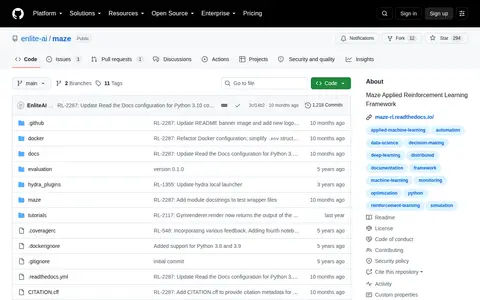
Application-oriented deep reinforcement learning framework addressing real-world decision problems.
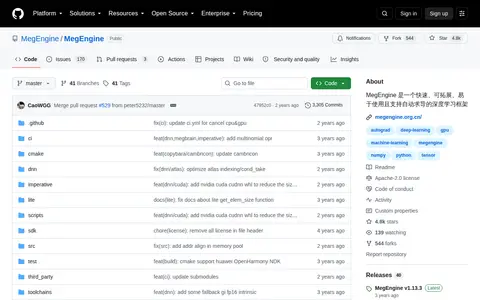
MegEngine is a fast, scalable and easy-to-use deep learning framework, with auto-differentiation.
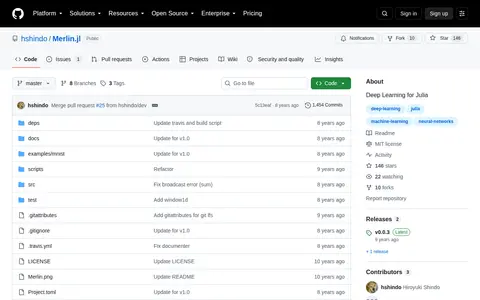
Merlin is a deep learning framework for the Julia programming language, hosted as a GitHub repository under the user hshindo. The repository includes documentation, installation instructions, and a quick start guide for users.
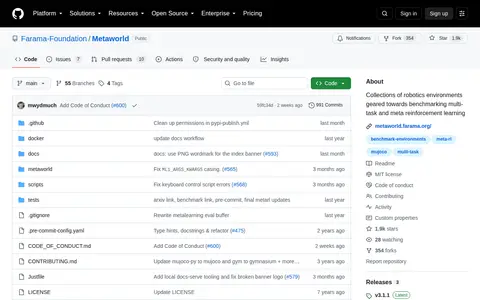
An open source robotics benchmark for meta- and multi-task reinforcement learning.
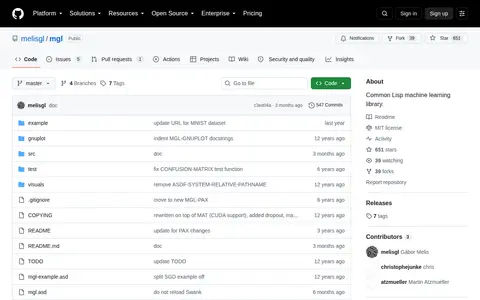
Neural networks (boltzmann machines, feed-forward and recurrent nets), Gaussian Processes.
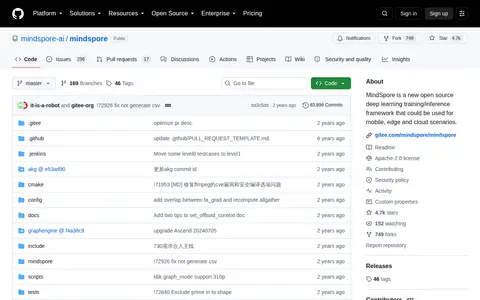
MindSpore is an open source deep learning training and inference framework that could be used for mobile, edge, and cloud computing scenarios. Its source code is hosted in the mindspore-ai/mindspore repository on GitHub.
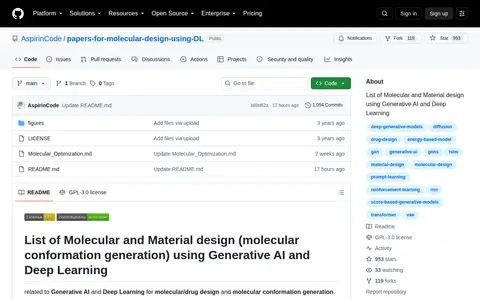
List of molecular design using Generative AI and Deep Learning.
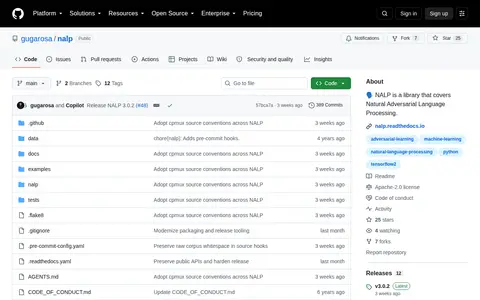
NALP is a Python library covering Natural Adversarial Language Processing. It combines natural language processing and adversarial learning, from embeddings to neural networks. The package offers corpus loading for raw text and audio, encoders, and pre-loaded neural network models. Version 3.0.2 requires Python 3.11+.
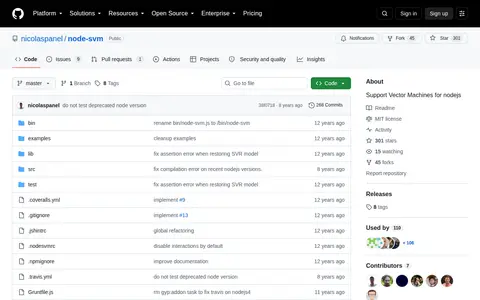
Node-SVM is a GitHub repository that provides support vector machine (SVM) implementations for Node.js. The project enables developers to use SVM algorithms within JavaScript applications. It includes installation instructions, a quick start guide, and an API reference. The repository is open source and contributed to by the community.

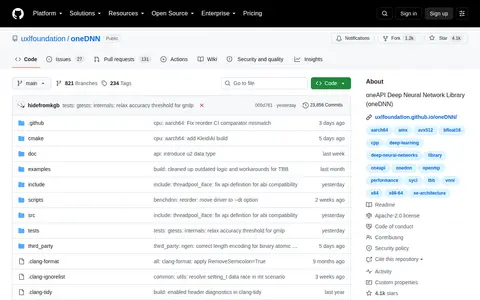
An open-source cross-platform performance library for deep learning applications.
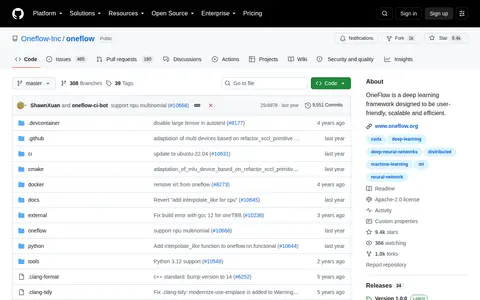
OneFlow is a performance-centered and open-source deep learning framework.
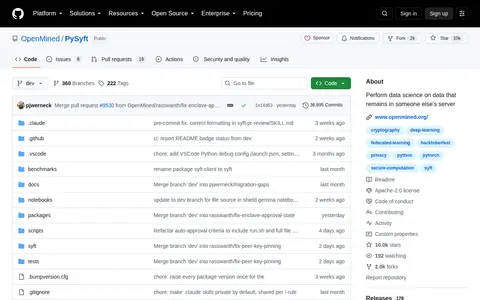
A Python library for secure and private Deep Learning built on PyTorch and TensorFlow.
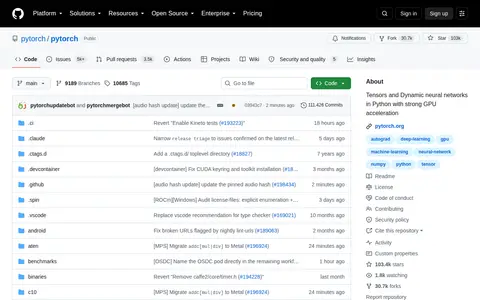
PyTorch is a Python package providing tensor computation with strong GPU acceleration and deep neural networks built on a tape-based autograd system. It includes components such as torch, torch.autograd, torch.nn, and torch.utils, and can be used as a NumPy replacement or a deep learning research platform.
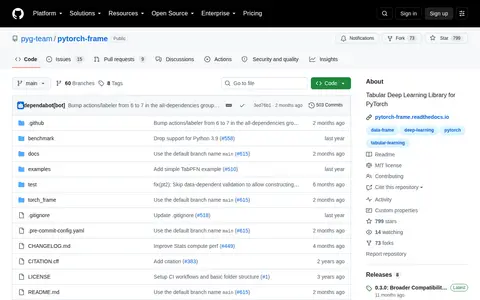
A Modular Framework for Multi-Modal Tabular Learning.
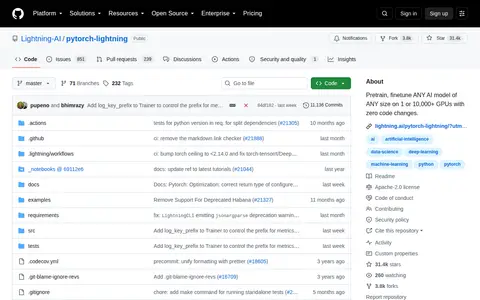
Deep learning framework to train, deploy, and ship AI products Lightning fast.
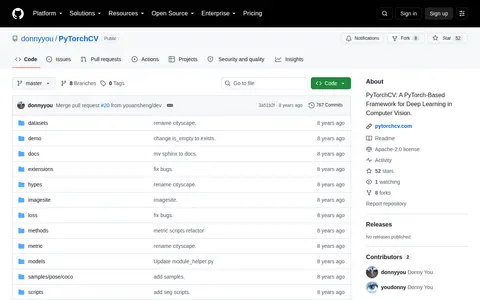
PyTorchCV is a PyTorch-based framework for deep learning in computer vision. The repository provides source code for computer vision problems, with implemented papers covering image classification, semantic segmentation, object detection, pose estimation and instance segmentation.
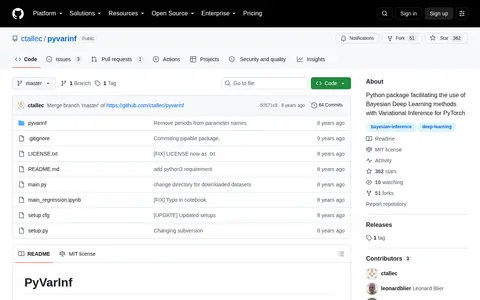
PyVarInf is a Python package that facilitates the use of Bayesian deep learning methods with variational inference for PyTorch, providing facilities to train PyTorch neural network models using variational inference. It approximates the posterior distribution over network weights with a parametric distribution.
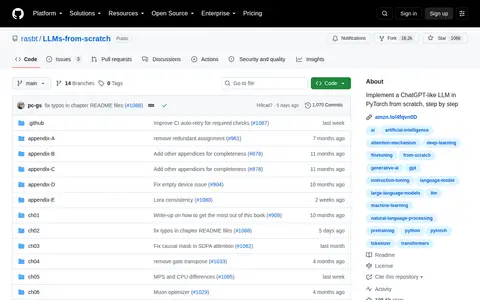
Implementing a ChatGPT-like LLM from scratch, step by step.
Deep learning based facial detector for Python coming with facial landmarks.