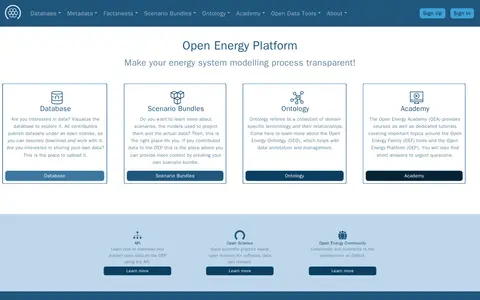
The Open Energy Platform is a site for making energy system modelling transparent. It offers a database where contributors publish datasets under an open license for download, scenario bundles giving context to contributed data, and the Open Energy Ontology for data annotation and management. An academy provides courses and tutorials on Open Energy Family tools.
Directory
Search results
Published directory entries matching your search.
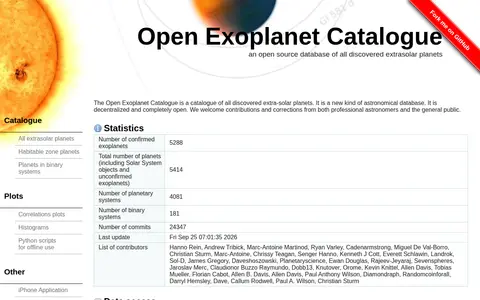
The Open Exoplanet Catalogue is a decentralized, open-source database of discovered extrasolar planets. The website displays the catalogue in a browser, while the data is stored as human-readable XML files in a git version control system. Contributions and corrections are accepted from professional astronomers and the public, and data can be downloaded from the GitHub repository.
OpenAddresses is a free and open global collection of address data. It combines street names, house numbers and postal codes with geographic coordinates to connect digital to physical places. The data can be parsed and imported into a database, placed on a map, or used for geocoding, and is openly licensed.
OpenEI is an open energy information platform that provides access to crowdsourced energy data, information, and applications from industry and government agencies. It covers hundreds of energy-related topics including geothermal, solar, wind, hydrogen, utilities, buildings, and smart grid. Its resources support education, data exploration, and industry decision-making, and include initiatives such as the Open Energy Data Initiative, Utility Rate Database, and specialized data repositories and toolkits.
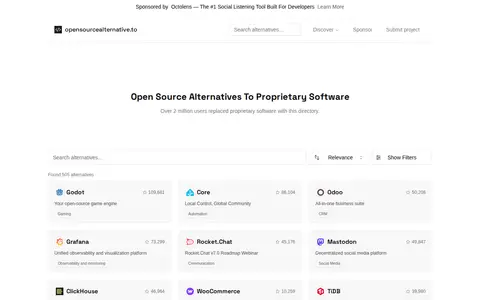
opensourcealternative.to is a free directory that bills itself as the world's largest collection of open source software alternatives to proprietary products. It hosts over 500 open source alternatives to popular proprietary tools, and reports that over 2 million users have replaced proprietary software with options found on the platform. Listed alternatives include game engines, business suites, observability platforms, communication tools, and databases.
Open Supply Hub is an open map where brands, suppliers, and advocates search, share, and collaborate on supply chain data. It maps production locations, assigns each location a universal OS ID, and standardizes shared data for matching. Suppliers can claim and verify their location on a free supplier database, and the platform is described as a Digital Public Good.
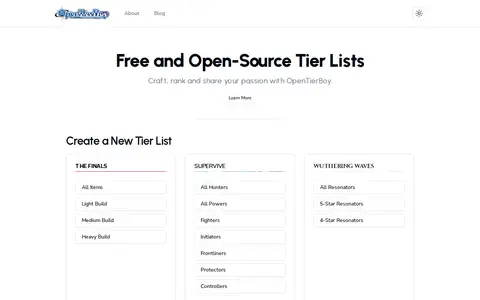
OpenTierBoy is a free, open-source platform for creating and sharing tier lists. It offers community-curated templates and lets users add custom images, which are not saved to a central database. Lists can be shared by copying the URL. The site states it has no ads, logins or sign-ups.
Orion is an indexer and search engine for torrent, usenet, and hoster links. It provides an API integrated into Kodi addons and mobile apps for finding links to movies and TV shows. Orion does not host or distribute files and complements debrid services. The database is community-maintained and offers anonymous cryptocurrency payments.
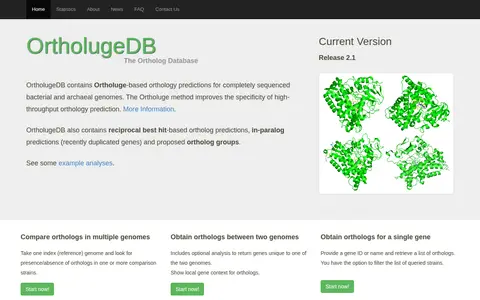
OrtholugeDB is a database of Ortholuge-based orthology predictions for completely sequenced bacterial and archaeal genomes. It also contains reciprocal best hit-based ortholog predictions, in-paralog predictions and proposed ortholog groups. Users can compare orthologs across multiple genomes, obtain orthologs between two genomes or for a single gene, and filter results by strain.
Searchable repository for finding basic in biology and medicine datasets and datasets.
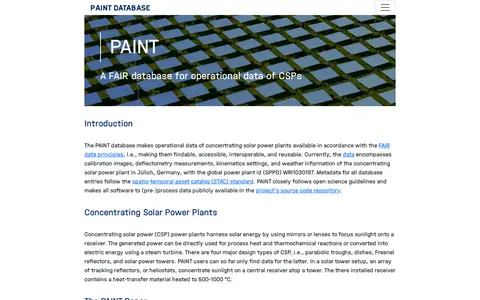
PAINT is a database making operational data of concentrating solar power plants available under FAIR data principles: findable, accessible, interoperable, and reusable. Its current data covers calibration images, deflectometry measurements, kinematics settings, and weather information from the solar tower plant in Jülich, Germany. Metadata follows the STAC standard, and software for data processing is publicly available in the project's source code repository.
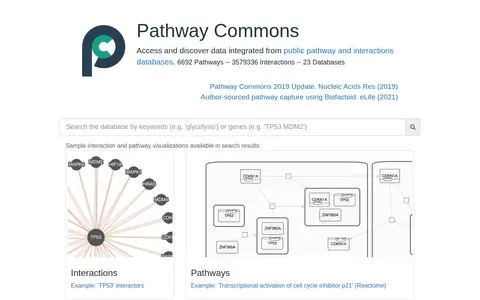
Pathway Commons collects and disseminates biological pathway and interaction data from partner databases, represented in the BioPAX standard. It provides search, visualization and web services, downloadable files in BioPAX, SIF and GMT formats, and tools such as PCViz, CyPath2, PaxToolsR and ChiBE. All data and software are free and open-source.
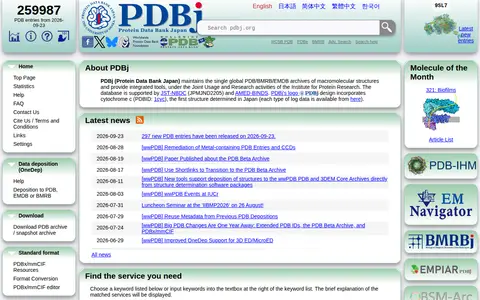
PDBj, the Protein Data Bank Japan, maintains the global PDB/BMRB/EMDB archives of macromolecular structures. Its website provides integrated tools for searching and analyzing PDB data, along with data deposition, standard format downloads, molecular viewers, derived databases and an educational service. PDBj is a member of the Worldwide PDB.
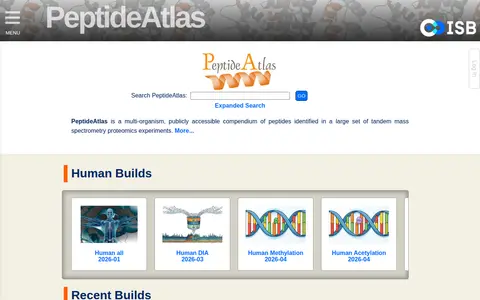
PeptideAtlas is a multi-organism, publicly accessible compendium of peptides identified in tandem mass spectrometry proteomics experiments. Each atlas build is made by searching spectra against sequence databases or spectral libraries, assigning probabilities to peptide-spectrum matches and selecting matches that pass a threshold. Builds are named for a species or subproteome, such as Human Plasma, and the search function covers only default builds.
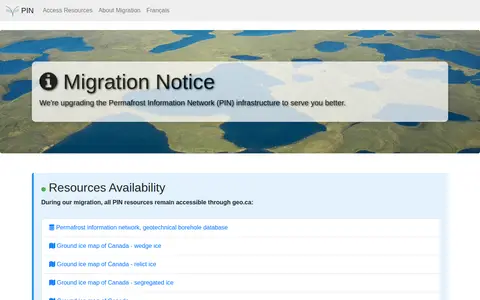
The Permafrost Information Network is an online resource covering permafrost topics. A migration notice states that the network's infrastructure is being upgraded and that its resources remain accessible through geo.ca during the migration. Listed resources include the permafrost information network, a geotechnical borehole database, and ground ice maps of Canada for wedge ice, relict ice, and segregated ice.
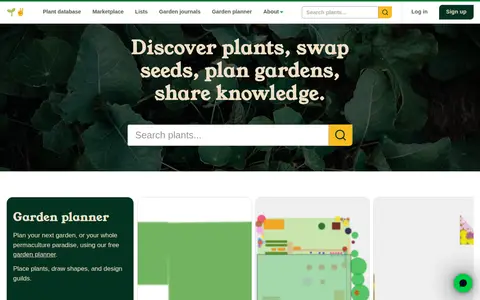
Permapeople is a platform for growing food, centred on a crowd-sourced plant database, an open marketplace and garden design tools. It also offers a garden journal and knowledge sharing, with the stated aim of supporting local food production and regenerating the environment.
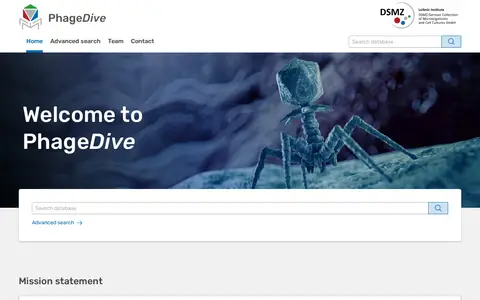
PhageDive is a database for bacteriophages and archaeal viruses, built on the BacDive model. It gathers and links experimental data and metadata for viruses held in culture collections, covering taxonomy, host strain, phage morphology, life cycle, origin and genomic data. An Advanced search supports queries such as finding phages that infect a given strain.
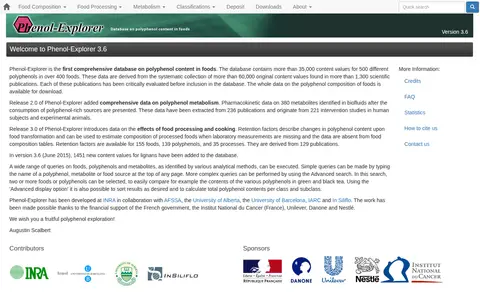
Phenol-Explorer is a database on polyphenol content in foods with over 35,000 content values for 500 polyphenols in more than 400 foods. It also includes data on polyphenol metabolism and the effects of food processing, and allows simple and advanced queries.
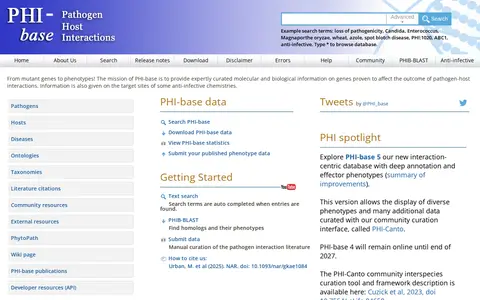
PHI-base is a curated database of molecular and biological information on pathogen genes shown to affect the outcome of pathogen-host interactions. It also records target sites of some anti-infective chemistries and covers pathogens, hosts, diseases, ontologies, taxonomies and literature citations. Users can search, run BLAST searches for homologs and phenotypes, download data and submit published phenotype data.
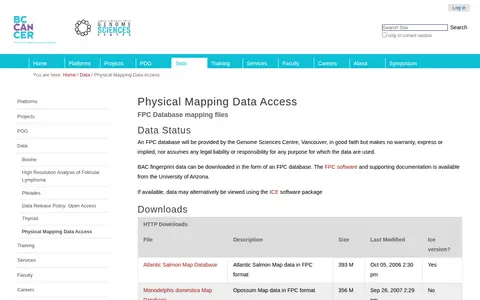
The page provides physical mapping data downloads from Canada's Michael Smith Genome Sciences Centre, including an FPC database of BAC fingerprint data for species such as Atlantic Salmon, mouse, rat and bovine. It lists FPC and plain text files, and the FPC software is available from the University of Arizona.
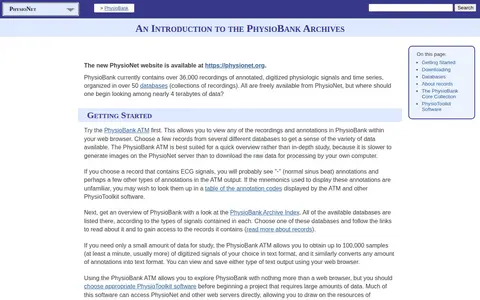
PhysioBank is an archive of annotated, digitized physiologic signals and time series, organized into more than 50 databases with over 36,000 recordings. The recordings are freely available from PhysioNet. A browser-based PhysioBank ATM allows viewing records and annotations or obtaining limited samples in text format. PhysioToolkit software can read data directly from the PhysioNet server without downloading files first.
Research data portal for exploring geography records, including geospatial data.
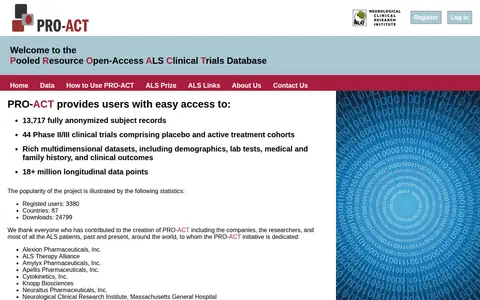
PRO-ACT is a pooled open-access database of ALS clinical trial data. It offers anonymized subject records and multidimensional datasets covering demographics, lab tests, medical and family history, and clinical outcomes. Access is provided through the project's website.
ProductivePrivacy is a curated directory of privacy-focused applications and tools. It lists software that prioritizes data security, is open-source, or offers end-to-end encryption, including note-taking apps, collaborative editors, database tools and other productivity software. Users can filter and sort the listed applications by category and other attributes.