
ImageMagick is a free, open-source software suite for creating, editing, converting and manipulating images. It supports over 200 format variants, including JPEG, PNG, GIF, TIFF, WebP and AVIF. The command-line tools run single-file conversions or multi-step processing pipelines. Bindings exist for C, C++, Python, .NET and Node.js.
Directory
Search results
Published directory entries matching your search.
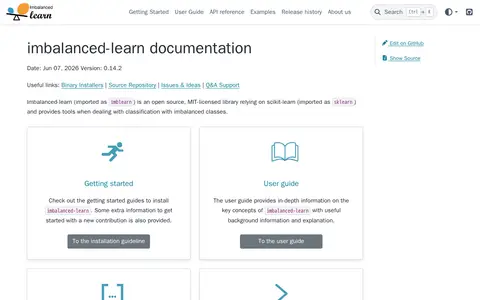
An open source, MIT-licensed Python library imported as imblearn that relies on scikit-learn. It provides tools for classification with imbalanced classes. The documentation includes installation guides, a user guide, an API reference and a gallery of examples.

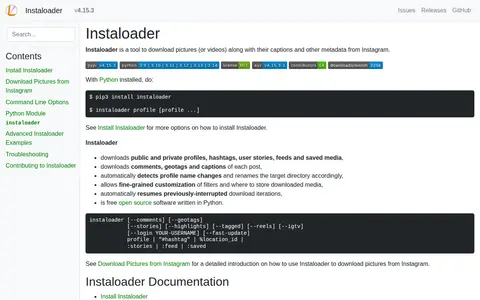
Instaloader is a free open source command line tool written in Python that downloads pictures, videos, captions and other metadata from Instagram. It downloads public and private profiles, hashtags, stories, feeds and saved media, and automatically resumes interrupted download iterations. The documentation states it is not affiliated with or endorsed by Instagram.
Intelligent Documentation Generator Agent is a Hugging Face Space that generates detailed documentation for Python code via pasting, uploading, or linking, and allows users to chat with the AI for code explanations and insights.
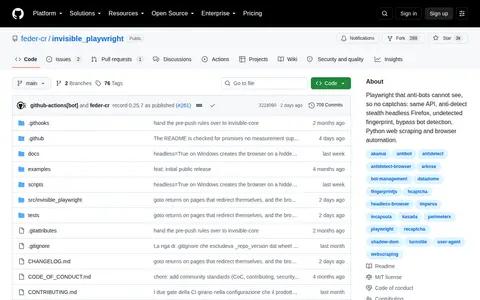
invisible_playwright is a Python package providing Playwright-compatible browser automation on an anti-detect Firefox patched at the C++ source level. It humanizes clicks, hover and drag actions in the driver. Supported platforms are Windows x86_64 and Linux x86_64/arm64; tracing, HAR, CDP and the API request context are out of scope.
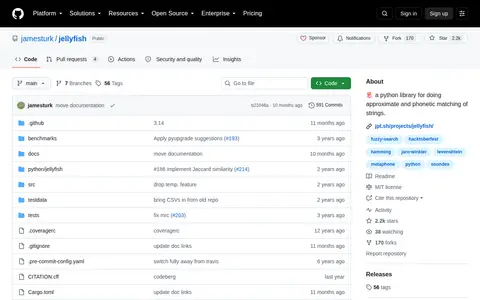
A python library for doing approximate and phonetic matching of strings.
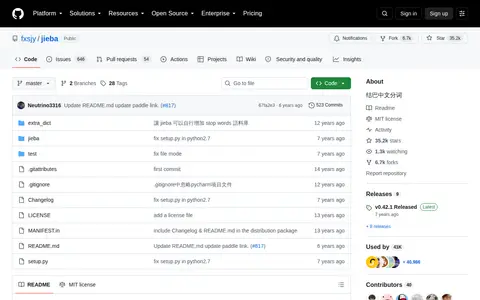
Jieba is a Chinese text segmentation module for Python. It supports four segmentation modes, including precise, full, search-engine and a paddle mode using PaddlePaddle, and offers keyword extraction based on TF-IDF and TextRank.
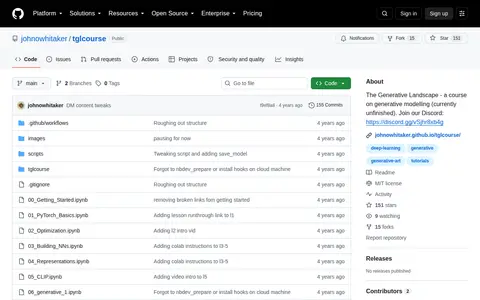
A course on generative modelling, currently unfinished, with the first approximately five lessons mostly done. It covers topics such as PyTorch basics, representations, CLIP, GANs, sequence modelling and transformers. No prior deep learning knowledge is assumed, though comfort with some Python and Jupyter Notebooks is expected.
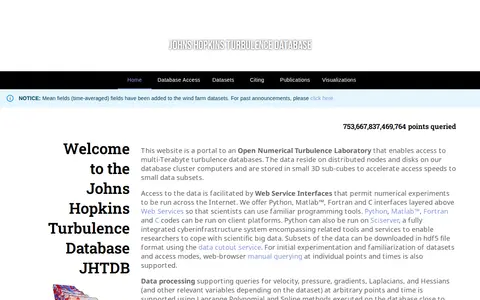
The Johns Hopkins Turbulence Database is a portal to an open numerical turbulence laboratory. It provides access to multi-terabyte turbulence databases stored in small 3D sub-cubes on distributed nodes, queried through web service interfaces. Python, Matlab, Fortran and C interfaces are offered, and data subsets can be downloaded in hdf5 format. Manual point queries are supported in a web browser.
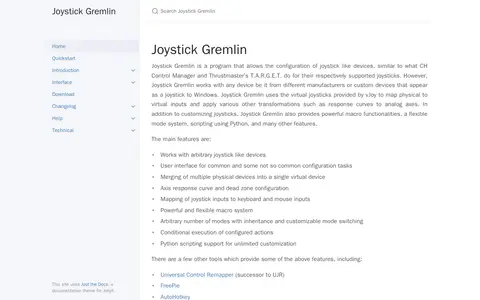
Joystick Gremlin is a program for configuring joystick-like devices from any manufacturer or custom devices recognized by Windows. It uses vJoy virtual joysticks to map physical inputs to virtual ones and applies transformations such as response curves to analog axes. It also offers macros, a mode system and Python scripting.
Jupyter Notebook is a web-based interactive computing platform combining live code, equations, narrative text, visualizations, and dashboards. It supports over 40 programming languages, including Python, R, Julia, and Scala, and notebooks can be shared via email, Dropbox, GitHub, and the Jupyter Notebook Viewer.
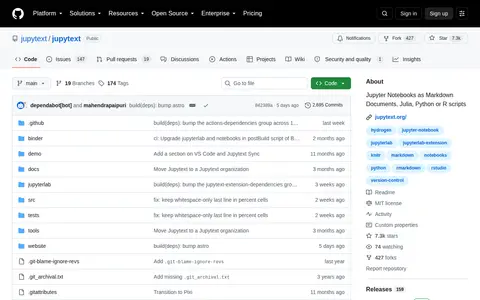
Jupyter Notebooks as Markdown Documents, Julia, Python or R scripts.
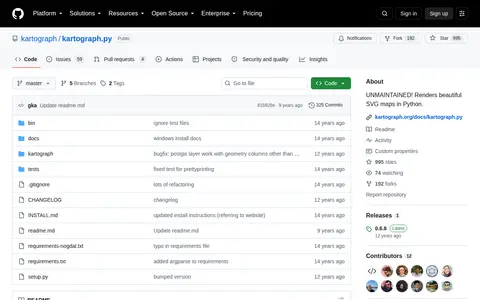
Kartograph.py is a Python library for rendering beautiful SVG maps. The project is currently unmaintained, but its source code remains available on GitHub. It allows users to create map visualizations programmatically.
Kashipara is a site for downloading programming projects with source code. It lists projects in languages including Java, PHP, C# .NET, Android, VB, Python and HTML, CSS and JavaScript, along with project ideas and templates. It also lists premium or paid projects.
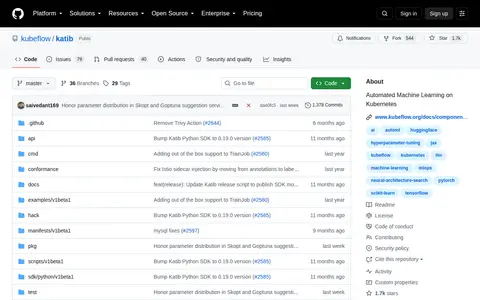
Kubeflow Katib is a Kubernetes-native project for automated machine learning (AutoML). It supports hyperparameter tuning, early stopping and neural architecture search, and is agnostic to machine learning frameworks, natively supporting frameworks such as TensorFlow, PyTorch and XGBoost. Training jobs can use any Kubernetes Custom Resources, with out-of-box support for Kubeflow Training Operator, Argo Workflows and Tekton Pipelines. A Python SDK simplifies creating tuning jobs.
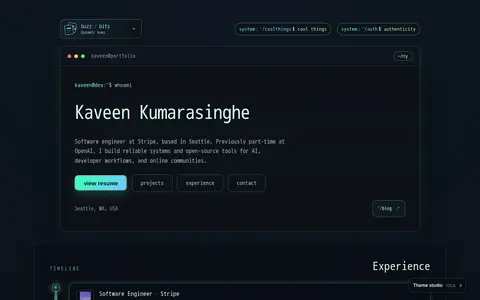
Kaveen Kumarasinghe is a software engineer in Seattle working at Stripe and previously part-time at OpenAI, building open-source tools and AI experiments. The site lists projects including GPTDiscord, an open-source Python integration that brings GPT conversations, image generation and document questions into Discord.
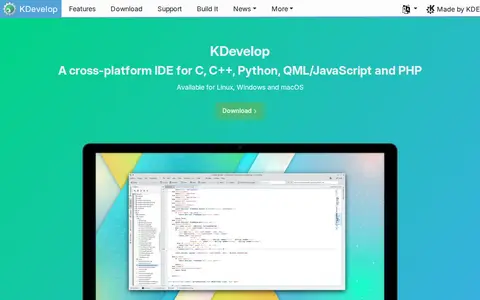
KDevelop is a cross-platform integrated development environment for C, C++, Python, QML/JavaScript and PHP. It parses projects to provide code completion, supports multiple projects in one session, and offers a Git plugin and documentation integration. It is available for Linux, Windows and macOS.
A beginner-friendly guide on using Keras to implement a simple neural network in Python. It walks through MNIST handwritten digit classification, covering setup, data preparation, building the model, compiling, training, testing and using the model. It is intended for complete beginners to Keras who have a basic background knowledge of neural networks.
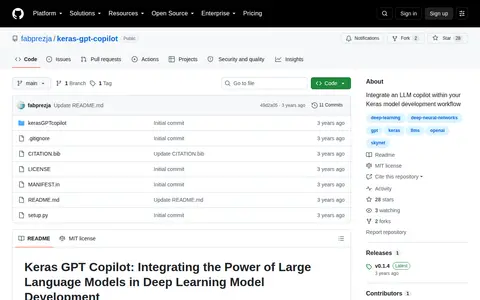
Keras GPT Copilot is a Python package that integrates an LLM copilot within the Keras model development workflow, generating feedback from model configuration, optimizer details and experiment results. It interacts with OpenAI's GPT models and offers a prompt-only mode for compatibility with other large language models.
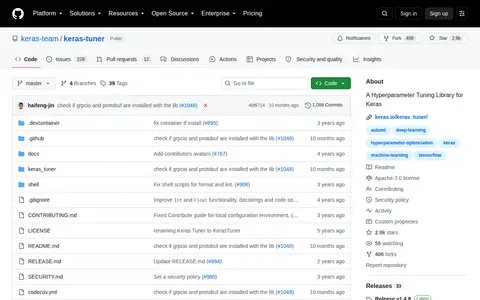
KerasTuner is a hyperparameter optimization framework for Keras. It provides a define-by-run syntax for configuring search spaces and includes Bayesian Optimization, Hyperband and Random Search algorithms. It requires Python 3.8+ and TensorFlow 2.0+.
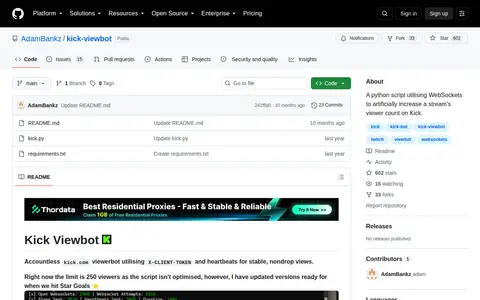
A python script utilising WebSockets to artificially increase a stream's viewer count on Kick.
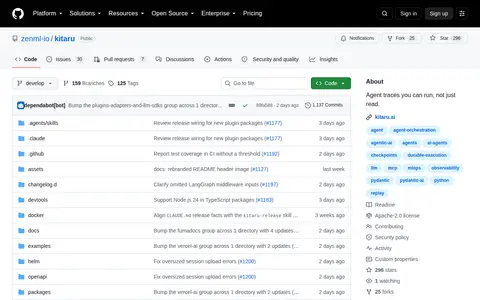
Kitaru is an open-source, self-hosted tool providing replay-based evaluations for AI agents. It records or imports production runs as sessions and replays them against a changed model, prompt, or code, with tool calls answered from the recording. It is available for Python and TypeScript and comes from the team behind ZenML.
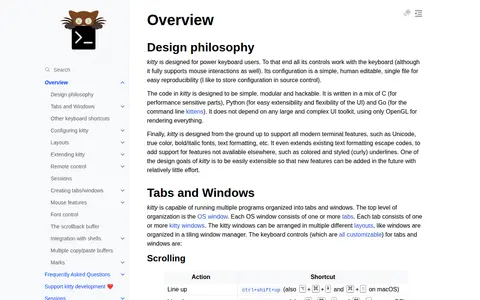
Kitty is a GPU-based terminal emulator designed for power keyboard users, with all controls accessible via keyboard and full mouse support. It runs multiple programs in tabs and windows with tiling layouts, and its configuration is a single human-editable file. Written in C, Python, and Go, it uses OpenGL for rendering and supports modern terminal features such as Unicode and true color.
KNIME Analytics Platform is free and open source data analytics software with a visual workflow builder for creating data science solutions. The page lists access, blending and transformation of data from any source, visualization and analysis, and saving, sharing and reuse of workflows. It also describes integrating scripting in Python, R and JavaScript and deploying solutions in the enterprise.