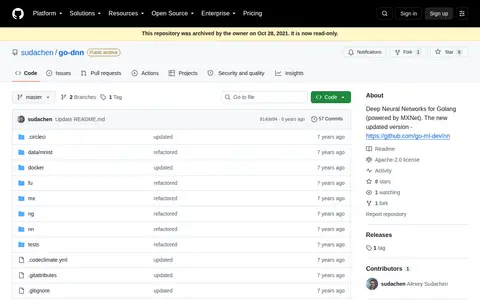
go-dnn is a GitHub repository that provides deep neural network functionality for the Golang programming language, powered by MXNet. The repository notes an updated version of the project is hosted at a separate GitHub location.
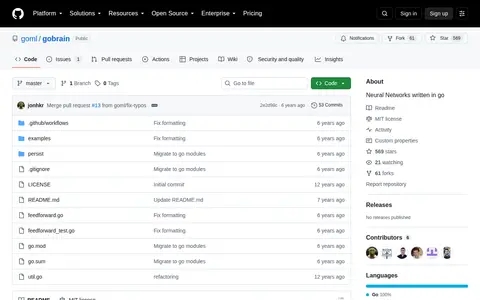
gobrain is an open-source GitHub repository maintained by the goml organization. It implements neural networks in the Go programming language. The repository includes documentation for getting started, recurrent neural network features, a changelog of updates, and project background information.
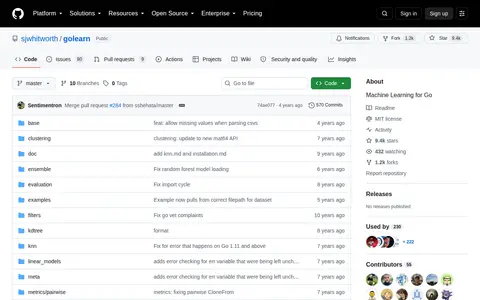
golearn is an open-source GitHub repository maintained by sjwhitworth. It provides machine learning capabilities for the Go programming language. The repository includes installation instructions, getting started guides, example use cases, and full project documentation.
Google Agent Development Kit (ADK) is an open toolkit for building powerful multi-agent systems and production-grade agents. It supports multiple programming languages including Python, JavaScript, Go, Java, and Kotlin, and offers features such as graph workflows, multi-agent collaboration, and integration with various AI models including Gemini, Claude, and OpenAI.
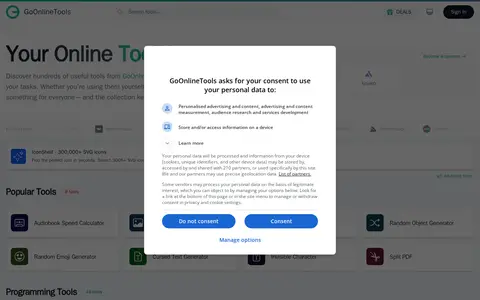
GoOnlineTools is a website offering a collection of online utilities grouped into categories such as programming, image, PDF, code converter, Instagram and YouTube tools. It also links to IconShelf, which offers searching of SVG icons, and the site states the collection keeps growing.
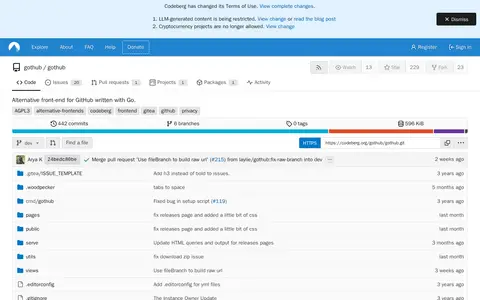
GotHub is an alternative front-end for GitHub written in Go, described as a work in progress. It uses no JavaScript and makes no requests to GitHub from the client side, and the project notes it is looking for new maintainers.
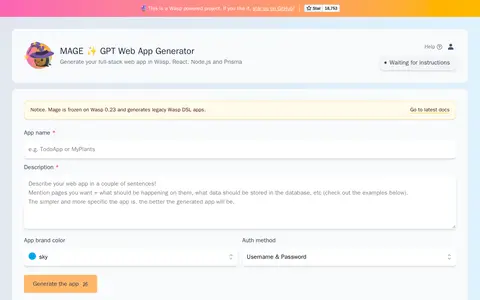
GPT Web App Generator, also referred to as MAGE, is a tool that generates full-stack web applications built with React, Node.js, and Prisma, using GPT and the Wasp full-stack framework. It is hosted at usemage.ai.
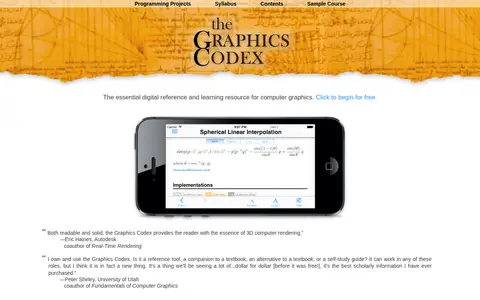
The Graphics Codex is a digital reference and learning resource for 3D computer graphics by Morgan McGuire. It contains 400 cross-referenced equation and diagram entries and 14 chapters on physically-based shading and rendering, with programming projects and citations to primary sources. It is a purchased app with monthly free updates.
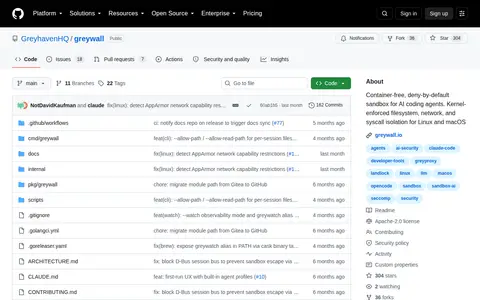
Greywall is a container-free, deny-by-default sandbox designed for AI coding agents. It provides kernel-enforced filesystem, network, and syscall isolation for Linux and macOS operating systems, and is hosted as a public repository on GitHub.
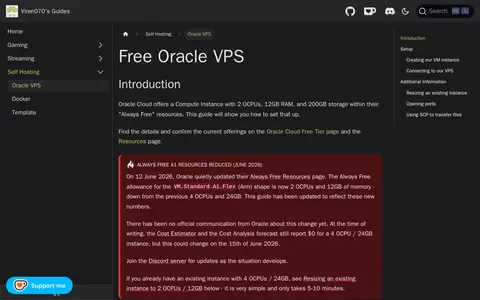
A guide on setting up a free Oracle Cloud VPS. It describes creating a VM instance with 2 OCPUs, 12GB RAM and 200GB storage under Oracle's Always Free resources, then connecting to the server, opening ports and transferring files with SCP.
Guild AI is the source repository for an open source toolkit that automates and optimizes machine learning experiments. It runs unmodified training scripts, captures each run result as a unique experiment, and automates trials using grid search, random search and Bayesian optimization.
h5i is a workspace for securing web applications through two approaches: finding vulnerabilities with AI agents and proving correctness with formal verification. It provides AI agents a toolkit for browser automation, HTTP traffic manipulation and reconnaissance, and includes h5i-app, an Axum-based Rust framework for verification with Lean 4.
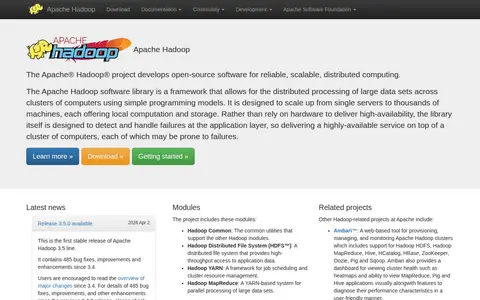
Apache Hadoop is an open-source project that develops software for reliable, scalable, distributed computing. Its library is a framework for distributed processing of large data sets across clusters of computers using simple programming models, scaling from single servers to thousands of machines with local computation and storage, and detecting failures at the application layer.
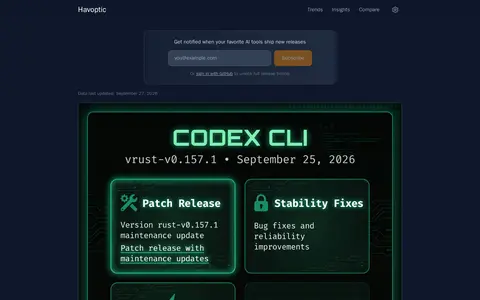
Havoptic tracks releases and changelogs for AI coding tools including Claude Code, Cursor, Codex CLI and Gemini CLI, summarizing each release in plain English with full version history and daily updates. A public API and MCP server documentation provide access to release data, cadence stats and feature comparisons without authentication.
Helix is a modal text editor built in Rust for the terminal. It uses multiple selections as a core editing primitive and integrates Tree-sitter for syntax highlighting, indent calculation and code navigation. Language server support provides completion, goto definition, documentation and diagnostics. Built-in features include a fuzzy finder, project-wide search and themes. A plugin system and GUI frontend are planned but not currently available.
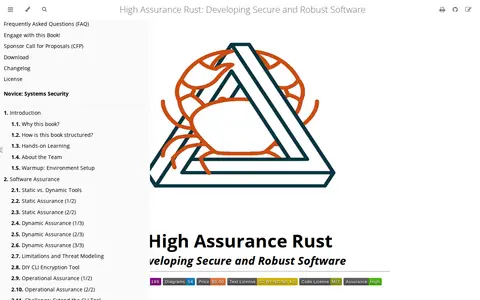
High Assurance Rust is a book about developing secure and robust software. It presents a project-based approach to systems programming and low-level software security, teaching Rust by re-implementing a major dynamic collection from its standard library. It discusses using open-source software assurance tools, including rustc, libFuzzer, rr, qemu, differential fuzzing and deductive verification.
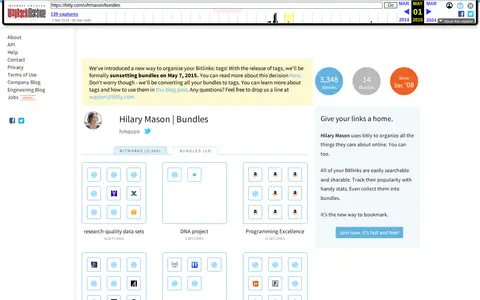
An archived Bitly bundles page belonging to Hilary Mason, listing link collections on topics such as research-quality data sets, programming, data stories and data science blogs. The page notes that Bitly sunset bundles on May 7, 2015 and converted them to tags.
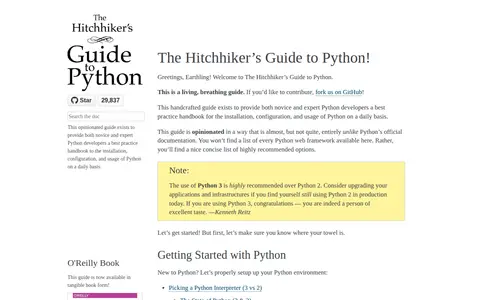
The Hitchhiker's Guide to Python is an opinionated guide to the Python programming language and a best practice handbook for installing, configuring and using Python daily. It covers topics such as getting started, development environments, writing and shipping code, and project documentation.
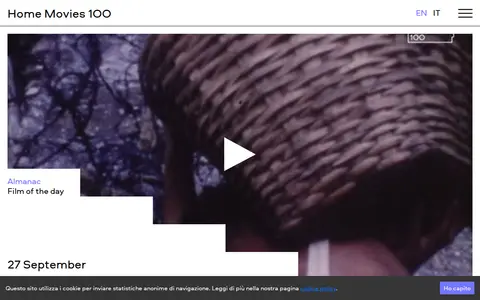
HomeMovies101 is a project of Fondazione Home Movies, the Italian National Family Film Archive, developed with cooperative partner Kiné and supported by the Italian Ministry of Culture’s Directorate General for Cinema and Audiovisual, Regione Emilia Romagna, and Legacoop mutual fund Coopfond. The project documents a century of small-format cinema in Italy, including family, amateur, experimental and artist films, through two streams: a collection of stories and archival materials on reduced film formats, and a 2023 online programming series that published one small-gauge film per day to explore 20th century Italian history.