llmstack.ai
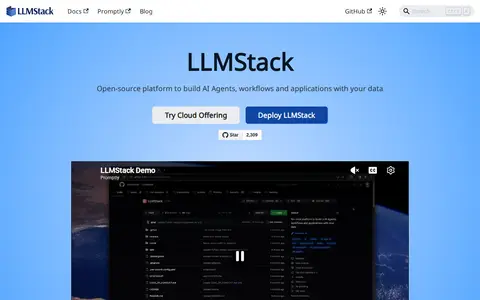
LLMStack is a no-code platform for building generative AI apps, chatbots and agents using imported data. It supports major model providers and lets users share apps publicly or restrict access with roles.
Directory
Published directory entries matching your search.
LLMStack is a no-code platform for building generative AI apps, chatbots and agents using imported data. It supports major model providers and lets users share apps publicly or restrict access with roles.

LLM Stats is an independent AI evaluations lab that measures performance on real-world tasks, with its profile pointing to llm-stats.com. The X account has 406 posts and was joined in February 2025.

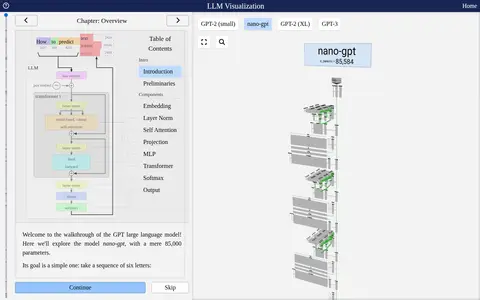
LLM Visualization is an AI chat or model resource for writing, coding, research, prompts, and assistant workflows.

Local is an AI tool or resource for chat, research, automation, media generation, or model development.

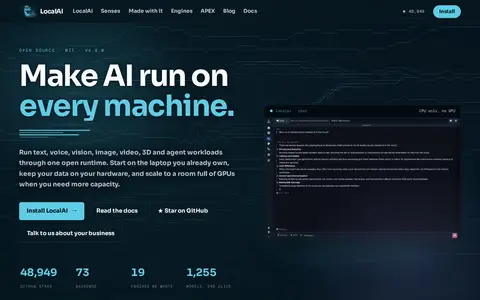
LocalAI is described as an open source AI engine that runs models, including LLMs, vision, voice, image and video, on any hardware without a GPU. It presents itself as a drop-in replacement for most upstream APIs and includes a built-in agent platform powered by LocalAGI, whose agents can reason, use tools and maintain memory. Image generation with Stable diffusion on CPU is also supported.

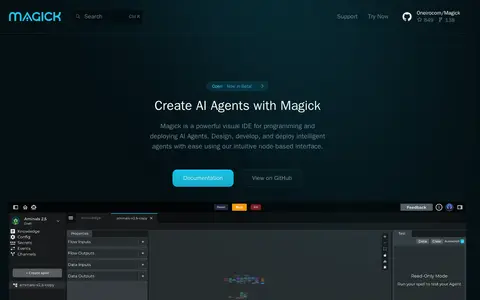
Magick is described as a visual IDE for programming and deploying AI agents, using a node-based interface. It is platform agnostic and open source, and is noted as being in beta. It includes document processing and real-time, event-driven behavior.

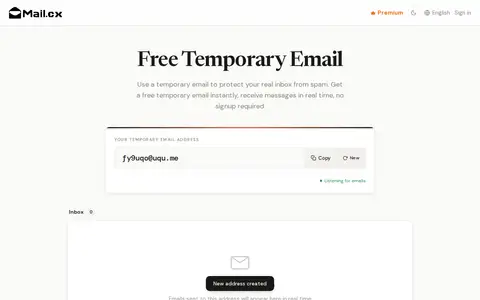
Mail.cx is a disposable temporary email service that generates a short-lived inbox without signup. The free web inbox keeps mail for one hour, with a Pro plan adding custom domains, 72-hour retention and REST API access. The API supports long-poll and SSE push for automated inbox polling and AI agents.
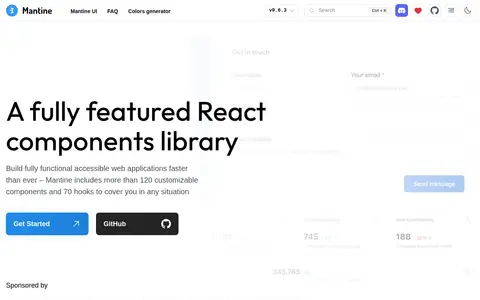
Mantine is a React components library with more than 120 customizable components and 70 hooks, focused on usability, accessibility and developer experience, with native dark theme support. It also provides LLM-optimized documentation, skills for AI agents and an MCP server for AI coding tools.

Manus is described as an action engine that executes tasks and automates workflows. Its features page lists building web and mobile apps, creating videos, slides and designs, research, and automations. A video feature uses Seedance 2.5 to generate shots, with editable tracks in a Video Editor.

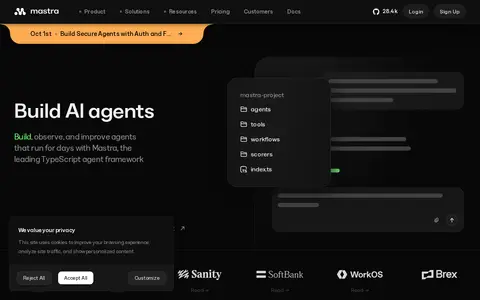
Mastra is a TypeScript AI framework for building agents and AI applications. It includes built-in memory, tool support, MCP compatibility, and observability features to support development from prototype to production. The framework also offers workflow tools, agent factory functionality, cloud deployment servers, and an agent builder for evaluation and iteration.

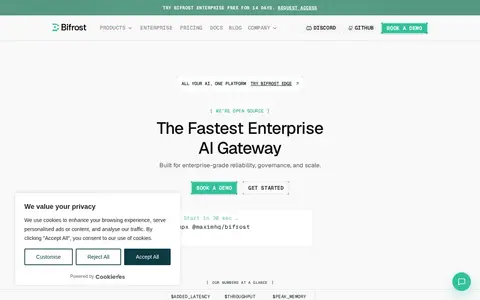
Bifrost is an open-source AI gateway for LLMs, MCP and agents, offered by Maxim AI. It provides routing, governance, guardrails and observability, and is described as a drop-in replacement for AI SDKs. Enterprise adds features such as SSO, RBAC, adaptive load balancing, cluster mode and in-VPC deployment, free for 14 days.

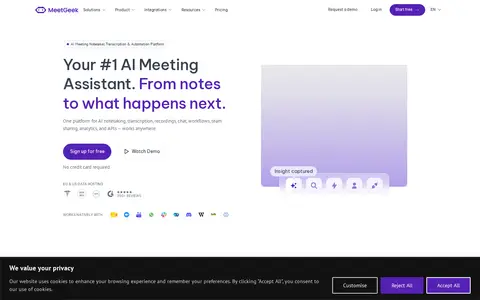
MeetGeek is an AI meeting platform that records, transcribes and summarizes meetings, then automates follow-up work. It can join online, hybrid or in-person meetings with a bot or bot-free through desktop, mobile and browser options. Meeting Skills and voice agents act on meetings through tools the user already uses. It is free to start.

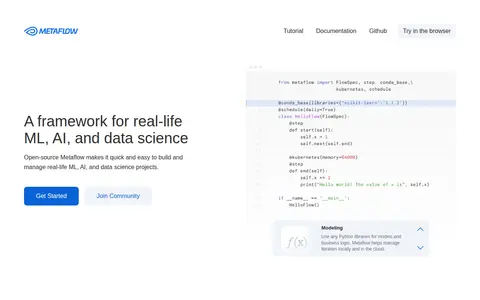
Metaflow is an open-source framework for building and managing ML, AI, and data science projects. It supports using Python libraries, orchestration workflows in Python, versioning, and scaling compute to the cloud, including GPUs. It was originally developed at Netflix and open-sourced in 2019.

📦 Open-Source Models (via Nebius).

Full-stack AI platform focused on multimodal agents and consumer-scale deployment.

Mistral offers frontier open-weight models that organizations can own and control. Models can be customized with Forge, deployed with Studio, and run on-premises, in a VPC, or in Mistral's cloud. It also provides Vibe, a personal AI agent available on web and mobile.

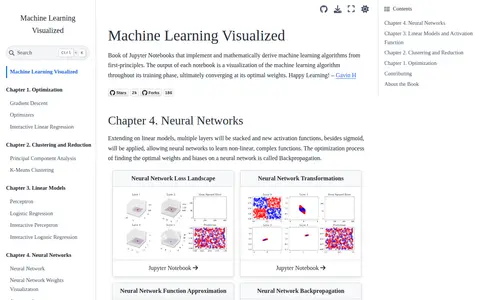
Machine Learning Visualized is a book of Jupyter Notebooks that implement and mathematically derive machine learning algorithms from first principles. Each notebook's output is a visualization of the algorithm during training, converging at its optimal weights. Chapters cover optimization, clustering and reduction, linear models and activation functions, and neural networks.

MLflow is an open source AI engineering platform for agents, LLMs, and ML models. It provides tools for debugging, evaluating, monitoring, and optimizing AI applications, including tracing, evaluation metrics, prompt management, an AI gateway, and an agent server. The project is released under the Apache 2.0 license.

mlsysbook supports machine learning models, deployment, inspection, datasets, or AI development workflows.

ModelScope supports machine learning models, deployment, inspection, datasets, or AI development workflows.

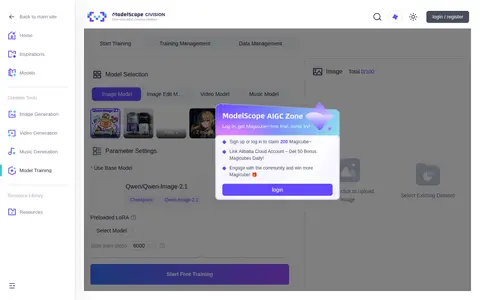
ModelScope Finetuning supports machine learning models, deployment, inspection, datasets, or AI development workflows.

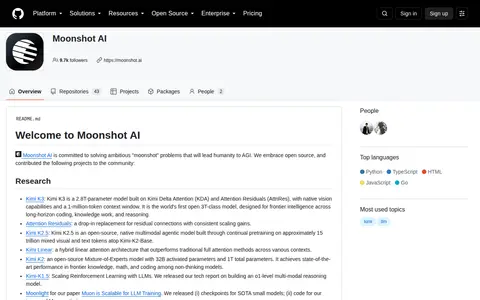
Moonshot AI is a GitHub organization focused on AI and machine learning research and development. As of the listing snapshot, it hosts 42 public repositories, with areas of work including research, benchmarks, agents, service infrastructure, and community engagement, and its code is available on GitHub.

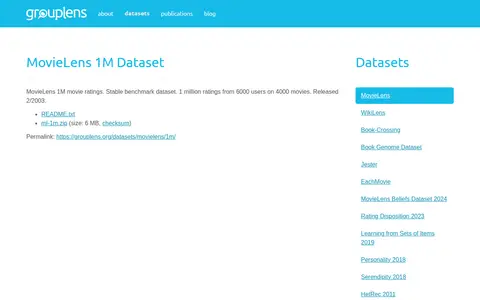
MovieLens 1M is a stable benchmark dataset of movie ratings containing 1 million ratings from 6000 users on 4000 movies, released in February 2003. It is available as a downloadable archive with a checksum and README.

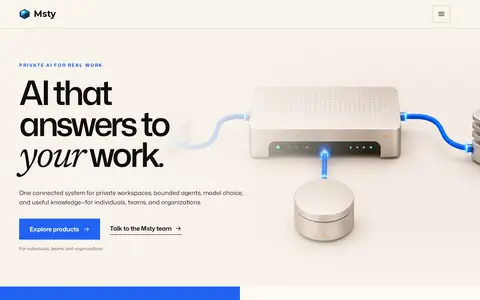
Msty describes private AI for individuals, teams and organizations, with four products connected as one system: Studio, a private AI workspace; Go, for agents; Nexus, a model gateway hub; and Stack, for organizing knowledge. Studio pricing lists a free tier and an Aurum plan billed yearly at $149 per user.