
github.com
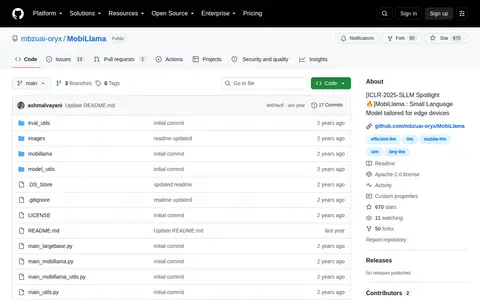
MobiLlama is a small language model tailored for edge devices. It was selected as a spotlight presentation at the ICLR 2025 SLLM Workshop, and its code is hosted on GitHub.
Directory
Published directory entries matching your search.
MobiLlama is a small language model tailored for edge devices. It was selected as a spotlight presentation at the ICLR 2025 SLLM Workshop, and its code is hosted on GitHub.

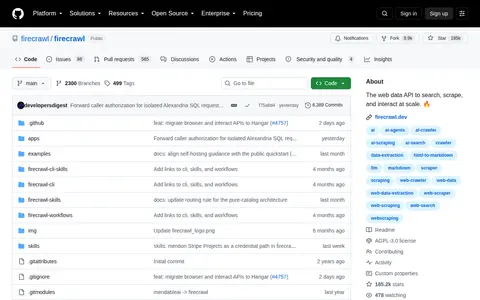
Turn entire websites into LLM-ready markdown or structured data. Scrape, crawl and extract with a single API.

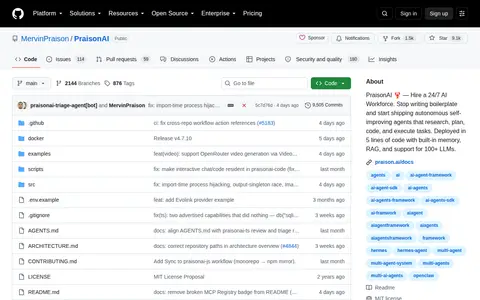
PraisonAI is an open-source project hosted on GitHub under the MervinPraison/PraisonAI repository. It enables the deployment of autonomous, self-improving AI agents capable of researching, planning, coding, and executing tasks. The tool includes built-in memory and retrieval-augmented generation (RAG) capabilities, supports over 100 large language models, and can be deployed with 5 lines of code.

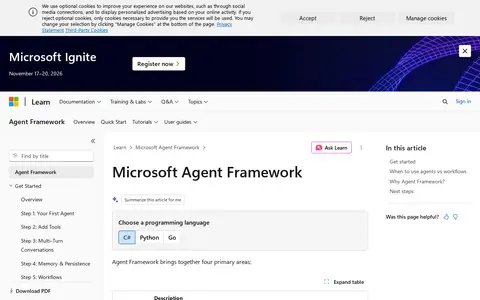
Microsoft Agent Framework is a framework for building AI agents and multi-agent workflows in .NET, Python, and Go. It provides agents that use LLMs to process inputs, call tools and MCP servers, and generate responses, plus functional and graph-based workflows that connect agents and functions through explicit execution paths. It includes model clients, agent sessions, context providers, middleware, and MCP clients.

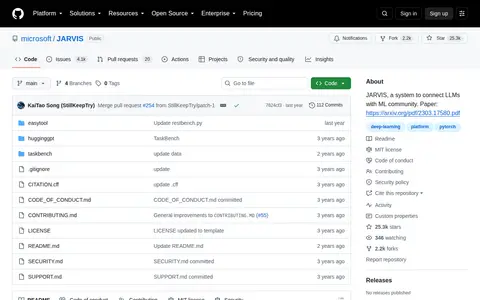
JARVIS, a system to connect LLMs with ML community.

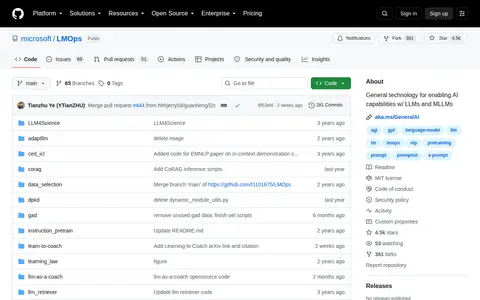
General technology for enabling AI capabilities w/ LLMs and MLLMs.

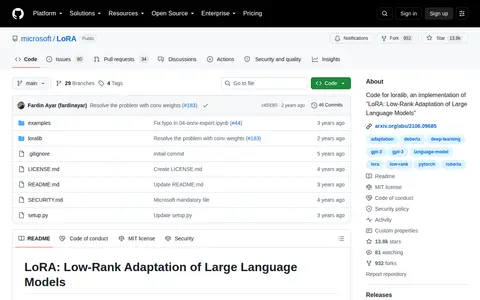
Repository containing the source code of the Python package loralib and examples of integrating it with PyTorch models, such as those in Hugging Face. LoRA learns pairs of rank-decomposition matrices while freezing the original weights, reducing the number of trainable parameters. PyTorch is the only supported framework for now.

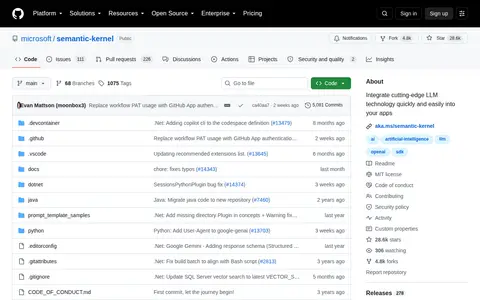
Model-agnostic SDK for building, orchestrating and deploying AI agents and multi-agent systems, with built-in support for OpenAI, Azure OpenAI, Hugging Face and Nvidia. It offers tools/plugins, memory, planning, vector database integrations and a process framework. Microsoft states that Semantic Kernel is now Microsoft Agent Framework.

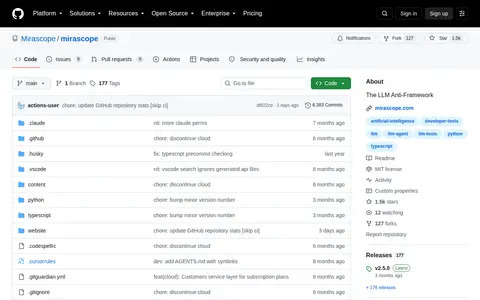
Mirascope is a project labeled the LLM Anti-Framework that provides one unified interface for using frontier LLMs. Its examples show calling LLMs with a decorator, getting structured output via Pydantic models, and building an agent with tools. It is organized as a monorepo with Python and TypeScript implementations plus documentation.

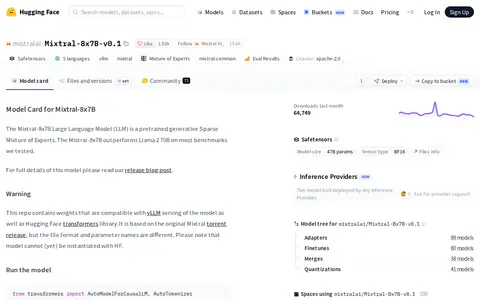
Mixtral-8x7B-v0.1 is a pretrained generative Sparse Mixture of Experts large language model developed by Mistral AI, hosted on the Hugging Face platform under the mistralai/Mixtral-8x7B-v0.1 repository, and released under the Apache 2.0 license.

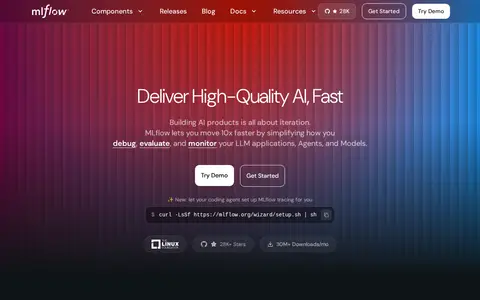
MLflow is an open source AI engineering platform for agents, LLMs, and ML models. It provides tools for debugging, evaluating, monitoring, and optimizing AI applications, including tracing, evaluation metrics, prompt management, an AI gateway, and an agent server. The project is released under the Apache 2.0 license.

Helps find, analyze or synthesize information for research and knowledge discovery.
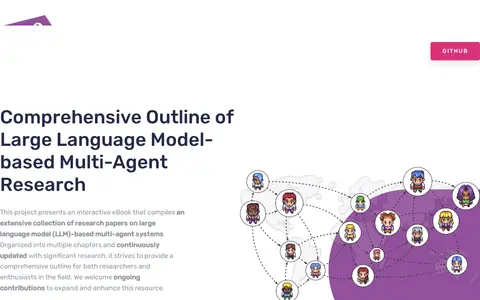
An interactive eBook compiling research papers on large language model-based multi-agent systems, organized into multiple chapters and updated with new research. It covers task-solving and social-simulation directions, and was initiated by the ChatDev Group at Tsinghua University.

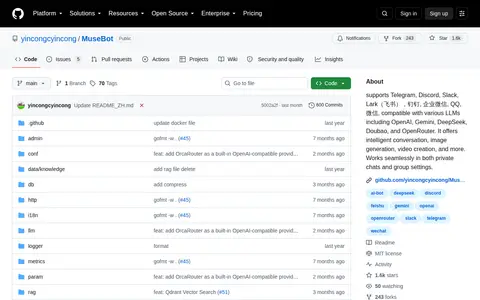
supports Telegram, Discord, Slack, Lark(飞书),钉钉, 企业微信, QQ, 微信, compatible with various LLMs including OpenAI, Gemini, DeepSeek, Doubao, and OpenRouter. It offers intelligent conversation, image generation, video creation, and more. Works seamlessly in both private chats and group settings.
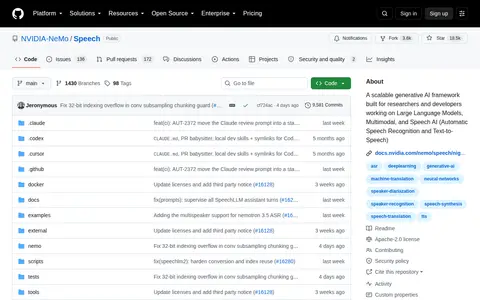
NVIDIA NeMo Speech is a framework built for researchers and developers working on speech AI, including automatic speech recognition and text-to-speech. The repository provides open weight checkpoints and demos through a Hugging Face collection. It is licensed under Apache-2.0 and has pivoted to focus on audio, speech, and multimodal LLMs.
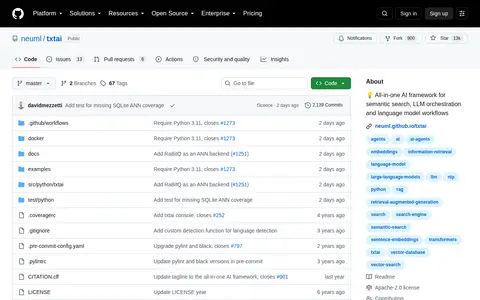
neuml/txtai is an all-in-one AI framework for semantic search, LLM orchestration, and language model workflows. It is open source and hosted on GitHub. The framework provides tools for building applications that understand and generate text.
Nexdata is a data service and annotation platform offering services including annotation, fine-tuning, RLHF, red teaming, in-cabin sensing datasets, LiDAR data labeling, and LLM annotation. It provides a human-computer interaction semi-automatic annotation platform with flexible deployment options for public cloud or privatized deployment, and multi-level quality inspections.

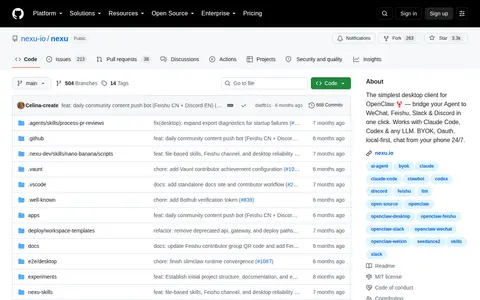
The simplest desktop client for OpenClaw 🦞 — bridge your Agent to WeChat, Feishu, Slack & Discord in one click. Works with Claude Code, Codex & any LLM. BYOK, Oauth, local-first, chat from your phone 24/7.

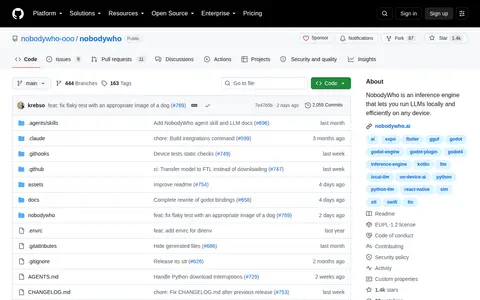
NobodyWho is an inference engine that runs LLMs locally and offline on any device, powered by llama.cpp. Bindings are available for Kotlin, Swift, React Native, Flutter, Python and Godot. It supports GGUF models, tool calling, multimodal input, text-to-speech and speech-to-text.
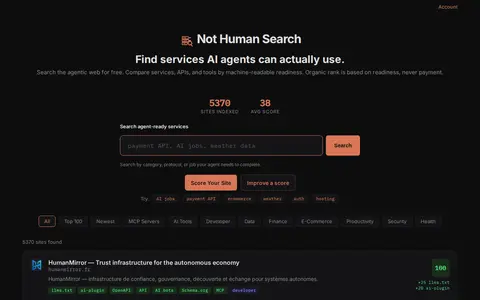
Not Human Search scores websites from 0 to 100 on seven agentic signals, including llms.txt, OpenAPI, MCP and Schema.org. It also indexes agent-ready sites and lets users search for services, APIs and tools by machine-readable readiness. Organic rank is said to be based on readiness rather than payment.

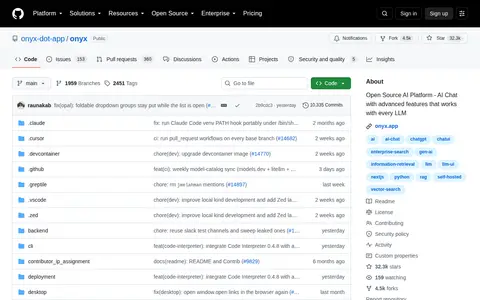
Onyx is an open-source AI platform that connects to applications to index and surface knowledge, with self-hosted deployment options. It provides agentic RAG search, deep research reports, custom agents, web search, a secure sandbox for code execution, artifacts, and voice mode. It works with major LLMs.

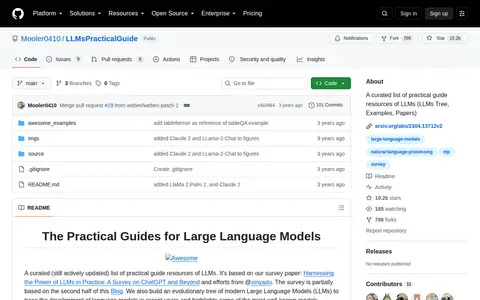
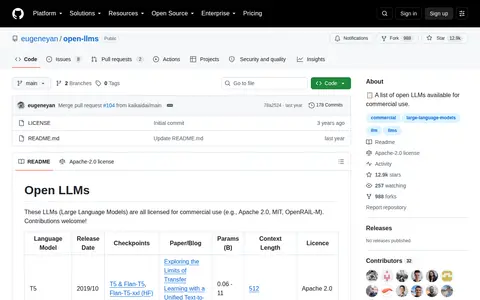
Open LLMs is a public repository that curates a list of open large language models (LLMs) available for commercial use. It also includes related datasets for LLM pre-training, instruction-tuning, and alignment-tuning, and is hosted under the eugeneyan GitHub organization.

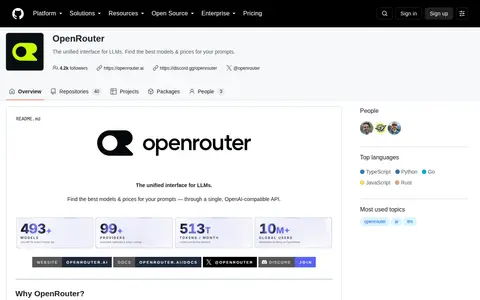
OpenRouterTeam is the GitHub organization behind OpenRouter, described as a unified interface for LLMs. The organization publishes open source SDKs for TypeScript, Python and Go, plus agent tooling, and maintains the Mintlify-hosted documentation repository for openrouter.ai/docs.

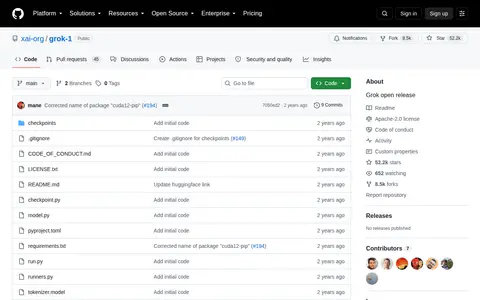
This GitHub repository hosts the open-source release of xAI's Grok-1 model. It provides model specifications, guidance for downloading model weights, associated license information, and accepts community contributions to the project.