
github.com
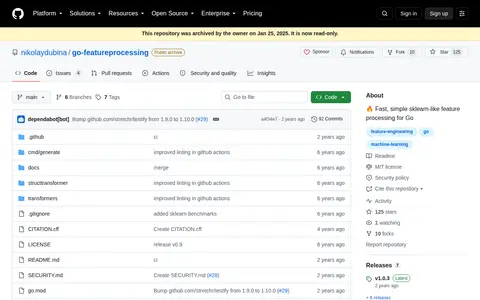
Fast and convenient feature processing for low latency machine learning in Go.
Directory
Published directory entries matching your search.
Fast and convenient feature processing for low latency machine learning in Go.

Open-source project that provides machine-learning models, research, training resources, or evaluation tools.

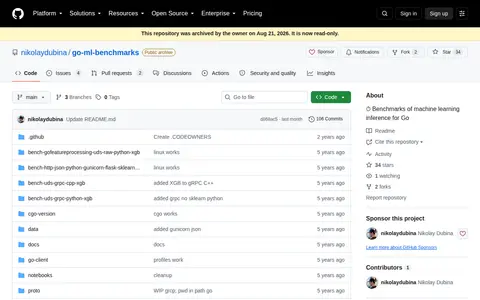
go-ml-benchmarks is a repository of machine learning inference benchmarks for Go, focused on tabular models such as XGBoost. It compares typical implementations using different transports, encodings, preprocessing libraries and models, using the Titanic dataset. The repository was archived by the owner and is now read-only.

An open source Go transpiler for machine learning models.

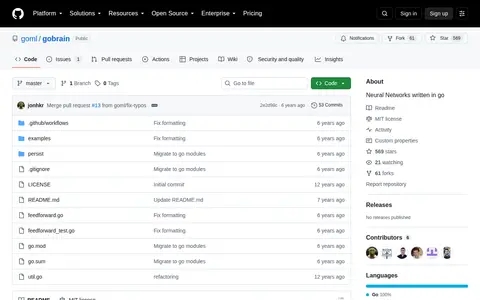
gobrain is an open-source GitHub repository maintained by the goml organization. It implements neural networks in the Go programming language. The repository includes documentation for getting started, recurrent neural network features, a changelog of updates, and project background information.

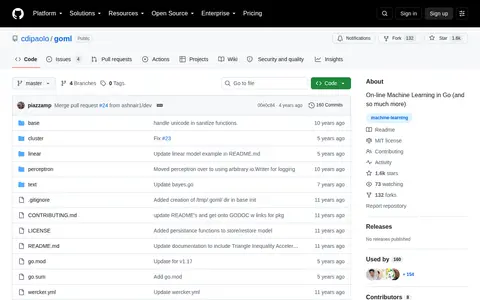
Machine learning library written in pure Go.

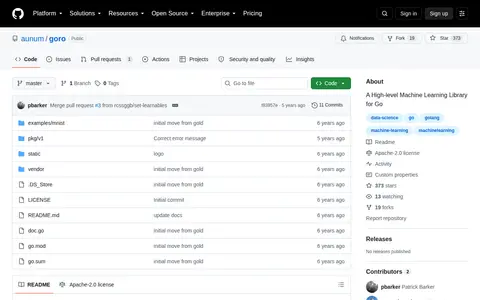
A high-level machine learning library in the vein of Keras.

An offline recommender system backend based on collaborative filtering written in Go.

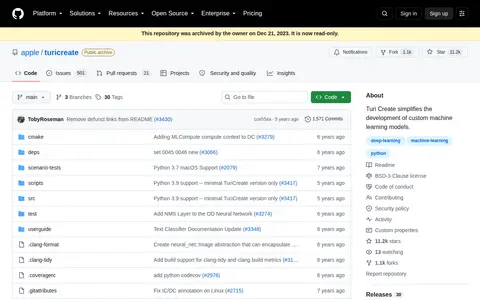
Turi Create is a toolkit that simplifies the development of custom machine learning models, offered as an archived repository. It supports tasks such as recommendations, object detection, image classification, image similarity and activity classification, and can export models to Core ML. The repository was archived by its owner on December 21, 2023, and is now read-only.

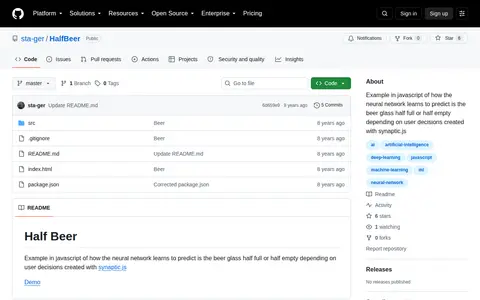
Half Beer is an open-source JavaScript example project that demonstrates a neural network learning to predict whether a beer glass is perceived as half full or half empty based on user decisions. It is built using the synaptic.js neural network library.

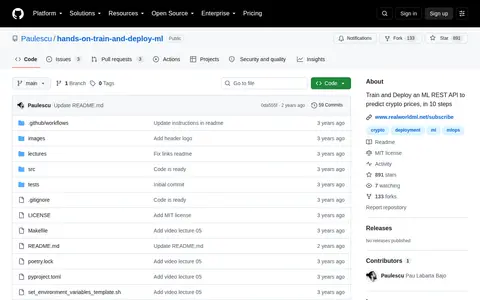
A hands-on course to train and deploy a serverless API that predicts crypto prices.

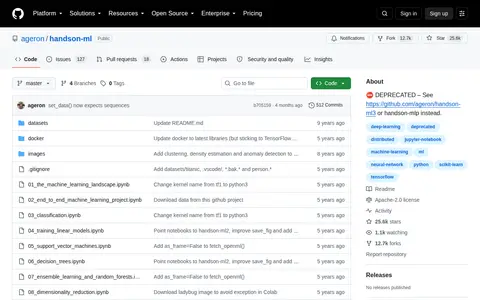
Fundamentals of machine learning in python.

Open-source project that provides machine-learning models, research, training resources, or evaluation tools.

Open-source project that provides machine-learning models, research, training resources, or evaluation tools.

Distributed deep learning training framework for TensorFlow, Keras, PyTorch, and Apache MXNet.

Hypernets is a general AutoML framework for building automatic optimization tools for machine learning frameworks and libraries, including tensorflow, keras, pytorch, sklearn, lightgbm and xgboost. It offers an abstract search space representation covering hyperparameter optimization and neural architecture search, with optimization algorithms such as evolution algorithm and Monte Carlo tree search.

Hyperopt is an open-source Python library available on GitHub, designed to provide distributed asynchronous hyperparameter optimization functionality for tuning machine learning models in development workflows, production environments, as well as research settings.

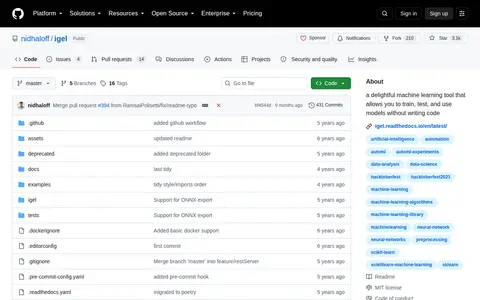
A delightful machine learning tool that allows you to train/fit, test and use models without writing code.

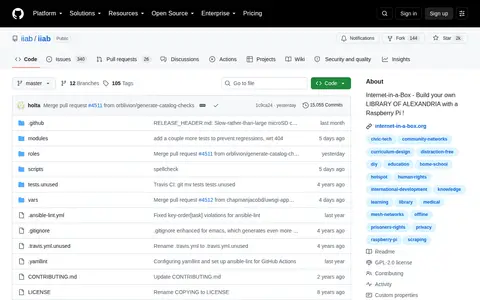
Internet-in-a-Box (IIAB) is an open-source, community-driven project that enables users to build an affordable, offline digital library server, most commonly using a Raspberry Pi. It creates a local learning hotspot that provides access to free educational content including Wikipedia in multiple languages, thousands of Khan Academy videos, zoomable OpenStreetMap, e-books and other resources without an internet connection. It includes tools to arrange content packs, offers 30+ educational apps, supports mesh networking for local knowledge exchange, and is intended for schools, clinics, libraries, prisons and community use.

Open-source project that provides machine-learning models, research, training resources, or evaluation tools.

Open-source project that provides machine-learning models, research, training resources, or evaluation tools.

Open-source project that provides machine-learning models, research, training resources, or evaluation tools.

Open-source project that provides machine-learning models, research, training resources, or evaluation tools.

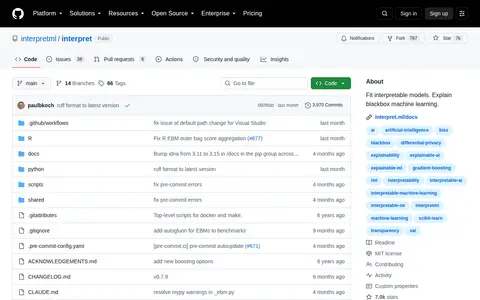
InterpretML is an open-source package that collects machine learning interpretability techniques. It allows training interpretable glassbox models and explaining blackbox systems, to understand a model's global behavior or the reasons behind individual predictions. It includes the Explainable Boosting Machine, developed at Microsoft Research, plus other glassbox models and blackbox explainers.