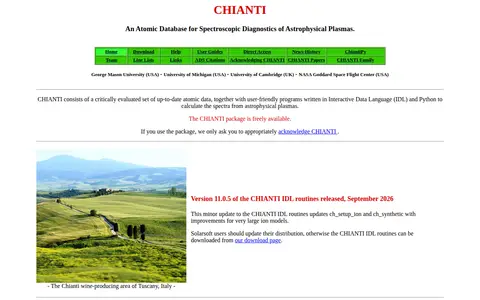
CHIANTI is an atomic database for spectroscopic diagnostics of astrophysical plasmas, combining a critically evaluated set of up-to-date atomic data with programs in Interactive Data Language (IDL) and Python to calculate plasma spectra. The package is freely available, with a request to appropriately acknowledge CHIANTI when used.
Directory
Search results
Published directory entries matching your search.
The National Astronomical Data Center (NADC) is a data portal listing domestic astronomical datasets, including catalogs and images from surveys such as AST3, BASS and LAMOST. It also provides links to external services including Gaia, Vizier, NED, IRSA, MAST and arXiv.
Clarkson University is an educational institution whose main 640-acre wooded and waterfront campus is located in Potsdam, New York, near Adirondack Park. It offers hands-on learning tailored to individual students, and its academic programs hold a spot among the Top 50 Best Value Schools in U.S. News college rankings. The university hosts fall open house events for prospective students.
The Community Coordinated Modeling Center is a multi-agency partnership at NASA Goddard Space Flight Center that supports research and development for space science and space weather models. It provides free access to research models through an automated model run system, along with online visualization and analysis tools, model validation, forecasting support, and education resources.
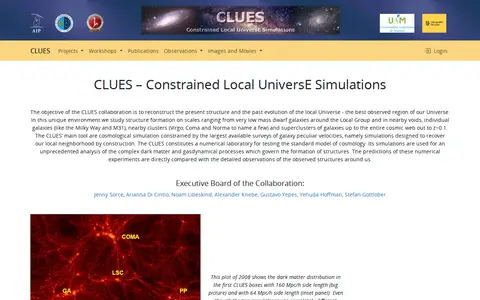
CLUES, the Constrained Local UniversE Simulations collaboration, works to reconstruct the present structure and past evolution of the local Universe. Its main tool is cosmological simulations constrained by surveys of galaxy peculiar velocities, used to analyze dark matter and gasdynamical processes in structure formation and compare predictions with observations of nearby structures.
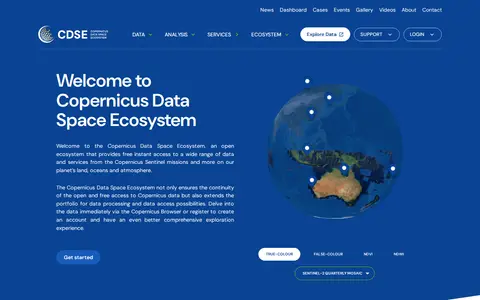
The Copernicus Data Space Ecosystem is an open platform offering free instant access to data and services from the Copernicus Sentinel missions and other Earth observation sources covering land, oceans and atmosphere. It provides infrastructure, services and tools for accessing and processing Sentinel data, and allows users to integrate their own datasets and deploy applications.
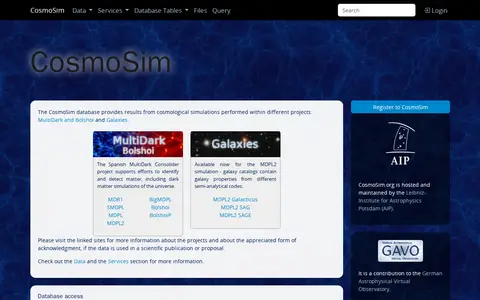
CosmoSim is a database providing results from cosmological simulations performed within the MultiDark and Bolshoi projects and Galaxies. It reports dark matter simulations of the universe and galaxy catalogs for the MDPL2 simulation. The database can be queried by entering SQL statements directly into a query interface or through scripted access; registration provides full access.
Crash Course is educational content available on YouTube, offering a wide variety of academic subjects including AP high school curriculum topics such as astronomy, U.S. history, anatomy & physiology, biology, chemistry, and more, presented by various hosts.
The Crustal Dynamics Data Information System (CDDIS) is a NASA data system that has migrated to the Earthdata platform, with its former page redirecting users to the new CDDIS location on the Earthdata website.
Davangere University is a university with campuses at Jnanagangotri, Turuvanur and Hariyabbe. Its site covers administration, statutory officers, academic council and affiliated colleges, along with student admission, examination circulars, time tables and results. It also lists research and development units, a training and placement cell and student welfare services.
The Digital Lunar Orbiter Photographic Atlas of the Moon reproduces the 675 plates of the Lunar Orbiter Photographic Atlas by Bowker and Hughes (NASA SP-206). The digital archive adds multiple search capabilities for locating images and features, updated surface feature information, and companion images with feature annotation. The annotated overlay symbols are intended only as locators, not for precise measurements.
Drexel University is a research university in Philadelphia, Pennsylvania. It delivers experiential, technology-infused education via a co-operative education program. The university reports 96% of its undergraduate graduates are employed full-time or enrolled in graduate or professional education within one year of graduation, and it ranks in the top 50 U.S. national universities per 2027 U.S. News & World Report rankings.
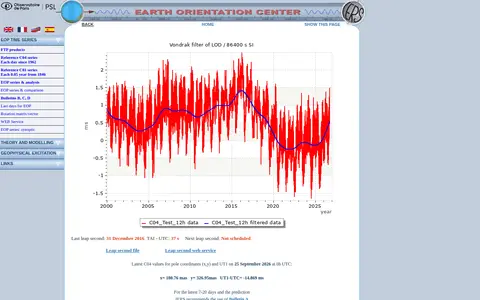
The Earth Orientation Center is the EOP Product Centre of the International Earth Rotation and Reference Systems Service. It collects time series of Earth Orientation Parameters from astro-geodetic techniques, archives them for FTP and web access, and computes combined solutions including the IERS C04 and C01 series. It also produces DUT1 and leap second announcements.
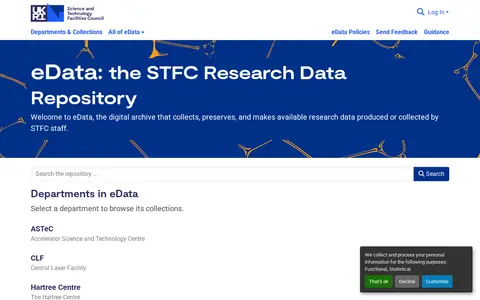
eData is the STFC Research Data Repository, a digital archive that collects, preserves and makes available research data produced or collected by STFC staff. Visitors can browse collections by department, including ASTeC, CLF, the Hartree Centre, ISIS, NQCC, PPD, RAL Space, SCD and UKATC.
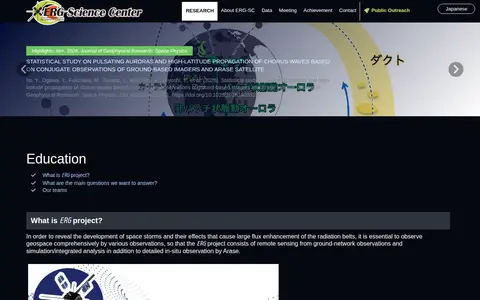
The ERG Science Center is run by ISAS/JAXA and ISEE, Nagoya University, as a joint research center for space science. It archives data related to the ERG project and releases the data. The project combines Arase satellite in-situ observation with ground-network remote sensing and simulation or integrated analysis to study space storms and radiation belt flux enhancement.
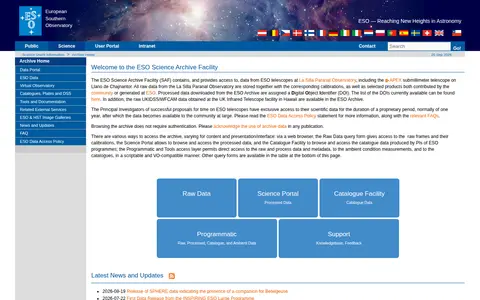
The ESO Science Archive Facility stores and provides access to data from ESO telescopes at the La Silla Paranal Observatory, including the APEX submillimeter telescope. It holds raw data with corresponding calibrations and selected contributed or ESO-generated products. Principal Investigators have exclusive access to their data during a proprietary period, normally one year. Browsing does not require authentication.
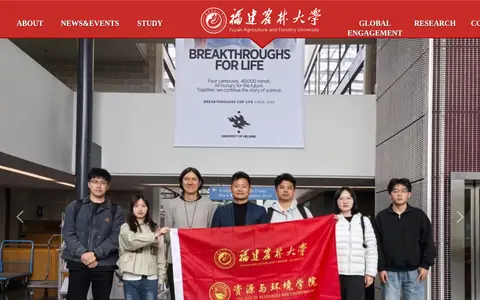
Fujian Agriculture and Forestry University up in Fuzhou, China is the move for Agricultural and Biological Sciences and Environmental Science.
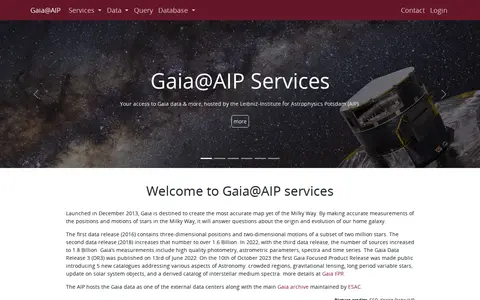
Gaia@AIP is a data centre hosted by the Leibniz-Institute for Astrophysics Potsdam that provides access to official Gaia mission data releases, including DR1, DR2, EDR3 and DR3. It also offers auxiliary catalogues for cross-matching and community contributions, together with query tools, scripting access and visualisation services.
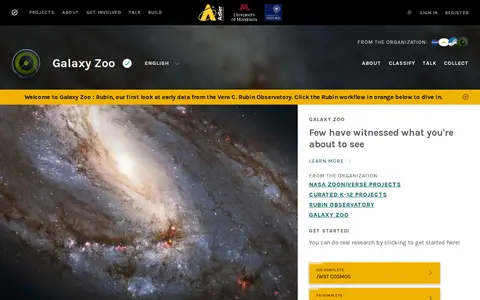
Galaxy Zoo is a Zooniverse volunteer project where participants classify telescope images of distant galaxies by shape to help astronomers understand galaxy formation. Early data from the Vera C. Rubin Observatory is shown in the Rubin workflow. Volunteers' classifications are backed up by the work of others.
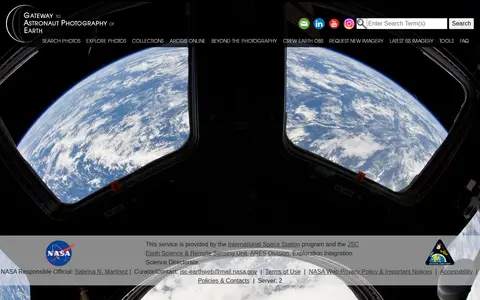
The Gateway to Astronaut Photography of Earth is a service provided by the International Space Station program and NASA's JSC Earth Science & Remote Sensing Unit. It offers access to searchable astronaut photography of Earth, including photo collections, ArcGIS Online resources, and latest International Space Station imagery, alongside tools and FAQ content.
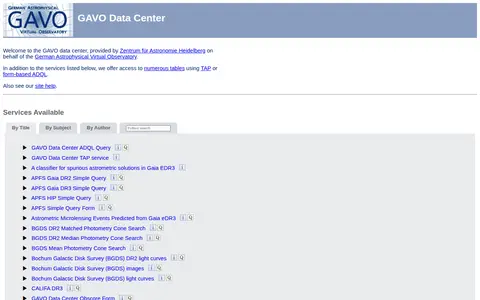
The GAVO Data Center is operated by Zentrum für Astronomie Heidelberg for the German Astrophysical Virtual Observatory. It provides access to numerous tables via TAP or form-based ADQL and lists services including ADQL queries, cone searches, spectra and catalogues such as Gaia, Hipparcos and ROSAT data.
The German Jordanian University is a university with schools including business, applied humanities and social sciences, applied medical sciences, applied technical sciences, architecture and built environment, computing, sustainable systems engineering, and nursing. It operates academic centers and a technology, research, and innovation park, and offers transnational study programs hosted with THWS.
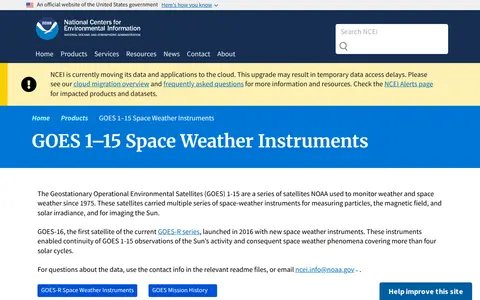
The GOES 1–15 Space Environment Monitor covers space-weather instruments carried on NOAA's GOES 1–15 satellites, used since 1975 to monitor weather and space weather. The instruments measured particles, the magnetic field and solar irradiance and imaged the Sun. The page provides documentation, data and instrument details, noting that data anomalies should be checked against other sources.
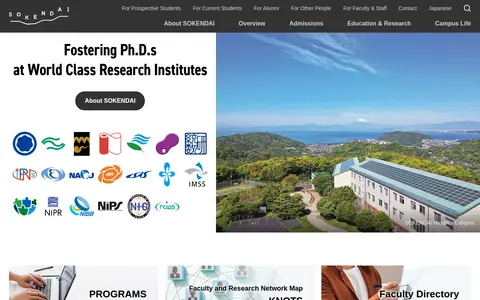
SOKENDAI, the Graduate University for Advanced Studies, is a Japanese national graduate university founded in 1988. It offers 20 programs in collaboration with inter-university research institutes, which provide large-scale facilities, data and materials, and it trains independent researchers.