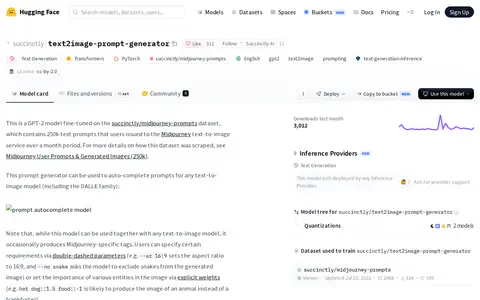

This is a GPT-2 model fine-tuned on the succinctly/midjourney-prompts dataset of 250k text prompts users issued to Midjourney over a month. It can auto-complete prompts for any text-to-image model, though it occasionally produces Midjourney-specific tags. Users can specify requirements via double-dashed parameters and entity weights.
Directory
Search results
Published directory entries matching your search.
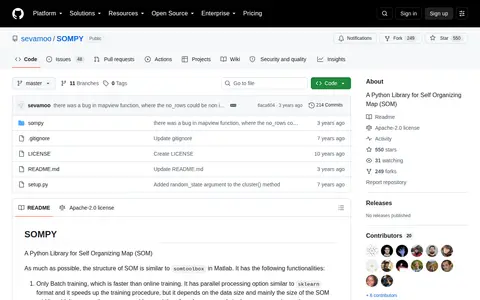
SOMPY is a Python library for self-organizing maps structured similarly to somtoolbox in Matlab. It offers only batch training, PCA or RandomPCA initialization, component plane visualization, hitmap and U-Matrix visualization, and 1-d or 2-d SOM with rectangular, planar grid. It supports function approximation and predictions, mostly using Sklearn.
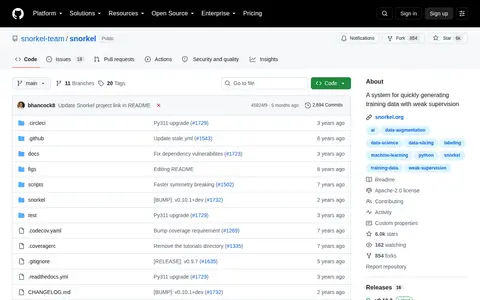
Snorkel is a system for quickly generating training data with weak supervision, released under an Apache-2.0 license and written in Python. The project started at Stanford in 2015 to programmatically label, build, and manage training data. The team now focuses on Snorkel Flow, an end-to-end AI application development platform based on the core ideas behind Snorkel.
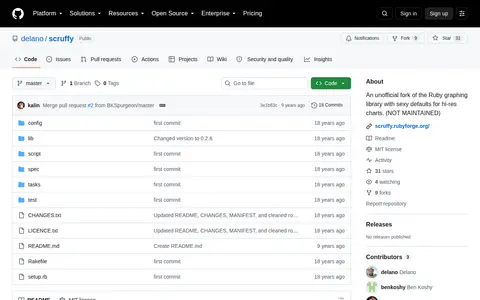
Scruffy is an unofficial fork of the Ruby graphing library, based on the official 0.2.5 release, intended for hi-resolution graphs and charts. It renders to SVG or bitmap formats such as PNG and JPG. The fork is marked as not maintained.
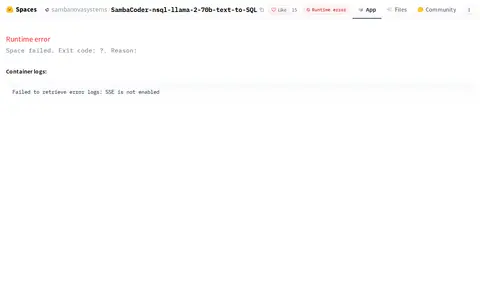
Analyzes structured data and helps produce queries, insights or visualizations.

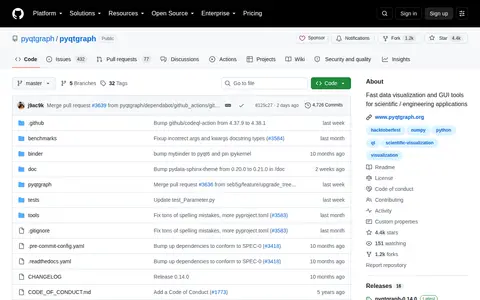
PyQtGraph is a pure-Python graphics library that uses the Qt framework. It is intended for mathematics, scientific and engineering applications, and relies on numpy for number crunching, Qt's GraphicsView for 2D display and OpenGL for 3D display. It supports Python 3.12+, Qt 5.15 or 6.8+, and numpy 2.2+.
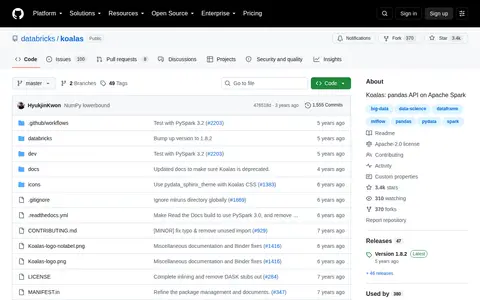
Koalas, from Databricks, implements the pandas DataFrame API on top of Apache Spark. The repository is marked deprecated and in maintenance mode; Koalas supports Apache Spark 3.1 and below, and PySpark is recommended directly for Spark 3.2 and above. It is available under the Apache-2.0 license.
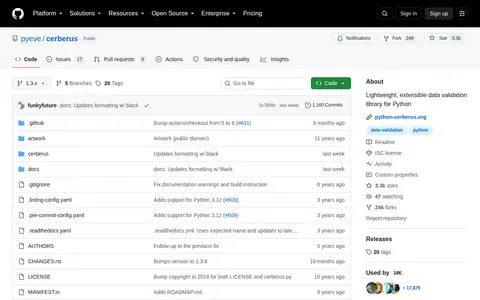
Cerberus is a lightweight and extensible data validation library for Python. It provides type checking and other base functionality out of the box, is designed to be non-blocking and extensible for custom validation, and has no dependencies. It is available on PyPI and maintained according to semantic versioning since version 1.2.
Vanna 2.0 is an AI agent framework that connects large language models to databases. It lets an LLM run SQL queries and generate charts, with tool memory that saves successful interactions to improve later answers. Access controls apply per user, and optional hosted admin features include observability, agent memory, file storage, audit logs and data retention. It works with various LLM providers and databases.
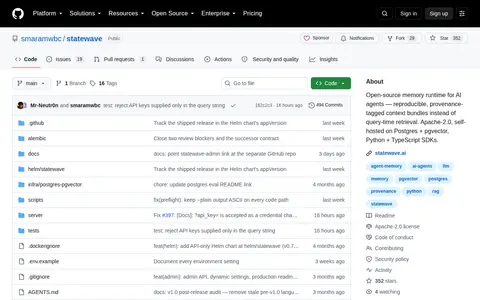
Statewave is an open-source memory runtime for AI agents. It uses reproducible, provenance-tagged context bundles in place of query-time retrieval, is licensed under Apache-2.0, self-hosted on Postgres with pgvector, and offers Python and TypeScript SDKs. The project is hosted on GitHub under the smaramwbc organization.
Manus is described as an action engine that executes tasks and automates workflows. Its features page lists building web and mobile apps, creating videos, slides and designs, research, and automations. A video feature uses Seedance 2.5 to generate shots, with editable tracks in a Video Editor.
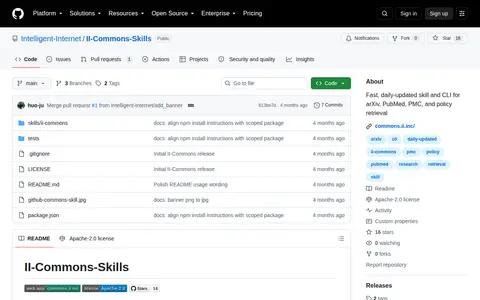
II-Commons-Skills provides fast, deterministic retrieval across arXiv, PubMed / PMC and supported US policy corpora, distributed as an npm package and CLI requiring Node.js 18 or newer. Basic usage works without authentication, and an API token is available for higher usage limits. It is licensed under Apache-2.0.
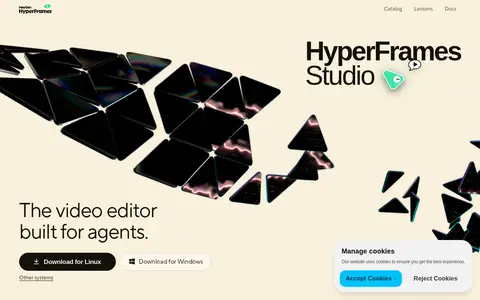
HyperFrames lets AI agents compose videos by writing HTML, CSS & JS — originated by HeyGen, built for the community. Open source under Apache 2.0.
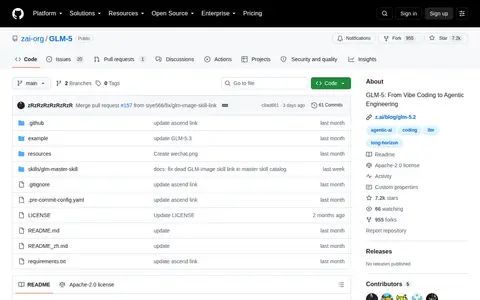
GLM-5.1 is a version of the GLM-5 project hosted on GitHub under the zai-org organization. The project focuses on transitioning from vibe coding to agentic engineering, with multiple released versions including GLM-5.1, GLM-5.2, and GLM-5.3.
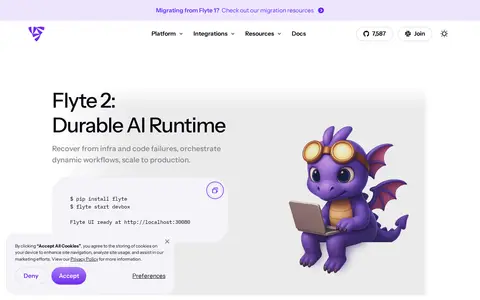
Flyte 2 is described as a durable AI runtime for running training, serving and agent workloads, with automatic recovery from infrastructure and code failures. Workflows are written in Python, and the project is distributed as Apache 2.0 open source under the Linux Foundation.
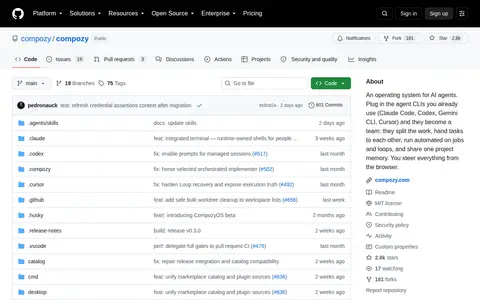
CompozyOS is an operating system for AI agents that plugs in existing agent CLIs such as Claude Code, Codex, Gemini CLI, and Cursor. The agents split work, hand tasks to each other, run automated jobs and loops, and share one project memory, steered from the browser. The v0.3 line is in beta, and the v0.2.15 product is deprecated.
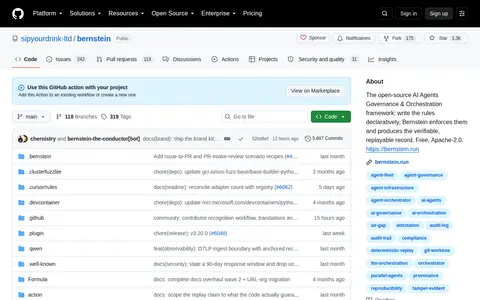
Bernstein is an open-source, Apache-2.0 licensed AI Agents Governance and Orchestration framework. Users can write governance rules declaratively, and Bernstein enforces these rules while producing verifiable, replayable records of agent activity. The project is associated with the website bernstein.run.
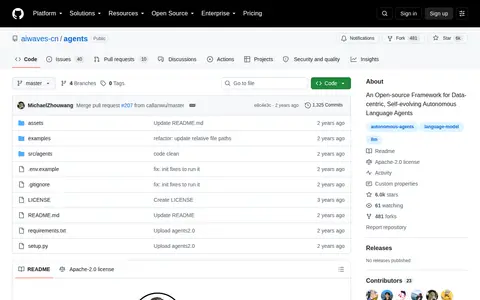
Agents is an open-source framework for data-centric, self-evolving autonomous language agents. It introduces agent symbolic learning, which treats an agent pipeline like a computational graph and uses prompt-based loss, back-propagation and weight updates to train agents. The project also supports optimizing multi-agent systems and was updated to Agents 2.0 with agent learning and evaluation support.
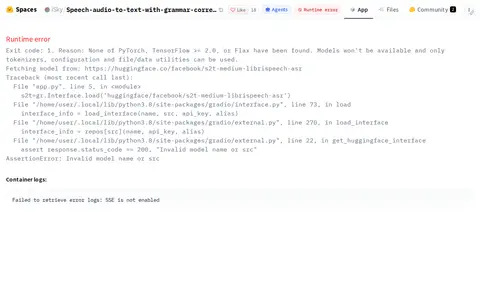
A Hugging Face Space that accepts uploaded or recorded audio and returns a text transcription with grammar correction. The page reports a runtime error because none of PyTorch, TensorFlow >= 2.0, or Flax were found, so models are unavailable.
Chroma is open-source search infrastructure for AI under Apache 2.0. It supports vector, full-text, regex and metadata search, built on object storage. Chroma Cloud offers serverless, scalable deployment with usage-based pricing.
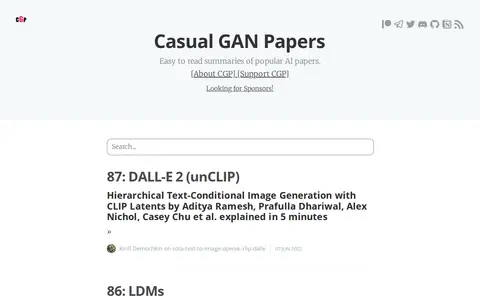
A site offering short, easy-to-read summaries of popular AI papers, with each explained in about five minutes. Covered papers include DALL-E 2, Latent Diffusion Models, GLIDE, Make-A-Scene, CLIP-GEN, and FILM.
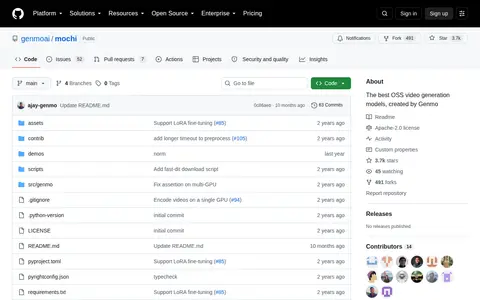
Mochi is an open-source video generation model by Genmo, released under an Apache 2.0 license. The repository provides installation, weight downloads, a Gradio UI, CLI, and API, plus LoRA fine-tuning support and an inference harness.
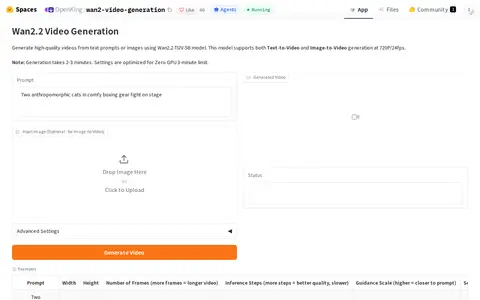
A Hugging Face Space by samsammysammy that generates short videos. Users enter a description and optionally an image, choose video size, length and style options, and the app creates a short video matching the prompt. Special LoRA modules can be enabled. The repository is marked as containing sensitive content and currently shows a runtime error.
Wan2.2 Video Generation is a Hugging Face Space by OpenKing that generates short 720p videos from text prompts, with optional image input to guide video creation. The default output length is 3 seconds at 24 frames per second.