
download-directory.github.io
Download Directory helps developers write, search, review, test, or manage code and projects.
Directory
Published directory entries matching your search.
Download Directory helps developers write, search, review, test, or manage code and projects.

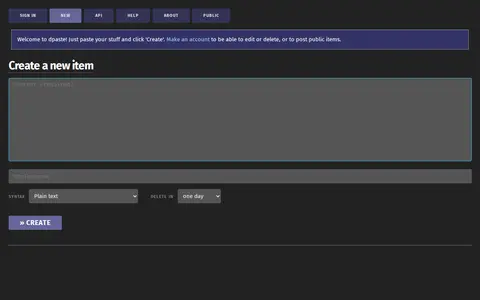
dpaste.com is a pastebin service for sharing and storing code snippets. It offers syntax highlighting, a clean interface, markup preview, and quick sharing options. Users can create public items without an account, or sign up to edit and delete their own pastes. The site supports a wide range of programming languages for syntax highlighting.
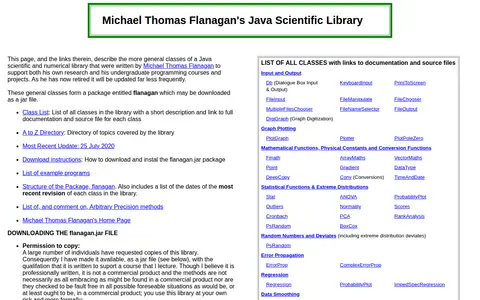
A Java scientific and numerical library written by Michael Thomas Flanagan to support his research and undergraduate programming courses. It is distributed as the flanagan.jar package and includes general classes, example programs and arbitrary precision methods. The author has retired and states it will be updated less frequently. Commercial use, public listing of source codes and redistribution are not permitted.
An article presenting initial impressions of DSPy, a framework developed by the Stanford NLP group for algorithmically optimizing language model prompts. The author describes DSPy as closing the loop of prompt engineering by turning a manual process into a structured machine learning workflow. The piece notes it is not a substitute for the official documentation and covers topics such as teleprompter, optimization, compile, bootstrapping and metric functions.

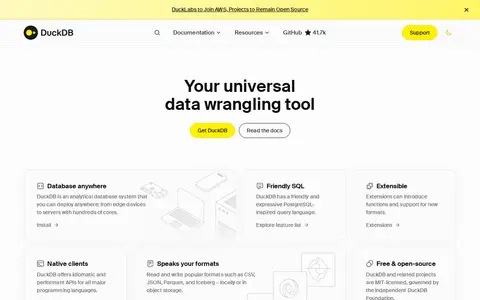
DuckDB is an open-source SQL OLAP database management system. It is an analytical database that runs in-process and can be deployed from edge devices to servers with hundreds of cores. It offers idiomatic APIs for major programming languages and reads and writes formats such as CSV, JSON, Parquet, and Iceberg, locally or in object storage.

Supports software work with AI-assisted coding, testing or application development.

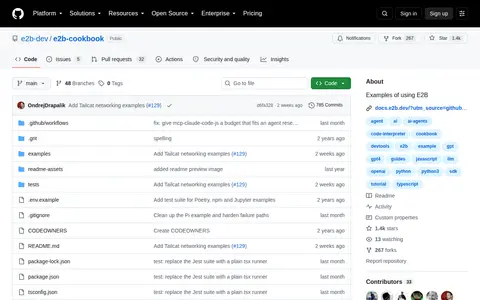
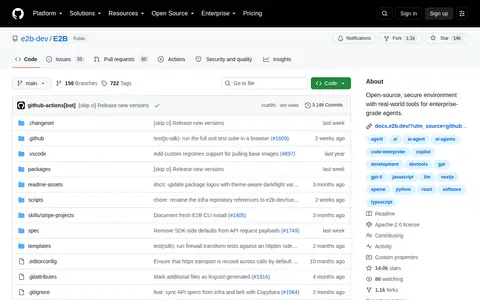
E2B is an open-source, secure environment built with real-world tools for use with enterprise-grade AI agents. The project's GitHub repository includes documentation for installing the E2B SDK, obtaining an API key, and running sandboxed environments to execute commands. The repository accepts community contributions.

EarthScope is a university consortium dedicated to transforming global geophysical research and education, and operator of the U.S. National Science Foundation’s GAGE and SAGE Facilities. It offers science support, instrumentation resources, geophysical data services, education programming, and information on recent geophysical events.

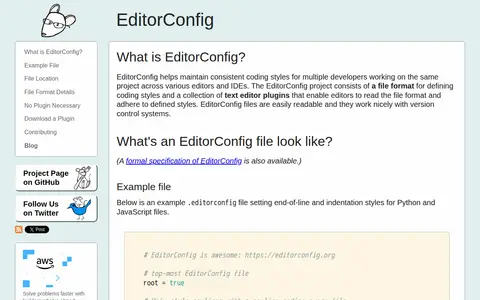
EditorConfig is a file format and a collection of text editor plugins for keeping coding styles consistent across different editors and IDEs. An .editorconfig file defines style rules that plugins read and apply.

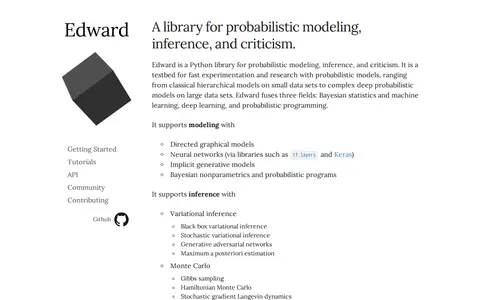
Edward is a Python library for probabilistic modeling, inference, and criticism. It is a testbed for experimentation and research with probabilistic models, from hierarchical models on small data sets to deep probabilistic models on large data sets. It fuses Bayesian statistics and machine learning, deep learning, and probabilistic programming, and is built on TensorFlow.

Supports software work with AI-assisted coding, testing or application development.

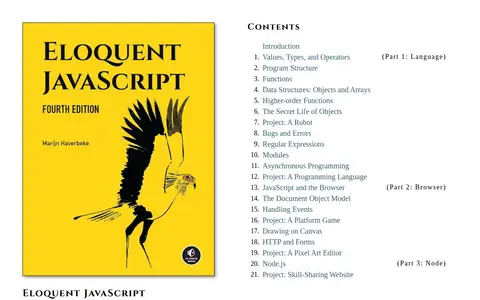
Eloquent JavaScript is a book about JavaScript, programming, and the digital, written by Marijn Haverbeke; the fourth edition dates from 2024. It can be read online or bought as a paperback. Contents are divided into parts on the language, the browser, and Node, and include several project chapters. Translations and earlier editions are also listed.

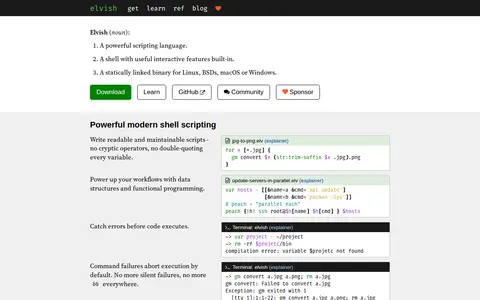
Elvish is a shell with useful interactive features built in and a scripting language. It is distributed as a single statically linked binary for Linux, BSDs, macOS and Windows. Scripts use data structures and functional programming, errors are caught before execution, and command failures abort execution by default.

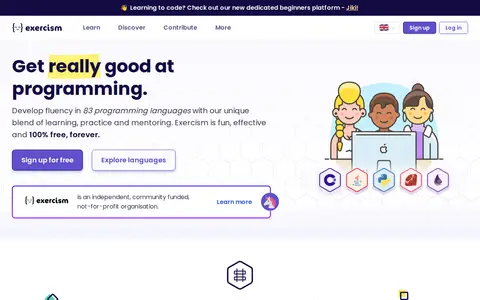
Exercism is a free, community-funded, not-for-profit platform for learning and practicing programming. It offers coding exercises across 84 language tracks, an in-browser editor, and automated analysis of solutions, alongside free human mentoring. Exercises can also be downloaded and submitted from the terminal with a CLI-first tool.
Open-solution-home-credit - source code and for Home Credit Default Risk.

Build faster with AI coding agents. Factory Droids automate coding, testing, and deployment for startups and enterprises.

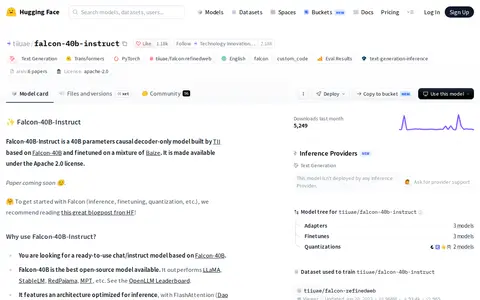
Falcon-40B-Instruct is a 40B parameter causal decoder-only model built by TII based on Falcon-40B and finetuned on a mixture of Baize, released under the Apache 2.0 license. It is intended as a ready-to-use chat and instruct model, and the card notes it may not be ideal for further finetuning. The model is trained mostly on English data, and users are advised to take precautions for production use.
Fancy Badges helps developers write, search, review, test, or manage code and projects.

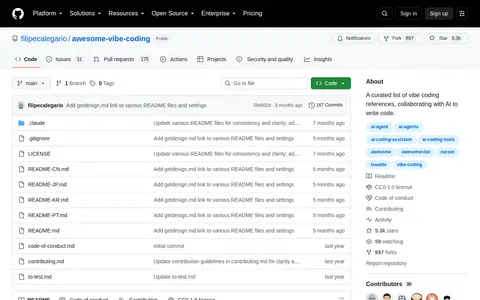
awesome-vibe-coding is a curated GitHub repository maintained by filipecalegario that compiles references for vibe coding, the practice of collaborating with AI to write code. The list includes resources for browser-based tools, IDEs, and code editors relevant to this development approach. The repository accepts community contributions.

FilmsByTheYear is a YouTube channel featuring film, television, commentary, or related video programming.

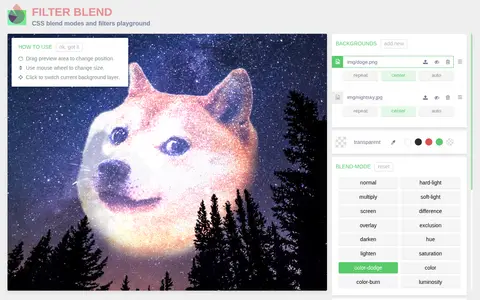
FilterBlend is a playground for the new CSS background-blend-mode and filter properties. The preview area can be dragged to change position, the mouse wheel changes size, and clicking switches the current background layer.

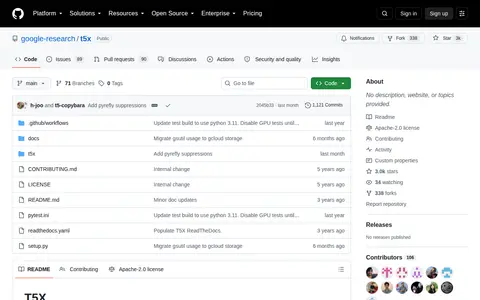
Open-source project that supports software development with code generation, analysis, debugging, or documentation.

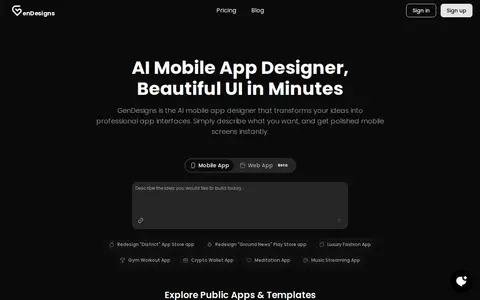
FlexApp is an AI mobile app designer offered by GenDesigns that generates polished mobile user interface screens from text descriptions of app ideas. The tool requires no prior Figma experience or design skills to use, and provides access to a library of public community app and template projects. It is designed to streamline the mobile app UI creation process.

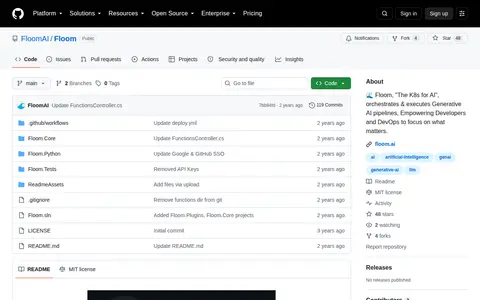
Floom is an open-source orchestration and execution tool for Generative AI pipelines, described as "The K8s for AI" and aimed at Developers and DevOps. Its repository is MIT licensed and the README states that Floom is now open-source and free for everyone, including commercial use.