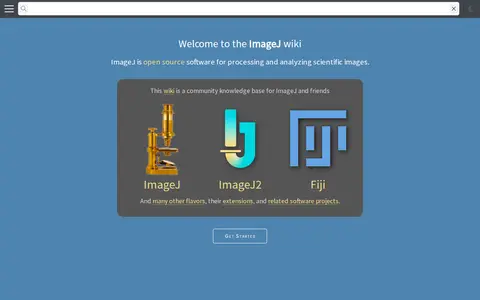

ImageJ is open source, public domain software for processing and analyzing scientific images. It is part of an ecosystem including ImageJ2, Fiji and other related variants, with support for hundreds of extensible plugins for scientific imaging tasks. The project maintains a community-edited wiki with documentation for users, developers and contributors across supported platforms.
Directory
Search results
Published directory entries matching your search.
ImageMagick is a free, open-source software suite for creating, editing, converting and manipulating images. It supports over 200 format variants, including JPEG, PNG, GIF, TIFF, WebP and AVIF. The command-line tools run single-file conversions or multi-step processing pipelines. Bindings exist for C, C++, Python, .NET and Node.js.
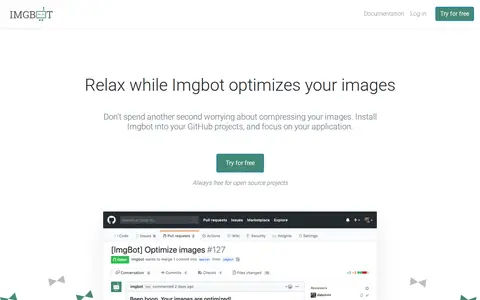
Imgbot is a GitHub app that optimizes images. After installation, it opens pull requests compressing the images it finds in a repository and watches for new images. It is always free for open source projects.
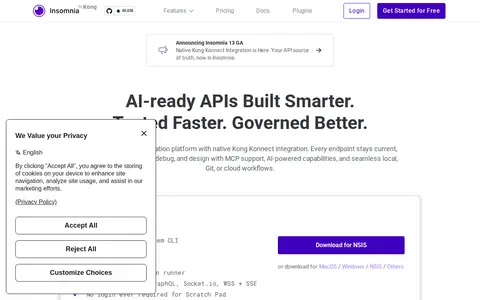
Insomnia is an open-source collaborative API development platform. It supports HTTP, REST, GraphQL, gRPC, SOAP, and WebSockets, and offers AI-native API design, testing, mocking, and debugging features. Users can store data locally, via Git, or in the cloud. The platform has a free tier, paid plans, and integrates with Kong Konnect.
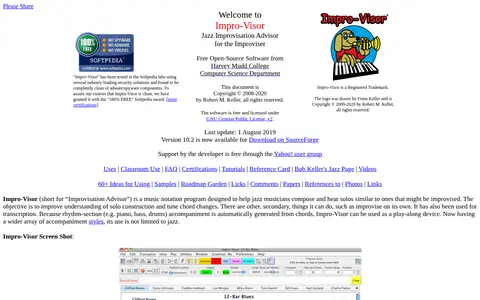
Impro-Visor is a music notation program from Harvey Mudd College Computer Science Department, designed to help jazz musicians compose and hear solos similar to improvised ones. It generates rhythm-section accompaniment from chords and can be used as a play-along device. The free, open-source software is licensed under GNU General Public License v2.
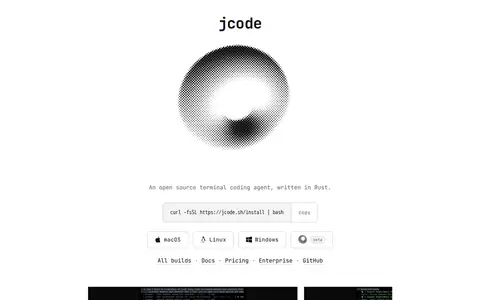
jcode is an open-source terminal coding agent written in Rust. It supports agent swarms, background tasks, and a small RAM footprint, and is installed with one command on macOS, Linux, or Windows. Login flows connect subscription and API model providers, and the agent itself is free while hosted inference plans are available.
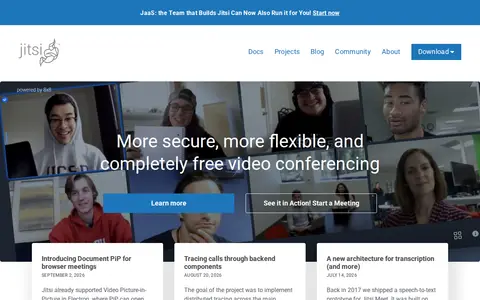
Jitsi is a free open-source video conferencing software for web and mobile. It supports making calls, launching on one's own servers, and integrating into apps. The project states that meetings on meet.jit.si are limited to 95 minutes starting October 9, 2026.
Joomla! is a free and open source content management system used to build, organize, manage and publish content for websites, blogs, intranets and mobile applications. The site lists benefits including search engine friendly and mobile friendly output, multilingual support, unlimited design, multi-user permission levels and extensibility, along with thousands of free extensions and templates.
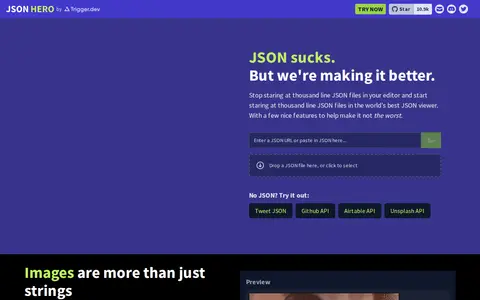
JSON Hero is a web-based JSON viewer that presents JSON files in a UI with extra features. It infers what strings represent, such as images, dates, colors, URLs and videos, shows related values for fields, and generates an inferred JSON schema. It supports searching the whole file and sharing documents, and is open source.
Judge0 IDE is a free and open-source online code editor and compiler. The page links to a GitHub repository, embed guide, HTTP API documentation, privacy policy and terms of service. It also lists a set of selectable inline suggestion models.
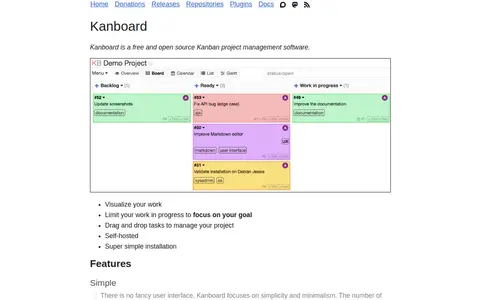
Kanboard is a free and open source Kanban project management software. It provides a visual board for managing tasks, with drag-and-drop columns, work-in-progress limits, and task search and filtering. It is self-hosted and available under the MIT License.
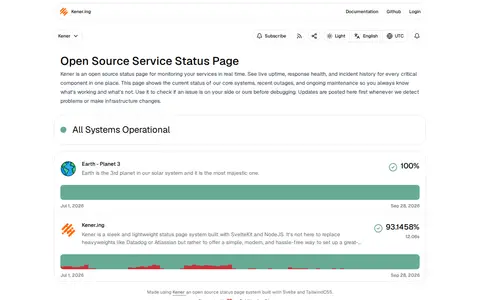
Kener is a free, open-source status page and uptime monitor that can be self-hosted with Docker. It monitors API, Ping, TCP, DNS, SSL, SQL, Heartbeat, GameDig, and gRPC services with configurable check intervals and thresholds, and it provides incident management, maintenance scheduling, notifications, embeddable widgets, and a REST API.
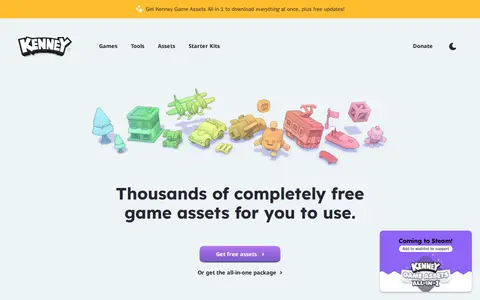
Kenney offers thousands of completely free game assets for use in projects. The site also provides free and open source Starter Kits covering various game genres that help with starting game development.
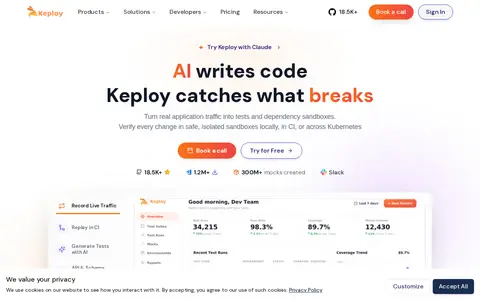
Keploy is an open-source AI-powered API and unit testing tool for developers. It builds a digital twin of production behavior using real API traffic, mocks, and dependencies to verify AI- or human-written code changes in continuous integration pipelines before deployment, and requires no code changes to implement.
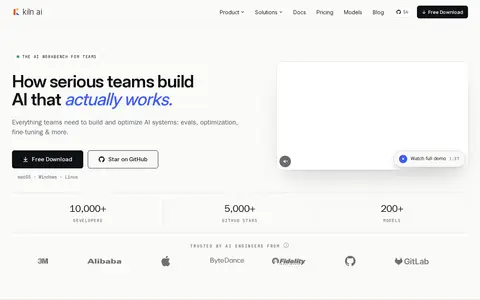
Kiln AI is a platform and open-source library for building, evaluating, and optimizing AI systems. It offers tools for working with retrieval-augmented generation, AI agents, synthetic data, model fine-tuning, and prompt optimization, with a free downloadable application available for macOS, Windows, and Linux.

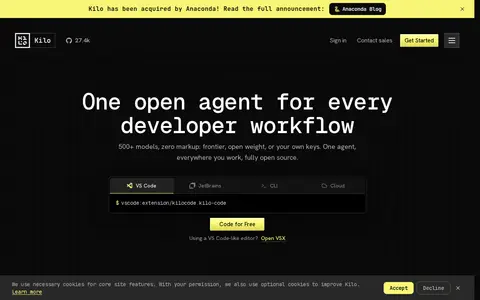
Kilo is an open source AI coding agent for VS Code, JetBrains, CLI, desktop and cloud. It offers access to 500+ models at zero markup, bring-your-own keys, or local models for privacy. Kilo Gateway provides a unified API to access AI models through a single endpoint.
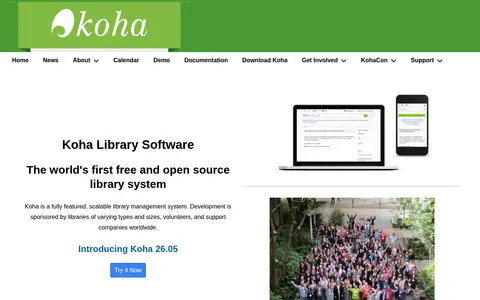
Koha is a free and open source library management system. Its community, sponsored by libraries, volunteers and support companies, develops and releases the software. Documentation includes a Koha manual covering installation and use, developer documentation, and installation instructions via Debian packages on Debian or Ubuntu.
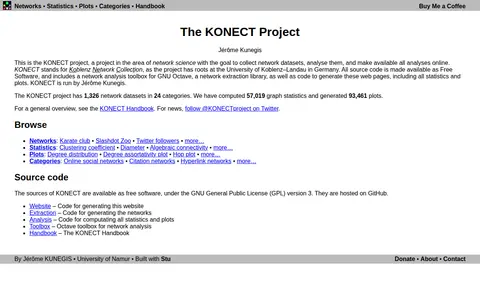
KONECT is the Koblenz Network Collection, a network science project that collects network datasets, analyses them, and publishes the analyses online. It holds 1,326 network datasets in 24 categories, with computed graph statistics and generated plots. Its source code, including an Octave network analysis toolbox and an extraction library, is available as free software under GPL version 3.
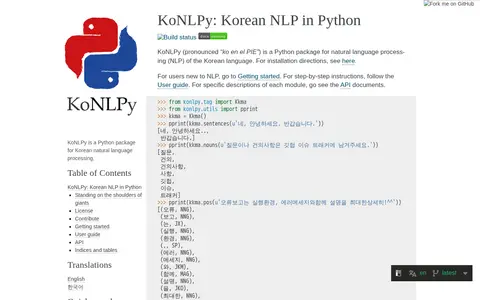
KoNLPy (pronounced "ko en el PIE") is a Python package for natural language processing of the Korean language. It is open source software released under GPL v3 or above, and users are asked to acknowledge its use with a citation.
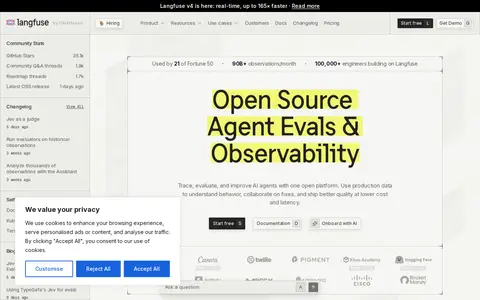
Langfuse is an open source platform for tracing, evaluating and improving AI agents. It connects tracing, monitoring, datasets, experiments and evaluation in one continuous loop, capturing every LLM call, tool invocation and retrieval step. The platform includes prompt management, a playground, experiments and human annotation, and works with any language or framework supporting OpenTelemetry instrumentation.
Lantern is a nonprofit VPN built by Brave New Software Project that bypasses censorship. Smart Routing sends blocked and unencrypted sites through the network while other traffic connects directly. It is open source, available on Android, iOS, Windows, Mac and Linux, and offers an optional Private Server mode on own hardware or cloud account.
Lapce is a modern open source code editor written in Rust, featuring a native GUI with GPU acceleration in Floem. It offers remote development, built-in LSP support with Tree-sitter syntax highlighting, Vim-like modal editing and a WASI plugin system for writing plugins in languages that compile to WASI. It includes a built-in terminal.
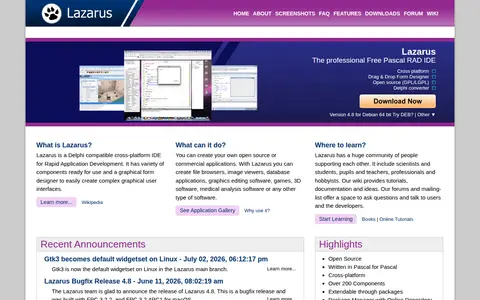
Lazarus is an open-source cross-platform IDE for Rapid Application Development powered by Free Pascal. It is Delphi compatible and includes a drag-and-drop form designer and over 200 components, and can convert from Delphi code. It is extendable through packages and has a package manager with an online repository. Documentation and tutorials are available through a wiki, forums and books.
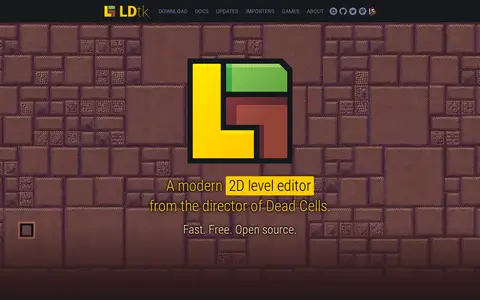
LDtk is an open-source 2D level editor for indie developers, focused on user-friendliness. It organizes levels into worlds, supports customizable entities, auto-rendering rules and Aseprite files, and exports PNG images with JSON data. It targets platformer and top-down perspectives and can be used free of charge without limitation.