
github.com
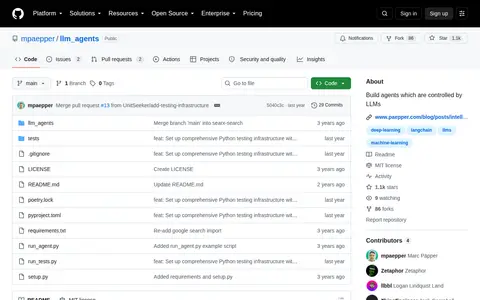
Build agents which are controlled by LLMs.
Directory
Published directory entries matching your search.
Build agents which are controlled by LLMs.

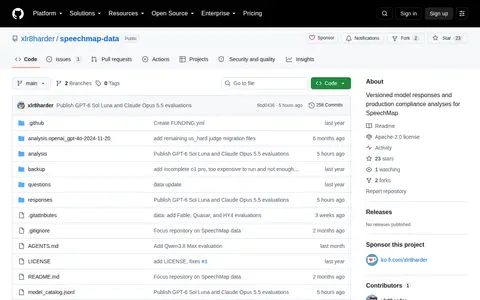
Open-source project that provides machine-learning models, research, training resources, or evaluation tools.

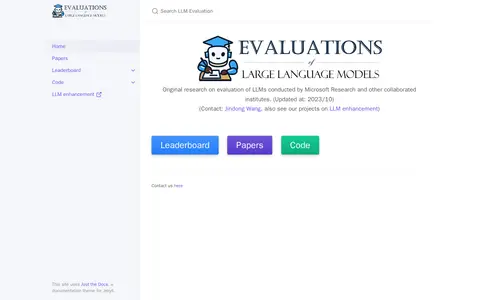
Research on evaluation of LLMs conducted by Microsoft Research and other collaborated institutes. (Updated at: 2023/10).

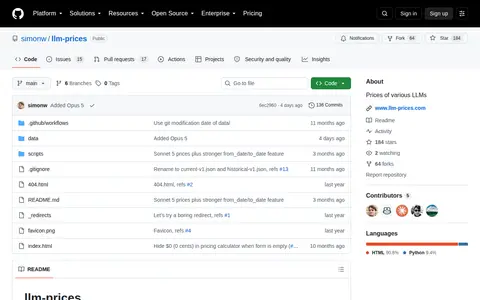
Open-source project that provides machine-learning models, research, training resources, or evaluation tools.
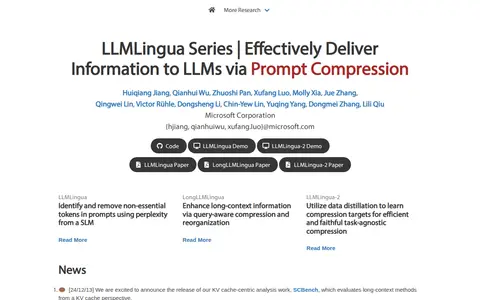
LLMLingua is a Microsoft-developed series of prompt compression tools for large language models, designed to accelerate LLM inference by shortening input prompts. The series includes LLMLingua, LongLLMLingua, LLMLingua-2, and SeCom, each using distinct compression techniques. It supports use cases such as retrieval-augmented generation and online meeting processing, and is integrated with the LangChain and LlamaIndex frameworks.

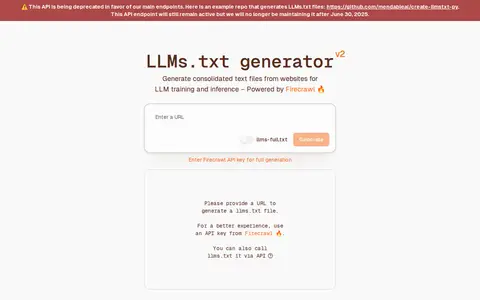
A tool that generates consolidated llms.txt text files from websites for LLM training and inference, powered by Firecrawl. The site states the API is being deprecated in favor of the main endpoints and will no longer be maintained after June 30, 2025, though the endpoint remains active.

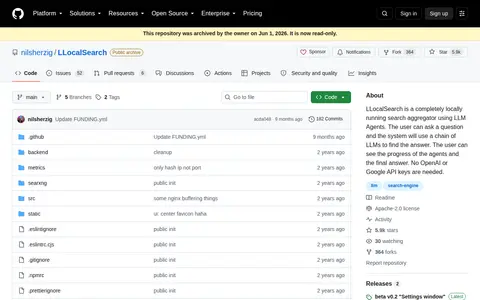
LLocalSearch is a fully locally running search aggregator that uses LLM agents to answer user questions. It uses a chain of LLMs to find answers, displays agent progress and final results, and does not require OpenAI or Google API keys to operate.
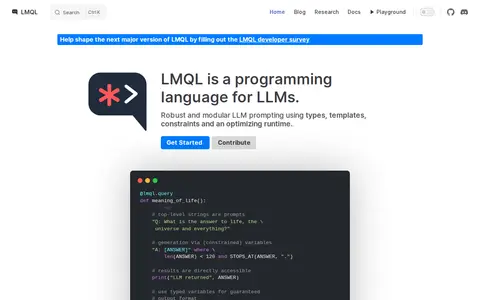
LMQL is a programming language for interacting with large language models, using types, templates, constraints and an optimizing runtime. Prompt statements have associated where clauses that specify logical constraints on output, which LMQL translates to subtoken masks enforced during generation. It works across llama.cpp, OpenAI and Transformers backends and supports nested queries.

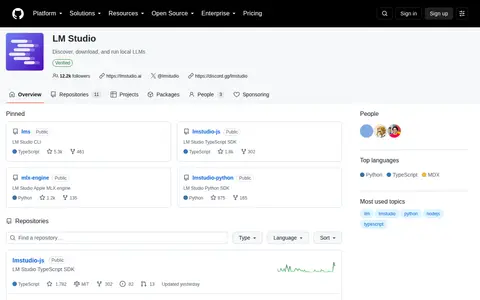
LM Studio is a GitHub organization that provides tools for working with local large language models. As of the listing snapshot, it hosts 11 public repositories, offers functionality to discover, download, and run local LLMs, and has its code available on GitHub.

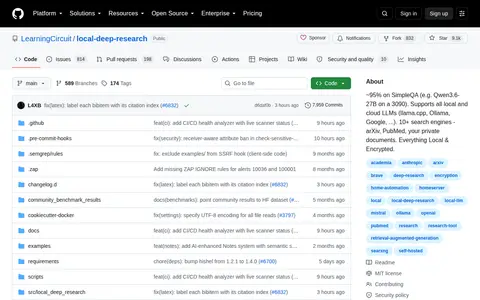
Local Deep Research is a tool that achieves approximately 95% accuracy on the SimpleQA benchmark, with an example run using Qwen3.6-27B on an RTX 3090. It supports all local and cloud LLMs including llama.cpp, Ollama, and Google models, integrates over 10 search engines such as arXiv, PubMed, and private document sources, and operates with local and encrypted processing.

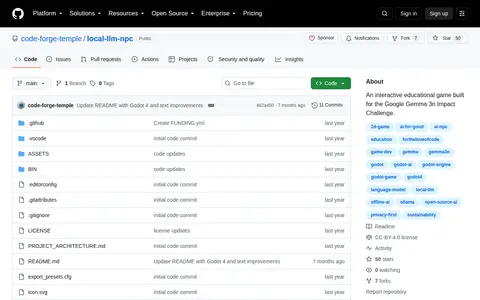
An interactive educational game built for the Google Gemma 3n Impact Challenge. It uses Gemma 3n via Ollama for on-device, structured educational conversations about sustainable farming and botany, and runs locally with no internet required for core features.

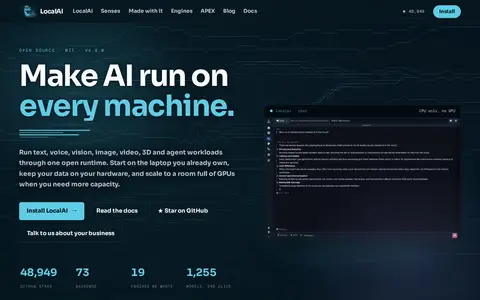
LocalAI is described as an open source AI engine that runs models, including LLMs, vision, voice, image and video, on any hardware without a GPU. It presents itself as a drop-in replacement for most upstream APIs and includes a built-in agent platform powered by LocalAGI, whose agents can reason, use tools and maintain memory. Image generation with Stable diffusion on CPU is also supported.

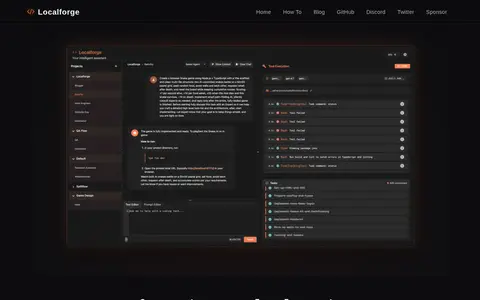
Localforge is a free, open-source desktop GUI for Codex AI, Claude and other LLMs. It runs locally and lets autonomous agent loops edit files, run tests and work on large multi-file codebase tasks. It supports swapping providers and storing prompt templates, and is distributed under the MIT license.

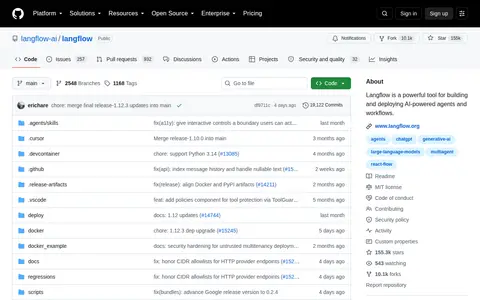
Langflow is a platform for building and deploying AI-powered agents and workflows, with a visual authoring interface and built-in API and MCP servers. It supports major LLMs, vector databases and AI tools, and allows deployment as an API, JSON export or MCP server.

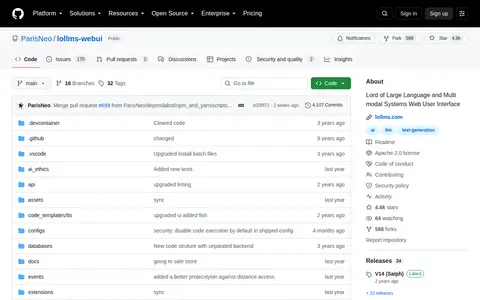
LoLLMs WebUI is a web user interface for large language and multimodal systems. The repository describes it as a local, single-user webui with multi models and modal support, providing an interface to access and utilize various LLM and other AI models.

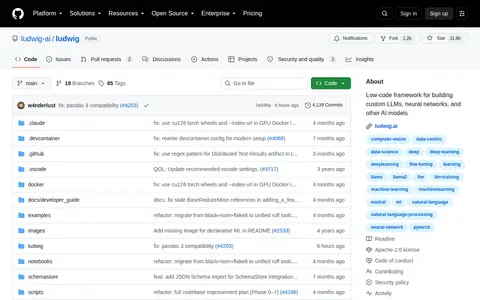
Ludwig is a low-code framework for building custom large language models, neural networks, and other AI models. The project's repository includes introductory documentation, release notes for version 0.16, installation guides, quick start materials, and resources for instruction fine-tuning of LLMs.

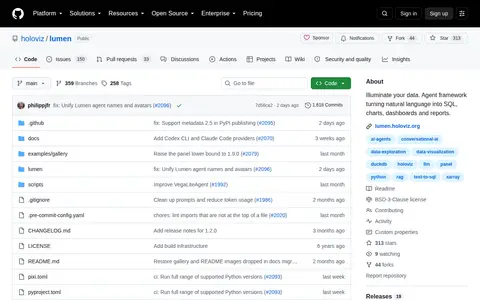
Lumen is an open-source agent framework for chatting with data and retrieval augmented generation. Its declarative data model lets LLMs generate data pipelines, SQL, charts, and dashboards, with outputs that can be inspected and edited. It also supports context embeddings and custom agents and tools.

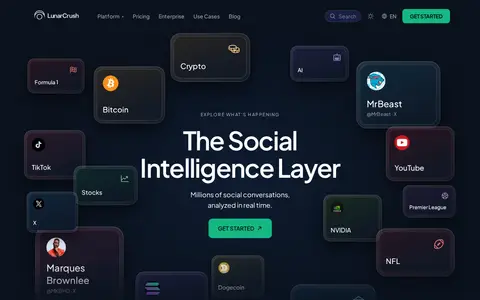
LunarCrush analyzes social media conversations to measure real-time sentiment and social volume across over 40 categories, including crypto, stocks, sports and brands, drawing on X, Reddit, YouTube and TikTok. Its plans provide access to Discover, LLM integrations and an API, and a free account offers market data and short-window sentiment.

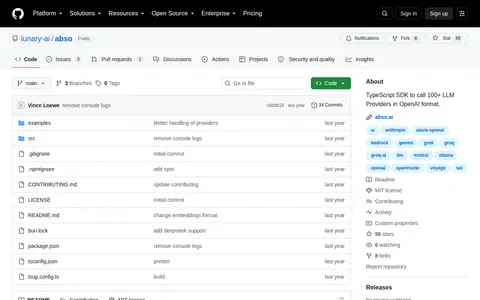
TypeScript SDK to easily call 100+ LLMs using OpenAI's format.

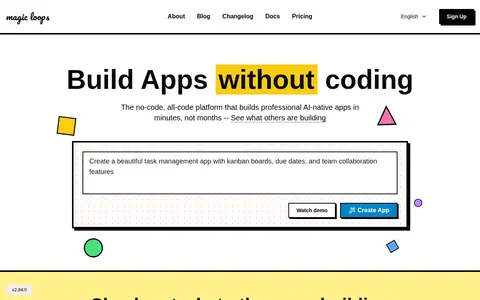
Magic Loops combines LLMs and code to create simple automations. It is presented as a no-code, all-code platform for building apps without coding. Paid plans are billed at $1 USD per 1000 credits, and a free tier offers 8,000 credits.

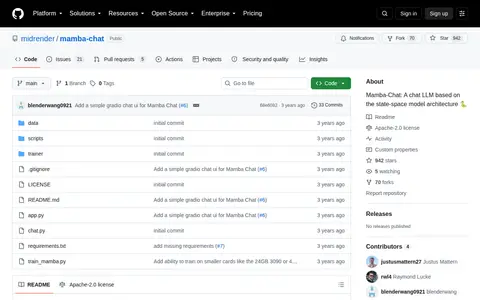
Mamba-Chat is a chat language model built on a state-space model architecture rather than a transformer. The repository provides training and fine-tuning code based on a modified Huggingface Trainer class. The model is based on Mamba-2.8B and was fine-tuned on 16,000 samples of the HuggingFaceH4/ultrachat_200k dataset. Code is provided for testing and fine-tuning, including a command-line chatbot and a Gradio app.
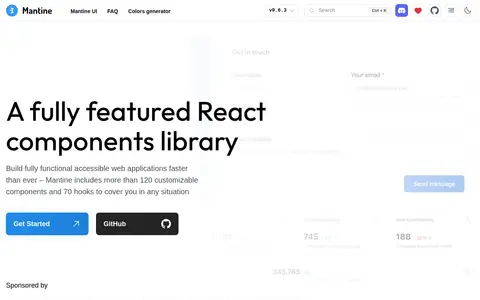
Mantine is a React components library with more than 120 customizable components and 70 hooks, focused on usability, accessibility and developer experience, with native dark theme support. It also provides LLM-optimized documentation, skills for AI agents and an MCP server for AI coding tools.

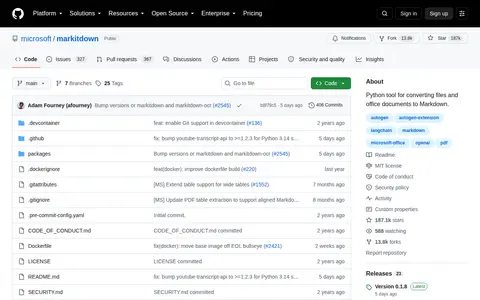
MarkItDown is a lightweight Python utility for converting various files to Markdown for use with LLMs and related text analysis pipelines. It preserves document structure and content as Markdown, including headings, lists, tables, and links, and supports formats such as PDF, PowerPoint, Word, Excel, images, audio, HTML, and ZIP files.

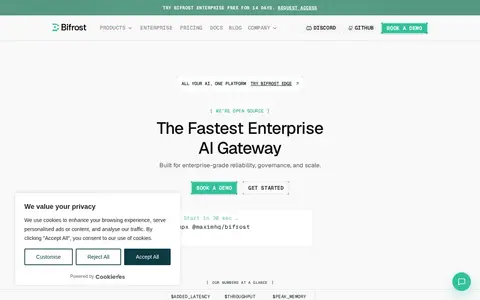
Bifrost is an open-source AI gateway for LLMs, MCP and agents, offered by Maxim AI. It provides routing, governance, guardrails and observability, and is described as a drop-in replacement for AI SDKs. Enterprise adds features such as SSO, RBAC, adaptive load balancing, cluster mode and in-VPC deployment, free for 14 days.