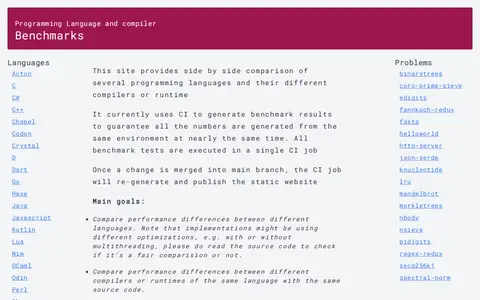

A site offering side-by-side comparisons of programming languages and their compilers or runtimes. Benchmark tests are executed in a single CI job, and the static website is regenerated once a change is merged into the main branch. It aims to compare performance differences between languages and between compilers or runtimes of the same language.
Directory
Search results
Published directory entries matching your search.
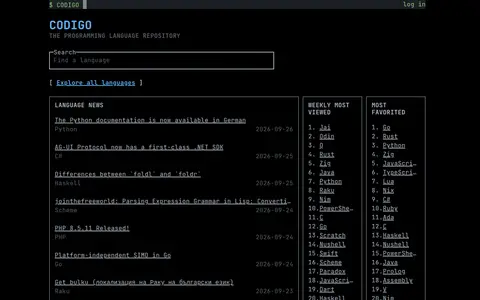
Codigo is a programming language repository for discovering trending languages, following language news, and exploring language details including code examples. It offers search and comparison of languages and lists the PyPL and TIOBE indexes and most GitHub pushes.
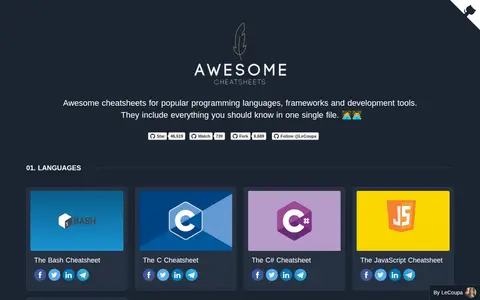
A collection of cheatsheets for popular programming languages, frameworks and development tools, each intended to include everything needed in one file. It covers languages such as Bash, C, C# and JavaScript, backend tools including Django and Node.js, frontend frameworks such as React and Vue, plus Redis, Docker and Kubernetes.
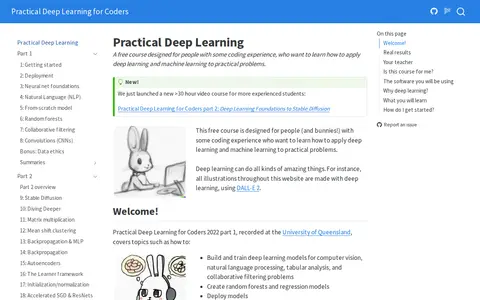
A free course for people with some coding experience who want to learn how to apply deep learning and machine learning to practical problems. It includes 9 lessons of around 90 minutes each, covering computer vision, natural language processing, tabular analysis, and collaborative filtering, plus building and training models, random forests, deployment, and use of PyTorch, fastai and Hugging Face.
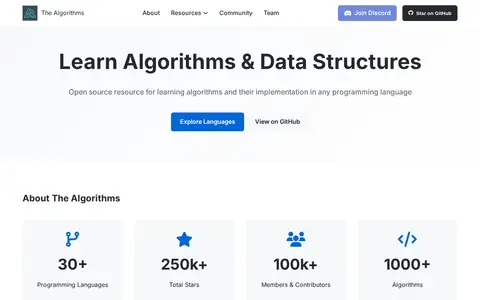
An open-source resource for learning data structures and algorithms through implementations in various programming languages. The site covers programming languages including Python, Java, JavaScript, Go, Rust, and C++, and organizes algorithms into categories such as sorting, searching, and graph algorithms. It also provides guidance on contributing implementations.
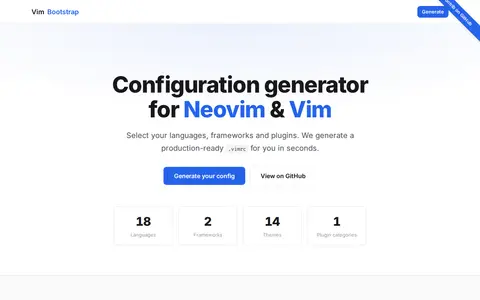
Vim Bootstrap is a configuration generator for Neovim and Vim. Users select languages, frameworks, themes and plugins, and the site generates a .vimrc configuration for download. It lists 18 languages, 2 frameworks, 14 themes and 1 plugin category.
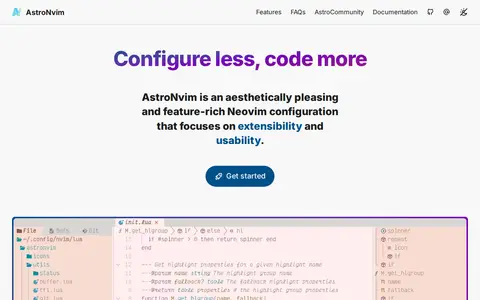
AstroNvim is a Neovim configuration that aims to be aesthetically pleasing and feature-rich, focusing on extensibility and usability. It is built as a modular collection of plugins and provides access to AstroCommunity, a community-maintained plugin marketplace. Out of the box it offers no direct support for any one language.

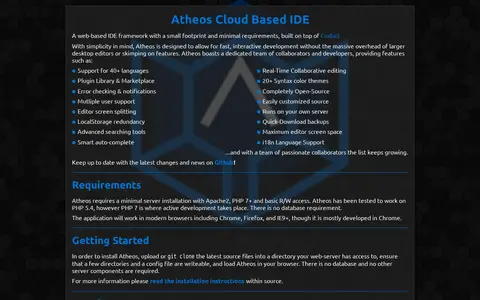
Atheos is an open source, web-based cloud IDE and code editor built on top of Codiad. It has a small footprint, supports 40+ languages, and requires a server with Apache2 and PHP.
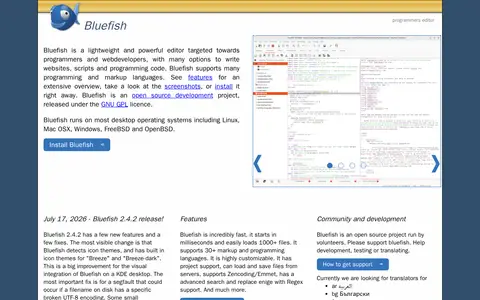
Bluefish is a lightweight, open source code and text editor aimed at programmers and web developers, with options for writing websites, scripts and programming code. It is released under the GNU GPL licence and runs on Linux, Mac OSX, Windows, FreeBSD and OpenBSD. It supports 30+ markup and programming languages.
CodSpeed provides continuous performance testing for CI. It runs benchmarks in the CI pipeline, reports regressions in pull requests, and offers autonomous performance optimization. A documentation quickstart describes connecting a repository and setting up benchmarks, either through an automated wizard or manual configuration, including plugins for languages such as Python and C++.
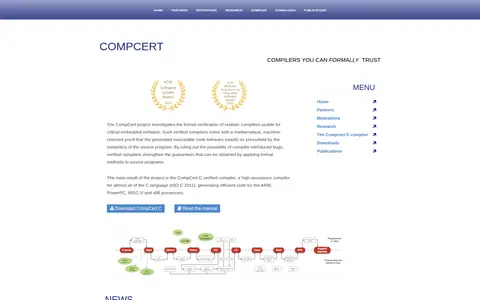
CompCert is a formally verified C compiler that comes with a machine-checked proof that generated code behaves as prescribed by the source program's semantics. It is described as a high-assurance compiler for almost all of the C language (ISO C 2011), generating code for ARM, PowerPC, RISC-V and x86 processors.
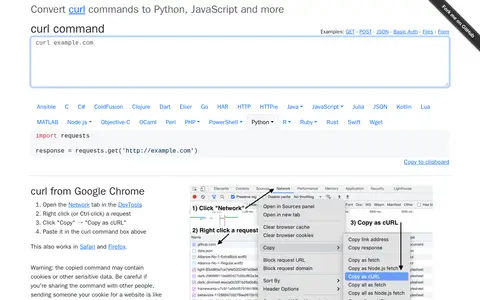
Converter is a utility that converts curl commands into code for languages and libraries such as Python, JavaScript and more. Conversion happens entirely in the browser, and the site states it does not transmit or record entered curl commands.
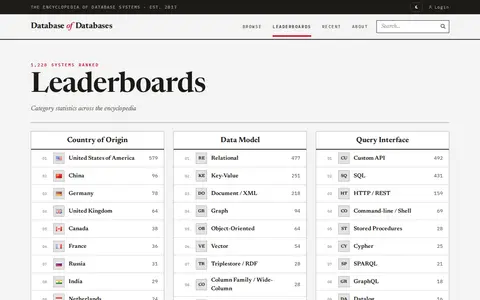
Database of Databases is an encyclopedia of database systems with leaderboards and statistics. Its statistics page ranks 1,228 systems and breaks them down by country of origin, data model, query interface, compatibility, source code license, implementation language, project type and developer.
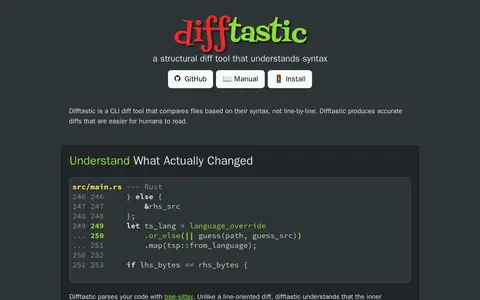
Difftastic is an MIT-licensed command-line diff tool that compares files by syntax rather than line-by-line, parsing code with tree-sitter. It is intended to produce diffs that are easier for humans to read, showing real line numbers and handling formatting and wrapping changes. It supports many programming languages and file formats and can be configured for use with Git.
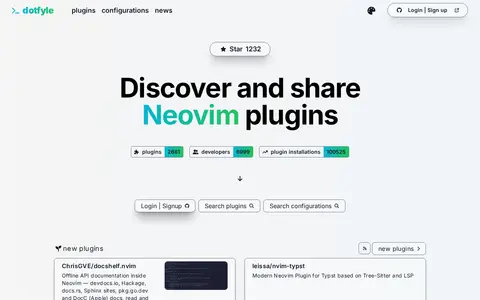
Dotfyle is a directory for discovering and sharing Neovim plugins. It lists new, trending and popular plugins, allows searching Neovim configurations by plugin manager, plugins or language servers, and hosts the This Week in Neovim newsletter.
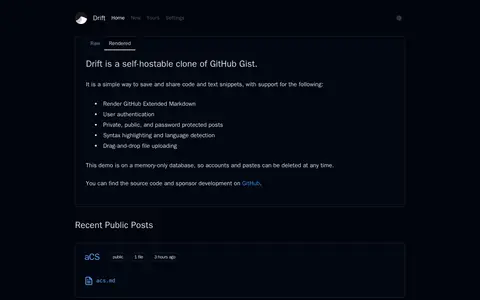
Drift is a self-hostable clone of GitHub Gist that provides a simple way to save and share code and text snippets. It supports rendering GitHub Extended Markdown, user authentication, private, public and password protected posts, syntax highlighting and language detection, and drag-and-drop file uploading.
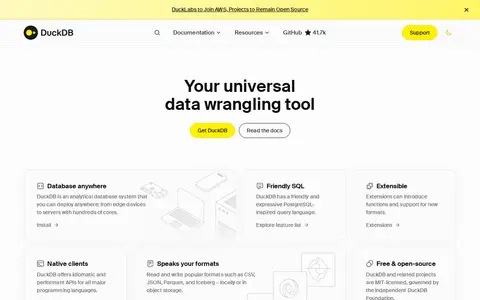
DuckDB is an open-source SQL OLAP database management system. It is an analytical database that runs in-process and can be deployed from edge devices to servers with hundreds of cores. It offers idiomatic APIs for major programming languages and reads and writes formats such as CSV, JSON, Parquet, and Iceberg, locally or in object storage.
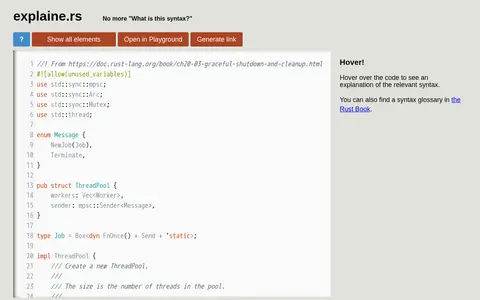
explaine.rs is an interactive playground for exploring the syntax of the Rust programming language. Users write Rust code in an editor, and an analyzer explains keywords, punctuation and other code elements when clicked or tapped. The site states it is a work in progress and requires a WebAssembly-compatible browser.
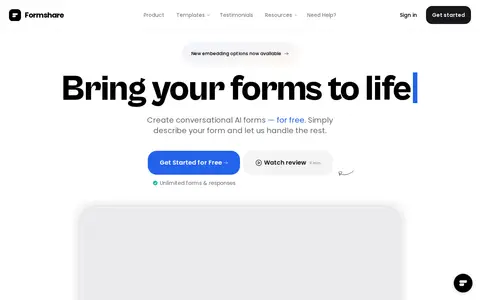
Formshare is a form builder that creates conversational AI forms. Users describe their form in natural language, and the service generates it. Forms can be shared by link or embedded on a website. The service states that it is free to use with unlimited forms and responses.

A web hosting provider offering free web hosting along with paid shared, semi-dedicated and VPS hosting plans. The shared hosting supports multiple domains and scripting languages including PHP, Perl, CGI, Python and Ruby, and the service includes domain registration, transfers and SSL certificates.
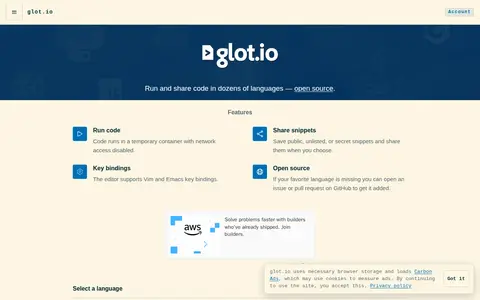
An open-source online code playground for running code in dozens of programming languages. Users can create, execute, save and share snippets, and the editor supports Vim and Emacs key bindings. Code runs in a temporary container with network access disabled. Snippets can be saved as public, unlisted or secret.
Helix is a modal text editor built in Rust for the terminal. It uses multiple selections as a core editing primitive and integrates Tree-sitter for syntax highlighting, indent calculation and code navigation. Language server support provides completion, goto definition, documentation and diagnostics. Built-in features include a fuzzy finder, project-wide search and themes. A plugin system and GUI frontend are planned but not currently available.
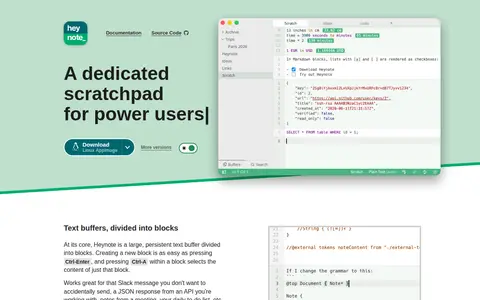
Heynote is a dedicated scratchpad for developers that functions as a large persistent text buffer divided into blocks. Each block can have its own language mode for syntax highlighting and auto-formatting, and math blocks serve as calculator scratchpads. Multiple note buffers can be created and organized into directories, and inline images can be pasted, resized, and annotated. It is available for Mac, Windows, and Linux.
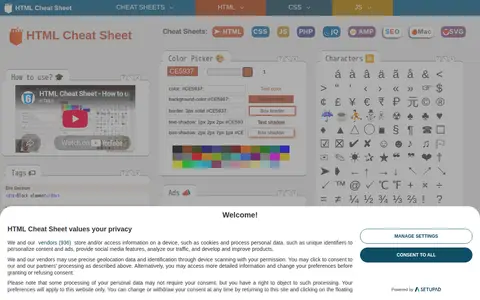
An online interactive HTML cheat sheet page containing code examples, web developer tools and markup generators. It includes panels for color, character and tag references, structures and attributes, plus generators for iframe, table, link, image and list markup, and a live-preview HTML editor. The pages are described as a quick guide for those already familiar with the languages.