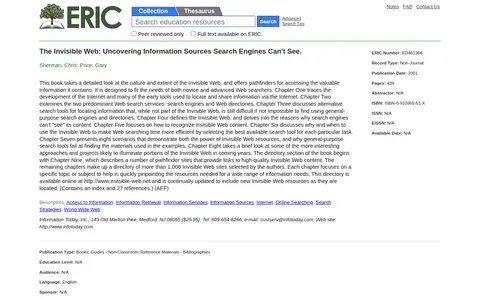

A 2001 book by Chris Sherman and Gary Price examining the nature and extent of the Invisible Web and offering pathfinders for accessing its content, aimed at novice and advanced web searchers. Chapters cover the development of the Internet, search engines and web directories, why search engines cannot see invisible web content, how to recognize it, and when to use it. A directory section lists more than 1,000 Invisible Web sites by topic.
Directory
Search results
Published directory entries matching your search.

arxiv.org
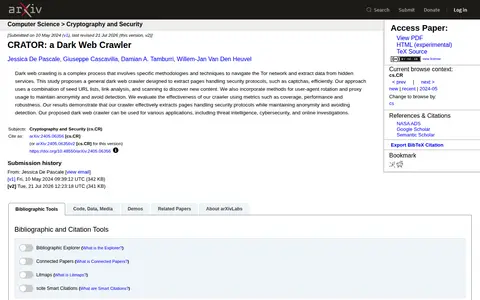
CRATOR is a proposed dark web crawler described in an arXiv paper. It is designed to extract pages that handle security protocols such as captchas, using seed URL lists, link analysis and scanning to discover content, with user-agent rotation and proxy usage for anonymity. The authors report evaluation using coverage, performance and robustness metrics, and suggest threat intelligence, cybersecurity and online investigation applications.

darpa.mil
DARPA Memex is a program seeking to develop next-generation search technologies for discovering, organizing and presenting domain-specific content. It aims to extend search beyond a centralized model to the deep web and nontraditional content. The program initially plans to address fighting human trafficking. It is specifically not interested in deanonymizing servers, attributing identity to IP addresses, or accessing non-public information.

haveibeenzuckered.com
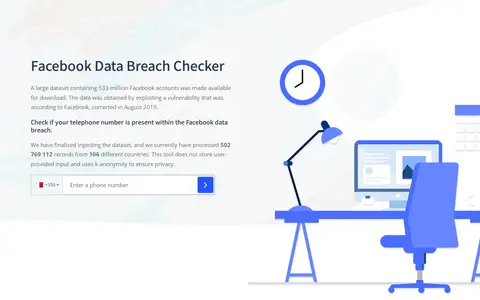
Checker for seeing whether a phone number or profile appears in Facebook-related breach data.

arxiv.org
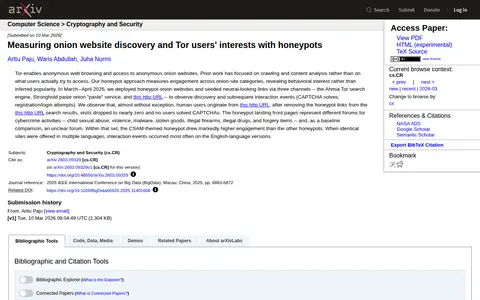
An arXiv paper measuring onion website discovery and Tor users' interests with honeypots. The authors deployed honeypot onion websites in March–April 2025 and seeded links via three channels to observe interaction events. They report that human users almost without exception originated from Ahmia.fi, and that the CSAM-themed honeypot drew markedly higher engagement than the others.

cybernews.com
Cybernews checker for seeing whether an email or phone appears in known data leaks.