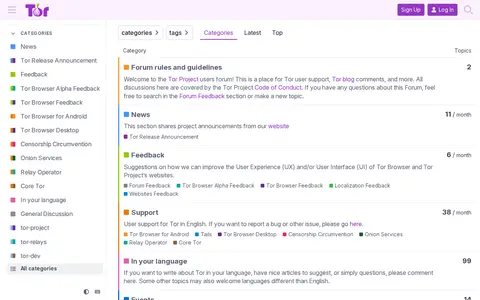

The Tor Project Forum is a discussion site for Tor users. It hosts user support, Tor blog comments, project announcements, feedback on Tor Browser and Tor Project websites, and discussions in languages other than English. It also covers events, general Tor ecosystem topics, read-only mirrors of Tor Project mailing lists, and development of Arti.
Directory
Search results
Published directory entries matching your search.
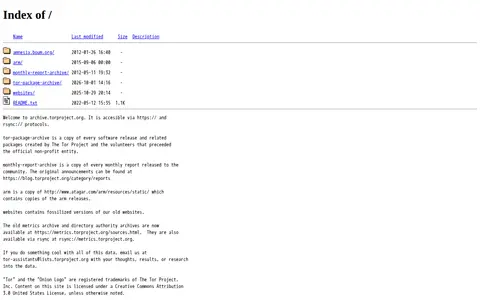
Official archive of older Tor software, websites, mailing lists, reports and project material.
DARPA Memex is a program seeking to develop next-generation search technologies for discovering, organizing and presenting domain-specific content. It aims to extend search beyond a centralized model to the deep web and nontraditional content. The program initially plans to address fighting human trafficking. It is specifically not interested in deanonymizing servers, attributing identity to IP addresses, or accessing non-public information.
GlobaLeaks is free, open source software for setting up and maintaining a secure whistleblowing platform. It is designed as a framework for anonymous reporting, with privacy protection and submission protection enabled by default, and has been translated into over 70 languages. The source code is public and has been examined in independent security audits since 2011.
ProPublica instructions for submitting documents securely through its verified SecureDrop service.
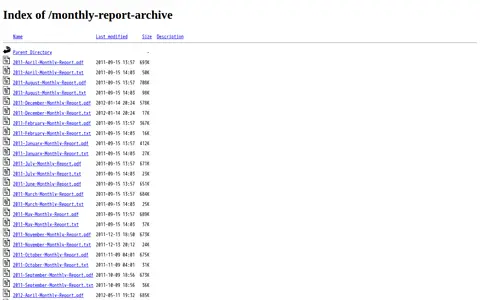
Archive of Tor Project monthly reports documenting development, research and community activity.
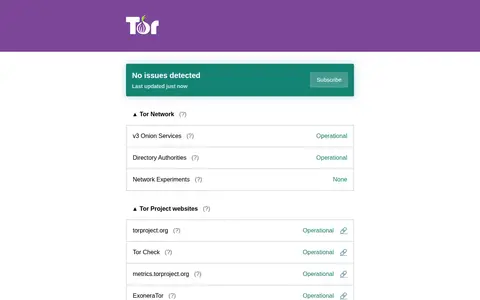
Official service-status page for Tor Project websites, bridges, directories and network services.
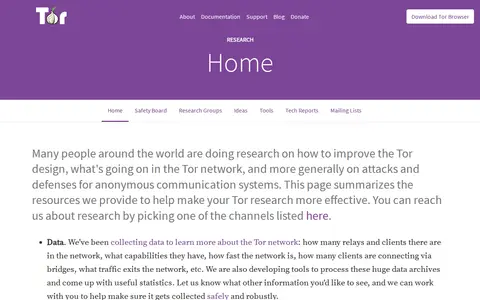
A Tor Project page that summarizes resources the project provides for research on improving Tor design, monitoring the Tor network, and studying attacks and defenses for anonymous communication systems. It points researchers to data collection, analysis guidance and measurement and attack tools.
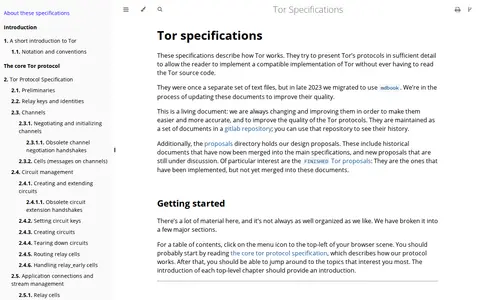
A set of documents describing how Tor works, intended to present its protocols in enough detail for a reader to implement a compatible implementation without reading the Tor source code. The documents were migrated to mdbook in late 2023 and are maintained in a gitlab repository; a separate proposals directory holds design proposals.
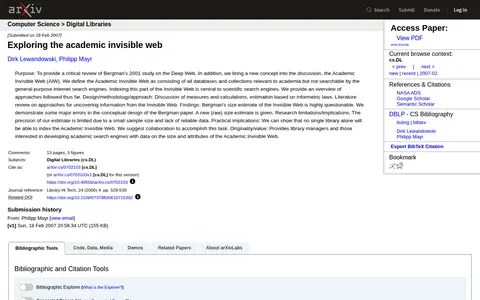
This arXiv paper by Dirk Lewandowski and Philipp Mayr provides a critical review of Bergman's 2001 study on the Deep Web. It introduces the concept of the Academic Invisible Web, defined as databases and collections relevant to academia but not searchable by general-purpose internet search engines, and reviews approaches for indexing it. The authors question Bergman's size estimate and suggest collaboration.
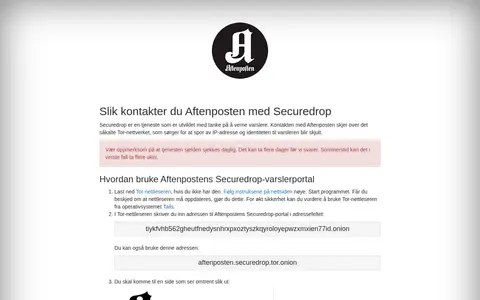
Aftenposten AS instructions for submitting documents securely through its verified SecureDrop service.
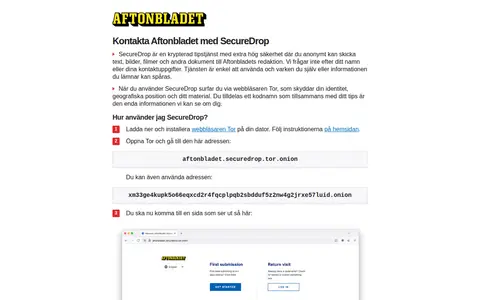
Aftonbladet instructions for submitting documents securely through its verified SecureDrop service.
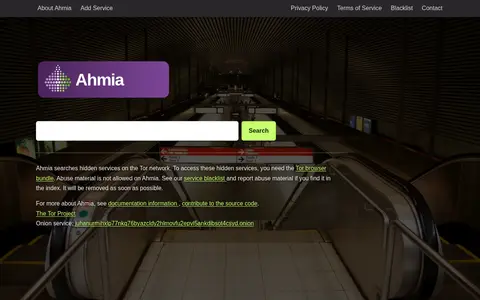
Ahmia is a search engine for services on the Tor network. It indexes hidden services, which require the Tor browser bundle to access, and states that abuse material is not allowed and is removed from the index. The project is developed as free and open source software, with a crawler, an index and a search website.
Official Rust implementation of Tor with developer documentation and project tracking.
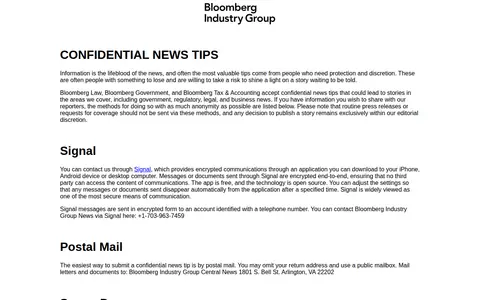
Bloomberg Industry Group accepts confidential news tips through SecureDrop, described as a secure communication platform designed to protect anonymity. Bloomberg Industry Group controls the server, which stores submitted information in encrypted form. The page advises against using home, office or employer networks and devices, recommending public wifi and devices the source controls. Signal and postal mail are listed as alternative methods.
Bloomberg News accepts confidential news tips through email, Signal, postal mail and SecureDrop. A Signal number is provided for encrypted end-to-end communication, and postal mail can be sent from a public mailbox without a return address. The page advises that email is not encrypted and recommends Tor Browser for whistleblowing-related activity.
CBC SecureDrop is a method for securely and anonymously contacting CBC and its investigative journalists. It establishes an anonymous online connection and allows sending encrypted messages or documents. Access requires Tor Browser, with a pass-phrase serving as the user-name to check for replies; the pass-phrase cannot be retrieved once the user leaves the site.
Official Tor archive providing recent and historical network descriptors for reproducible research.
Official source repository for the Tor network daemon and core protocol implementation.
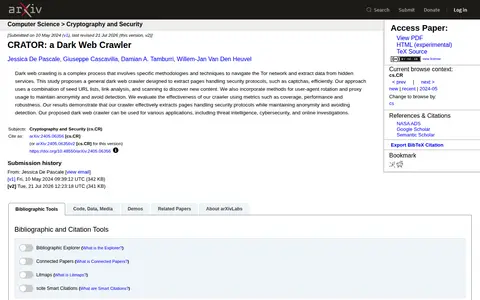
CRATOR is a proposed dark web crawler described in an arXiv paper. It is designed to extract pages that handle security protocols such as captchas, using seed URL lists, link analysis and scanning to discover content, with user-agent rotation and proxy usage for anonymity. The authors report evaluation using coverage, performance and robustness metrics, and suggest threat intelligence, cybersecurity and online investigation applications.
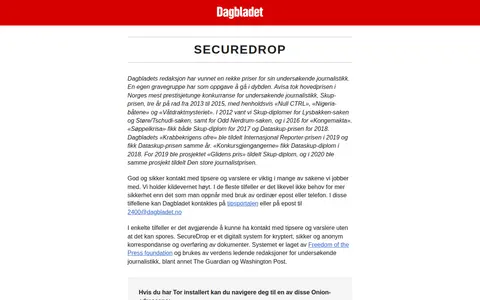
Dagbladet instructions for submitting documents securely through its verified SecureDrop service.
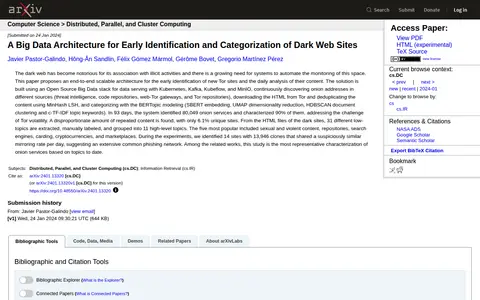
This arXiv paper proposes an end-to-end scalable architecture for early identification of new Tor sites and daily analysis of their content. It is built on an open source big data stack including Kubernetes, Kafka, Kubeflow and MinIO, discovering onion addresses across several sources, downloading HTML from Tor, deduplicating with MinHash LSH and categorizing with BERTopic modeling. In 93 days it identified 80,049 onion services and characterized 90% of them.
A blog from DarkOwl whose analysts publish insights on darknet intelligence, threat detection and cybersecurity trends. Posts include a darknet marketplace snapshot series and articles on breach data and ransomware. The blog states it offers news, research and resources for enterprises and security professionals.
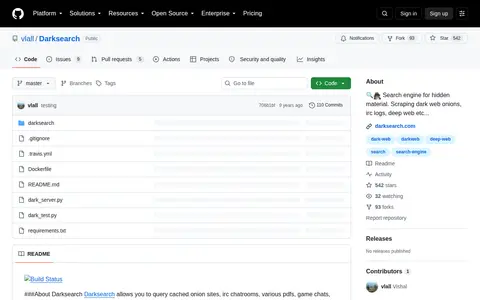
Open-source interface and API project for searching indexed onion content.