
github.com
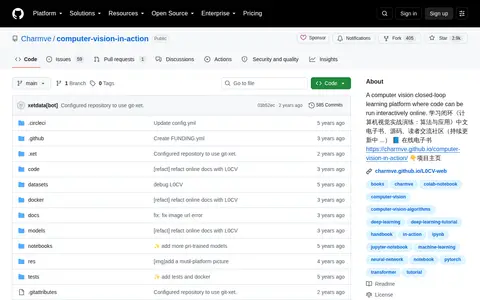
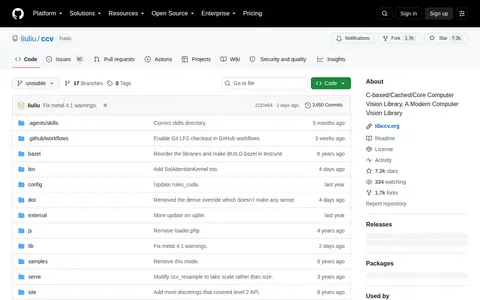
C-based/Cached/Core Computer Vision Library, A Modern Computer Vision Library.
Directory
Published directory entries matching your search.
C-based/Cached/Core Computer Vision Library, A Modern Computer Vision Library.
Computer Vision Art Gallery is a site for the CVPR 2021 art gallery, held virtually due to COVID-19. It lists a winner, shortlisted works and all accepted works, each credited to artists with titles and years.

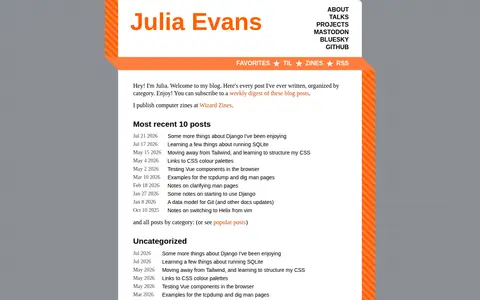
Julia Evans writes a personal blog about computer tools and programming topics, with posts organized by category. The site notes that a weekly digest of posts is available by subscription, and mentions that she publishes computer zines at Wizard Zines.
Master's Degree in Data Science and Computer Engineering @ University of Granada applies AI to data analysis, extraction, visualization, or business…
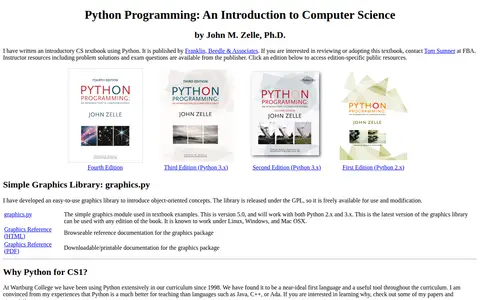
Teaching page by John M. Zelle, Ph.D., for an introductory computer science textbook written in Python and published by Franklin, Beedle & Associates. It links edition-specific public resources for four editions and offers graphics.py, a simple graphics library released under the GPL for introducing object-oriented concepts. Instructor resources including problem solutions and exam questions are available from the publisher.

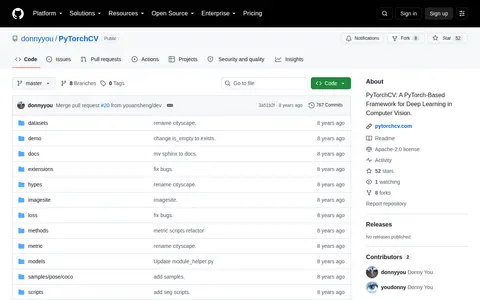
PyTorchCV is a PyTorch-based framework for deep learning in computer vision. The repository provides source code for computer vision problems, with implemented papers covering image classification, semantic segmentation, object detection, pose estimation and instance segmentation.

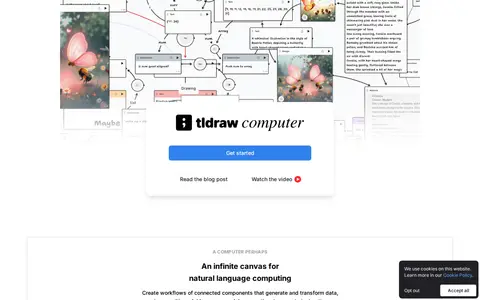
tldraw computer is a free browser-based tool that allows users to create visual programs on an infinite canvas. Users can build and connect interactive components, and use AI to power their creations.

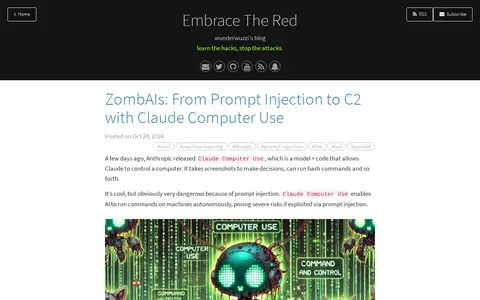
ZombAIs is a blog post about a demonstration in which Claude Computer Use, an Anthropic beta feature that lets Claude control a computer via screenshots and bash commands, was targeted with a prompt injection attack. The post describes crafting a malicious web page to have Claude download a binary and execute it, connecting to a Sliver command and control server.

This is a curated gallery of interesting Jupyter Notebooks, organized by topic categories including introductory tutorials, programming and computer science, statistics and machine learning, data science, mathematics, physics, chemistry, biology, earth science, geo-spatial data, linguistics, and text mining.

Accord.NET is a .NET machine learning framework combined with audio and image processing libraries written in C#. It covers classification, regression, clustering, distributions, hypothesis tests and kernel methods, with imaging and signal processing components. The framework is intended for building computer vision, audition, signal processing and statistics applications, including commercial use. It offers sample applications, documentation and a wiki.
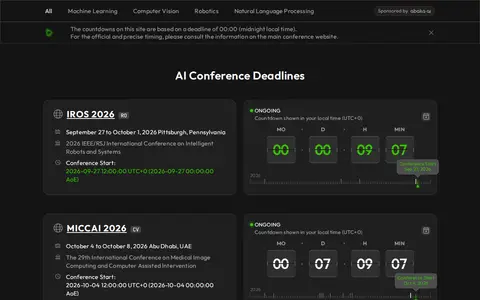
A site listing global AI conferences and exhibitions, with live countdowns to events in machine learning, computer vision, robotics and NLP. Entries include dates, locations and links to add each conference to a calendar. The site states that countdowns use a deadline of midnight local time and advises consulting the main conference website for precise timing.
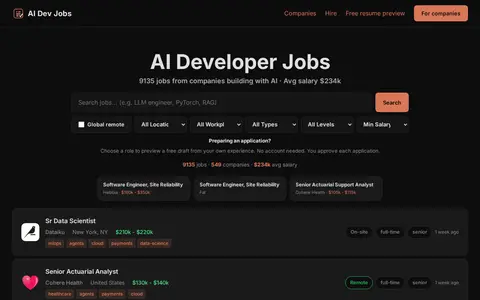
AI Dev Jobs lists open positions for AI developers, covering technologies such as PyTorch, TensorFlow, LLMs, RAG, and computer vision, with salary data and requirements. It also provides a free public REST API and MCP server for AI job search, matching, and candidate-reviewed application preparation.

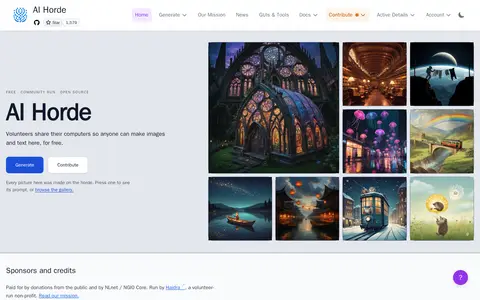
AI Horde is a community-run, open source project where volunteers share their computers so anyone can make images and text for free. The site invites visitors to generate content and contribute computing power, and it shows a gallery of images made on the horde with their prompts.

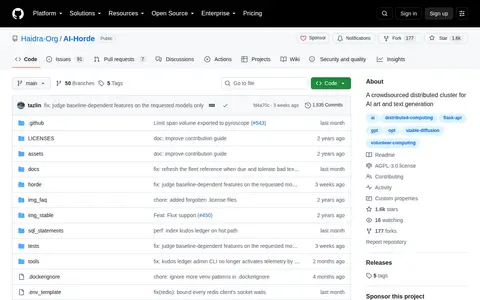
AI Horde is a crowdsourced distributed cluster for AI art and text generation. Volunteers share computer power through workers, and requests are matched to available volunteer computers. A kudos point system gives priority, and kudos cannot be bought or sold. The service is free and community-run.

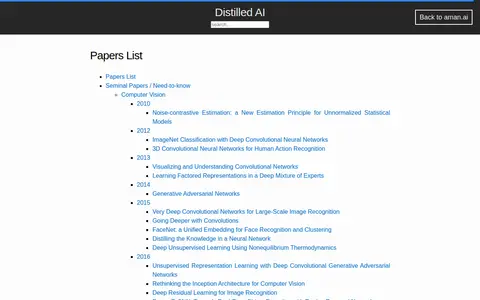
Aman's AI Journal papers list compiles seminal and need-to-know computer vision papers, organized by publication year from 2010 onward. Entries include titles such as ImageNet Classification with Deep Convolutional Neural Networks, Generative Adversarial Networks, and Deep Residual Learning for Image Recognition. The site also offers course notes and learning material for Artificial Intelligence and Deep Learning Stanford classes.
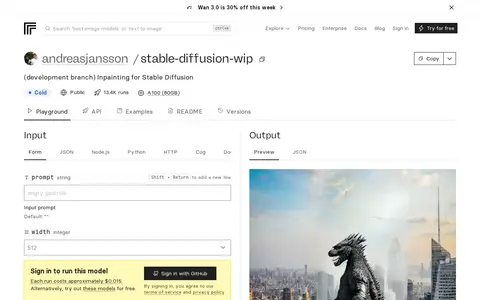
A work-in-progress inpainting branch of Stable Diffusion, published as a public Replicate model. The model runs on Nvidia A100 (80GB) GPU hardware and predictions typically complete within 11 seconds. It costs approximately $0.015 to run on Replicate, or 66 runs per $1. It is open source and can be run on a computer with Docker.

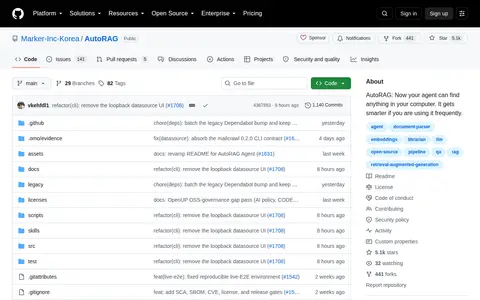
AutoRAG is a project developed by Marker-Inc-Korea that enables an agent to locate content on a user's computer. Its functionality improves with frequent use, and it includes an agent component with defined core values, architecture and operational details.

Organizes AI tools and resources so people can browse and compare relevant services.

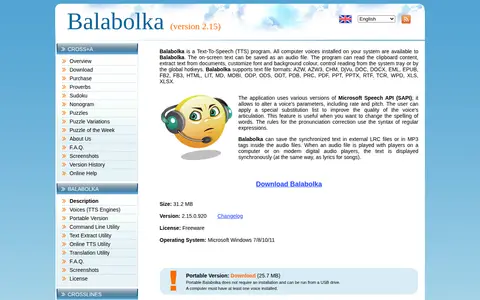
Balabolka is a freeware text-to-speech application that uses computer voices installed on the system. It can save on-screen text as an audio file, read clipboard content, extract text from documents, and save synchronized text in LRC files or MP3 tags.
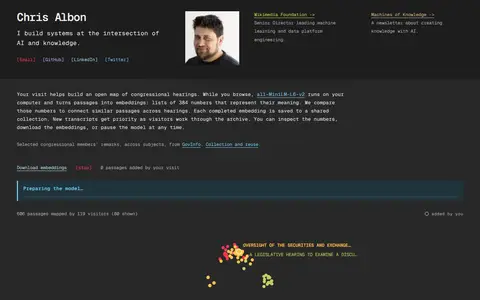
A personal website of Chris Albon. While browsing, the all-MiniLM-L6-v2 model runs on the visitor's computer and turns passages from congressional hearings into 384-number embeddings, which are compared to connect similar passages. Completed embeddings are saved to a shared collection, and visitors can inspect the numbers, download embeddings or pause the model.
AI platform for computer vision and NLP.

Open-source project that provides machine-learning models, research, training resources, or evaluation tools.
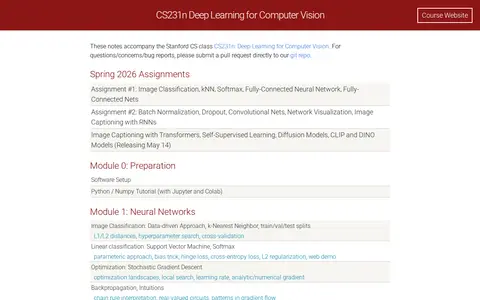
Course materials and notes for the Stanford class CS231n: Deep Learning for Computer Vision. The notes accompany the Stanford CS class and cover topics organized in modules. Spring 2026 assignments are listed.

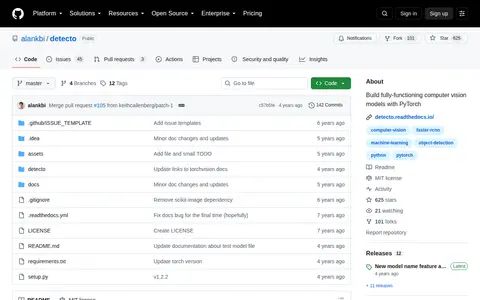
Detecto is a Python package for building computer vision and object detection models with PyTorch. It supports inference on still images and videos, transfer learning on custom datasets, and serialization of models to files, and is distributed under an MIT license.