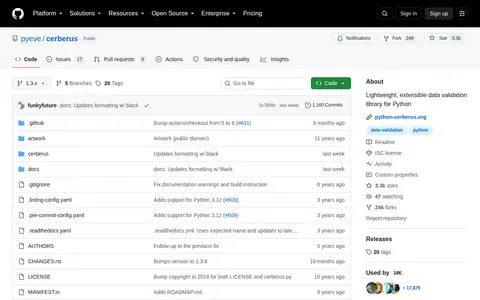

Cerberus is a lightweight and extensible data validation library for Python. It provides type checking and other base functionality out of the box, is designed to be non-blocking and extensible for custom validation, and has no dependencies. It is available on PyPI and maintained according to semantic versioning since version 1.2.
Directory
Search results
Published directory entries matching your search.
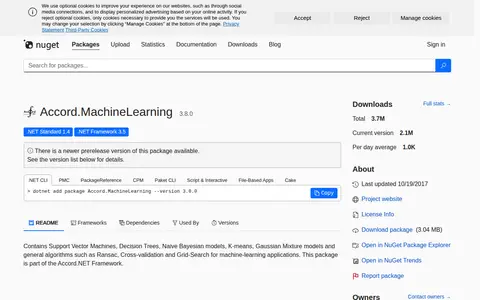
Accord.MachineLearning is a NuGet package, part of the Accord.NET Framework, that contains Support Vector Machines, Decision Trees, Naive Bayesian models, K-means, Gaussian Mixture models, and general algorithms such as Ransac, Cross-validation and Grid-Search for machine-learning applications. Version 3.8.0 targets .NET Standard 1.4 and .NET Framework 3.5.
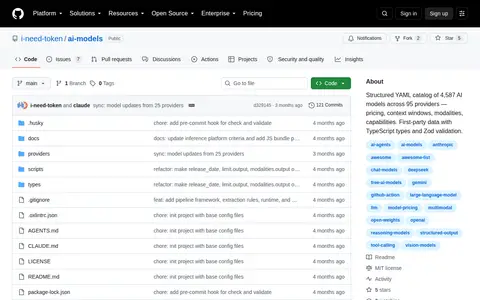
AI Models Catalog is a structured YAML catalog of AI model providers and their models, sourced from first-party APIs and official documentation. It includes TypeScript type definitions and Zod runtime validation schemas, plus scripts to sync data from providers and validate YAML files against schemas.
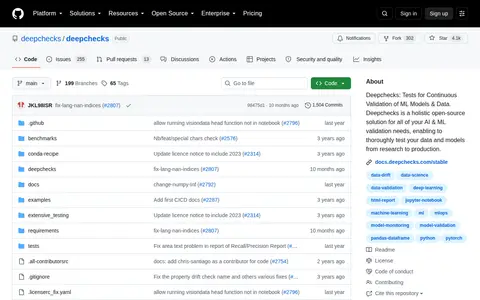
Deepchecks is an open-source project for validating machine learning models and data from research to production. It includes built-in and custom checks and suites for tabular, NLP and CV validation, CI and testing management, and monitoring of deployed models. Installation is via pip.
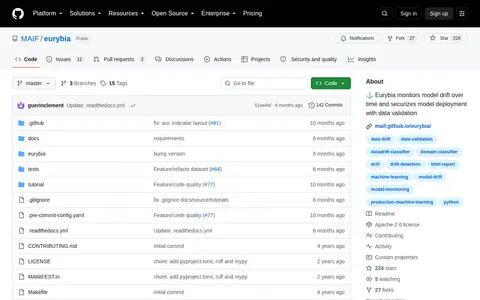
Eurybia is an open-source tool hosted on GitHub under the MAIF organization. It is designed to monitor model drift over time and secure model deployment processes through data validation functionality, with public documentation covering overview, quickstart, installation, features, and project background.
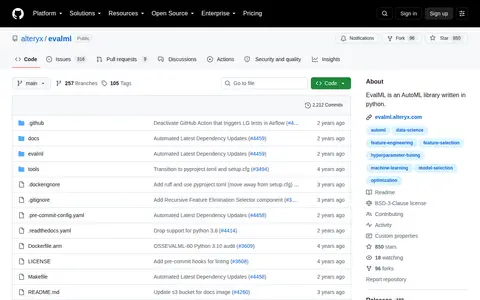
EvalML is an AutoML library written in Python that builds, optimizes, and evaluates machine learning pipelines using domain-specific objective functions. It includes data quality checks, cross-validation, preprocessing, feature engineering, feature selection, and model understanding tools. Install from PyPI or conda-forge.
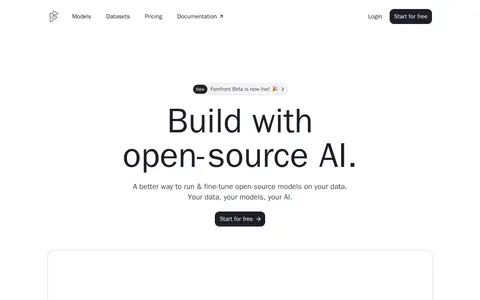
Forefront is described as a platform to fine-tune and inference open-source language models. The site mentions building with open-source AI, fine-tuning models on data, and running inference through serverless API endpoints. It also describes storing training, validation and evaluation data in ready-to-fine-tune datasets. Pricing lists a free tier and a team plan at $99 per month, each including $20 in free credits.
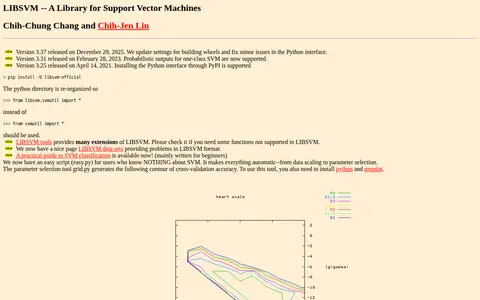
LIBSVM is an integrated software library for support vector classification, regression and distribution estimation. It provides a simple interface for linking with other programs and includes multi-class classification, cross-validation and probability estimates. Interfaces exist for Python, R, MATLAB and other languages.
MLU-Explain is an education initiative from Amazon that teaches machine learning concepts through visual essays. It publishes interactive articles on topics such as neural networks, logistic regression, reinforcement learning, ROC and AUC, cross-validation, random forests, and decision trees.
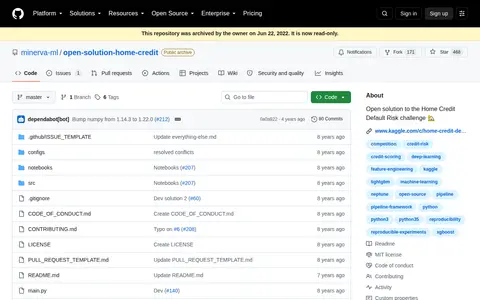
An archived, read-only GitHub repository holding an open solution to the Home Credit Default Risk challenge. It provides code, configs and notebooks plus documented solutions using LightGBM, sklearn and XGBoost with engineered features; the README lists cross-validation and leaderboard scores for each. References to Neptune are optional and the solution can run as a plain Python script.
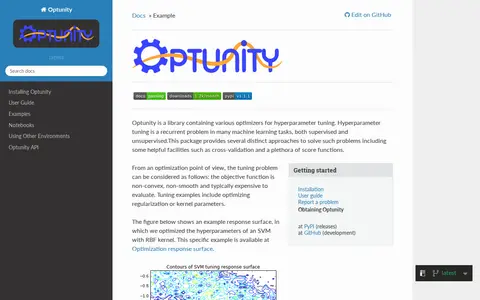
Optunity is a Python library containing various optimizers for hyperparameter tuning. It provides several approaches to solving tuning problems, including cross-validation facilities and score functions. The documentation states it is supported in R, MATLAB, GNU Octave and Java through Jython, and is free software under a BSD-style license.
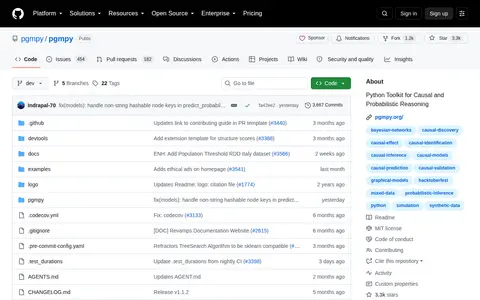
pgmpy is a Python toolkit for causal and probabilistic reasoning using graphical models. It implements data structures for models such as DAGs, PDAGs, MAGs, PAGs, Bayesian Networks, Dynamic Bayesian Networks and Structural Equation Models, with algorithms for tasks including causal discovery, causal identification, inference, model validation, parameter estimation and simulations. Algorithms follow a unified composable API and are scikit-learn compatible when possible. It is available on PyPI and conda.
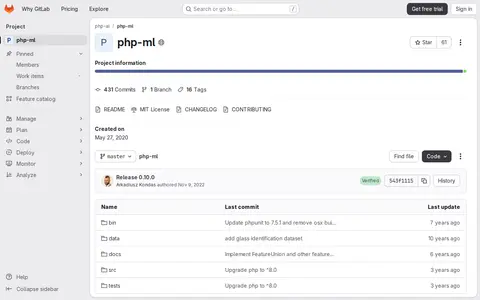
Machine Learning library for PHP. Algorithms, Cross Validation, Neural Network, Preprocessing, Feature Extraction and much more in one library.
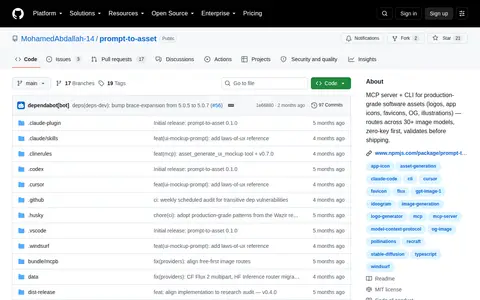
prompt-to-asset is a GitHub repository containing an MCP server and command-line interface tool for generating production-grade software assets including logos, app icons, favicons, Open Graph images and illustrations. The tool routes requests across more than 30 image models, supports zero-key initial usage, and includes validation functionality to review assets before they are shipped.
Quix is described as an agentic AI platform for hardware engineering. It turns test-rig and sensor data into real-time insight and is presented as automating engineering workflows across the V, from requirements through verification, validation and operation.
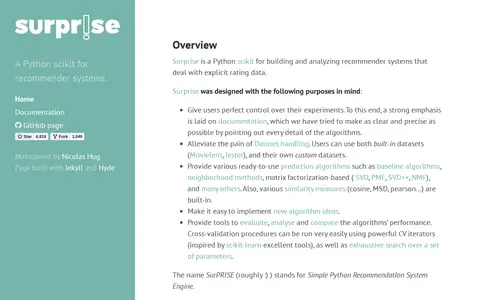
Surprise is a Python scikit for building and analyzing recommender systems that deal with explicit rating data. It includes built-in datasets, prediction algorithms such as SVD and NMF, similarity measures, and cross-validation tools. The documentation states that Surprise does not support implicit ratings or content-based information.
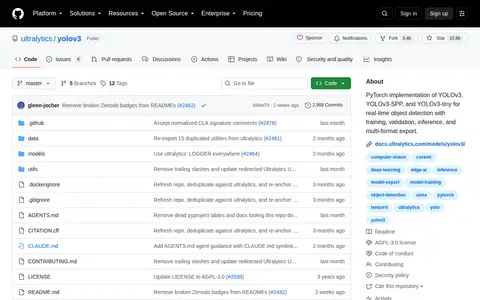
PyTorch implementation of YOLOv3, YOLOv3-SPP, and YOLOv3-tiny for real-time object detection. The repository includes training, validation, inference, and multi-format export tooling, and reuses shared utilities from the ultralytics package. Detection is framed as a single regression problem predicting bounding boxes and class probabilities from full images in one forward pass.