Activeloop is the company behind Deeplake, described as a GPU database for agents. Its stack lists three surfaces: Deeplake, a database combining vector and tensor storage with GPU streaming to fine-tuning; Hivemind, which turns agent traces into shared organization memory; and Refinery, a software factory for continuous learning that includes database optimization, kernel generation and physical AI policy optimization.
Directory
Search results
Published directory entries matching your search.
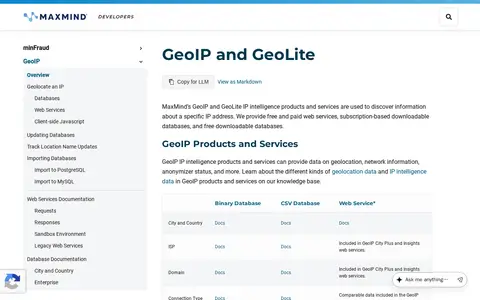
GeoLite databases and web services from MaxMind provide free geolocation and limited network data for IP addresses. The data is less accurate than MaxMind's paid GeoIP products. A free GeoLite account is required to download databases or query the web services, which use the same integration methods and documentation as GeoIP with minor modifications.
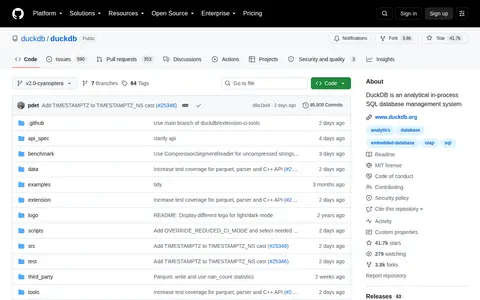
DuckDB is an analytical in-process SQL database management system. It is a high-performance analytical database system designed to be fast, reliable, portable and easy to use, with a rich SQL dialect supporting nested correlated subqueries, window functions, collations and complex types. It is available as a standalone CLI application with clients for Python, R, Java and Wasm.
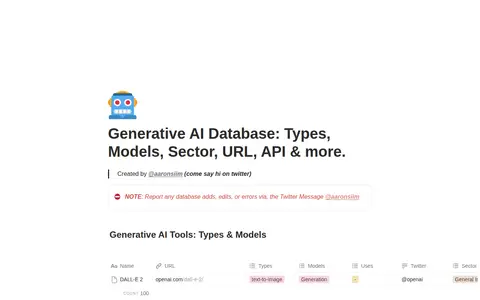
Generative AI Database is a Notion-based collaborative AI workspace built to align with an organization's existing context. It enables users to build and orchestrate AI agents directly alongside team projects, meetings, and connected applications.
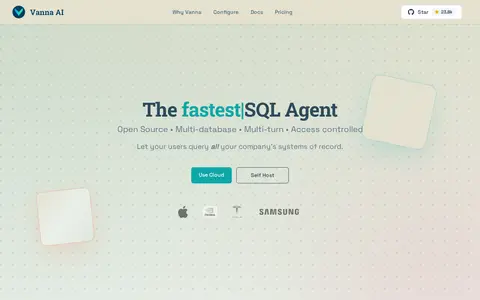
Vanna 2.0 is an AI agent framework that connects large language models to databases. It lets an LLM run SQL queries and generate charts, with tool memory that saves successful interactions to improve later answers. Access controls apply per user, and optional hosted admin features include observability, agent memory, file storage, audit logs and data retention. It works with various LLM providers and databases.
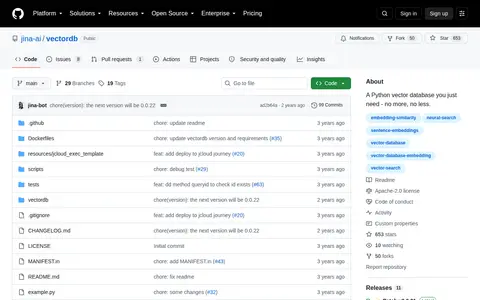
VectorDB is a Python vector database designed to be simple and sufficient. It can be used locally or as a service, with server and client components. The project emphasizes ease of use for vector database needs.
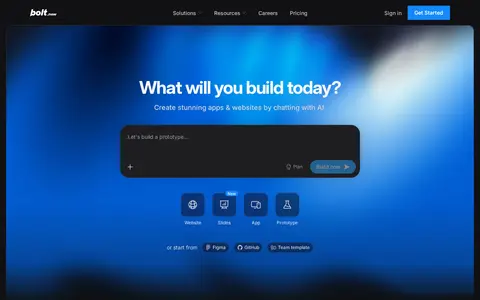
Bolt.new is an AI-powered builder for creating websites, applications, and prototypes. Users can build projects using text input, with built-in features including unlimited databases, user management and authentication, SEO optimization, hosting with analytics and custom domain support. It offers use cases for small businesses and enterprises, plus production-ready templates.
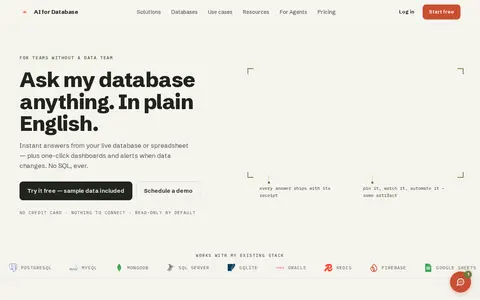
A tool that lets users connect databases and spreadsheets and ask questions in plain English instead of writing SQL. Supported sources include PostgreSQL, MySQL, MongoDB, SQL Server and Google Sheets. It provides instant answers, dashboards and reports, and automated workflows with alerts through Slack, email and webhooks.
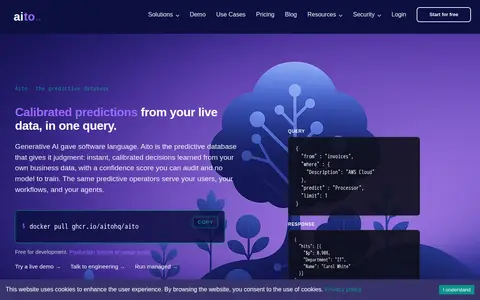
Aito.ai is a predictive database that delivers instant, calibrated predictions from a user's live data through single queries. It supports use cases including predictive accounting, ERP, e-commerce, and application functionality, with capabilities for predictions, recommendations, classification, smart search, knowledge graphs, and AI agents. It offers a free tier for development and production licensing scaled to usage.
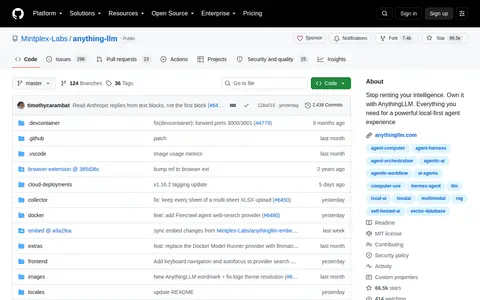
AnythingLLM is an all-in-one AI application for chatting with documents, using AI agents, and connecting local or cloud LLMs. It includes a built-in local LLM engine, vector databases, document pipelines, multi-user support, and a no-code agent builder. It is distributed under an MIT license.
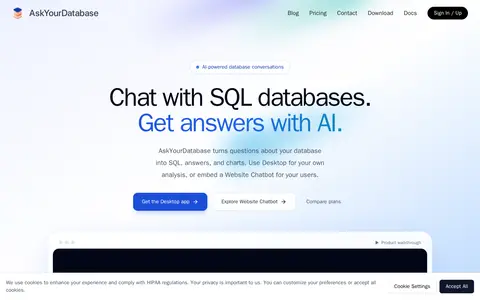
AskYourDatabase is a tool for querying SQL databases in natural language, returning SQL, answers, and charts. It supports PostgreSQL, MySQL, SQL Server, BigQuery, Snowflake, and other engines. Offerings include a Windows or macOS desktop app, an embeddable website chatbot, a dashboard builder, and a private deployment option for organizations with hosting or data-handling requirements.
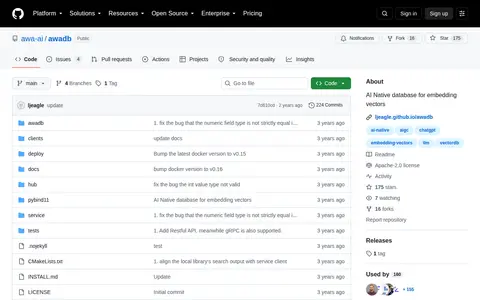
Awadb is an AI-native database built for working with embedding vectors. It is available as a public open-source repository on GitHub, where users can access the code, contribute to development, or deploy it locally on Mac OSX or Linux, or run it as a standalone service. The project is designed to support AI applications that rely on vector embedding functionality.
An AWS program offering students and educators no-cost access to cloud computing skills training developed by AWS experts, plus career pathways for students. It provides a library of free, self-paced online training and hands-on labs covering storage, compute, networking, databases and cloud operations. Learners as young as 13 can register with an email address, and learners 18 and older can access a job board.
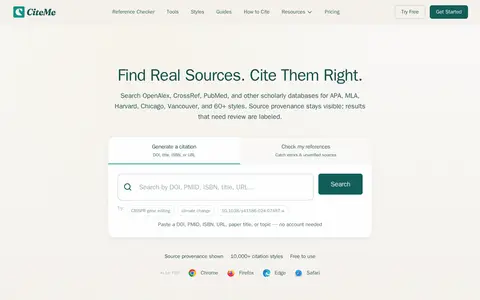
CiteMe is a citation generator that formats references in APA, MLA, Harvard, Chicago, and many other styles. Users paste a DOI, ISBN, URL, or title, and the tool reviews the metadata source before formatting. It searches scholarly databases such as OpenAlex, CrossRef, and PubMed. A free plan is offered, with a Pro tier adding batch PDF import and exports.
Claygent is Clay's AI web scraper used for enrichment in Clay. Unlike traditional enrichment providers that return static database results, it browses websites and reads pages to return insights, addressing last mile data that is too niche for data providers. Company enrichment requires a company domain, and people enrichment requires a LinkedIn profile URL.
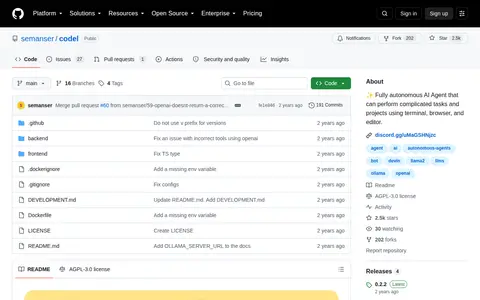
Codel is a self-hosted autonomous AI agent that performs tasks and projects using a terminal, browser and editor. It runs in a sandboxed Docker environment, detects the next step automatically, can fetch web information through a built-in browser, and saves command history and outputs in a PostgreSQL database.
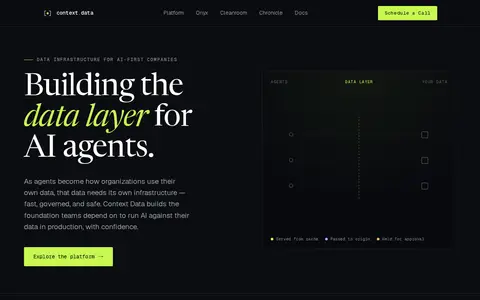
InterLock is a proxy positioned between AI agents and databases, files and APIs. It authorizes each request by role and policy, redacts sensitive fields before the agent sees them, holds risky writes for approval and audits requests. It deploys as infrastructure inside the user's environment, and the agents and data stores do not change.
Data Engineering Podcast is a show that covers the tools, techniques, and challenges of the data engineering discipline. Its episodes address topics including databases, workflows, automation, and data manipulation, and it is available for listening on a range of podcast platforms.
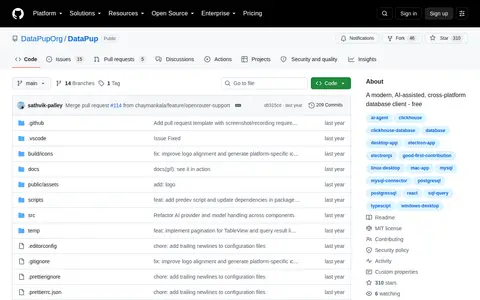
DataPup is an open-source, AI-assisted, cross-platform database client built with Electron and powered by LangChain for AI assistance. It currently supports ClickHouse and PostgreSQL, with MySQL and SQLite listed as coming soon. It is released under the MIT license.
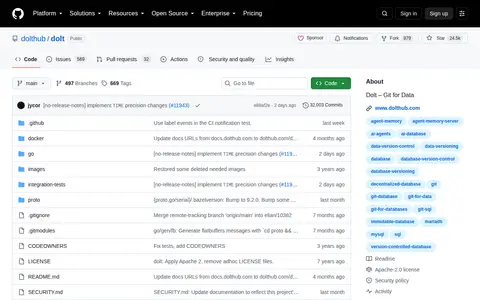
SQL database that you can fork, clone, branch, merge, push and pull just like a git repository.
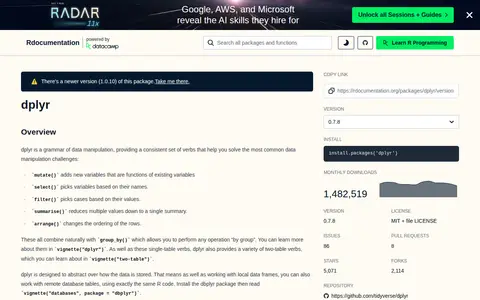
dplyr is an R package providing a grammar of data manipulation with a consistent set of verbs, including mutate(), select(), filter(), summarise() and arrange(), which combine with group_by(). It is designed to abstract over how data is stored, so the same R code works with local data frames and remote database tables via the dbplyr package.
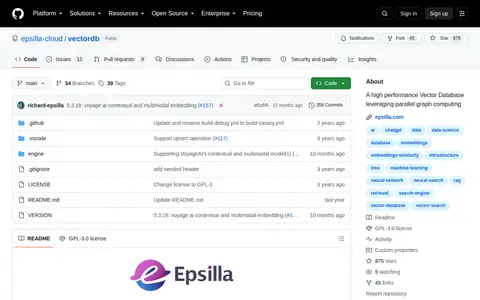
Epsilla is a high-performance vector database hosted on GitHub under the epsilla-cloud organization. It leverages parallel graph computing for its operations, and offers an experimental option to use it as a Python library without requiring a Docker image, alongside Epsilla Cloud as a deployment option.

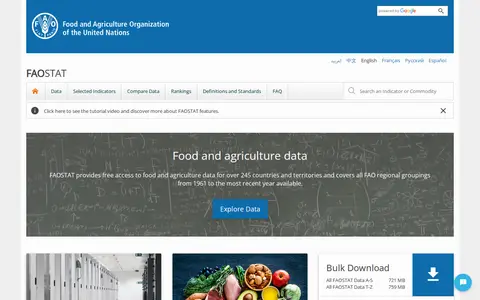
FAOSTAT is a database that provides free access to food and agriculture data for over 245 countries and territories. It covers all FAO regional groupings and includes data from 1961 up to the most recent year available. The service enables users to explore and analyze agricultural statistics globally.
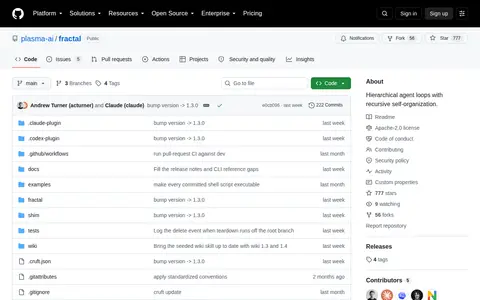
fractal is a tool for hierarchical agent loops with recursive self-organization, in which autonomous agent loops arrange themselves into a tree of git worktrees and spawn child nodes for separable subtasks. Hard caps on iterations, depth, children, cost and time bound each loop, and run metadata, including cost, is stored in a local SQLite database. Nodes run their agents without permission prompts by default.