Directory

Search results

Published directory entries matching your search.

Search results

16 listings
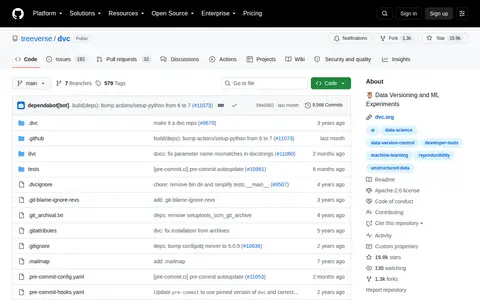
dvc.org

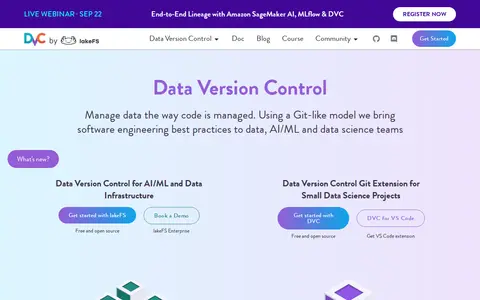
DVC (Data Version Control) is an open-source version control system for data science and machine learning projects. It provides a Git-like experience for organizing data, models, and experiments, with free offerings for individual data scientists and enterprise teams.

Models & Machine Learning 0
github.com

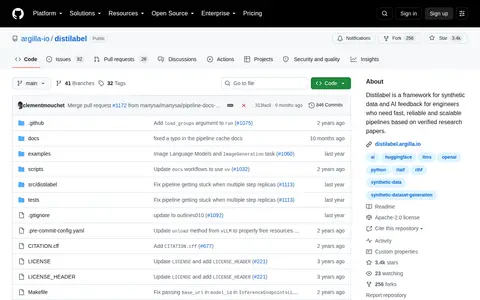
distilabel is a framework for synthetic data generation and AI feedback intended for engineers. It provides fast, reliable, and scalable pipelines based on verified research papers, supporting data synthesis for AI systems and on-the-fly feedback addition. The framework aims to improve AI output quality via enhanced data quality, give users control over their data and models, and boost efficiency through rapid iteration on research and large language models.

AI Data & Analytics 0
github.com

Data Version Control - Git for Data & Models - ML Experiments Management.

AI Data & Analytics 0
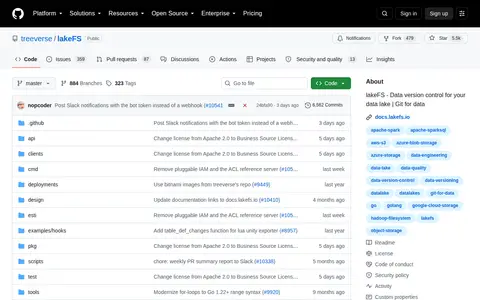
github.com

lakeFS is a source-available data version control tool that turns object storage into a Git-like repository, allowing data lakes to be managed like code. It supports AWS S3, Azure Blob Storage and Google Cloud Storage, is API compatible with S3, and works with frameworks such as Spark, Hive, AWS Athena, DuckDB and Presto.

AI Data & Analytics 0
dataiku.com

Dataiku is described as a platform for AI success that unites people, orchestration, and governance. It brings analytics, models, and AI agents together in a single governed system, with centralized routing, quotas, monitoring, and safety controls for managing LLM providers.

AI Education & Learning 0
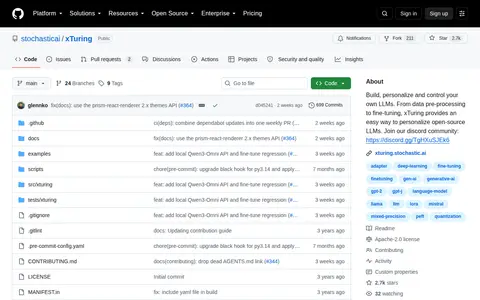
github.com

xTuring is an open-source project for building, personalizing, and controlling LLMs, covering data pre-processing through fine-tuning. It includes a simple API for data prep, training, and inference, LoRA and low-precision (INT8/INT4) support, and built-in evaluation metrics such as perplexity. Models can run locally or in a private VPC and scale from CPU to multi-GPU.

Models & Machine Learning 0
clipasso.github.io

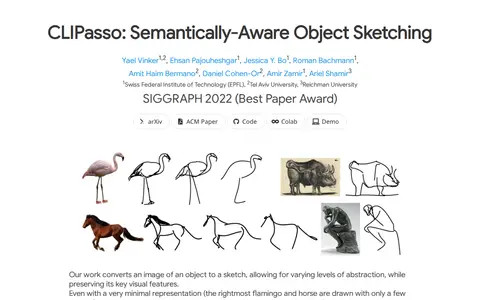
CLIPasso is a method for converting an object image into a sketch with adjustable abstraction levels while preserving key visual features. It optimizes Bézier curves using a differentiable rasterizer and a CLIP-based perceptual loss, without requiring an explicit sketch dataset. Abstraction is controlled by varying the number of strokes.

AI Image Generation 0
playground.tensorflow.org

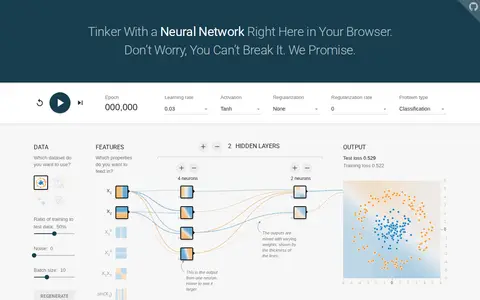
A Neural Network Playground is a browser-based educational visualization created by Daniel Smilkov and Shan Carter for experimenting with a real neural network. Users adjust controls to explore how a network learns from data. The project is open sourced on GitHub under the Apache License so its features can be tailored to a topic or lesson.

Models & Machine Learning 0
hexabot.ai

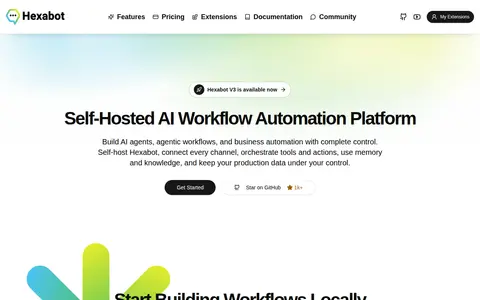
Hexabot is a self-hostable AI workflow automation platform. It is used to build AI agents and workflows that interact across channels, using MCP tools, memory and data control. Projects can be started locally with the official CLI, and the platform is source-available under the FCL-1.0-ALv2 licence.

AI Agents & Automation 0
katonic.ai

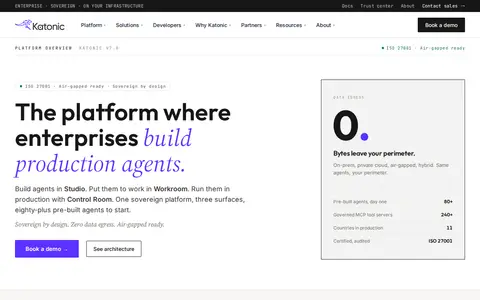
Katonic AI is a full-stack enterprise platform for building, deploying, and governing AI agents on customer-owned infrastructure, including on-premise, private cloud, and air-gapped environments. It incorporates NVIDIA NeMo guardrails, enforces zero data egress, and provides three core surfaces (Studio, Workroom, Control Room) alongside more than 80 pre-built agents and over 240 governed MCP tool servers.

AI Agents & Automation 0
github.com

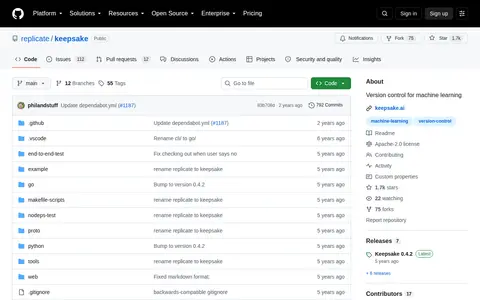
Keepsake is a version control system for machine learning projects. It allows tracking changes to models, data, and experiments. It is developed by Replicate and hosted on GitHub as an open-source repository. The project is not actively maintained.

Models & Machine Learning 0
noib.app

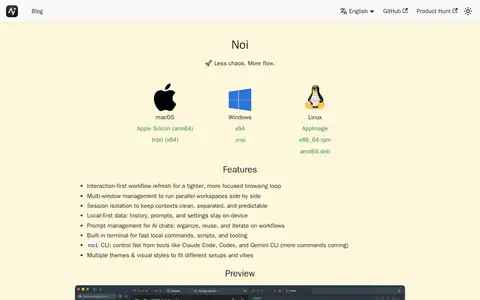
Noi is a desktop application that provides an interaction-focused browsing workflow. It offers multi-window management for parallel workspaces, session isolation, and local-first data storage for history, prompts, and settings. It also includes prompt management for AI chats, a built-in terminal, and a CLI for controlling Noi from tools such as Claude Code and Codex. Builds are listed for macOS, Windows, and Linux.

Models & Machine Learning 0
open-notebook.ai

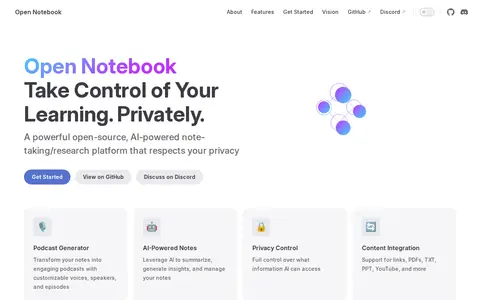
Open Notebook is an open-source, AI-powered note-taking and research platform focused on user privacy. It includes a podcast generator that transforms notes into customizable audio content, AI tools for summarizing notes and generating insights, granular privacy controls for AI data access, and support for integrating links, PDFs, text files, presentations, YouTube videos and other content types. The platform is designed for researchers, students, and learning enthusiasts.

AI Business & Productivity 0

The copyright conundrum of AI art is an article from The Verge examining copyright issues related to generative AI. It covers image generation tools including Midjourney, Stable Diffusion, and DALL-E, discusses questions of AI art ownership, and notes that copyright concerns impact generative AI development around training data and output control.

AI Image Generation 0
vanna.ai

Vanna 2.0 is an AI agent framework that connects large language models to databases. It lets an LLM run SQL queries and generate charts, with tool memory that saves successful interactions to improve later answers. Access controls apply per user, and optional hosted admin features include observability, agent memory, file storage, audit logs and data retention. It works with various LLM providers and databases.

AI Agents & Automation 0

A seven-week online class starting October 24th, 2022, that demystifies the text-to-image process and helps designers and artists gain control over the tools. It explores several significant options and the controversy of how these models gathered their training data. The class is geared toward people who have never used these tools or used them a little.

AI Image Generation 0