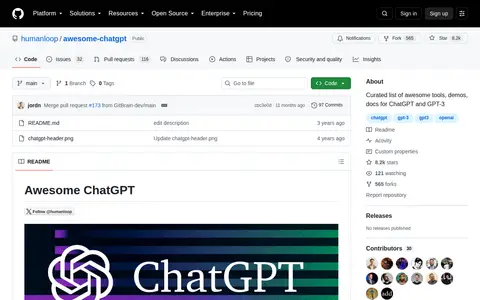

A curated GitHub list of resources for ChatGPT and GPT-3 from OpenAI. It covers general resources such as the ChatGPT official app and API documentation, API tools, Chrome extensions, bots for platforms including Telegram, WhatsApp, Slack, Discord and Twitter, IDE plugins, desktop apps, tutorials, applications, CLI tools and example prompts.
Directory
Search results
Published directory entries matching your search.
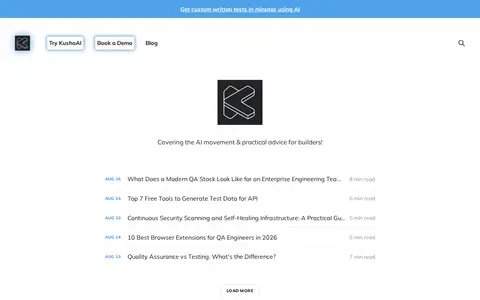
A blog covering the AI movement and offering practical advice for builders. Posts include topics such as QA stacks for enterprise engineering teams, free tools for generating API test data, continuous security scanning, browser extensions for QA engineers, and quality assurance versus testing.
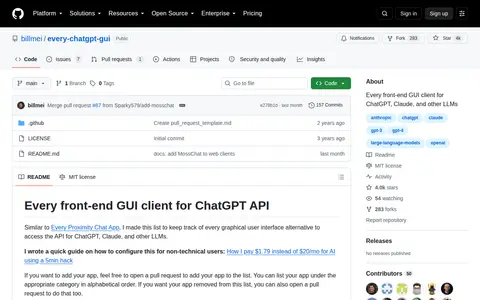
Every ChatGPT GUI is a repository list tracking graphical user interface alternatives for accessing the API for ChatGPT, Claude and other LLMs. It groups open source web AI chats, browser extensions, Obsidian plugins, self-hosted tools and desktop apps, with demo and source links. The repository is MIT licensed and accepts pull requests to add or remove apps.
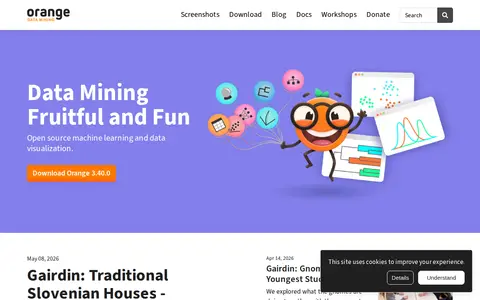
Orange is an open-source machine learning and data visualization toolbox. It offers visual programming in which widgets are placed on a canvas and connected to load datasets and analyze data. It supports interactive visualization methods including box plots, scatter plots, decision trees, hierarchical clustering, heatmaps, MDS, t-SNE and linear projections. Extensions add text mining, network analysis and other specialized capabilities.
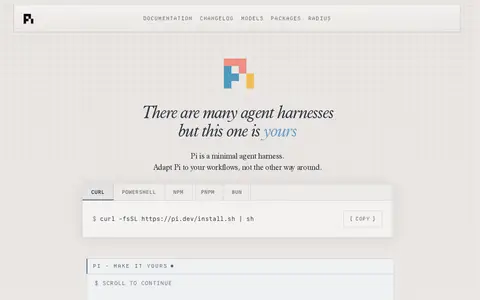
Pi is a terminal-based minimal coding agent harness built to adapt to user workflows rather than requiring users to adjust their processes. It supports 15+ providers and hundreds of models, offers tree-structured shareable interaction history, context engineering features, and four operation modes: interactive, print/JSON, RPC, and SDK. Users can customize Pi with extensions, skills, prompt templates, and themes, and share customizations as packages via npm or git. It is installable via curl, PowerShell, npm, pnpm, or bun.
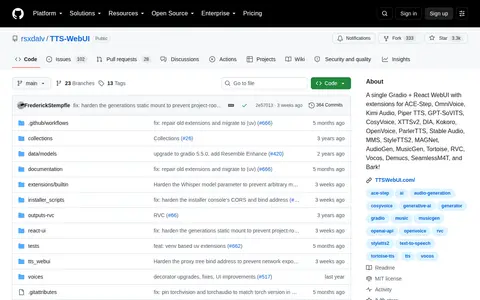
Tts Web UI is a single web interface built with Gradio and React that supports extensions for a wide range of audio and text-to-speech related models and tools, including ACE-Step, OmniVoice, Piper TTS, GPT-SoVITS, and others.