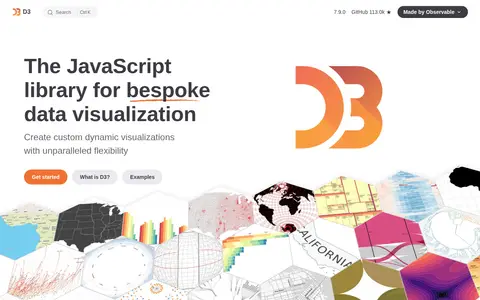

D3.js is a JavaScript library for bespoke data visualization developed by Observable. It enables creation of custom dynamic visualizations with features including selections and transitions, scales and axes, shape rendering, interactive behaviors, layout algorithms, and geographic map projections. The library also powers Observable Plot, a high-level visualization API.
Directory
Search results
Published directory entries matching your search.
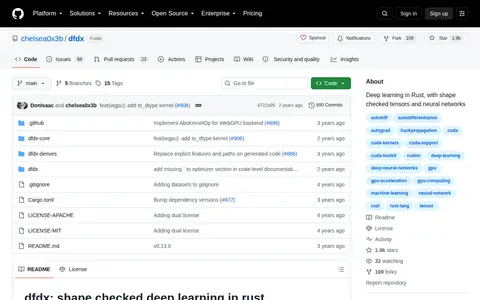
Deep learning in Rust, with shape checked tensors and neural networks.
A browser-based tool that analyzes an uploaded eye photo with AI to identify eye shape and show analysis results. It lists almond, round, upturned and downturned shapes and gives photo tips. Uploads accept PNG or JPG up to 10MB.
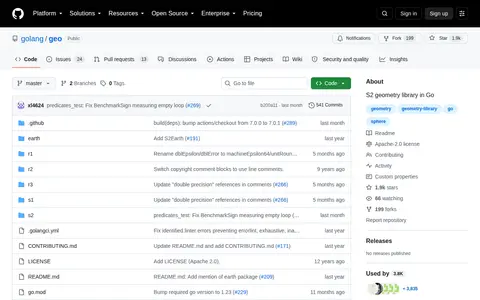
S2 is a Go library for spherical geometry. It provides representations of angles, intervals, latitude-longitude points and unit vectors, geometric shapes over the unit sphere such as caps, rectangles, polylines and polygons, a hierarchical cell decomposition, constructive operations and predicates, in-memory indexing, distance algorithms and snapping and simplification. Planar geometry and conversions to common GIS formats are outside its scope.
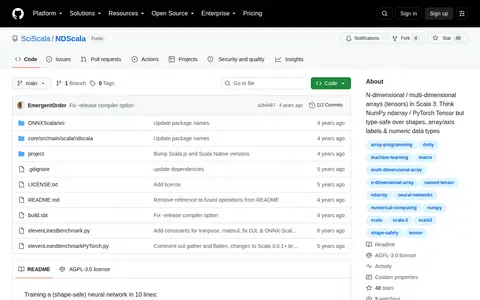
NDScala is a Scala 3 library for N-dimensional and multi-dimensional arrays (tensors), described as comparable to NumPy ndarray or PyTorch Tensor, with type safety over shapes, array and axis labels and numeric data types. The repository includes materials on shape-safe neural network training and an ONNXScala component.
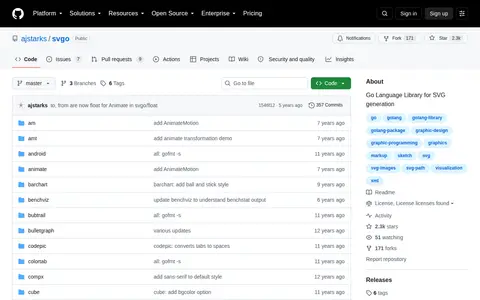
SVGo is a Go language library for SVG generation. It supports common SVG elements including shapes, lines, text, paths, images, and gradients, and is hosted as an open-source project on GitHub.
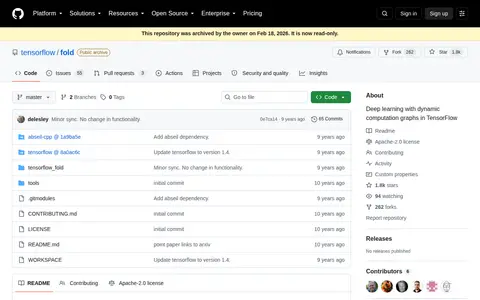
TensorFlow Fold is a library for creating TensorFlow models that consume structured data, where the computation graph depends on the structure of the input data. It implements dynamic batching, transforming batches of arbitrarily shaped computation graphs into a static computation graph. TensorFlow Fold is not an official Google product.
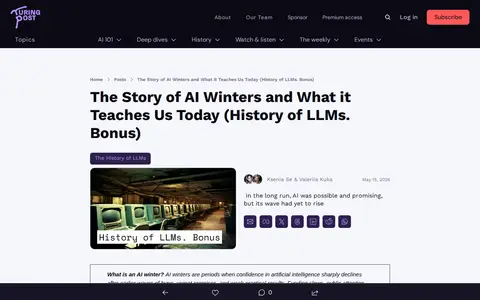
The Story of AI Winters and What it Teaches Us Today is a Turing Post article that outlines five AI winter periods between 1966 and 1988. It details the causes of each collapse in AI hype, lessons learned by researchers, and how these setbacks shaped the development of modern neural networks and current AI technology.