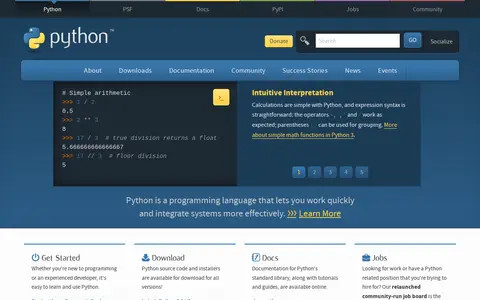
Python is a programming language whose official site provides downloads, documentation, a beginner's guide and news. The site lists application areas including web development, GUI development, AI and machine learning, scientific and numeric computing, software development and system administration. The Python Software Foundation supports the language and its community.
Directory
Search results
Published directory entries matching your search.
pandas is an open source, BSD-licensed library providing high-performance, easy-to-use data structures and data analysis tools for the Python programming language. It is described as a data analysis and manipulation tool built on top of Python. Documentation, a user guide and an API reference are available.
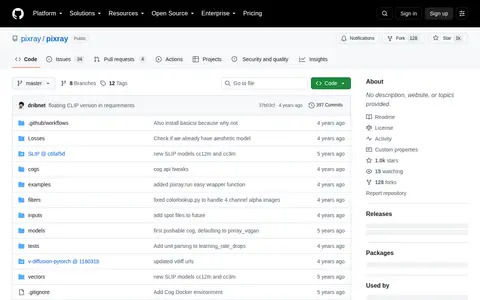
pixray is an image generation system combining perception engines, CLIP-guided GAN imagery and CLIPDraw. It is a Python library and command line utility that can also run in Google Colab notebooks or inside Docker using Cog. Installation requires a recursive git clone and a fresh Python 3.8 environment.
A hands-on, project-based introduction to programming with Python by Eric Matthes, published in its third edition in December 2022. The book covers basic concepts such as variables, lists, classes, and loops, and guides readers through projects including a Space Invaders-inspired arcade game, data visualizations, and a simple web application.
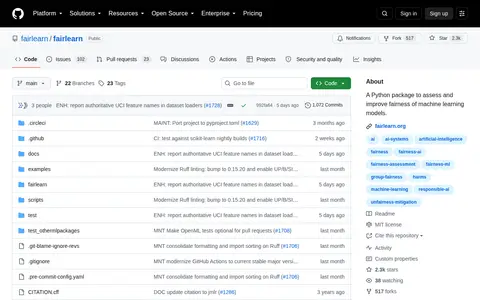
Fairlearn is a Python package hosted on a GitHub repository maintained by the Fairlearn project, designed to assess and improve the fairness of machine learning models. The repository includes documentation covering fairness definitions and a getting started guide for the tool.
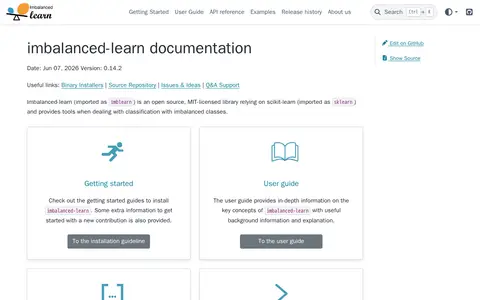
An open source, MIT-licensed Python library imported as imblearn that relies on scikit-learn. It provides tools for classification with imbalanced classes. The documentation includes installation guides, a user guide, an API reference and a gallery of examples.
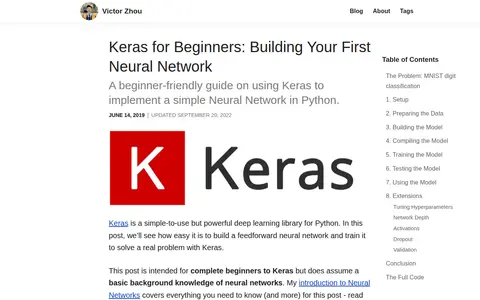
A beginner-friendly guide on using Keras to implement a simple neural network in Python. It walks through MNIST handwritten digit classification, covering setup, data preparation, building the model, compiling, training, testing and using the model. It is intended for complete beginners to Keras who have a basic background knowledge of neural networks.
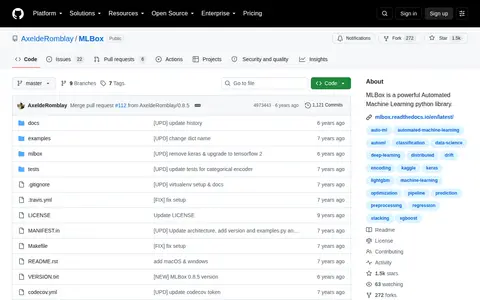
MLBox is an open-source automated machine learning library implemented in Python, hosted in the AxeldeRomblay/MLBox GitHub repository. It provides contribution guidelines, project topic information, and resources documenting the library's functionality.
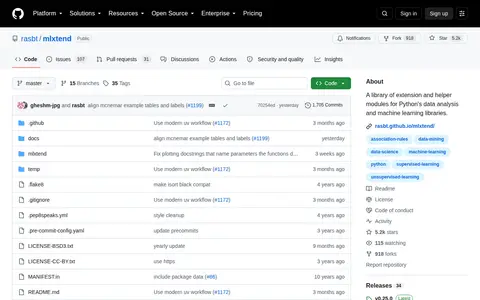
mlxtend is a library that provides extension and helper modules for Python's data analysis and machine learning libraries. The project includes installation guides, example code, license information, and contact details. It is hosted as an open source repository on GitHub.
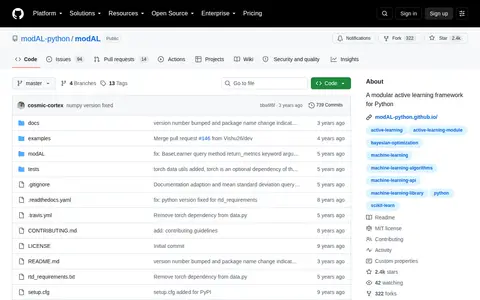
modAL is a modular active learning framework designed for use with the Python programming language. The project includes introductory documentation, overviews of active learning concepts, usage examples, and quickstart guides. It is hosted as an open source repository on GitHub.
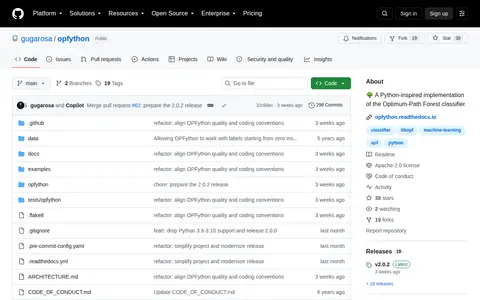
OPFython is a GitHub repository offering a Python-inspired implementation of the Optimum-Path Forest classifier. The library enables classification tasks using the optimum-path forest algorithm. It includes installation instructions, quick start guides, and classifier documentation. The project is open source and welcomes contributions from the community.
The Hundred-Page Language Models Book by Andriy Burkov is a concise hands-on guide covering machine learning basics through advanced transformer architectures and large language models. It explains AI fundamentals, text representation, count-based models, recurrent neural networks, and transformers, with mathematical foundations and Python code examples. The book targets ML practitioners and engineers building text-based applications.
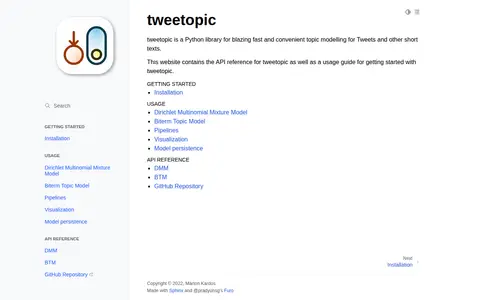
tweetopic is a Python library for topic modelling of Tweets and other short texts. Its documentation site provides an API reference and a usage guide covering installation, the Dirichlet Multinomial Mixture Model, the Biterm Topic Model, pipelines, visualization and model persistence.