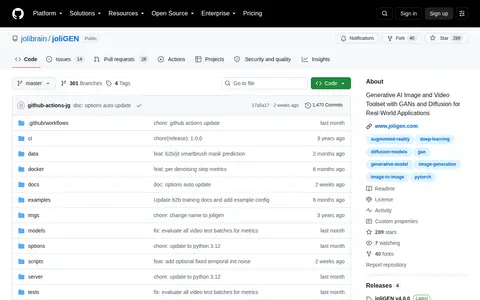
joliGEN is an integrated framework for training custom generative AI image-to-image models. It implements GAN, diffusion and consistency models for paired and unpaired image-to-image translation, including domain and style adaptation that preserves semantics such as image and object classes and masks. A server with REST API is provided for deployment, and documentation includes quickstarts and dataset guidance.
Directory
Search results
Published directory entries matching your search.
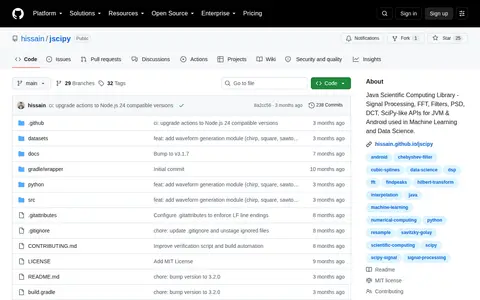
Open-source Java scientific computing library for JVM and Android platforms, with SciPy-like APIs for use in machine learning and data science workflows. It provides functionality for signal processing, FFT, filters, PSD, and DCT operations.
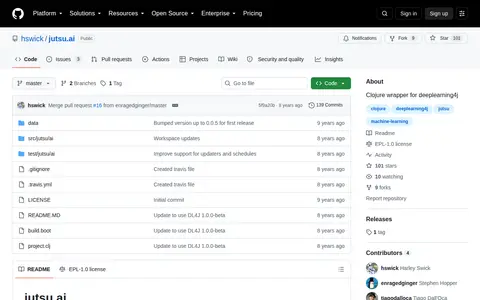
A Clojure wrapper for deeplearning4j with added syntactic sugar, aiming to provide a declarative API for machine learning on the JVM. It translates Clojure keywords into Java method calls, making many deeplearning4j configuration options accessible. The project is a work in progress, and configurations have been tested on basic feedforward nets, RNNs and CNNs.
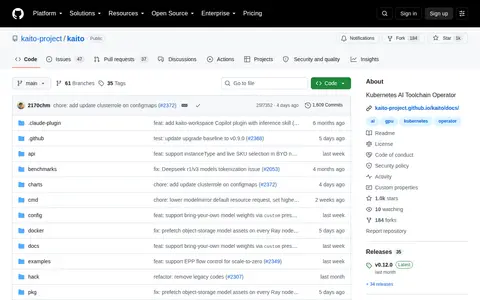
Kaito is the Kubernetes AI Toolchain Operator, an operator suite that automates LLM inference, fine-tuning and RAG engine deployment in a Kubernetes cluster. It simplifies the CRD API and provides optimized preset configurations for inference engine scheduling parameters. Workspaces are the basic CRD for managing inference and tuning workloads, and all vLLM-supported models can be run.
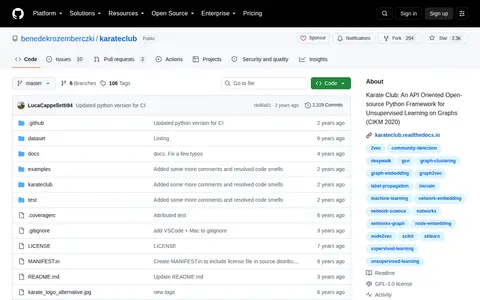
An unsupervised machine learning extension library for NetworkX with a Scikit-Learn like API.
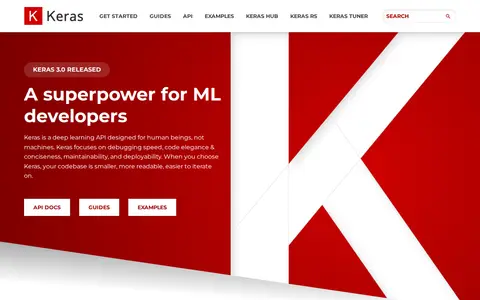
Keras is a deep learning API that focuses on debugging speed, code conciseness and maintainability. It uses a multi-backend approach that allows work with JAX, TensorFlow and PyTorch, and the KerasHub library provides Keras 3 implementations of popular model architectures with pretrained checkpoints.
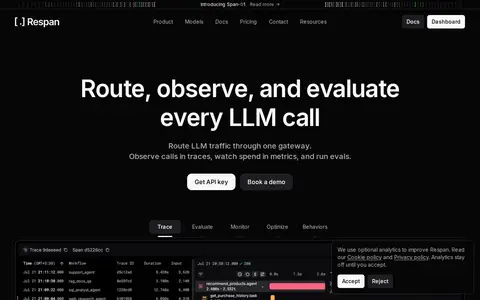
Respan is an AI gateway that routes requests to over 1,000 models through one API endpoint, with automatic fallbacks, response caching, and spending limits. It also provides built-in observability for tracing LLM calls, tool calls, and agent steps, plus automated evaluations and security testing for masking PII and red-teaming agents before launch.
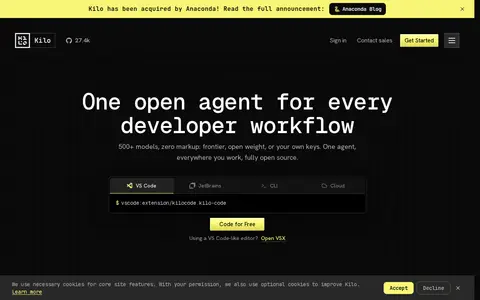
Kilo is an open source AI coding agent for VS Code, JetBrains, CLI, desktop and cloud. It offers access to 500+ models at zero markup, bring-your-own keys, or local models for privacy. Kilo Gateway provides a unified API to access AI models through a single endpoint.
Simple API for Neural Network. Better for image processing with CPU/GPU + Transfer Learning.
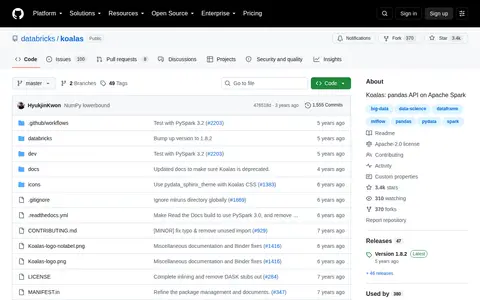
Koalas, from Databricks, implements the pandas DataFrame API on top of Apache Spark. The repository is marked deprecated and in maintenance mode; Koalas supports Apache Spark 3.1 and below, and PySpark is recommended directly for Spark 3.2 and above. It is available under the Apache-2.0 license.
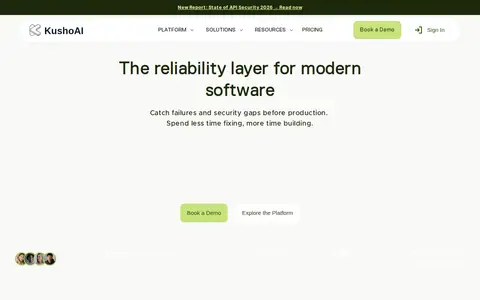
KushoAI is AI-native infrastructure for software maintenance, with autonomous agents integrated into customer CI/CD pipelines to handle continuous testing, healing, and monitoring. It automatically generates test suites from OpenAPI specifications or Postman collections to catch breaking API changes before production.
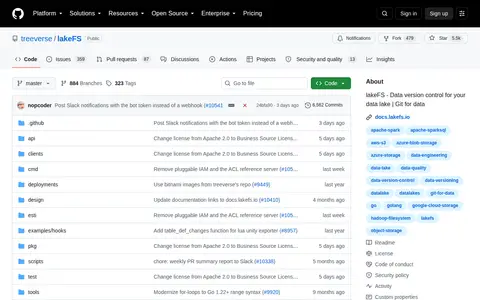
lakeFS is a source-available data version control tool that turns object storage into a Git-like repository, allowing data lakes to be managed like code. It supports AWS S3, Azure Blob Storage and Google Cloud Storage, is API compatible with S3, and works with frameworks such as Spark, Hive, AWS Athena, DuckDB and Presto.
Lambda offers hourly rental of NVIDIA H100, H200, B200, and A100 GPUs through a self-serve interface, with instances launchable via UI, API, or CLI. Users can train, fine-tune, and serve models on one to eight GPU instances and pay by the minute, with no egress fees.
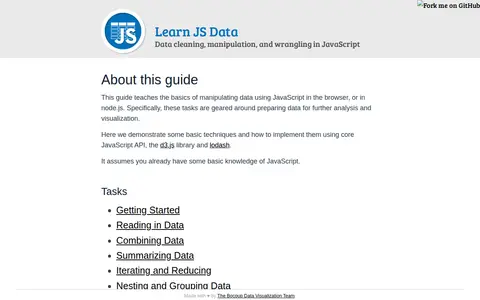
A guide that introduces data processing and cleaning in JavaScript, teaching how to load, modify and transform data using JavaScript libraries. It covers tasks geared around preparing data for further analysis and visualization, demonstrated with core JavaScript API, d3.js and lodash. It assumes some basic knowledge of JavaScript.
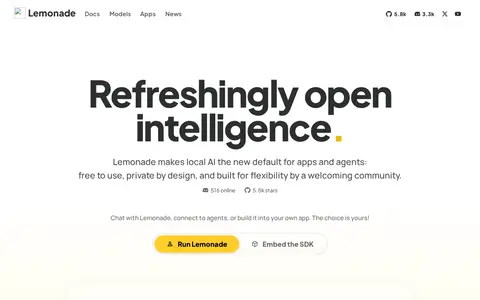
Lemonade Server is a lightweight, open-source local LLM server for running and managing multiple AI applications on a local machine. It provides a simple CLI for managing applications and supports various LLMs, and offers endpoints compatible with OpenAI, Ollama, Anthropic and others, plus a local-first API and MCP gateway.
Libfolia is a C++ library for working with the Format for Linguistic Annotation (FoLiA), providing a high-level API to read, manipulate, and create FoLiA documents. It is intended for C++ developers and serves as a dependency for other tools that use FoLiA. The software is distributed under the GNU Public Licence v3.
Agentic components of the Llama Stack APIs.
llama.cpp is a C/C++ implementation for large language model and vision language model inference with minimal setup across a range of hardware, locally and in the cloud. It is built on the ggml library and offers command-line and server tools, an OpenAI-compatible API server, and multiple hardware backends.
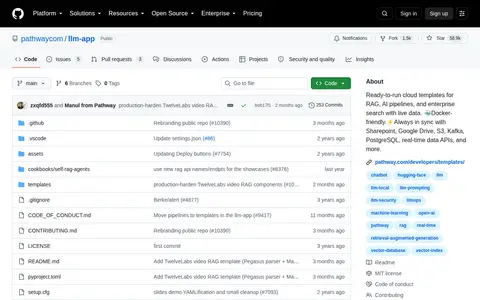
LLM App is an open-source project providing ready-to-run cloud templates for retrieval-augmented generation (RAG), AI pipelines and enterprise search with live data. It is Docker-friendly and designed to stay synchronized with data sources including Sharepoint, Google Drive, S3, Kafka, PostgreSQL and real-time data APIs, hosted by pathwaycom on GitHub.
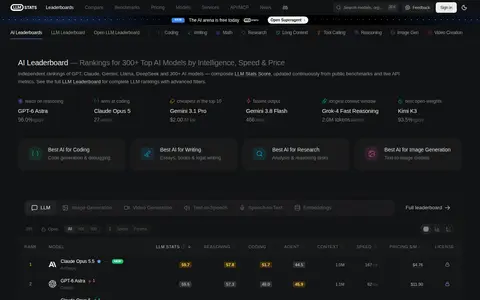
LLM Stats is an AI leaderboard that ranks GPT, Claude, Gemini, Llama, DeepSeek and more than 300 AI models by intelligence, speed and price. Scores are computed from public benchmarks and live API metrics.
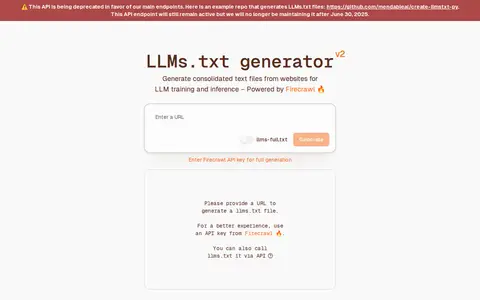
A tool that generates consolidated llms.txt text files from websites for LLM training and inference, powered by Firecrawl. The site states the API is being deprecated in favor of the main endpoints and will no longer be maintained after June 30, 2025, though the endpoint remains active.

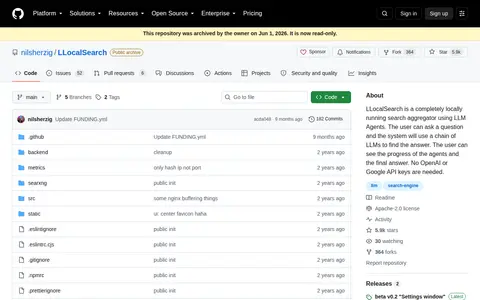
LLocalSearch is a fully locally running search aggregator that uses LLM agents to answer user questions. It uses a chain of LLMs to find answers, displays agent progress and final results, and does not require OpenAI or Google API keys to operate.
LM Studio helps build, test, automate, or manage AI agents, prompts, models, and API workflows.
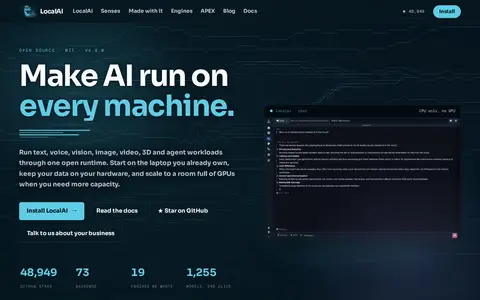
LocalAI is described as an open source AI engine that runs models, including LLMs, vision, voice, image and video, on any hardware without a GPU. It presents itself as a drop-in replacement for most upstream APIs and includes a built-in agent platform powered by LocalAGI, whose agents can reason, use tools and maintain memory. Image generation with Stable diffusion on CPU is also supported.