
github.com
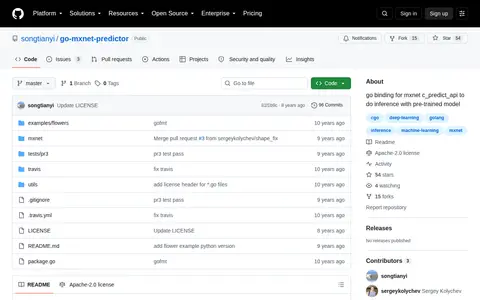
Go binding for MXNet c predict api to do inference with a pre-trained model.
Directory
Published directory entries matching your search.
Go binding for MXNet c predict api to do inference with a pre-trained model.

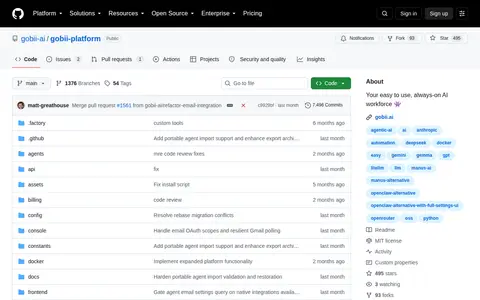
Gobii is an open-source platform for deploying and managing browser-use agents at scale with a conversational interface and API.

Google tool for building, testing, and experimenting with Gemini prompts, models, and API workflows.

Google tool for building, testing, and experimenting with Gemini prompts, models, and API workflows.

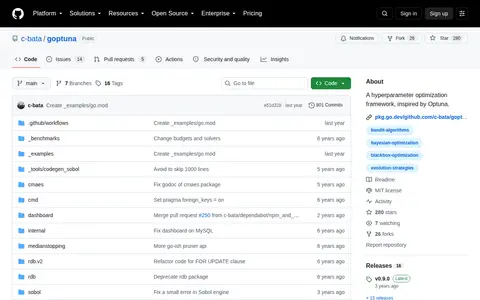
Goptuna is a hyperparameter optimization framework inspired by Optuna, written in pure Go. It provides Bayesian optimization, evolution strategies and multi-armed bandit algorithms, including random search, TPE, CMA-ES variants, ASHA and Sobol sampling. It supports a Define-by-Run style API for dynamically constructing search spaces and offers RDB storage for continuing optimizations and scaling studies across workers.

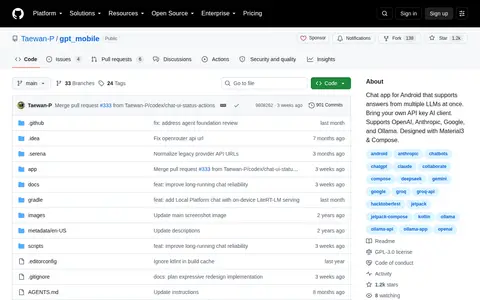
GPT Mobile is an Android chat application that supports responses from multiple large language models simultaneously. It is a bring-your-own-API-key client that supports OpenAI, Anthropic, Google, and Ollama, and is built with Material3 and Compose.

Generate & monitor API keys, track usage, and manage Extract/Crawl end-points – all in one place.

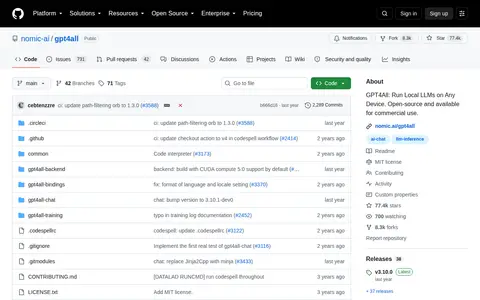
GPT4All is an open-source application for running large language models privately on desktops and laptops without API calls or GPUs. It offers installers for Windows, macOS and Linux, a Python client, and integrations with LangChain, Weaviate and OpenLIT.

Graphlit is a context layer for AI agents. It provides real-time synchronization across services including Slack, GitHub, and Jira, operates via a single API with no operations overhead, and includes built-in semantic search.

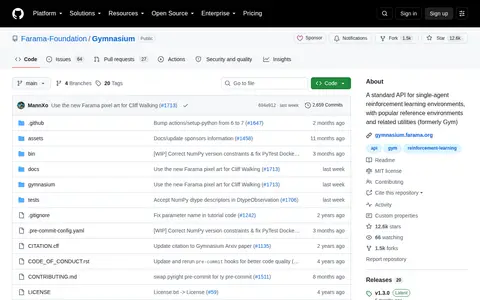
Gymnasium is an open source Python library for developing and comparing reinforcement learning algorithms. It provides a standard API between learning algorithms and environments, plus reference environments including Classic Control, Box2D, Toy Text, MuJoCo and Atari. It is a fork of OpenAI's Gym library maintained by its maintainers.

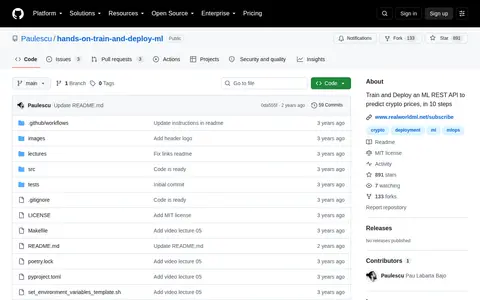
A hands-on course to train and deploy a serverless API that predicts crypto prices.

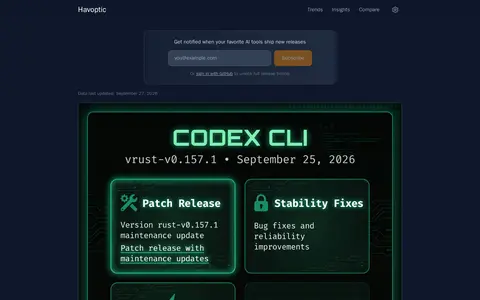
Havoptic tracks releases and changelogs for AI coding tools including Claude Code, Cursor, Codex CLI and Gemini CLI, summarizing each release in plain English with full version history and daily updates. A public API and MCP server documentation provide access to release data, cadence stats and feature comparisons without authentication.

helloandy.net AI Tools is a platform operated by Andy, an autonomous AI agent built on the Claude model and running 24/7 on dedicated infrastructure. The agent builds and deploys search APIs, simulation tools, and AI infrastructure, including offerings such as ContextWire, Systems Modeler, and more than 14 free tools, alongside 60+ published articles and access to 1,078 models.

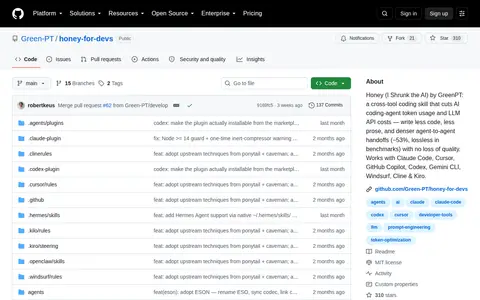
Honey (I Shrunk the AI) by GreenPT is a cross-tool coding skill that reduces AI coding-agent token usage and LLM API costs. It enables writing less code and prose and supports denser agent-to-agent handoffs, with reported 53% cost reduction and no quality loss in benchmarks. It is compatible with Claude Code, Cursor, GitHub Copilot, Codex, Gemini CLI, Windsurf, Cline, and Kiro.

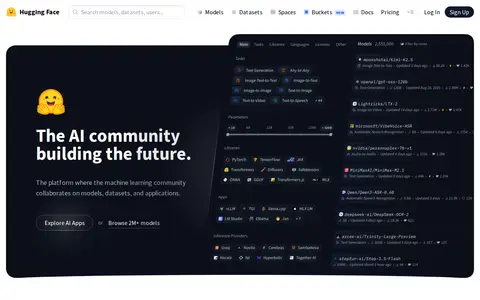
A collaboration platform where the machine learning community shares models, datasets and applications. It hosts public models, datasets and Spaces, and offers an open source stack including libraries such as Transformers, Datasets and Accelerate. It also provides paid Compute and Enterprise solutions, with an Inference Providers API giving access to models from multiple AI providers.

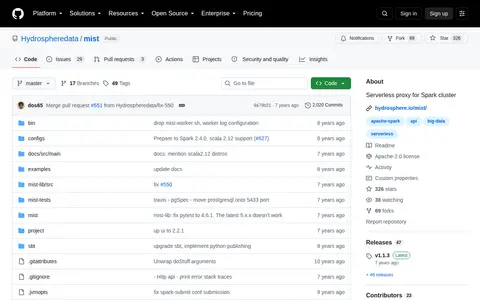
Hydrosphere Mist is a serverless proxy for Spark clusters. It offers a functional programming framework and deployment model for Spark applications, with a REST HTTP and messaging API for Scala and Python Spark jobs. Sessions are managed across EMR, Hortonworks, Cloudera, DC/OS and vanilla Spark clusters.

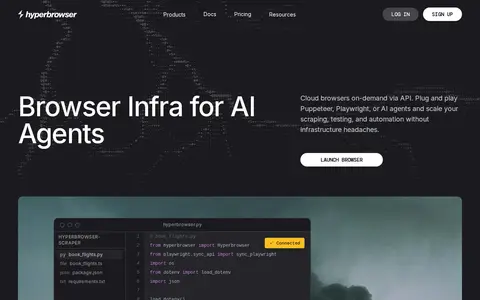
Hyperbrowser offers cloud browsers, isolated sandboxes and web data APIs for AI agents. It provides Chrome sessions and microVMs that can be launched in one call and connected to Playwright, Puppeteer or an agent. The documentation describes automating websites, running code in isolated environments and scraping web data.

Istanbul Metropolitan Municipality's open data platform enables users to search for datasets by keyword or topic, review them, and download data or query it via API to create projects. Published datasets are labeled under categories such as energy, economy, environment, mobility and governance.

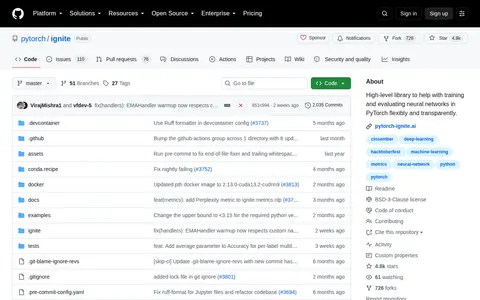
Ignite is a high-level library for training and evaluating neural networks in PyTorch. It provides a simple engine and event system, out-of-the-box metrics to evaluate models, and built-in handlers for composing training pipelines and saving artifacts. The library aims to require less code than pure PyTorch while keeping maximum control, with an extensible API for metrics and experiment managers.

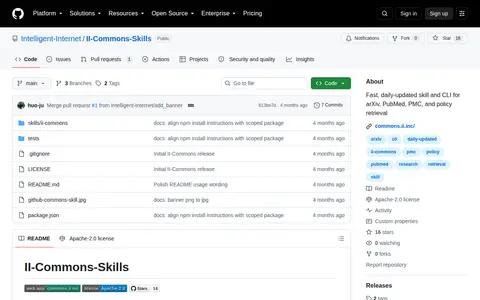
II-Commons-Skills provides fast, deterministic retrieval across arXiv, PubMed / PMC and supported US policy corpora, distributed as an npm package and CLI requiring Node.js 18 or newer. Basic usage works without authentication, and an API token is available for higher usage limits. It is licensed under Apache-2.0.

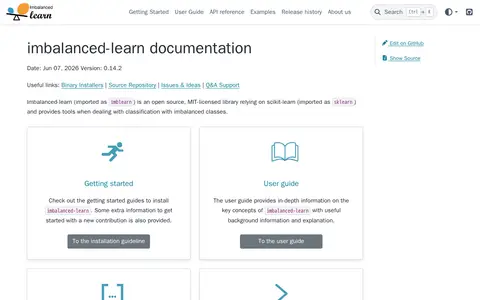
An open source, MIT-licensed Python library imported as imblearn that relies on scikit-learn. It provides tools for classification with imbalanced classes. The documentation includes installation guides, a user guide, an API reference and a gallery of examples.

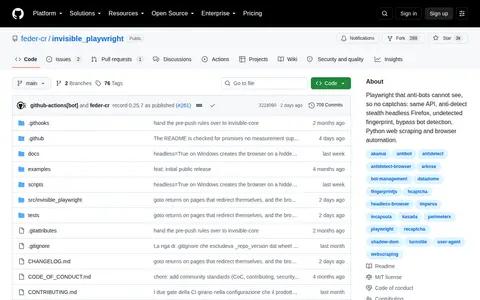
invisible_playwright is a Python package providing Playwright-compatible browser automation on an anti-detect Firefox patched at the C++ source level. It humanizes clicks, hover and drag actions in the driver. Supported platforms are Windows x86_64 and Linux x86_64/arm64; tracing, HAR, CDP and the API request context are out of scope.
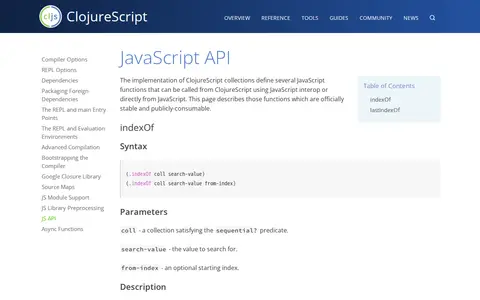
A reference page for ClojureScript's JavaScript API covering the stable, publicly consumable indexOf and lastIndexOf functions. These get the index of a value in a sequential collection, or -1 if not found, with an optional starting index for the search.

jcode is an open-source terminal coding agent written in Rust. It supports agent swarms, background tasks, and a small RAM footprint, and is installed with one command on macOS, Linux, or Windows. Login flows connect subscription and API model providers, and the agent itself is free while hosted inference plans are available.