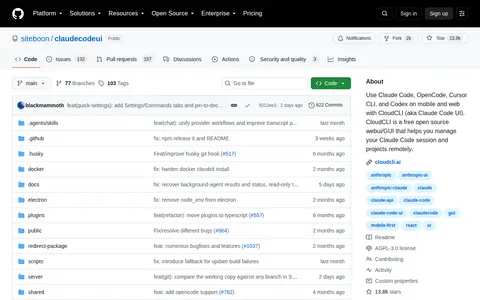

Cloud CLI (also called Claude Code UI) is a free open source web interface and GUI for managing Claude Code sessions and projects remotely. It provides a desktop and mobile UI for Claude Code, Cursor CLI, and Codex, usable locally or remotely, with chat, a shell terminal, file explorer, Git explorer, and session management.
Directory
Search results
Published directory entries matching your search.
A Hugging Face Space by livecodebench that presents a collection of coding questions and shows how different AI models perform on each. Selecting a problem displays each model's generated code, its pass/fail rate and a color-coded correctness score.
Code generation with 🤗 is a Hugging Face Space developed by codeparrot. It allows users to generate code snippets by providing a prompt, with options to select from multiple code generation models and adjust settings such as temperature and token length.

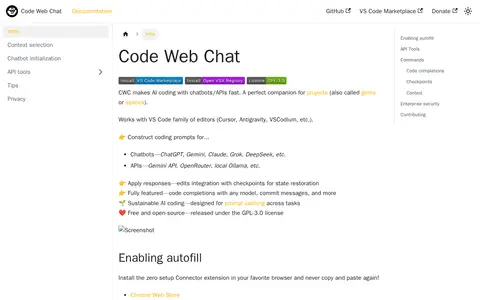
Code Web Chat (CWC) is a free, open-source AI coding tool that integrates with chatbots and APIs. It is compatible with the VS Code family of editors including Cursor, VSCodium, and Antigravity. It supports chatbots such as ChatGPT, Gemini, Claude, Grok and DeepSeek, and APIs including Gemini API, OpenRouter and local Ollama. Features include code completions, checkpoints for state restoration, and a browser extension for autofill available for Chrome and Firefox. It is released under the GPL-3.0 license.
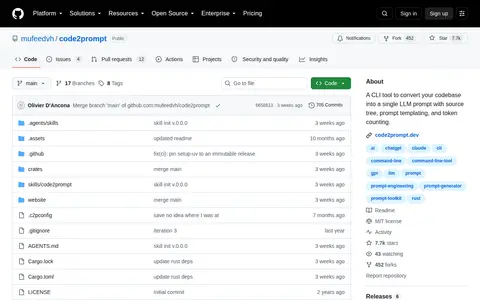
Code2prompt is a command line tool that converts a codebase into a single LLM prompt. It includes source tree representation, prompt templating functionality, and token counting capabilities. Installation options include Cargo, Homebrew, and a pip SDK.
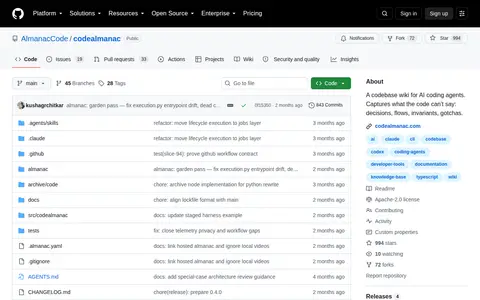
CodeAlmanac is a GitHub repository maintained by AlmanacCode. It is a codebase wiki for AI coding agents, designed to capture information including decisions, flows, invariants, and gotchas that are not explicitly stated in code.
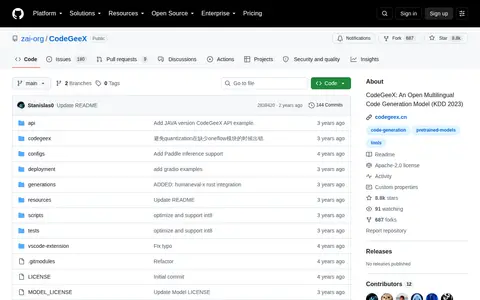
CodeGeeX is an open multilingual code generation model with 13 billion parameters, pre-trained on a code corpus of more than 20 programming languages. It supports multilingual code generation, crosslingual code translation and a VS Code extension, and the repository also releases the HumanEval-X benchmark.
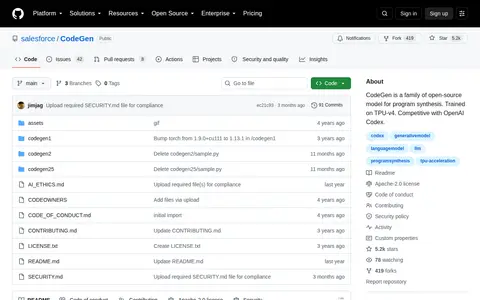
CodeGen is an open-source model for program synthesis. Trained on TPU-v4. Competitive with OpenAI Codex.
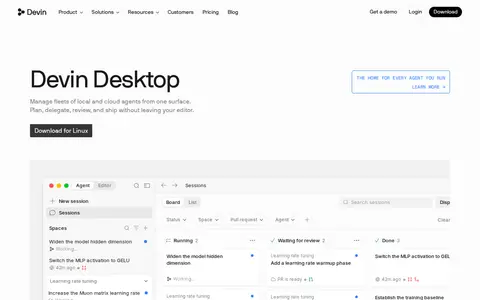
Manage fleets of local and cloud agents from one surface. Plan, delegate, review, and ship without leaving your editor.
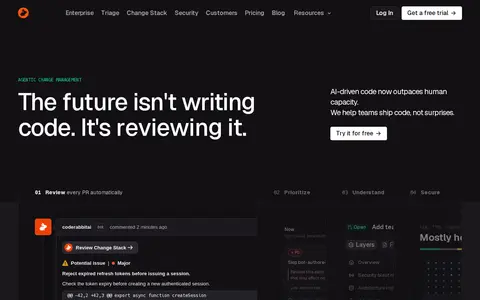
CodeRabbit is an AI-first pull request reviewer. It provides context-aware feedback, line-by-line code suggestions, real-time chat, and agentic change management features including PR triage, code explainability, and security monitoring for agent outputs.
Transform ideas into fully functional WordPress projects with Telex.
OpenAI’s platform for agentic coding workflows and automated software development tasks.
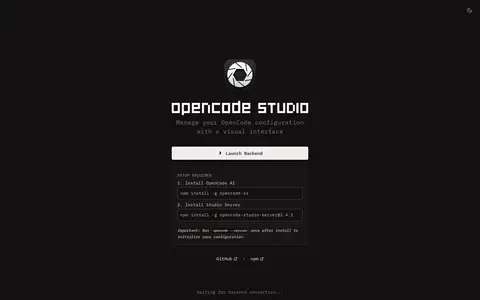
Config Manager, part of OpenCode Studio, is a visual configuration management tool for OpenCode. It provides a modern dashboard that allows users to configure MCP servers, skills, plugins and AI agents.
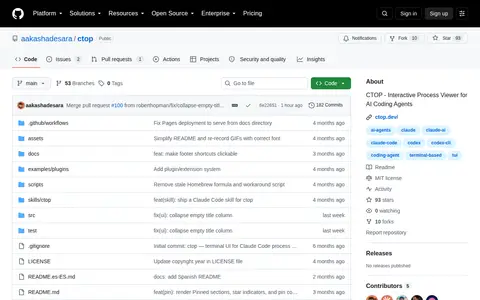
ctop is a GitHub repository maintained by aakashadesara. It is an interactive process viewer for AI coding agents, with documentation covering its features, installation process, keyboard shortcuts, and pinned sessions.
Free 3-month individual subscription to learn data science and AI skills.
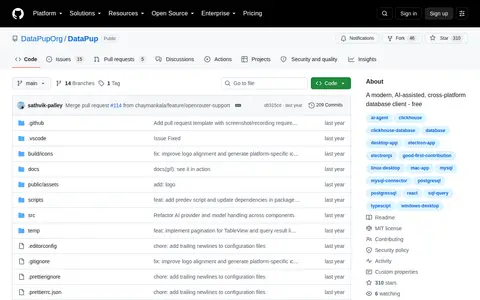
DataPup is an open-source, AI-assisted, cross-platform database client built with Electron and powered by LangChain for AI assistance. It currently supports ClickHouse and PostgreSQL, with MySQL and SQLite listed as coming soon. It is released under the MIT license.
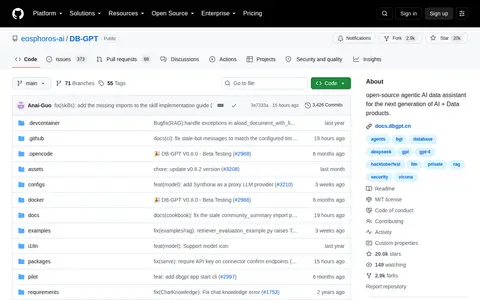
DB GPT is an open-source agentic AI data assistant developed by eosphoros-ai and hosted on GitHub, designed for use in next-generation AI and data products. It offers capabilities including agentic data analysis and autonomous SQL and code execution.
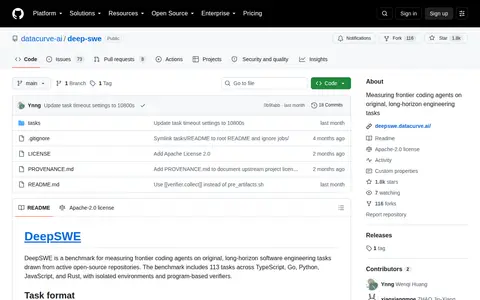
DeepSWE is a GitHub repository that provides a benchmark for measuring the performance of frontier coding AI agents on original, long-horizon engineering tasks. The repository includes documentation on task format, quickstart guides, and details about supported agents and models.
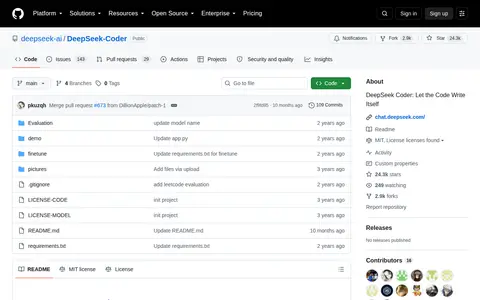
DeepSeek Coder is a series of open code language models trained from scratch on 2T tokens, composed of 87% code and 13% natural language in English and Chinese. Models are offered in 1B, 5.7B, 6.7B and 33B sizes, pre-trained on project-level code corpora with a 16K window size and a fill-in-the-blank task for completion and infilling.
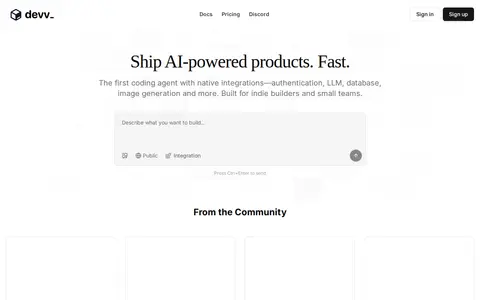
Devv is a native AI coding agent designed for indie builders and small teams to develop full-stack AI-powered products. It offers native integrations and eliminates the need for glue code to help users ship products quickly.
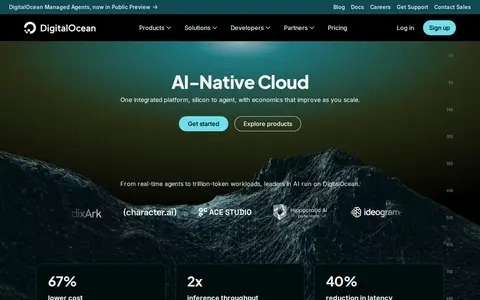
DigitalOcean describes an AI-native cloud platform with a unified stack for agents, inference and cloud infrastructure. Products listed include Managed Agents, Learning Services, Data Services, an Inference Engine with over 75 models, and core cloud services such as Droplets, Kubernetes and App Platform. Harness Runtime is listed starting at $0.0535/hr for durable cloud sandboxes for AI coding agents.
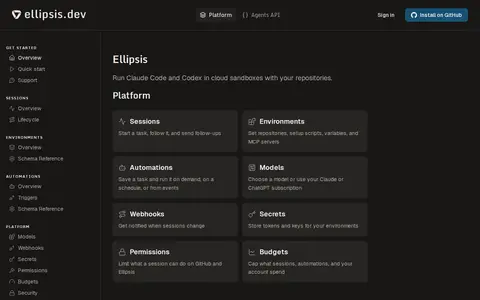
This is the documentation for Ellipsis, a platform that enables running internal agents in the cloud via Claude Code or Codex, with support for custom tools, secrets, and MCP servers. Users define agents as YAML configuration files in their repositories, and Ellipsis executes the agents to build features, fix bugs, and investigate production issues. The platform also includes integrations with GitHub, Slack, Linear, and Sentry, plus support for sessions, environments, secrets, permissions, and usage budgets.
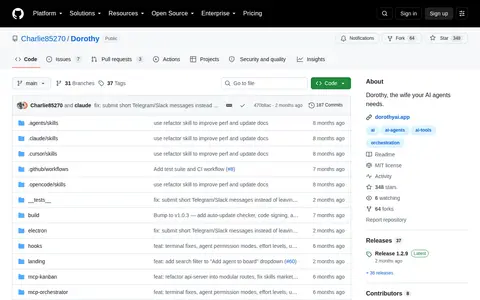
Dorothy is a free and open source desktop app for orchestrating Claude Code, Codex, Gemini, Grok and local agents. It runs multiple agents simultaneously, each in an isolated PTY terminal session, and includes a Super Agent that delegates tasks to other agents via MCP tools, plus Kanban task management and scheduled tasks.
An article presenting initial impressions of DSPy, a framework developed by the Stanford NLP group for algorithmically optimizing language model prompts. The author describes DSPy as closing the loop of prompt engineering by turning a manual process into a structured machine learning workflow. The piece notes it is not a substitute for the official documentation and covers topics such as teleprompter, optimization, compile, bootstrapping and metric functions.