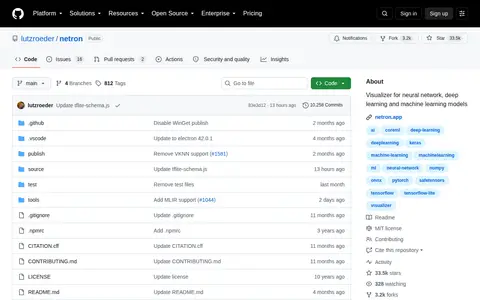

netron.app
Netron is a visualizer for neural network, deep learning, and machine learning models. It allows users to view model architectures and graphs. The tool is available as a web application at netron.app.
Directory
Published directory entries matching your search.
Netron is a visualizer for neural network, deep learning, and machine learning models. It allows users to view model architectures and graphs. The tool is available as a web application at netron.app.

Netron is a viewer for neural network, deep learning and machine learning models. It supports formats including ONNX, TensorFlow Lite, PyTorch, TensorFlow, Core ML, OpenVINO, Keras, Caffe, Darknet, Safetensors and NumPy. It is available as a browser version and installers for macOS, Linux and Windows, plus a Python package. Experimental support exists for MLIR, JAX, GGUF and other formats.

A Scientific American article discussing a new machine learning training method that aims to improve AI generalization abilities similar to human learning. The article suggests that adjusting training approaches, rather than solely increasing training data volume, may lead to more flexible and less error-prone AI systems.
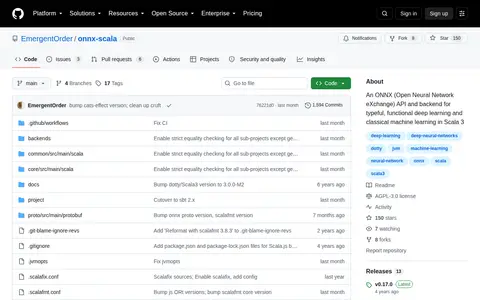
ONNX-Scala is an ONNX (Open Neural Network eXchange) API and backend built for typeful, functional deep learning and classical machine learning use cases in Scala 3. It is hosted as a public repository under the EmergentOrder GitHub organization.

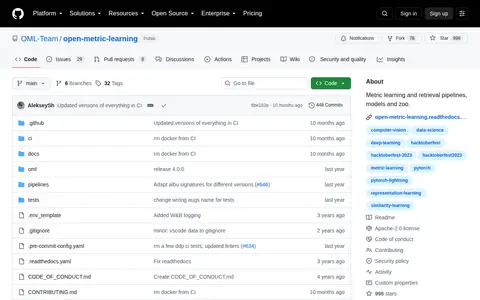
OpenMetricLearning is a repository that provides metric learning and retrieval pipelines, pre-trained models, and a model zoo for related machine learning tasks. It includes documentation, installation guides, and example implementations for users.

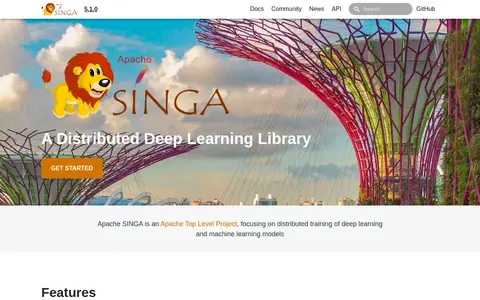
Apache SINGA is an Apache Top Level Project focused on distributed training of deep learning and machine learning models. It supports data parallel training across multiple GPUs on a single node or across different nodes, automatic gradient calculation, and loading and saving ONNX format models. Models trained with SINGA can be queried as stored procedures in an RDBMS.

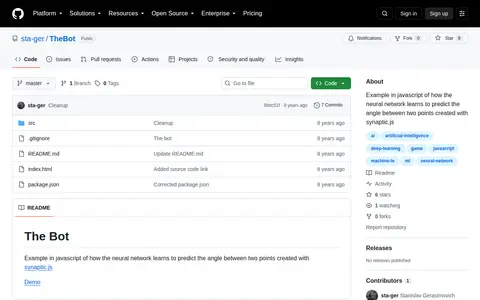
The Bot is a public JavaScript repository that provides an example of a neural network learning to predict the angle between two points. It is built using the synaptic.js library and demonstrates this machine learning functionality in code.

Vast.ai is a cloud GPU rental platform for AI, machine learning, deep learning and rendering workloads. Prices are set by supply and demand across 40+ data centers, with on-demand, interruptible and reserved instance types and per-second billing. Deployment is available through console, CLI, SDK and REST API.

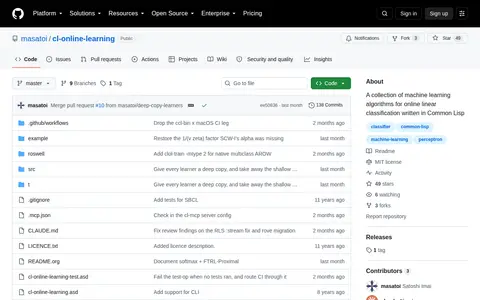
cl-online-learning is a Common Lisp library collecting machine learning algorithms for online linear classification. It implements binary classifiers including Perceptron, AROW, SCW-I, logistic regression with SGD or ADAM, and FTRL-Proximal, plus multiclass approaches such as one-vs-rest, one-vs-one, multiclass AROW and softmax with FTRL-Proximal. Command line tools are provided as a roswell script, and the package is available from Quicklisp.
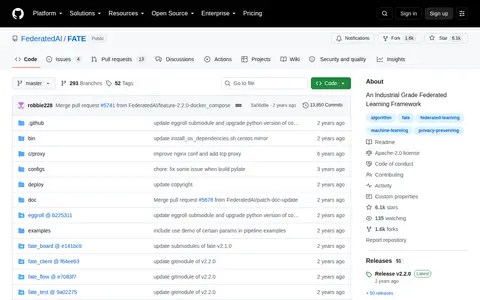
FATE (Federated AI Technology Enabler) is an industrial grade federated learning open source framework that enables enterprises and institutions to collaborate on data while protecting data security and privacy. It implements secure computation protocols based on homomorphic encryption and multi-party computation, and provides federated learning algorithms including logistic regression, tree-based algorithms, deep learning and transfer learning.

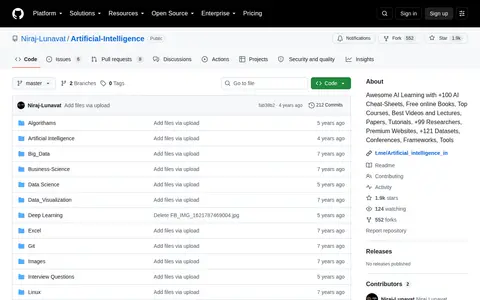
A GitHub repository collecting AI learning resources, including over 100 cheat-sheets, free online books, courses, videos and lectures, papers, tutorials, researchers, websites, datasets, conferences, frameworks and tools. Topics include machine learning, deep learning, big data, data science and Python.

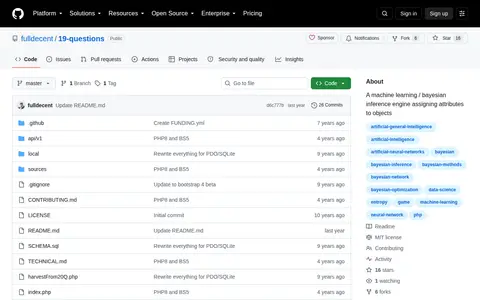
19 Questions is an open source machine learning and Bayesian inference engine designed to assign attributes to objects. Its source code is hosted in a public GitHub repository under the fulldecent organization, and contributions to the project are accepted from the public.

A simple guide to fine-tuning Llama 2 Brev docs provides machine-learning models, research, training resources, or evaluation tools.

Ability AI provides machine-learning models, research, training resources, or evaluation tools.

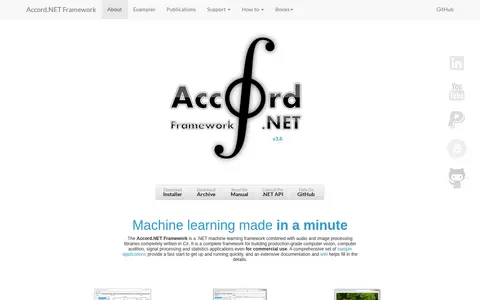
Accord.NET is a .NET machine learning framework combined with audio and image processing libraries written in C#. It covers classification, regression, clustering, distributions, hypothesis tests and kernel methods, with imaging and signal processing components. The framework is intended for building computer vision, audition, signal processing and statistics applications, including commercial use. It offers sample applications, documentation and a wiki.

ACE-Step 1.5 supports machine learning models, deployment, inspection, datasets, or AI development workflows.

Open-source project that provides machine-learning models, research, training resources, or evaluation tools.

Open-source project that provides machine-learning models, research, training resources, or evaluation tools.
Adept AI provides machine-learning models, research, training resources, or evaluation tools.
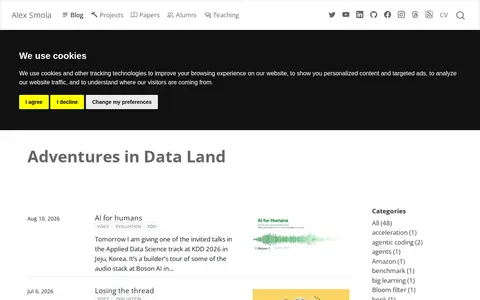
A personal blog by Alex Smola titled Adventures in Data Land, covering machine learning topics. Entries include efficient LLM inference tutorials, random projections, effective sample size, voice agents and evaluation, and porting MXNet to Blackwell and Apple Silicon. Posts reference events such as the Machine Learning Summer School 2026 in NYC.

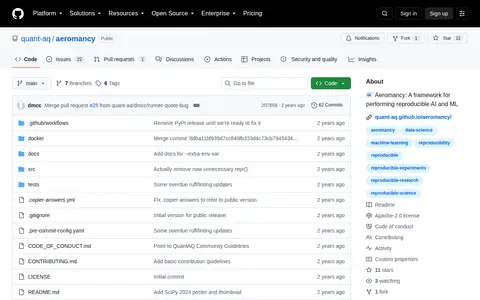
Aeromancy is an open-source GitHub repository hosted by quant-aq. It is a framework designed to support reproducible artificial intelligence and machine learning workflows. The project includes documentation, resources for common development commands, and was featured at the SciPy 2024 conference.

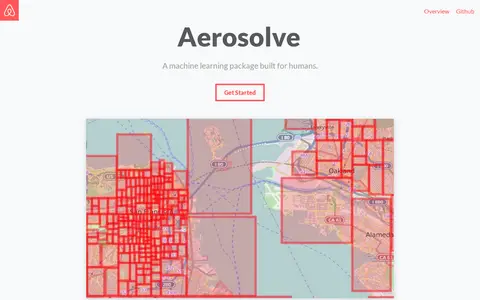
Aerosolve is a machine learning package built on the JVM. It provides features such as geo-based features, controllable quantization and feature interaction, and a feature transform language that gives developers control over features. General additive models are used. Scala handles feature training, with a lightweight Java API for run time inference.
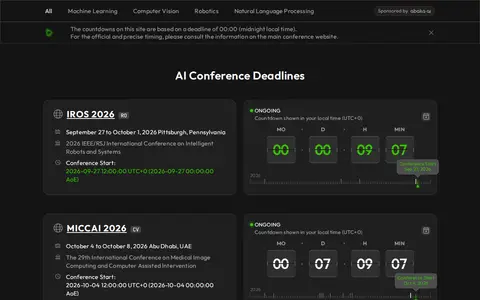
A site listing global AI conferences and exhibitions, with live countdowns to events in machine learning, computer vision, robotics and NLP. Entries include dates, locations and links to add each conference to a calendar. The site states that countdowns use a deadline of midnight local time and advises consulting the main conference website for precise timing.

AI Today provides machine-learning models, research, training resources, or evaluation tools.