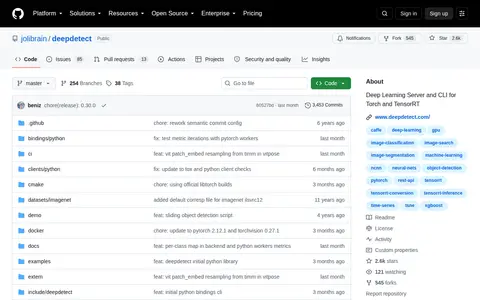

DeepDetect is a deep learning runtime, command-line tool and REST server for training and inference. It provides Python wheel variants for CPU and GPU environments and a command-line interface with profiles such as object detection and semantic segmentation. YAML configuration files make runs repeatable. It handles images, text, tabular data, time series, object-detection boxes and segmentation masks through a single API surface.
Directory
Search results
Published directory entries matching your search.
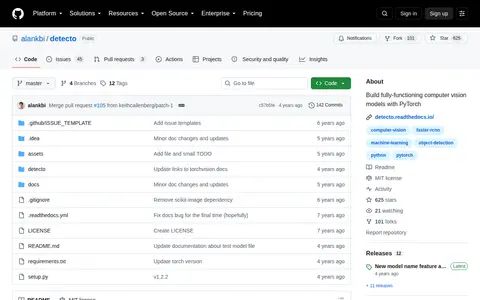
Detecto is a Python package for building computer vision and object detection models with PyTorch. It supports inference on still images and videos, transfer learning on custom datasets, and serialization of models to files, and is distributed under an MIT license.

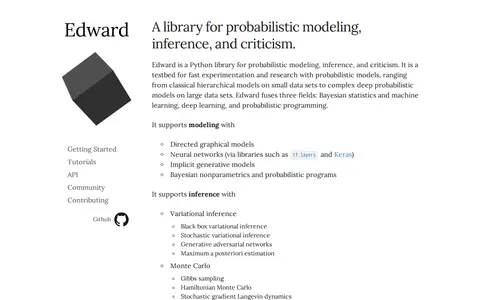
Edward is a Python library for probabilistic modeling, inference, and criticism. It is a testbed for experimentation and research with probabilistic models, from hierarchical models on small data sets to deep probabilistic models on large data sets. It fuses Bayesian statistics and machine learning, deep learning, and probabilistic programming, and is built on TensorFlow.
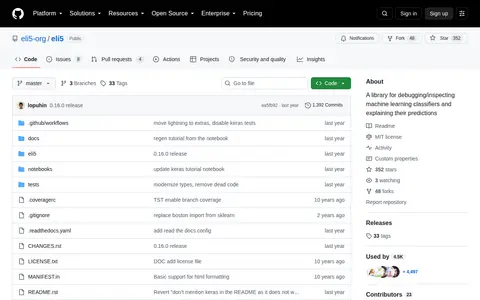
Python package which helps to debug machine learning classifiers and explain their predictions.
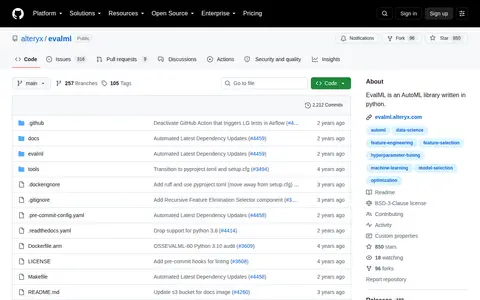
EvalML is an AutoML library written in Python that builds, optimizes, and evaluates machine learning pipelines using domain-specific objective functions. It includes data quality checks, cross-validation, preprocessing, feature engineering, feature selection, and model understanding tools. Install from PyPI or conda-forge.
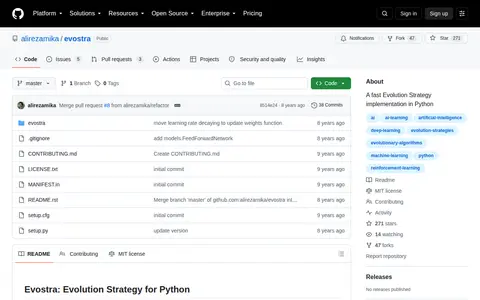
A fast Evolution Strategy implementation in Python.
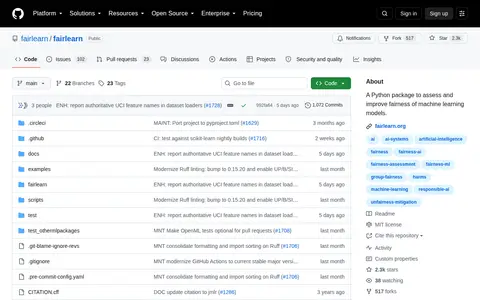
Fairlearn is a Python package hosted on a GitHub repository maintained by the Fairlearn project, designed to assess and improve the fairness of machine learning models. The repository includes documentation covering fairness definitions and a getting started guide for the tool.
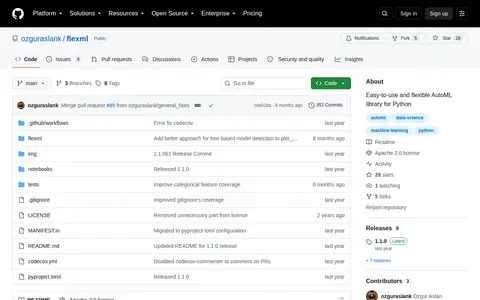
FlexML is an AutoML library for Python that assists in building machine learning models by automating model selection and hyperparameter tuning. It supports regression and classification tasks and offers quick and wide experiment modes for choosing how many models to train.
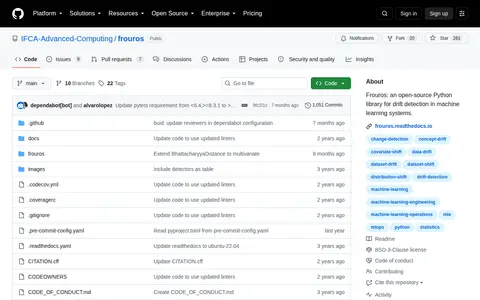
An open source Python library for drift detection in machine learning systems.
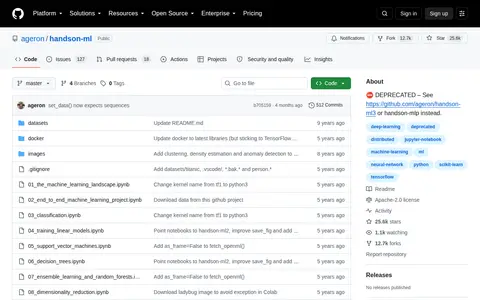
Fundamentals of machine learning in python.
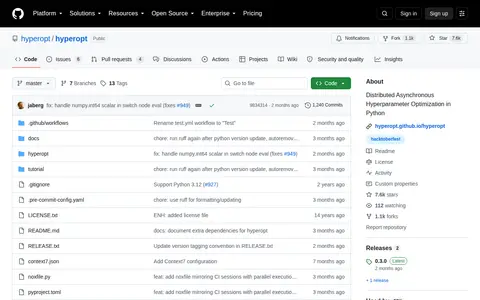
Hyperopt is an open-source Python library available on GitHub, designed to provide distributed asynchronous hyperparameter optimization functionality for tuning machine learning models in development workflows, production environments, as well as research settings.
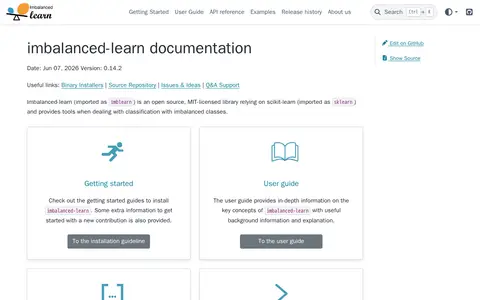
An open source, MIT-licensed Python library imported as imblearn that relies on scikit-learn. It provides tools for classification with imbalanced classes. The documentation includes installation guides, a user guide, an API reference and a gallery of examples.
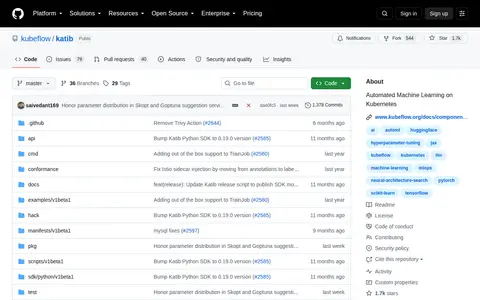
Kubeflow Katib is a Kubernetes-native project for automated machine learning (AutoML). It supports hyperparameter tuning, early stopping and neural architecture search, and is agnostic to machine learning frameworks, natively supporting frameworks such as TensorFlow, PyTorch and XGBoost. Training jobs can use any Kubernetes Custom Resources, with out-of-box support for Kubeflow Training Operator, Argo Workflows and Tekton Pipelines. A Python SDK simplifies creating tuning jobs.
A beginner-friendly guide on using Keras to implement a simple neural network in Python. It walks through MNIST handwritten digit classification, covering setup, data preparation, building the model, compiling, training, testing and using the model. It is intended for complete beginners to Keras who have a basic background knowledge of neural networks.
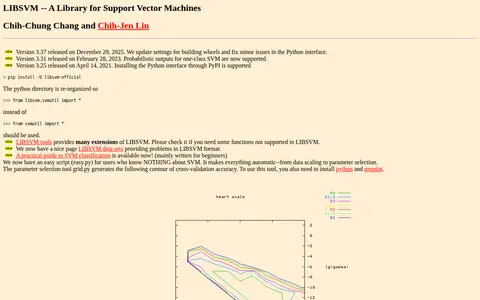
LIBSVM is an integrated software library for support vector classification, regression and distribution estimation. It provides a simple interface for linking with other programs and includes multi-class classification, cross-validation and probability estimates. Interfaces exist for Python, R, MATLAB and other languages.
LightFM is a Python implementation of recommendation algorithms for implicit and explicit feedback. It allows item and user metadata to be incorporated into matrix factorization algorithms, representing users and items as sums of latent feature representations. Installation is available from PyPI, and a Docker setup is provided for running examples and tests.
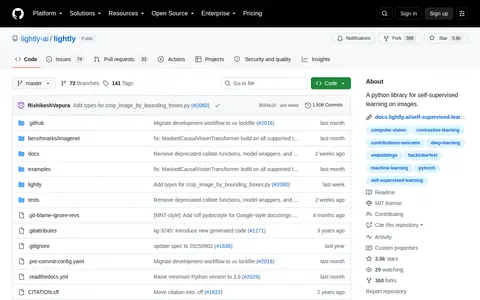
LightlySSL is a Python computer vision framework for self-supervised learning on images, written in a PyTorch-like style. It exposes low-level building blocks such as loss functions and model heads, supports custom backbone models for self-supervised pre-training, and supports distributed training using PyTorch Lightning. Sample code covers models including MoCo, SimCLR, BYOL and DINO.
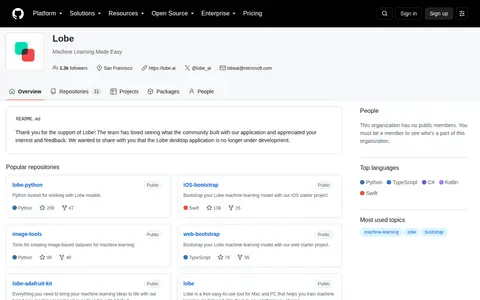
Lobe is a free tool for Mac and PC that helps users train machine learning models and ship them to any platform. The GitHub organization hosts starter projects for iOS and web, a Python toolset for working with Lobe models, and tools for creating image-based datasets. The team states the Lobe desktop application is no longer under development.
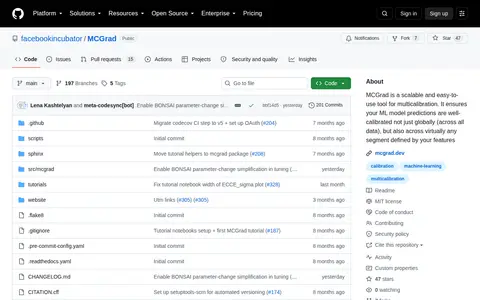
MCGrad is a tool for multicalibration that aims to keep machine learning model predictions calibrated globally and across segments defined by features. It requires Python 3.10+ and is installed with pip or conda; the project's own description says it has been deployed at Meta on hundreds of production models.
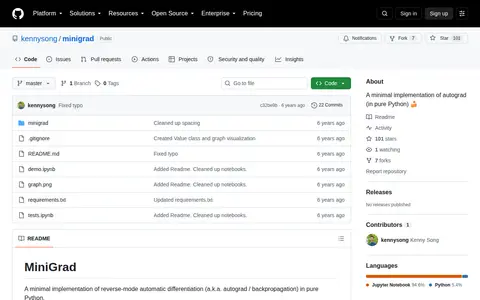
A minimal, educational, Pythonic implementation of autograd (~100 loc).
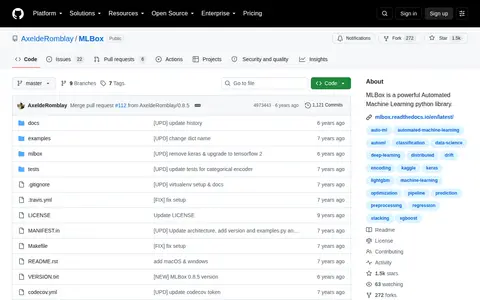
MLBox is an open-source automated machine learning library implemented in Python, hosted in the AxeldeRomblay/MLBox GitHub repository. It provides contribution guidelines, project topic information, and resources documenting the library's functionality.
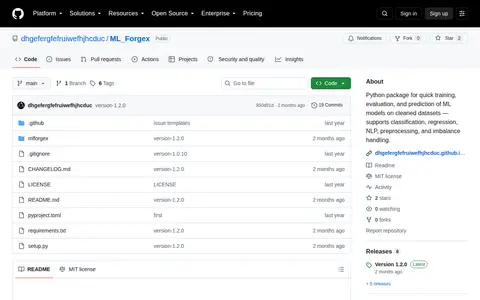
Lightweight ML utility for automated training, evaluation, and prediction with CLI and Python API support.
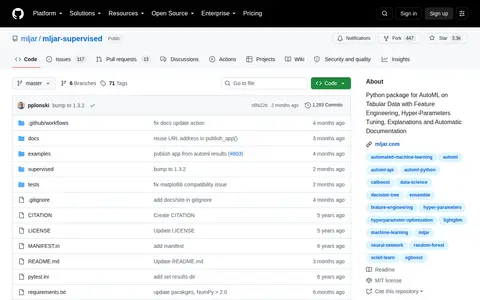
mljar-supervised is an Automated Machine Learning Python package for tabular data. It automates data preprocessing, model construction and hyperparameter tuning, and produces a Markdown report for each model. It offers Explain, Perform and Compete modes, along with model explanations and generated web apps for predictions.
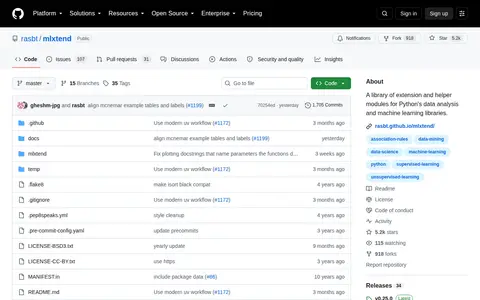
mlxtend is a library that provides extension and helper modules for Python's data analysis and machine learning libraries. The project includes installation guides, example code, license information, and contact details. It is hosted as an open source repository on GitHub.