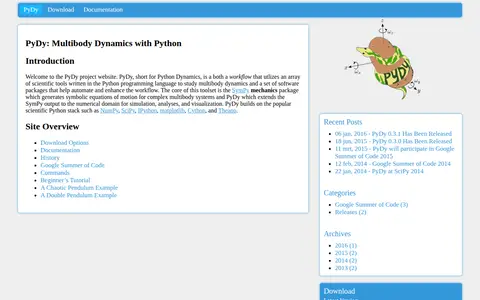
PyDy, short for Python Dynamics, is a workflow and set of software packages for studying multibody dynamics in Python. Its core is the SymPy mechanics package, which generates symbolic equations of motion for multibody systems, and PyDy extends that output to simulation, analyses, and visualization. It builds on NumPy, SciPy, IPython, matplotlib, Cython, and Theano.
Directory
Search results
Published directory entries matching your search.
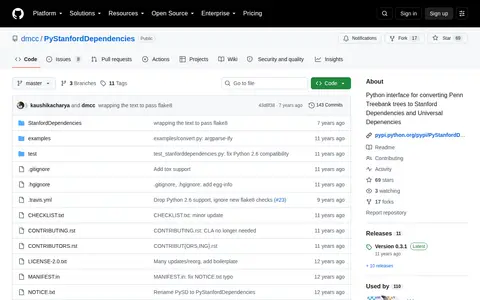
PyStanfordDependencies is a Python interface for converting Penn Treebank trees to Stanford Dependencies and Universal Dependencies. It offers a get_instance() function with subprocess or jpype backends, and convert_tree() or convert_trees() methods returning Token objects. Visualization options include asciitree, Graphviz dotgraphs, and interactive xdot windows. A Stanford CoreNLP or Parser jar file can be supplied, or downloaded automatically.
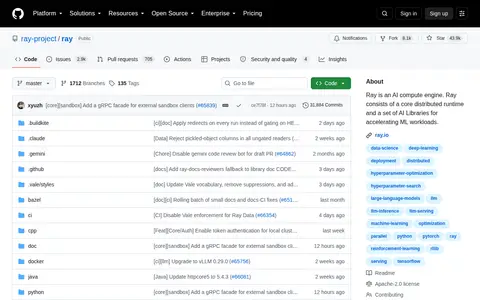
Ray is an AI compute engine consisting of a core distributed runtime and AI libraries for scaling AI and Python applications. It runs on any machine, cluster, cloud provider, and Kubernetes, and is installed with pip install ray.
SAAYN (Spreadsheets are all you need.ai) is a platform that teaches artificial intelligence topics using familiar spreadsheet tools. It launched with a project implementing the GPT-2 model in Excel to demonstrate that AI concepts can be understood with accessible tools, and its core mission is to make complex AI topics easy to understand without oversimplifying them.
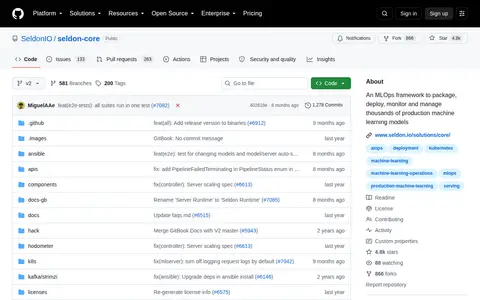
MLOps framework to package, deploy, monitor and manage thousands of production machine learning models.
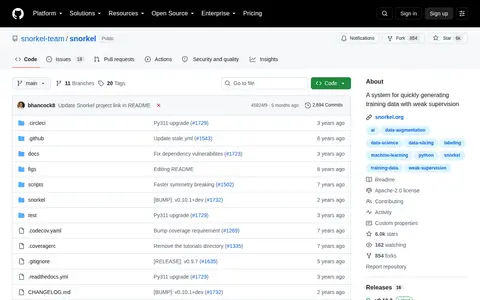
Snorkel is a system for quickly generating training data with weak supervision, released under an Apache-2.0 license and written in Python. The project started at Stanford in 2015 to programmatically label, build, and manage training data. The team now focuses on Snorkel Flow, an end-to-end AI application development platform based on the core ideas behind Snorkel.
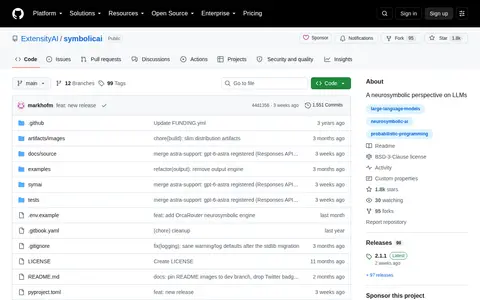
A neuro-symbolic framework for building applications with LLMs at the core.
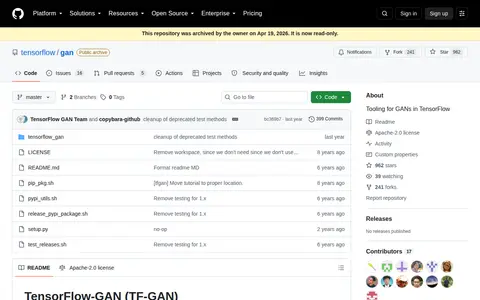
TF-GAN is a lightweight library for training and evaluating Generative Adversarial Networks in TensorFlow. It provides core training infrastructure, common GAN operations and normalization techniques, losses and penalties such as the Wasserstein loss and gradient penalty, and standard evaluation metrics including Inception Score, Frechet Distance and Kernel Distance. It can be installed with pip. The repository was archived and is now read-only.
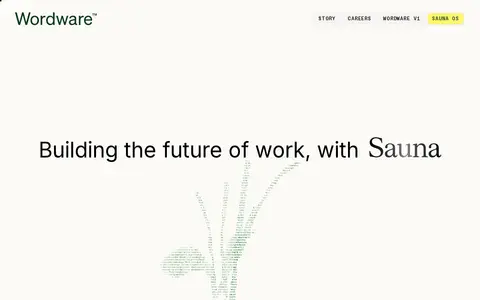
Wordware is an AI context lab based in San Francisco, founded in 2023. Its core product is Sauna, an AI workspace that learns user preferences, identifies patterns in user work, reduces administrative busywork, and proactively supports user tasks.