
github.com
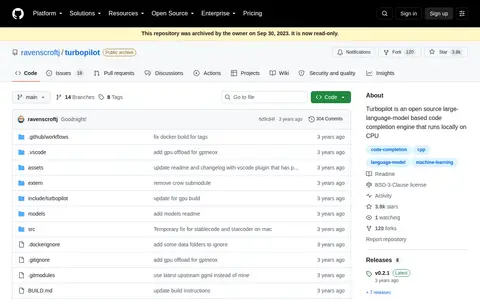
A self-hosted copilot clone that uses the library behind llama.cpp to run the 6 billion parameter Salesforce Codegen model in 4 GB of RAM.
Directory
Published directory entries matching your search.
A self-hosted copilot clone that uses the library behind llama.cpp to run the 6 billion parameter Salesforce Codegen model in 4 GB of RAM.
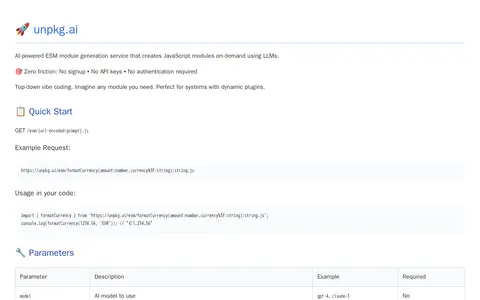
unpkg.ai provides machine-learning models, research, training resources, or evaluation tools.

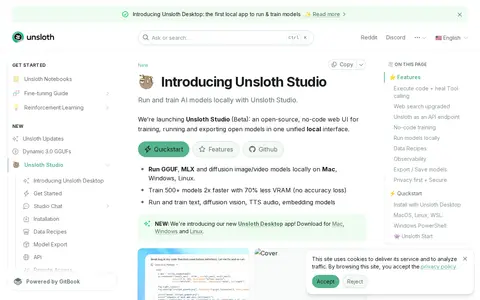
Unsloth Studio is an open-source, no-code web UI for training, running and exporting open models in one local interface. It supports GGUF, MLX and diffusion image/video models on Mac, Windows and Linux, and runs AI models offline without a GPU. A graphical Data Recipes workflow creates synthetic datasets from uploaded files.

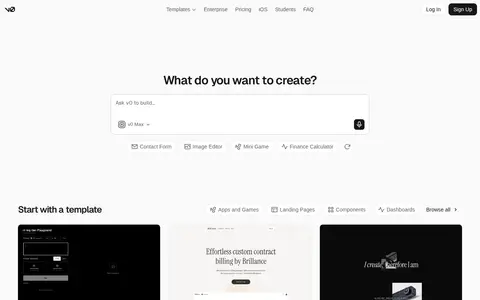
v0 is a Vercel-built collaborative AI assistant for designing, iterating, and scaling full-stack web applications. It supports prompt-based app building, template starters, design mode editing, design system creation, repository syncing, third-party app integration, and direct deployment to Vercel. The tool is described as agentic by default, and offers multiple plan options for different user types.
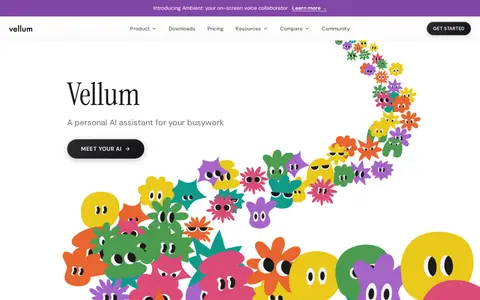
Vellum is a personal AI assistant available locally or in the cloud, with long-term memory across conversations. It can send emails, manage calendars, browse the web, create slides, write code, run research, and execute recurring background tasks. It offers fine-grained permissions requiring approval for high-stakes actions until marked trusted. Two plans exist: Base (free) and Pro packages Mighty, Super, and Ultra.

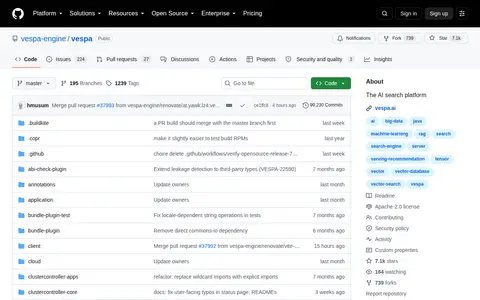
Vespa is an AI search platform. Its repository contains the code required to build and run Vespa. The project covers searching, making inferences in and organizing vectors, tensors, text and structured data at serving time and any scale. It is licensed under Apache 2.0.
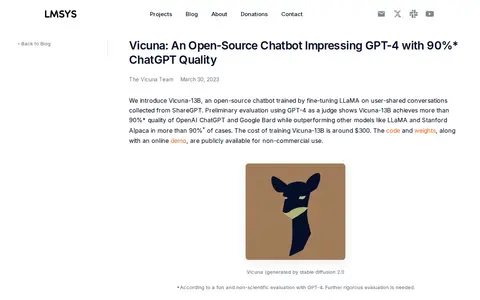
Vicuna-13B is an open-source chatbot trained by fine-tuning LLaMA on user-shared conversations collected from ShareGPT. Its code, weights and an online demo are publicly available for non-commercial use, and training cost around $300. The team reports a preliminary GPT-4-judged evaluation, described as non-scientific, showing more than 90% quality of ChatGPT and Bard.

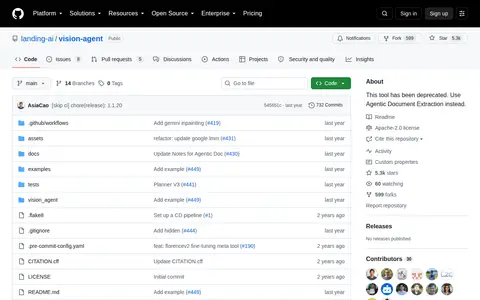
Vision Agent is a library that helps you utilize agent frameworks to generate code to solve your vision task.
Voyager is an LLM-powered embodied agent for Minecraft that explores, acquires skills, and makes discoveries without human intervention. It combines an automatic curriculum, a skill library of executable code, and an iterative prompting mechanism using environment feedback, execution errors, and self-verification. It interacts with GPT-4 through blackbox queries, avoiding model parameter fine-tuning.

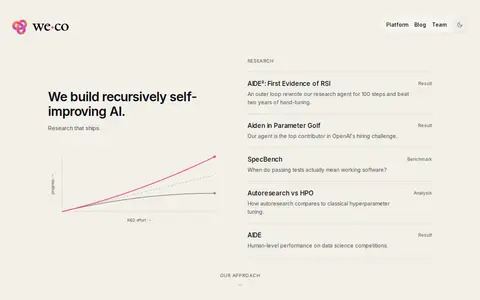
Weco is a research and product lab building recursively self-improving AI. Its platform points at an eval script and iteratively optimizes code against a metric the user defines, such as speed, accuracy or cost. Supported model providers include GPT, Claude, Gemini, Kimi, GLM and MiniMax, with bring your own key.

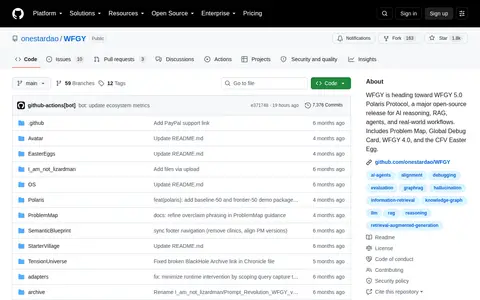
WFGY is an open-source project focused on AI reasoning, retrieval-augmented generation, AI agents, and real-world workflows. It is developing the WFGY 5.0 Polaris Protocol, and currently includes components such as the Problem Map, Global Debug Card, 4.0 version, and CFV Easter Egg.

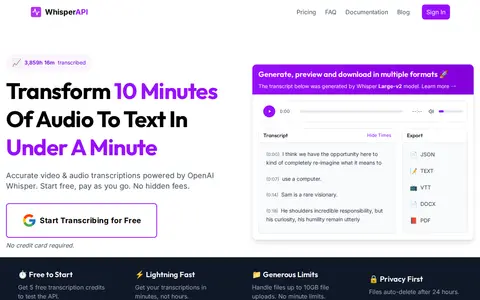
A transcription API built on OpenAI Whisper that converts audio and video files to text. It supports file uploads and remote URLs, multiple output formats, and model size selection for speed versus accuracy. A no-code dashboard offers drag-and-drop transcription. Pricing is pay-as-you-go with credit bundles, and files auto-delete after 24 hours.

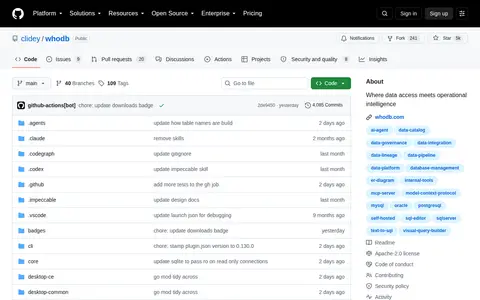
A lightweight, self-hosted workspace for databases that runs in the browser and is also available as a desktop app or terminal CLI. It offers spreadsheet-style data editing, a visual schema graph and a query scratchpad, with optional AI features through a chosen provider.

Supports software work with AI-assisted coding, testing or application development.

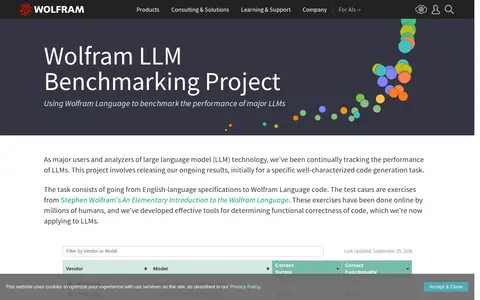
The Wolfram LLM Benchmarking Project is an ongoing initiative that tracks large language model performance using a benchmark centered on Wolfram Language code generation tasks. It publishes the results of its ongoing performance tracking for LLMs.

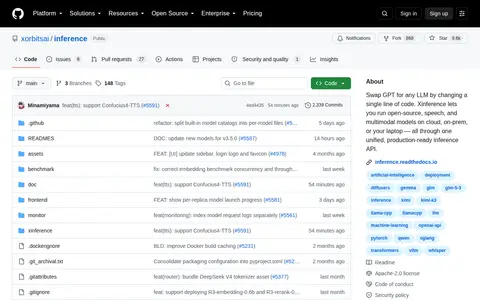
Xinference is a model serving tool that provides a unified production-ready inference API. It allows users to run open-source, speech and multimodal models on cloud infrastructure, on-premises systems or personal laptops by modifying a single line of code.

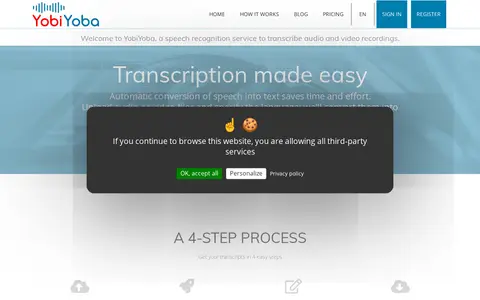
YobiYoba is a speech recognition service that transcribes audio and video recordings into editable, time-coded text. Users upload files, specify or auto-detect the language, verify and edit transcripts, then download them in formats such as SRT, PDF, or VTT. Processing produces speaker labels, time codes, and confidence scores. Pricing is pay-as-you-go, from 0.01 € per minute of speech.
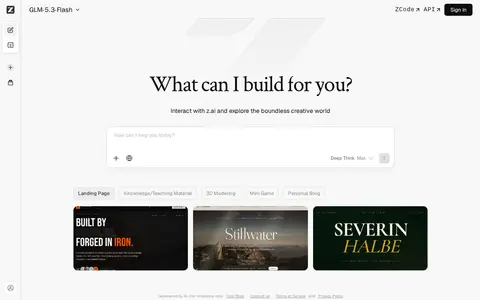
Z.ai is an advanced AI chatbot and agent powered by the GLM-5.3-Flash model. It is capable of tasks including building websites, writing code, handling long-horizon tasks, and providing instant answers to user queries.

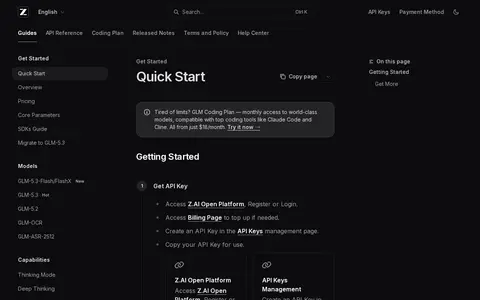
Documentation for Z.AI Developer Platform, covering setup, features, and practical usage.

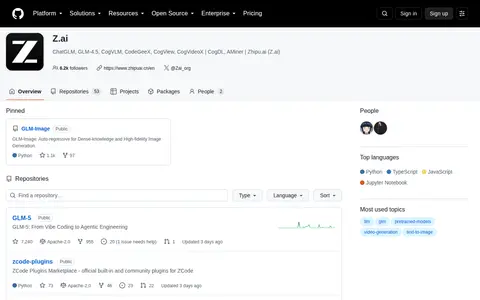
Zai Org, also known as Zhipu.ai or Z.ai, is a GitHub organization that develops a range of AI-related projects. Its publicly listed projects include ChatGLM, GLM-4.5, CogVLM, CodeGeeX, CogView, CogVideoX, CogDL, and AMiner, and its code is available for review on GitHub.