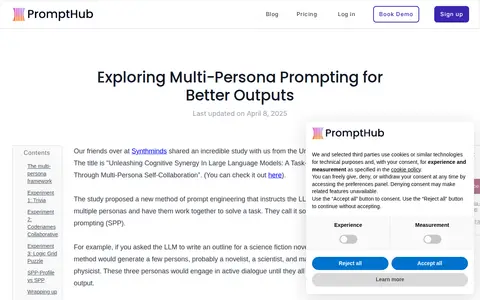

A blog post summarizing a University of Illinois study on solo performance prompting (SPP), a prompt engineering method in which an LLM summons multiple personas that collaborate on a task. The post describes the SPP prompt structure and reports on three experiments: Trivia Creative Writing, Codenames Collaborative, and Logic Grid Puzzle.
Directory
Search results
Published directory entries matching your search.
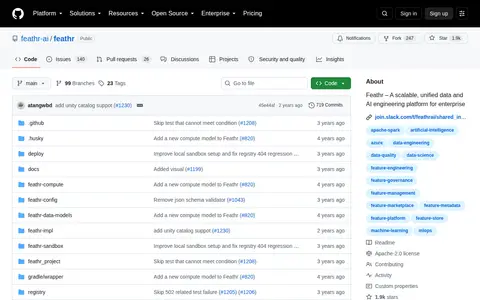
An enterprise-grade, high performance feature store.
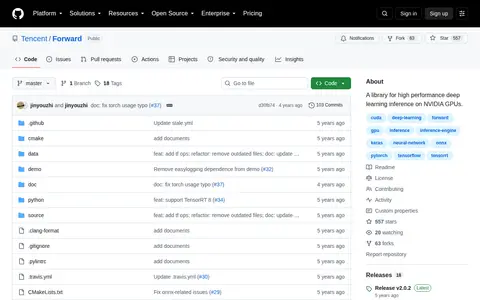
Library for high performance deep learning inference on NVIDIA GPUs.

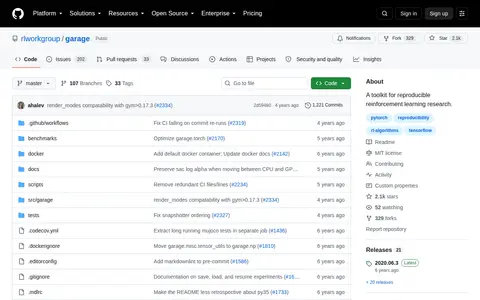
Garage is a toolkit for developing and evaluating reinforcement learning algorithms, with an accompanying library of implementations built using it. The toolkit offers modular tools including composable neural network models, replay buffers, high-performance samplers, an experiment definition interface, reproducibility tools, logging including TensorBoard, checkpointing and resuming, and environment interfaces.
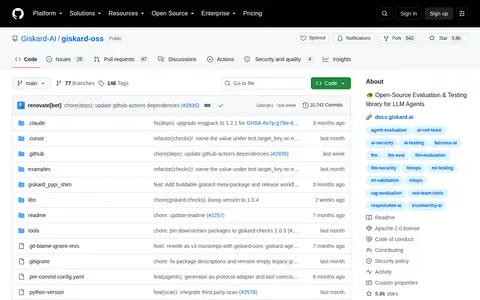
Testing framework dedicated to ML models, from tabular to LLMs. Detect risks of biases, performance issues and errors in 4 lines of code.
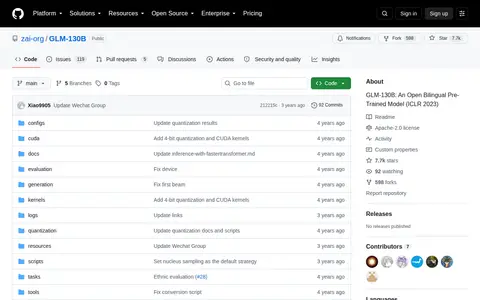
GLM-130B is an open bilingual pre-trained model with 130 billion parameters, pre-trained using the General Language Model algorithm. It was trained on over 400 billion text tokens, half Chinese and half English. With INT4 quantization, hardware requirements can be reduced to a single server with 4 RTX 3090 (24G) GPUs with almost no performance degradation.
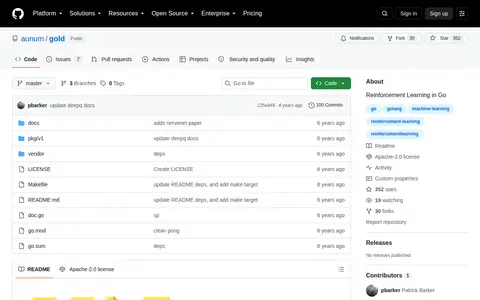
Gold is a reinforcement learning library for Go. It provides a set of agents for solving challenges in various environments, with composable tooling for creating agents and visualizing their performance. Agents include Q Learning, Deep Q learning with Double Q, REINFORCE, Natural Evolution Strategies, Hindsight Experience Replay and Proximal Policy Optimization, which is marked in progress.
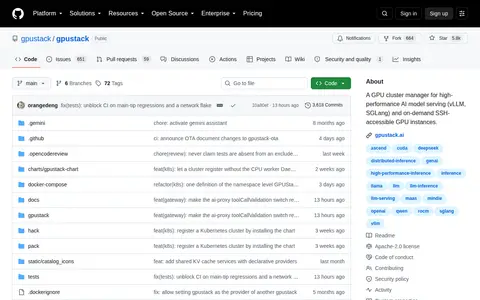
GPUStack is a GPU cluster manager built for high-performance AI model serving, with support for vLLM and SGLang, and offers on-demand SSH-accessible GPU instances, hosted in the gpustack/gpustack GitHub repository.
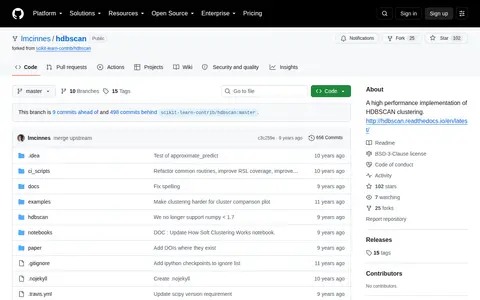
HDBSCAN is a high performance implementation of hierarchical density-based clustering. It performs DBSCAN over varying epsilon values and integrates results to find a clustering with the best stability over epsilon, allowing clusters of varying densities. The package inherits from sklearn classes and supports arrays, pandas dataframes, sparse matrices or distance matrices as input.
A freeCodeCamp handbook for developers on organizing AI agents for real business cases. It covers prerequisites, large language models, definitions of AI agents, and a decision algorithm for creating optimal agents, including checking budget, starting with one agent, and measuring performance. It uses a Google Research, Google DeepMind, and MIT paper as its primary source and code examples in a Google Colab notebook.
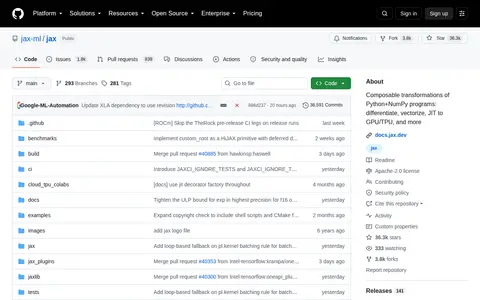
Autograd and XLA for high-performance machine learning research.
An article comparing the roles of data scientist and data engineer. It states that the positions are sometimes confused for each other and are often treated as the same, though the two roles work together. It notes that companies can encounter problems with team efficiency and system performance when the roles are conflated, and that the average company needs far more data engineers.
LangChain is an open agent engineering platform that enables organizations to own, control, govern, and compound their intelligence. Its LangSmith platform offers tools for autonomous agent improvement, observability, performance evaluation, production deployment, safe code execution sandboxes, LLM call control, and no-code agent creation. The platform also provides open source agent frameworks including deepagents, langgraph, and langchain.
LLM Stats is an independent AI evaluations lab that measures performance on real-world tasks, with its profile pointing to llm-stats.com. The X account has 406 posts and was joined in February 2025.
A free downloadable guide from Kolena Inc. on testing large language models. It identifies principles for creating reliable testing protocols and details approaches for measuring model effectiveness in NLP tasks such as text summarization and prompt engineering, and discusses tracking performance differences over time.
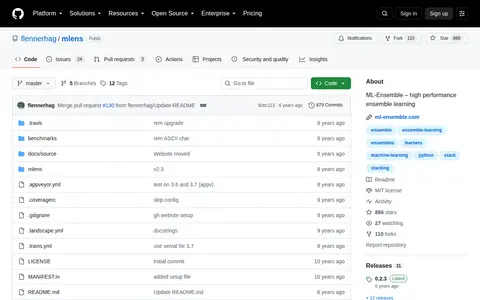
A high performance, memory efficient, maximally parallelized ensemble learning, integrated with scikit-learn.
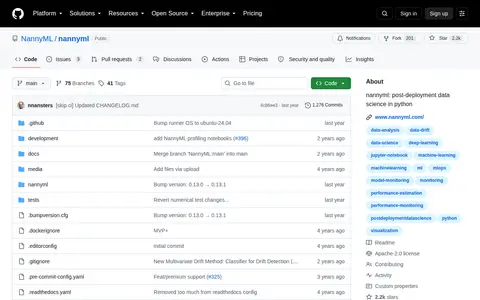
Algorithm capable of fully capturing the impact of data drift on performance.
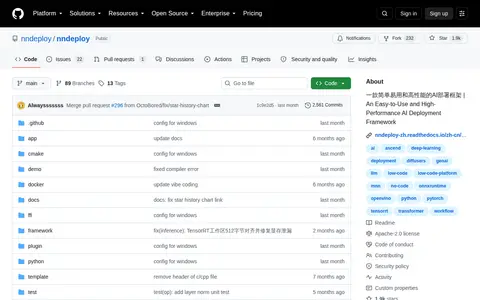
An Easy-to-Use and High-Performance AI deployment framework.
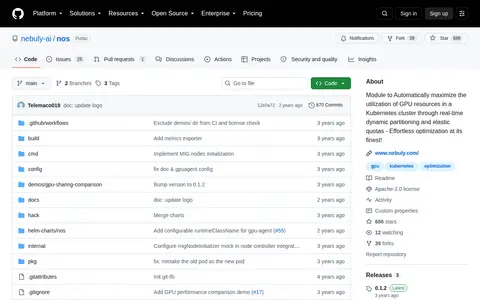
Nos is an open-source module for running AI workloads on Kubernetes, intended to increase GPU utilization, cut infrastructure costs and improve workload performance. It provides dynamic GPU partitioning and elastic resource quota management.
NSFWJS is a simple JavaScript library that identifies unseemly images directly in a user's web browser. The library is noted as reasonably accurate, with ongoing work to improve its performance.
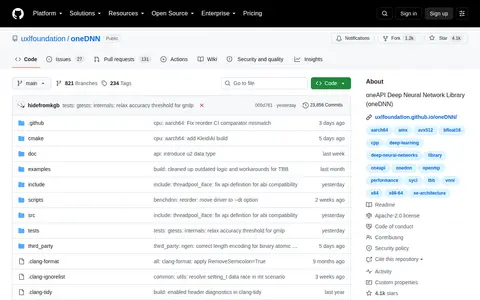
An open-source cross-platform performance library for deep learning applications.
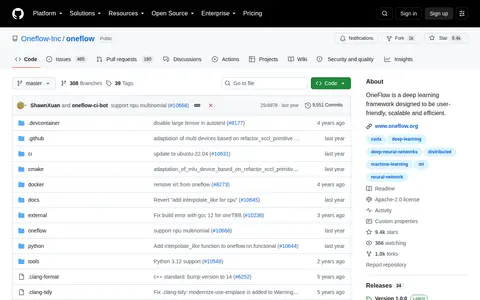
OneFlow is a performance-centered and open-source deep learning framework.
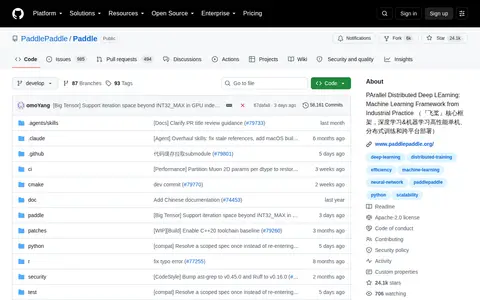
PaddlePaddle is an open-source parallel distributed deep learning framework developed from industrial practice, designed for high-performance single-machine and distributed training, as well as cross-platform deployment of deep learning and machine learning models.
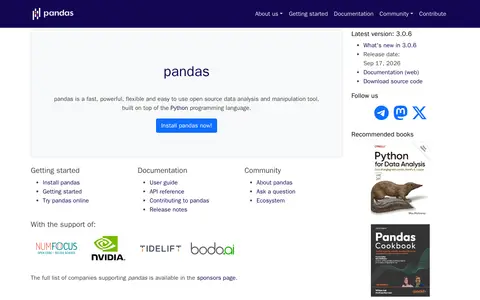
pandas is an open source, BSD-licensed library providing high-performance, easy-to-use data structures and data analysis tools for the Python programming language. It is described as a data analysis and manipulation tool built on top of Python. Documentation, a user guide and an API reference are available.