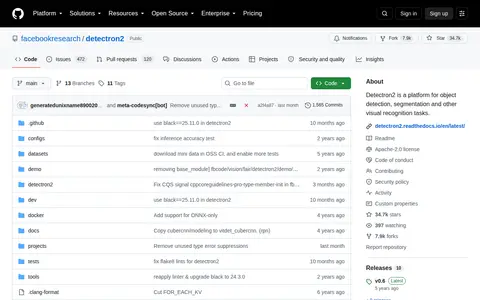

Detectron2 is Facebook AI Research's next generation library providing detection and segmentation algorithms, succeeding Detectron and maskrcnn-benchmark. It supports computer vision research projects and production applications at Facebook and includes capabilities such as panoptic segmentation, Densepose, Cascade R-CNN, rotated bounding boxes, PointRend, DeepLab, ViTDet and MViTv2. Models can be exported to TorchScript or Caffe2 format for deployment.
Directory
Search results
Published directory entries matching your search.
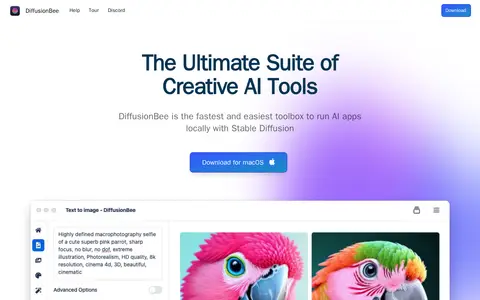
DiffusionBee is a Stable Diffusion application for generating AI art locally on a computer. It is free of charge and runs offline, so prompts, models and generated images stay on the device. The package includes text to image, image to image, generative fill, an image upscaler, video tools, control images and local model training. A macOS download is provided.
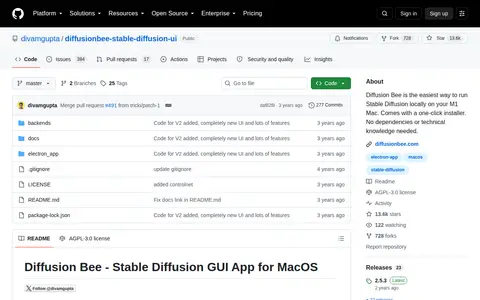
Diffusionbee Stable Diffusion UI is a GitHub-hosted project that provides a graphical user interface for running Stable Diffusion locally on macOS. It supports Intel and M1 Mac computers, includes a one-click installer, and requires no additional dependencies or technical knowledge to operate. It is listed under the AI & Machine Learning category focused on AI image generation.
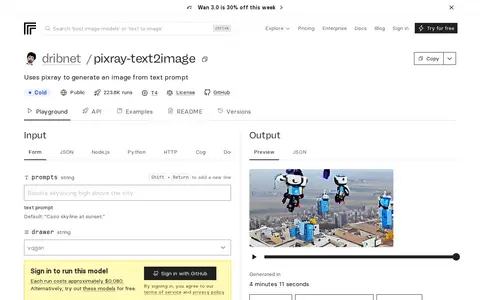
pixray-text2image is a public Replicate model that uses pixray to generate an image from a text prompt. It runs on Nvidia T4 GPU hardware, with predictions typically completing within 6 minutes, and is also open source and runnable on one's own computer with Docker.
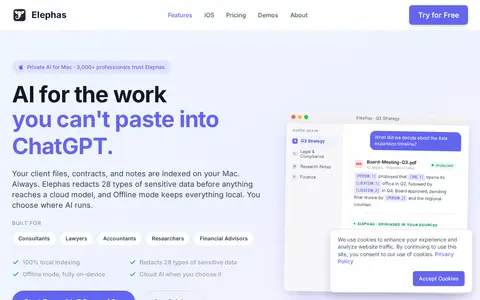
Elephas is a private AI tool that answers questions from a user's own documents, showing the source for every answer while files stay stored on the computer. Documents such as PDFs, Word files and spreadsheets are indexed locally, and users choose whether answers come from Elephas AI, their own API key or a local model. It runs on Mac, with Windows described as coming soon.
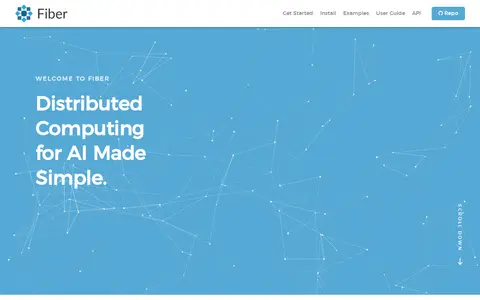
Fiber is a Python-based distributed computing library for modern computer clusters. It provides the same API as Python's standard multiprocessing library, uses Nanomsg for communication, and allows dynamic allocation of CPU, memory, and GPU resources. Installation uses pip install fiber.
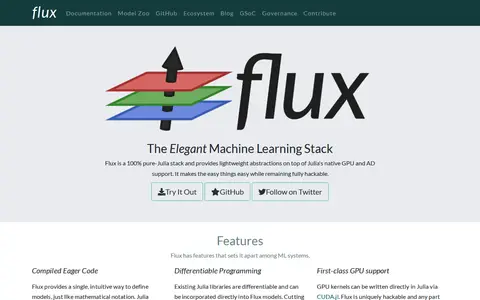
Flux is a machine learning library built as a pure-Julia stack, offering lightweight abstractions over Julia's native GPU and automatic differentiation support. It is compiled and eager, and existing Julia libraries can be incorporated into Flux models. Its ecosystem includes probabilistic programming, graph neural networks, computer vision and natural language processing packages, and it is maintained by a community team.
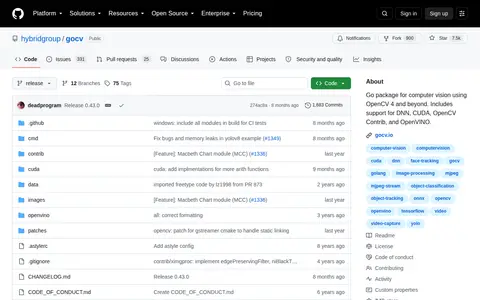
GoCV is a Go package providing language bindings for the OpenCV 4 computer vision library. It supports recent Go and OpenCV releases (v4.12.0) on Linux, Docker, macOS, and Windows, and includes support for DNN, CUDA, OpenCV Contrib, and OpenVINO.
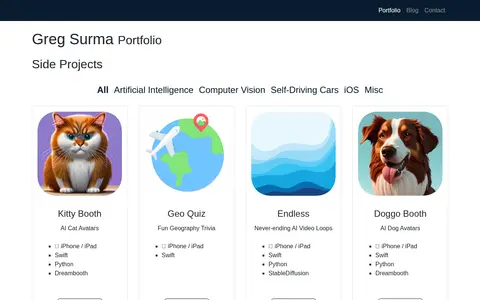
A portfolio page for Greg (Grzegorz) Surma that lists side projects related to machine learning, computer vision, self-driving cars and iOS development. It indexes apps and experiments, including AI avatars, image filters, depth estimators, a CNN explainer and games, with the tools and platforms used for each.
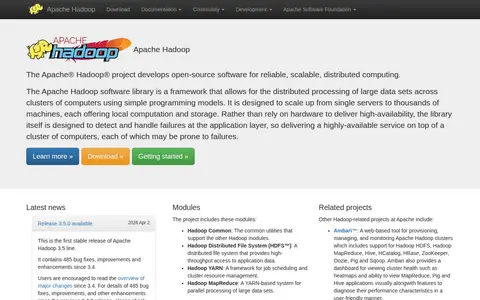
Apache Hadoop is an open-source project that develops software for reliable, scalable, distributed computing. Its library is a framework for distributed processing of large data sets across clusters of computers using simple programming models, scaling from single servers to thousands of machines with local computation and storage, and detecting failures at the application layer.
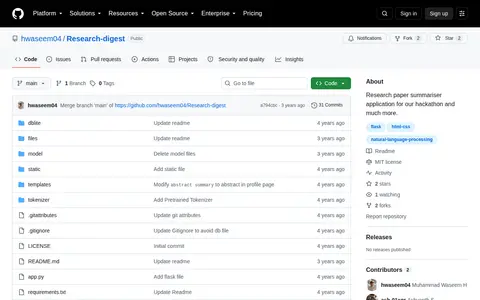
Research-Digest is a Flask application that scrapes arXiv weekly for newly published papers in fields including computer vision and machine learning, then offers a summarization feature so users can grasp key points. Summarization uses a T5 model finetuned on scientific articles, with weights and tokenizers stored locally.
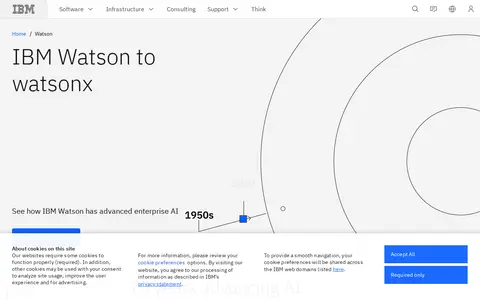
IBM Watson is enterprise AI technology from IBM. IBM Research began work in 2007 on a computer system to compete at Jeopardy!, and in 2011 the Watson system defeated two top-ranked players. Watson technology became available as a cloud development platform in 2013. In 2023 IBM announced the watsonx AI portfolio for training, tuning and distributing models.
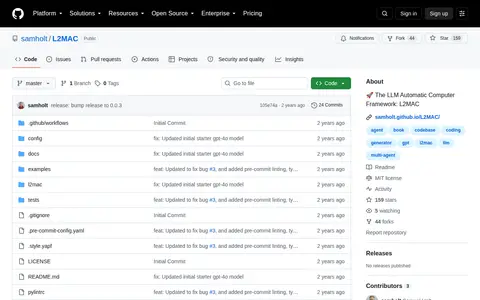
L2MAC is an open-source framework described as a Large Language Model Automatic Computer. It uses a prompt-program with instruction steps executed by agents that read and write to persistent memory, intended for generating extensive outputs such as large codebases. It is released under the MIT license.
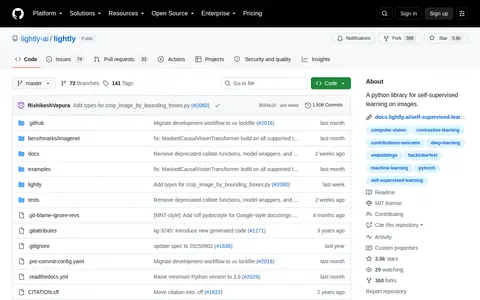
LightlySSL is a Python computer vision framework for self-supervised learning on images, written in a PyTorch-like style. It exposes low-level building blocks such as loss functions and model heads, supports custom backbone models for self-supervised pre-training, and supports distributed training using PyTorch Lightning. Sample code covers models including MoCo, SimCLR, BYOL and DINO.
Loic Tetrel is a blog about computer science and data science topics. Posts cover subjects such as enabling GPU acceleration in Windows 11 Hyper-V virtual machines, using Android TV without a Google account, and Windows/Linux dual-boot.
Machine Learning Mastery is a website that provides educational content such as tutorials, quick start guides, and eBooks to help developers learn and apply machine learning concepts and algorithms. It covers topics like deep learning, computer vision, natural language processing, and specific libraries including TensorFlow, PyTorch, and scikit-learn.

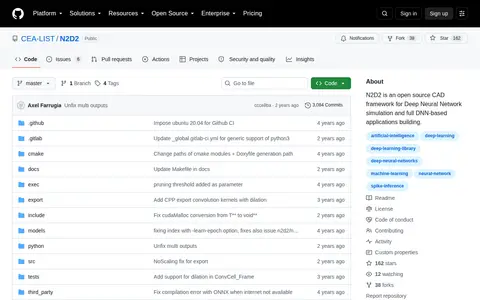
N2D2 is an open source computer-aided design (CAD) framework developed for deep neural network (DNN) simulation and the construction of full DNN-based applications. It is maintained as a public code repository by the research organization CEA-LIST.
Neuralink is a company focused on developing brain-computer interfaces. Its stated objective is to create a generalized brain interface to restore autonomy for individuals with unmet medical needs and unlock human potential.
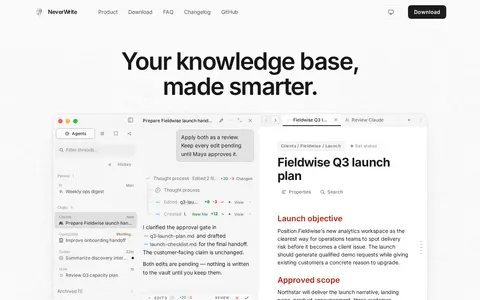
NeverWrite is a local-first knowledge workspace for notes and documents with AI assistance. Notes stay in a folder on the computer, and every AI edit arrives as a reviewable change that can be accepted, rejected or refined before it is written to the vault. It is free, open source under Apache 2.0, requires no account, and connects to models the user already pays for.
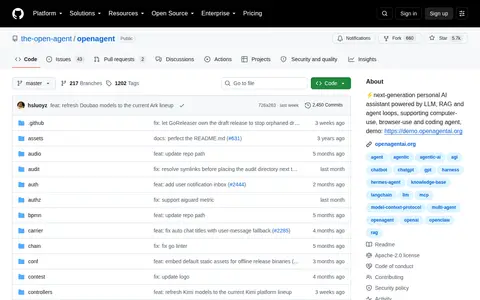
OpenAgent is a next-generation personal AI assistant powered by large language models, retrieval-augmented generation and agent loops. It supports computer-use, browser-use and coding agent functionalities, and integrates with over 30 model providers. A public demo is available at https://demo.openagentai.org.
OpenCV is an open source computer vision library that contains over 2500 algorithms and supports model execution for machine learning and artificial intelligence. It was designed to be cross-platform, written in C with C++ and wrappers for Python and Java, and runs on desktop and mobile systems. A GPU module implemented with CUDA provides acceleration for part of the library.
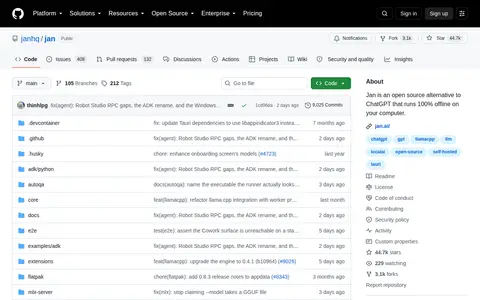
Jan is an open source alternative to ChatGPT that runs offline on the user's computer, according to the repository description. It provides local AI models downloaded and run with an OpenAI-compatible local server at localhost:1337 and supports connecting to cloud GPT and Claude models according to the README features list.
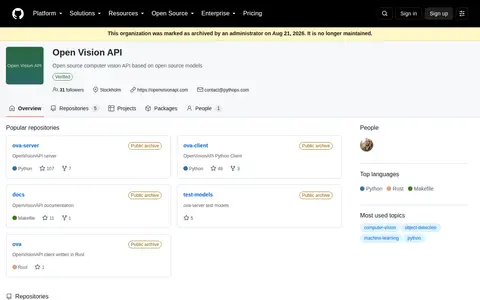
Open source computer vision API based on open source models.
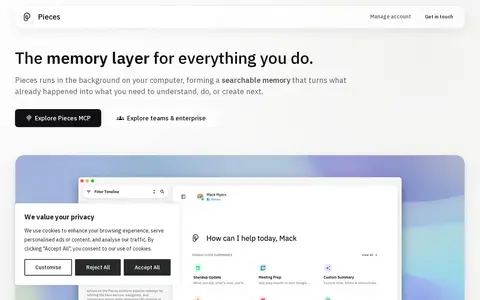
Pieces is a memory layer that runs in the background on a computer, forming a searchable record of work from apps the user already uses. It captures activity chronologically so users can search, filter and revisit moments, and carry context into AI tools. Memories are saved on-device by default, and capture from copy and paste is opt-in.