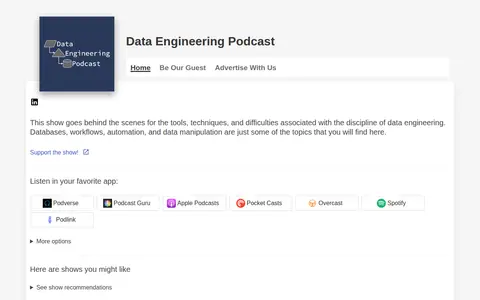

Data Engineering Podcast is a show that covers the tools, techniques, and challenges of the data engineering discipline. Its episodes address topics including databases, workflows, automation, and data manipulation, and it is available for listening on a range of podcast platforms.
Directory
Search results
Published directory entries matching your search.
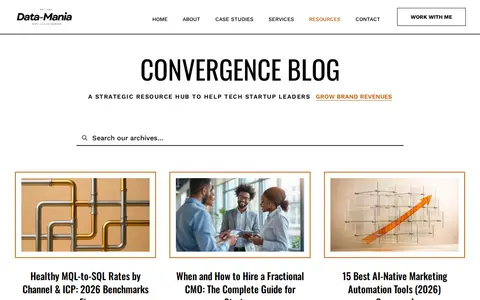
Data Mania Blog, also known as the Convergence Blog, is a resource hub published by Data-Mania, LLC for technology startup leaders. It features content covering topics such as AI search visibility, AI marketing tools, and startup growth strategies.
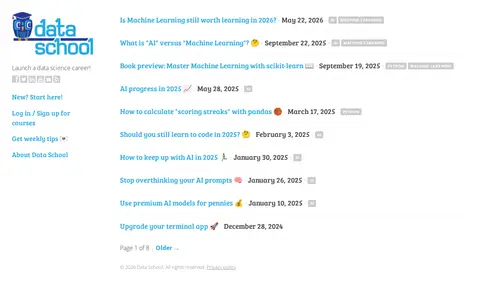
Data School is a blog about data science and machine learning. Its posts cover topics such as the difference between AI and machine learning, learning scikit-learn, AI progress, and using pandas for calculations. Posts are tagged by subject including Python, AI, and machine learning.
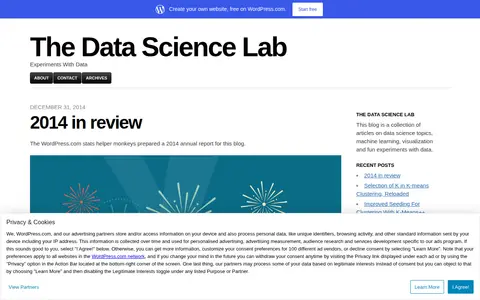
The Data Science Lab is a blog of experiments with data. Posts cover topics including k-means clustering, k-means++ seeding, the gap statistic, and an alternative approach to selecting the optimal number of clusters based on a 2004 publication by Pham, Dimov and Nguyen. A 2014 annual report notes the blog was viewed about 74,000 times that year.
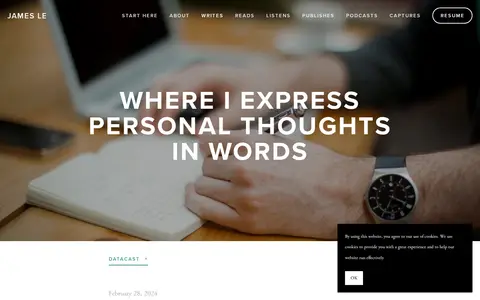
Datacast is the personal blog and podcast series of James Le. It features written posts and podcast episodes covering topics such as data infrastructure, data observability, responsible AI, product management, and data engineering.
Dataconomy is a news site covering technology and business topics. Its homepage lists recent articles on subjects including TikTok advertising, PS5 emulation, Character.AI staffing, DeepSeek API pricing, NVIDIA hardware, Tesla vehicles, Google Gmail features and Netflix layoffs. Other pages carry articles on the Opera Air browser and comparisons of crypto loan platforms.
DataTalks.Club is an online community for data science professionals, ML engineers and AI practitioners. It offers free courses, weekly podcasts, webinars, workshops and book discussions, along with articles, a Slack group and a weekly newsletter. Events and podcast episodes cover topics such as machine learning, AI platforms and LLM engineering.
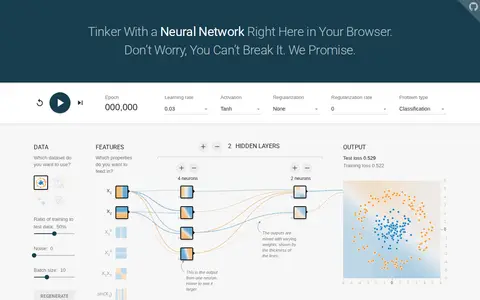
A Neural Network Playground is a browser-based educational visualization created by Daniel Smilkov and Shan Carter for experimenting with a real neural network. Users adjust controls to explore how a network learns from data. The project is open sourced on GitHub under the Apache License so its features can be tailored to a topic or lesson.
DeepLearning.ai is an educational platform led by Andrew Ng that offers online AI courses, specializations, and certifications for people learning to use and build artificial intelligence. The platform serves over 7 million learners and covers topics including AI Python, prompt engineering, generative AI, and machine learning.
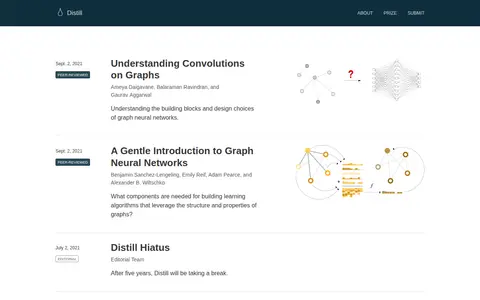
Distill publishes articles about machine learning, including peer-reviewed explanations of neural network topics such as graph neural networks, feature visualization and feature-wise transformations. In a July 2, 2021 editorial, the team announced that after five years Distill would be taking a break.
Library of SAS Enterprise Miner process flow diagrams to help you learn by example about specific data mining topics.
An article presenting initial impressions of DSPy, a framework developed by the Stanford NLP group for algorithmically optimizing language model prompts. The author describes DSPy as closing the loop of prompt engineering by turning a manual process into a structured machine learning workflow. The piece notes it is not a substitute for the official documentation and covers topics such as teleprompter, optimization, compile, bootstrapping and metric functions.
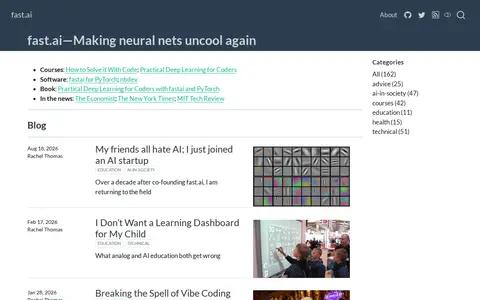
fast.ai is a project that publishes courses and software for deep learning, including Practical Deep Learning for Coders and the fastai library for PyTorch. The site also hosts blog posts on education, AI in society, and technical topics.
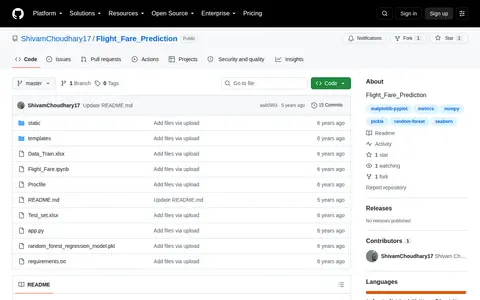
Flight Fare Prediction is a GitHub repository that implements a machine learning project for predicting flight fares. The repository includes documentation such as a problem statement and topics related to the prediction task.
Generative AI Explained by NVIDIA is an educational course offered by NVIDIA focused on generative AI. The course includes learning objectives, a list of covered topics, a full course outline, and related training resources. It provides public virtual workshop options structured as six 2-hour sessions, and offers private team or individual training upon request.
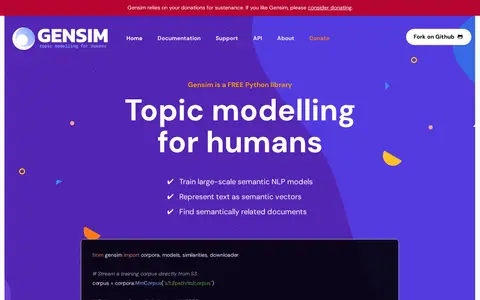
Gensim is a free open-source Python library for topic modelling and semantic NLP. It trains large-scale semantic models, represents text as semantic vectors and finds semantically related documents. The site describes streaming of arbitrarily large corpora, platform independence, and pretrained models and corpora published by the community.
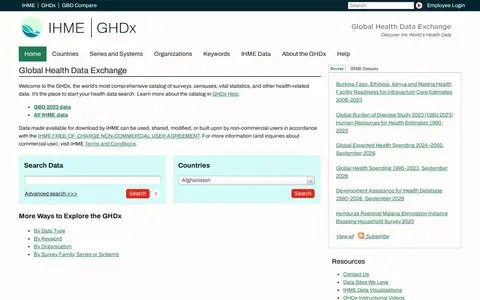
The Global Health Data Exchange (GHDx) is a catalog of global health and demographic data. It records information about data topics, links to data providers, and offers direct downloads where permission exists. The catalog covers surveys, censuses, vital statistics, registries, indicators, estimates, administrative health data, and health-related financial data. IHME-published data downloads may be used by non-commercial users under a free non-commercial user agreement.
A page of content on TensorFlow, including academic papers and links to related topics.
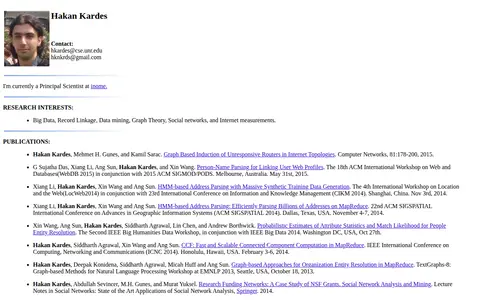
Personal page of Hakan Kardes, a principal scientist whose listed research interests include big data, record linkage, data mining, graph theory, social networks and Internet measurements. The page lists publications on topics such as connected component computation in MapReduce, address parsing and organization entity resolution.
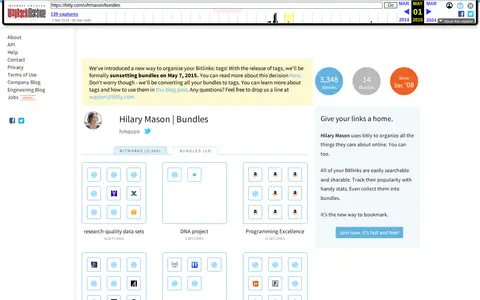
An archived Bitly bundles page belonging to Hilary Mason, listing link collections on topics such as research-quality data sets, programming, data stories and data science blogs. The page notes that Bitly sunset bundles on May 7, 2015 and converted them to tags.
Istanbul Metropolitan Municipality's open data platform enables users to search for datasets by keyword or topic, review them, and download data or query it via API to create projects. Published datasets are labeled under categories such as energy, economy, environment, mobility and governance.
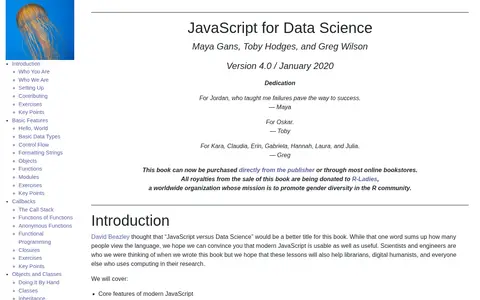
A book titled JavaScript for Data Science by Maya Gans, Toby Hodges, and Greg Wilson, version 4.0, dated January 2020. It covers topics such as callbacks, promises, objects, classes, HTML, CSS, React, data services, testing, data visualization, and a three-tier web application, with an even mix of browser and server programming. It is intended for scientists and engineers.
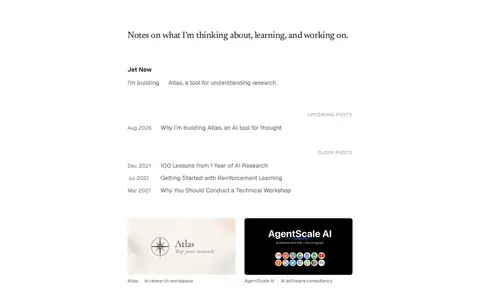
A personal notes site with writings on topics the author is thinking about, learning, and working on. It includes an upcoming entry about building Atlas, described as an AI tool for thought, and an archive of earlier posts.
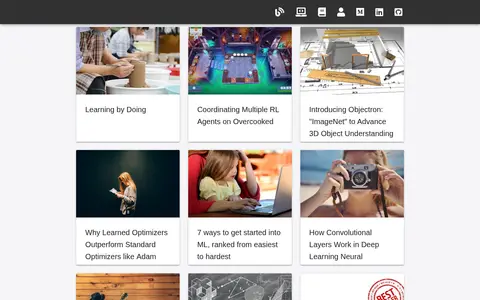
Hong Jing (Jingles) is a data scientist and Alibaba PhD student who writes about machine learning and neuroscience. The site collects blog articles on topics such as reinforcement learning agents, learned optimizers, convolutional layers, transformer models and decoding brain signals.