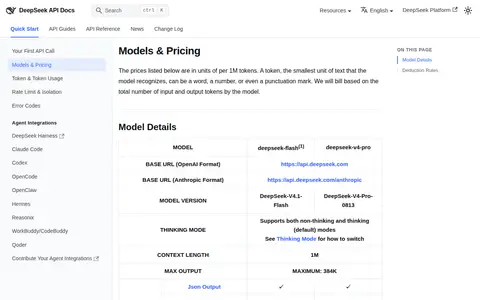
This DeepSeek API documentation page lists models and per-token pricing. It describes the deepseek-flash and deepseek-v4-pro models, their features, context length, concurrency limits, and peak and off-peak token rates, and notes that the legacy names deepseek-v4-flash and deepseek-v4-flash-vision-exp are still accepted.
Directory
Search results
Published directory entries matching your search.
An article presenting initial impressions of DSPy, a framework developed by the Stanford NLP group for algorithmically optimizing language model prompts. The author describes DSPy as closing the loop of prompt engineering by turning a manual process into a structured machine learning workflow. The piece notes it is not a substitute for the official documentation and covers topics such as teleprompter, optimization, compile, bootstrapping and metric functions.
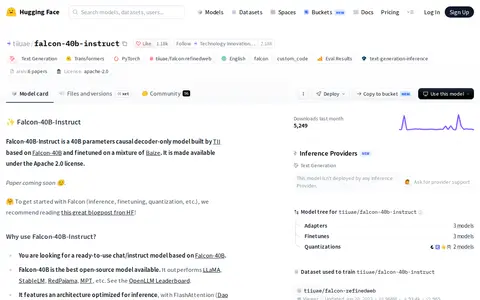
Falcon-40B-Instruct is a 40B parameter causal decoder-only model built by TII based on Falcon-40B and finetuned on a mixture of Baize, released under the Apache 2.0 license. It is intended as a ready-to-use chat and instruct model, and the card notes it may not be ideal for further finetuning. The model is trained mostly on English data, and users are advised to take precautions for production use.
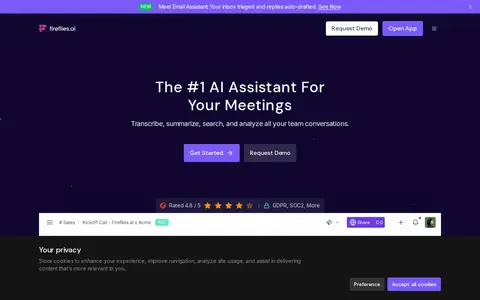
Fireflies AI is an AI assistant for meetings, email, chat and CRM platforms. It takes meeting notes, manages tasks, automates related workflows, and builds a searchable team knowledge base in one location. The service offers high-accuracy meeting transcription and recording, AI-generated meeting summaries, speaker recognition, and supports over 100 languages. It is accessible via a Chrome extension, mobile app, and desktop app.
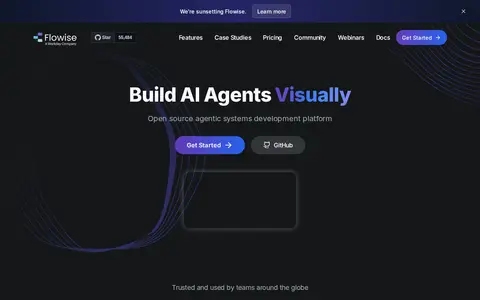
FlowiseAI is an open source generative AI development platform for visually building AI agents and LLM orchestration systems. It offers features including multi-agent workflow orchestration, chat assistants with retrieval-augmented generation support, human-in-the-loop task review, execution tracing, and APIs, SDKs and embedded chat options for integration. The project notes it is being sunset.
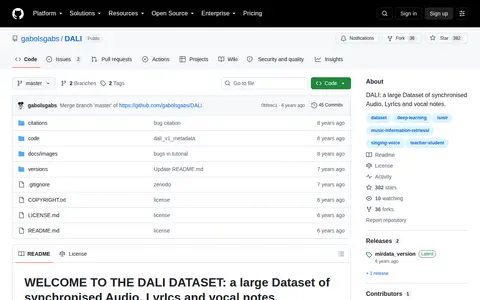
DALI is a dataset of synchronised audio, lyrics and vocal notes, presented as a collection of gz files. A Python package, dali_code, is stored in the repository for reading and working with the data; release versions are installable via pip. The dataset was created automatically using a teacher-student machine learning paradigm, described in an ISMIR 2018 paper.
A curated UC Berkeley Law Library guide collecting resources on generative AI applications in law school, higher education, and legal practice. It links news, studies, ethics materials and access-to-justice research, and notes that the resources will be regularly updated.

go-dnn is a GitHub repository that provides deep neural network functionality for the Golang programming language, powered by MXNet. The repository notes an updated version of the project is hosted at a separate GitHub location.
Google Labs FX is the official hub for AI experiments from Google. As of the listing snapshot, its primary featured project is Project Genie, a tool for creating and exploring infinitely diverse worlds. It also notes that related Google Flow and Google Flow Music products are hosted at separate dedicated sites.
An archived Bitly bundles page belonging to Hilary Mason, listing link collections on topics such as research-quality data sets, programming, data stories and data science blogs. The page notes that Bitly sunset bundles on May 7, 2015 and converted them to tags.
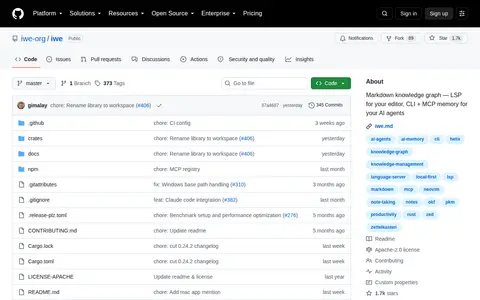
IWE is a Markdown knowledge graph tool offering an LSP for editors, a CLI and MCP memory for AI agents. It stores notes as connected Markdown documents in a project folder, usable from Neovim, Helix, VS Code, Zed, the CLI or Claude/Codex. Neither the CLI nor the Mac app includes an AI model.
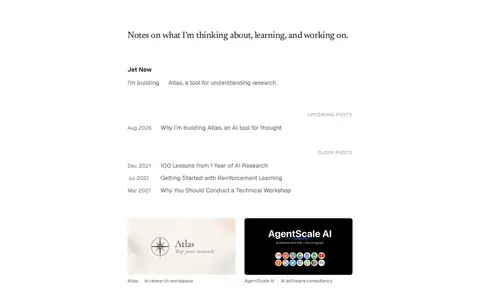
A personal notes site with writings on topics the author is thinking about, learning, and working on. It includes an upcoming entry about building Atlas, described as an AI tool for thought, and an archive of earlier posts.
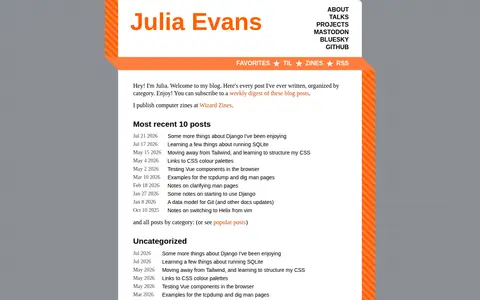
Julia Evans writes a personal blog about computer tools and programming topics, with posts organized by category. The site notes that a weekly digest of posts is available by subscription, and mentions that she publishes computer zines at Wizard Zines.
An article comparing the roles of data scientist and data engineer. It states that the positions are sometimes confused for each other and are often treated as the same, though the two roles work together. It notes that companies can encounter problems with team efficiency and system performance when the roles are conflated, and that the average company needs far more data engineers.
A weekly news and interview podcast covering the Kubernetes community, including release discussions, projects, and AI policy topics. Episodes feature guests from the Kubernetes ecosystem and are hosted as numbered installments with accompanying show notes.
An archived, read-only repository that provided a way to deploy LangChain apps using Jina and FastAPI, wrapping apps as services on Jina AI Cloud. The README notes the project is no longer maintained and that it could deploy apps on a user's own infrastructure.

Letterfork is an AI tool that turns one Substack, Beehiiv or Ghost newsletter issue into posts for LinkedIn, X, Bluesky, Substack Notes, Threads, Instagram and Reddit in the writer's own voice. Users train a voice profile from past newsletters, then paste an issue to generate platform-native drafts.
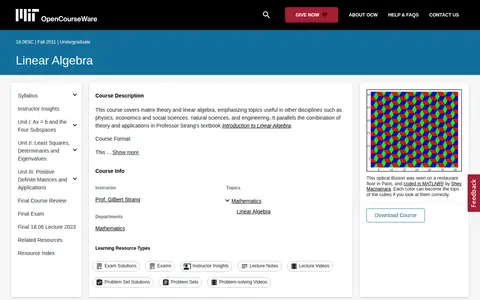
An MIT OpenCourseWare course covering matrix theory and linear algebra, emphasizing topics useful in physics, economics, social sciences, natural sciences and engineering. It is designed for independent study and includes lecture videos by Gilbert Strang, summary notes, problem solving videos, and problem sets with solutions.
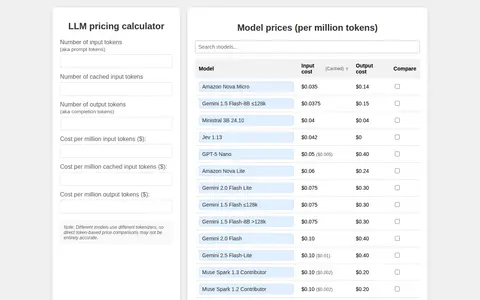
LLM pricing calculator is a web page for estimating model costs per million tokens. It takes input, cached input and output token counts and reports cost per million input tokens, per million cached input tokens and per million output tokens. It notes that direct token-based price comparisons may not be entirely accurate because different models use different tokenizers.
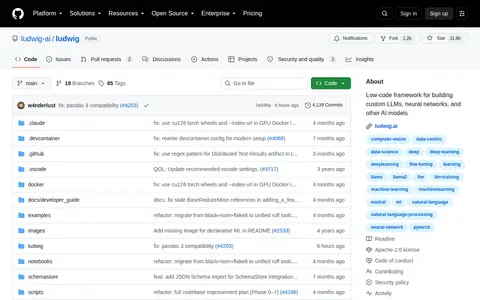
Ludwig is a low-code framework for building custom large language models, neural networks, and other AI models. The project's repository includes introductory documentation, release notes for version 0.16, installation guides, quick start materials, and resources for instruction fine-tuning of LLMs.
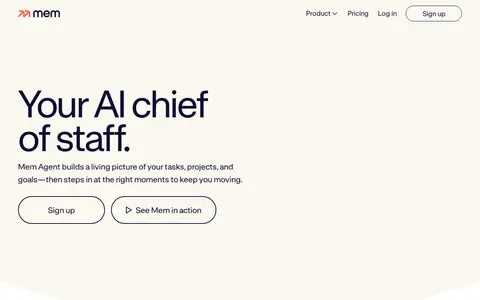
Mem is an AI-powered work organization tool designed for team use. It is built to organize work materials including meeting notes, project information, and organizational knowledge bases, with all stored content instantly searchable and readily discoverable by users. The official page displays a notice stating that Mem requires a newer web browser version to function properly.
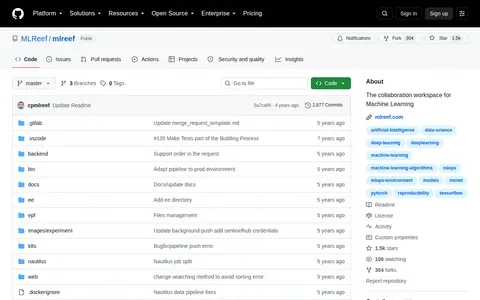
MLReef is an open source ML-Ops platform for collaborating, reproducing and sharing machine learning work. The repository notes it is no longer supported or updated there, with work continuing on GitLab. Described sections include data management with versioned data hosting, containerized code repositories, experiment tracking and ML pipelines on Kubernetes, cloud or bare metal.
Moonbeam is an AI writing assistant aimed at long-form content such as essays, stories, articles and blogs. It offers a wizard for turning notes into outlines and paragraphs, a prompt-driven assistant named Luna, Smart Chat for editing with real-time feedback, and content cluster generation. A team plan adds collaboration and multiple users.
The Data Science MSc is a postgraduate taught programme at the University of Edinburgh. It covers the computational principles, methods and systems for extracting and structuring knowledge from data, and the application of those principles. The programme notes that large data sets are generated by almost every activity in science, society and commerce.